
Baltimore Bolsters Rotation With Baz, While Tampa Bay Takes a More Is More Approach
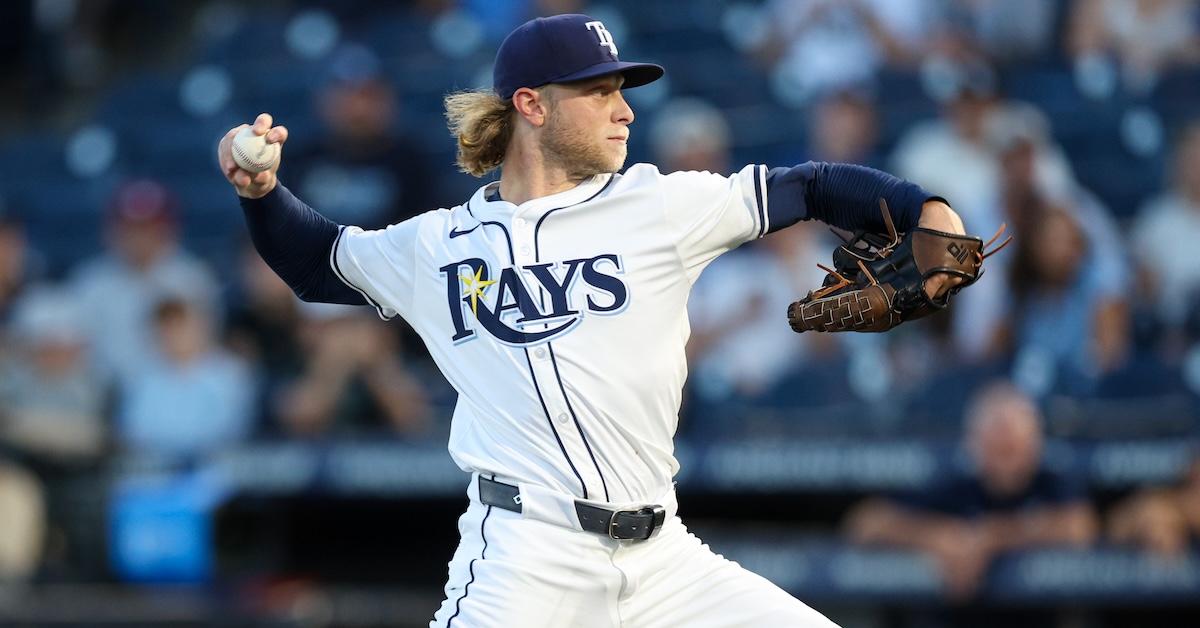
Orioles fans have had “Frontline Starter” on their Christmas list since the departure of Corbin Burnes, and though Friday’s acquisition of Shane Baz is perhaps the gift equivalent of asking for a Ferrari and getting an Acura, it adds a proven element to the middle of an Orioles rotation that still feels like it will be anchored by Kyle Bradish and Trevor Rogers.
To acquire the 26-year-old Baz, who is coming off a 2-WAR season, the Orioles had to part with a prospect potpourri made up of a pair of 2025 draftees (Coastal Carolina catcher Caden Bodine and high school outfielder Slater de Brun), a Competitive Balance Round A pick in next year’s draft, upper-level starting pitcher prospect Michael Forret, and speedy 22-year-old outfielder Austin Overn. It’s an enormous, high-volume return for one player and helps the roots of the Chris Archer trade tree anchor deeper into the game’s soil. I’ll talk more about each prospect, the comp pick, and the way this trade impacts both clubs’ farm systems later in the post. But let’s start with the most immediately consequential piece of the deal: Shane Baz.
Baz has been famous since his junior year of high school, when he emerged as one of the better pitching prospects in the 2017 draft. He was selected by Pittsburgh in the middle of the first round and traded as the Player to be Named in the Archer deal a little over a year later. The pandemic and persistent injuries (there were some near-misses as well) slowed Baz’s ascent through the minors and prevented him from working more than 81 innings in any single season until literally 2025. The Rays doggedly deployed him as a starter despite his injuries and early-career command woes, and they were rewarded with something of a breakout this year, as Baz ate 166.1 innings across 31 starts. He posted a 4.87 ERA, but hurricane damage to Tropicana Field meant that he pitched his home games in a minor league park with the hitter-friendly dimensions of Yankee Stadium; his xERA, which controls for defense, quality of contact, and the hitting environment, was 3.86.
The most relevant developments for Baz in 2025 were that the Rays reintroduced a third breaking pitch to his repertoire, and that he proved he can sustain upper-90s velocity across a starter’s load of innings. His fastball averaged 97 mph, which was in top 10 among qualified starters. Baz has always had a deep mix of breaking balls, but at points his repertoire has been changed or pared down in an effort to help him throw strikes. In 2025, he was throwing more explicit cutters than in 2024, a pitch more apt to finish in the top of the strike zone and play well with Baz’s best bat-misser, his elevated fastball. You can see those cutters (in black) have more vertical movement than the gyro-style sliders he was working with last year:
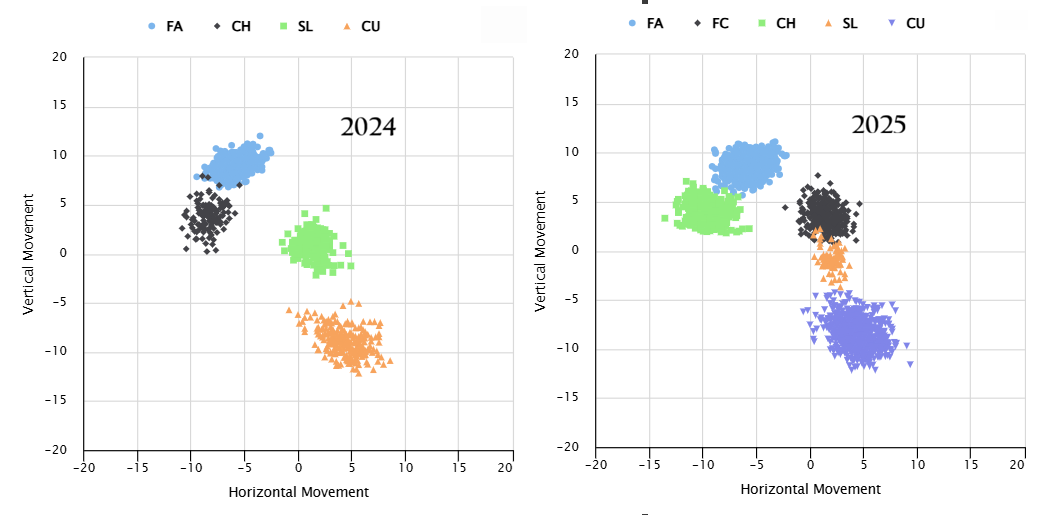
Though none of Baz’s secondary pitches besides his cutter generated plus miss or chase in 2025, when you isolate his splits against lefties and righties you can see he has the tools to generate plus results against batters of either handedness. He’s very unpredictable with two strikes against lefties, who see an even mix of elevated fastballs, changeups, and Baz’s deep-diving knuckle curveball. Righties see a steadier diet of fastballs and curves. Early-count cutters help to set up basically all of these offerings. If there’s one area Baz can still improve, it’s command refinement, as he bullies the strike zone but doesn’t locate with the precision needed for his stuff to play like a dominant mix.
This is the stuff of a good team’s third or fourth starter, with Baz’s on-field results to this point sliding him more toward the no. 4 designation. Pitching with this mix for a second big league season, and for an org that has a positive track record of pitching development — the Rays do too, of course, but so do the Marlins and the yet Orioles coaxed more out of Trevor Rogers — might reveal slightly better results. I think we can reasonably say that the Orioles now have three impact or playoff-caliber starters in Bradish, Rogers, and Baz, and then a deep group of backend types behind them. Pitching prospects like Trey Gibson, Luis De León, and Nestor German might join that impact contingent throughout 2026, but Baltimore probably still needs to add more arms in order to combat the possibility of injuries thinning out that group, especially considering the health track records of Bradish and Baz.
Baz is entering his first season of arbitration and RosterResource has his projected salary figure at $3.1 million. Even if he simply repeats his 2025 output, that’s a huge surplus value boon for the Orioles, who’ll be paying $3 million for a pitcher who would make roughly $20-25 million on the open market. That, plus the three seasons of team control remaining before Baz hits free agency after the 2028 campaign, helps explain why the trade return here was so massive.
Of course, Baltimore is well-equipped to meet Tampa Bay’s ask. The Orioles have an absurdly deep farm system in terms of the raw number of prospects. Their go-wide approach at the trade deadline and in the draft left them with a whopping 67 minor leaguers who I considered prospects at the end of the season. The Rays often take a similar approach, and tend to find ways to snowball their prospects. They traded Archer for three prospects, and then each of those guys was eventually moved for multiple prospects themselves. This trade is a prime example of that. What’s more, all but one of the players the Rays acquired have only recently entered pro ball. This keeps them far enough away from the 40-man roster to avoid a near-term roster crunch, and also gives the Rays’ player dev group lots of time to help mold their profile.
The prospect I had ranked highest at the time of trade is Bodine, a catcher out of Coastal Carolina who I had 18th on my 2025 Draft Board. He was picked 30th overall, signed for $3.1 million, and played 11 pro games after the draft. He’s a well-rounded switch-hitting catcher with plus bat-to-ball ability from both sides of the plate. Bodine posted a 93% zone contact rate as a sophomore and a 96% mark as a junior. He generates all-fields spray with low-ball power as a lefty and is more oppo-gap oriented as a righty, with his measurable power a little south of the big league average overall, but not by much. A late tip in his hands (which is more pronounced from the left side) might make him late on pro velo, but otherwise I consider him a very stable prospect as a hitter.
He is, however, going to be a bit of a project on defense. Bodine didn’t catch a ton of pro-quality stuff at Coastal, and receiving and ball-blocking the stuff of his Collegiate Team USA teammates was a challenge for him in 2024. He became a better framer in 2025 as, per Synergy, 57% of his received borderline pitches were called strikes, but ball-blocking was still a real problem for him. Bodine’s throwing is above average, and he makes accurate throws from funky platforms when he has to. There’s work to do on defense, but I think Bodine has a shot to be a primary catcher in three years or so.
The prospect in the trade who will yield a big league return the soonest, however, is the right-handed Forret (pronounced with the emphasis on the second syllable, as in Leonard Fournette), a strike-throwing developmental success who was drafted out of a Florida junior college and trained at Tread Athletics. Forret was ranked as the top 40-FV prospect in the Orioles system during our last cycle, and upon re-evaluation will likely be in the 45-FV tier.
Forret had a 1.58 ERA across 74 innings in 2025 and finished his season at Double-A. He’s entering his 40-man platform year and has a chance to make his big league debut with the Rays toward the end of the season. He has terrific feel for location, which helps his otherwise fairly pedestrian stuff play up. He can manipulate his fastball and breaking ball shapes to suit his needs depending on the handedness of the hitter, and he learned a kick change at Tread that quickly became his best bat-missing pitch. Forret can operate east/west with sinkers, sliders, and cambios when he wants, or elevate his fastball with upwards of 18 inches of vertical break on his best four-seamers. He’s of relatively slender build, but his delivery is effortless and he has sensational feel for location, with each of his pitches generating strikes at better than a 65% clip. He tends to operate in the 91-95 mph range and his breaking balls lack huge power, so we’re probably talking about an efficient innings-eater rather than a true star, but Forret is going to be a valuable part of a rotation fairly soon.
In my opinion, the next-best bit of the trade for the Rays is the comp pick. Compensation surrounding free agents who rejected qualifying offers will likely alter the draft order, but this pick will be somewhere in the mid-to-late 30s. This tends to be where the 45-FV and 40+-FV tiers intersect. Teams often target exciting, higher-upside high school players with either these comp picks, or with the bonus flexibility they have because of the pool space added by the pick, which in this case will probably be a shade under $3 million.
In a funny bit of coincidence, de Brun was drafted by the Orioles with the comp pick they acquired by trading reliever Bryan Baker to the Rays before last year’s draft; he received a $4 million bonus to eschew a commitment to Vandebrilt. de Brun is a muscular, top-heavy 5-foot-10, with wide, square shoulders and impressive strength for his size. He’s built a lot like Jasson Domínguez at the same stage, with Diamondbacks outfielder Slade Caldwell also a fair comp. de Brun’s skill set is in the young Brandon Nimmo mold — a patient speedster with advanced bat control — just without anything near the same kind of physicality. de Brun had a .616 OBP on the showcase circuit because of his plate discipline, contact ability, and speed. He can really bend into his lower half to adjust his barrel depth, but he has average bat speed and is not especially explosive or projectable. His speed should facilitate a center field fit even though his feel for defense is just okay; a lack of arm strength would shift him to left field if his reads remain inconsistent. de Brun was a 40+-FV prospect before the draft and will need to show special on-base skills in his 2026 pro debut if he’s going to stay there, because I tend to be skeptical of hitters who are already maxed out at this age.
Finally, Overn was a frustrating prospect at USC whose performance dipped in his draft year. A swing change in 2025 made it looked like he had a shot to break out. He spent the early part of the season struggling before he turned a corner after the All-Star break, slashing .281/.366/.479 and earning a late promotion to Double-A. Overn can really run, and he’s a threat to damage pitches in his wheelhouse, but he struggled to time fastballs last year and he’s still a pretty small athlete. He likely has a future as an extra outfielder, but the fact that he seemed to adjust to his new swing in the middle of last season at least gives the Rays some hope that he’ll continue to improve as a contact hitter and outpace that projection.
The Rays don’t have a ton of high-upside, Top 100 type prospects right now, but they’ll again have one of the deeper farm systems in all of baseball as we complete our cycle of lists. They traded Baz at the apex of his value, after his lone season demonstrating starter-quality stamina, for what feels like one nice piece per year of Baz’s remaining team control. If they can backfill Baz’s spot in the rotation internally, this will feel like a good deal for them 12 months from now. At this moment, though, they’ve helped an division rival get better.
Eric Longenhagen is from Catasauqua, PA and currently lives in Tempe, AZ. He spent four years working for the Phillies Triple-A affiliate, two with Baseball Info Solutions and two contributing to prospect coverage at ESPN.com. Previous work can also be found at Sports On Earth, CrashburnAlley and Prospect Insider.
De Brun has the highest ceiling of anyone the Orioles took in the 2025 draft and Bodine has the highest floor of anyone they took. I like both players a lot, but I would be fine moving them for Joe Ryan. I am not fine with moving them for Shane Baz.
2025 is the first time in Baz’s career that he surpassed 100 innings, so he has an injury history as checkered as Grayson Rodriguez, but with worse stuff and command. Elias absolutely has to sign one of Valdez, Imai, or Suarez because Baz isn’t someone you want to be starting a playoff game.