Baltimore Bolsters Rotation With Baz, While Tampa Bay Takes a More Is More Approach
Nathan Ray Seebeck-Imagn Images

Orioles fans have had “Frontline Starter” on their Christmas list since the departure of Corbin Burnes, and though Friday’s acquisition of Shane Baz is perhaps the gift equivalent of asking for a Ferrari and getting an Acura, it adds a proven element to the middle of an Orioles rotation that still feels like it will be anchored by Kyle Bradish and Trevor Rogers.

To acquire the 26-year-old Baz, who is coming off a 2-WAR season, the Orioles had to part with a prospect potpourri made up of a pair of 2025 draftees (Coastal Carolina catcher Caden Bodine and high school outfielder Slater de Brun), a Competitive Balance Round A pick in next year’s draft, upper-level starting pitcher prospect Michael Forret, and speedy 22-year-old outfielder Austin Overn. It’s an enormous, high-volume return for one player and helps the roots of the Chris Archer trade tree anchor deeper into the game’s soil. I’ll talk more about each prospect, the comp pick, and the way this trade impacts both clubs’ farm systems later in the post. But let’s start with the most immediately consequential piece of the deal: Shane Baz.

Baz has been famous since his junior year of high school, when he emerged as one of the better pitching prospects in the 2017 draft. He was selected by Pittsburgh in the middle of the first round and traded as the Player to be Named in the Archer deal a little over a year later. The pandemic and persistent injuries (there were some near-misses as well) slowed Baz’s ascent through the minors and prevented him from working more than 81 innings in any single season until literally 2025. The Rays doggedly deployed him as a starter despite his injuries and early-career command woes, and they were rewarded with something of a breakout this year, as Baz ate 166.1 innings across 31 starts. He posted a 4.87 ERA, but hurricane damage to Tropicana Field meant that he pitched his home games in a minor league park with the hitter-friendly dimensions of Yankee Stadium; his xERA, which controls for defense, quality of contact, and the hitting environment, was 3.86.

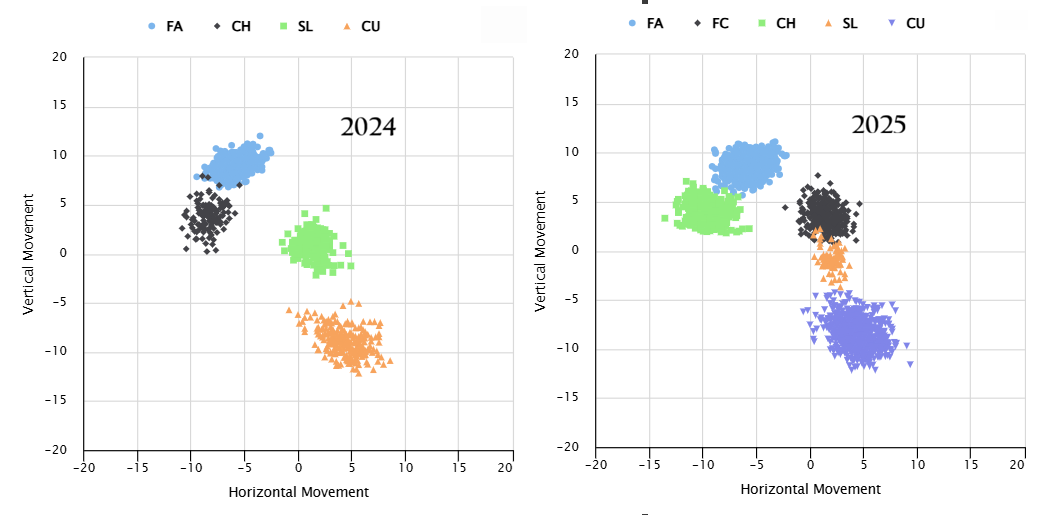
The most relevant developments for Baz in 2025 were that the Rays reintroduced a third breaking pitch to his repertoire, and that he proved he can sustain upper-90s velocity across a starter’s load of innings. His fastball averaged 97 mph, which was in top 10 among qualified starters. Baz has always had a deep mix of breaking balls, but at points his repertoire has been changed or pared down in an effort to help him throw strikes. In 2025, he was throwing more explicit cutters than in 2024, a pitch more apt to finish in the top of the strike zone and play well with Baz’s best bat-misser, his elevated fastball. You can see those cutters (in black) have more vertical movement than the gyro-style sliders he was working with last year:
Though none of Baz’s secondary pitches besides his cutter generated plus miss or chase in 2025, when you isolate his splits against lefties and righties you can see he has the tools to generate plus results against batters of either handedness. He’s very unpredictable with two strikes against lefties, who see an even mix of elevated fastballs, changeups, and Baz’s deep-diving knuckle curveball. Righties see a steadier diet of fastballs and curves. Early-count cutters help to set up basically all of these offerings. If there’s one area Baz can still improve, it’s command refinement, as he bullies the strike zone but doesn’t locate with the precision needed for his stuff to play like a dominant mix.

You Aren't a FanGraphs Member
It looks like you aren't yet a FanGraphs Member (or aren't logged in). We aren't mad, just disappointed.
We get it. You want to read this article. But before we let you get back to it, we'd like to point out a few of the good reasons why you should become a Member.
1. Ad Free viewing! We won't bug you with this ad, or any other.
2. Unlimited articles! Non-Members only get to read 10 free articles a month. Members never get cut off.
3. Dark mode and Classic mode!
4. Custom player page dashboards! Choose the player cards you want, in the order you want them.
5. One-click data exports! Export our projections and leaderboards for your personal projects.
6. Remove the photos on the home page! (Honestly, this doesn't sound so great to us, but some people wanted it, and we like to give our Members what they want.)
7. Even more Steamer projections! We have handedness, percentile, and context neutral projections available for Members only.
8. Get FanGraphs Walk-Off, a customized year end review! Find out exactly how you used FanGraphs this year, and how that compares to other Members. Don't be a victim of FOMO.
9. A weekly mailbag column, exclusively for Members.
10. Help support FanGraphs and our entire staff! Our Members provide us with critical resources to improve the site and deliver new features!
We hope you'll consider a Membership today, for yourself or as a gift! And we realize this has been an awfully long sales pitch, so we've also removed all the other ads in this article. We didn't want to overdo it.

This is the stuff of a good team’s third or fourth starter, with Baz’s on-field results to this point sliding him more toward the no. 4 designation. Pitching with this mix for a second big league season, and for an org that has a positive track record of pitching development — the Rays do too, of course, but so do the Marlins and the yet Orioles coaxed more out of Trevor Rogers — might reveal slightly better results. I think we can reasonably say that the Orioles now have three impact or playoff-caliber starters in Bradish, Rogers, and Baz, and then a deep group of backend types behind them. Pitching prospects like Trey Gibson, Luis De León, and Nestor German might join that impact contingent throughout 2026, but Baltimore probably still needs to add more arms in order to combat the possibility of injuries thinning out that group, especially considering the health track records of Bradish and Baz.

Baz is entering his first season of arbitration and RosterResource has his projected salary figure at $3.1 million. Even if he simply repeats his 2025 output, that’s a huge surplus value boon for the Orioles, who’ll be paying $3 million for a pitcher who would make roughly $20-25 million on the open market. That, plus the three seasons of team control remaining before Baz hits free agency after the 2028 campaign, helps explain why the trade return here was so massive.

Of course, Baltimore is well-equipped to meet Tampa Bay’s ask. The Orioles have an absurdly deep farm system in terms of the raw number of prospects. Their go-wide approach at the trade deadline and in the draft left them with a whopping 67 minor leaguers who I considered prospects at the end of the season. The Rays often take a similar approach, and tend to find ways to snowball their prospects. They traded Archer for three prospects, and then each of those guys was eventually moved for multiple prospects themselves. This trade is a prime example of that. What’s more, all but one of the players the Rays acquired have only recently entered pro ball. This keeps them far enough away from the 40-man roster to avoid a near-term roster crunch, and also gives the Rays’ player dev group lots of time to help mold their profile.

The prospect I had ranked highest at the time of trade is Bodine, a catcher out of Coastal Carolina who I had 18th on my 2025 Draft Board. He was picked 30th overall, signed for $3.1 million, and played 11 pro games after the draft. He’s a well-rounded switch-hitting catcher with plus bat-to-ball ability from both sides of the plate. Bodine posted a 93% zone contact rate as a sophomore and a 96% mark as a junior. He generates all-fields spray with low-ball power as a lefty and is more oppo-gap oriented as a righty, with his measurable power a little south of the big league average overall, but not by much. A late tip in his hands (which is more pronounced from the left side) might make him late on pro velo, but otherwise I consider him a very stable prospect as a hitter.

He is, however, going to be a bit of a project on defense. Bodine didn’t catch a ton of pro-quality stuff at Coastal, and receiving and ball-blocking the stuff of his Collegiate Team USA teammates was a challenge for him in 2024. He became a better framer in 2025 as, per Synergy, 57% of his received borderline pitches were called strikes, but ball-blocking was still a real problem for him. Bodine’s throwing is above average, and he makes accurate throws from funky platforms when he has to. There’s work to do on defense, but I think Bodine has a shot to be a primary catcher in three years or so.

The prospect in the trade who will yield a big league return the soonest, however, is the right-handed Forret (pronounced with the emphasis on the second syllable, as in Leonard Fournette), a strike-throwing developmental success who was drafted out of a Florida junior college and trained at Tread Athletics. Forret was ranked as the top 40-FV prospect in the Orioles system during our last cycle, and upon re-evaluation will likely be in the 45-FV tier.

Forret had a 1.58 ERA across 74 innings in 2025 and finished his season at Double-A. He’s entering his 40-man platform year and has a chance to make his big league debut with the Rays toward the end of the season. He has terrific feel for location, which helps his otherwise fairly pedestrian stuff play up. He can manipulate his fastball and breaking ball shapes to suit his needs depending on the handedness of the hitter, and he learned a kick change at Tread that quickly became his best bat-missing pitch. Forret can operate east/west with sinkers, sliders, and cambios when he wants, or elevate his fastball with upwards of 18 inches of vertical break on his best four-seamers. He’s of relatively slender build, but his delivery is effortless and he has sensational feel for location, with each of his pitches generating strikes at better than a 65% clip. He tends to operate in the 91-95 mph range and his breaking balls lack huge power, so we’re probably talking about an efficient innings-eater rather than a true star, but Forret is going to be a valuable part of a rotation fairly soon.

In my opinion, the next-best bit of the trade for the Rays is the comp pick. Compensation surrounding free agents who rejected qualifying offers will likely alter the draft order, but this pick will be somewhere in the mid-to-late 30s. This tends to be where the 45-FV and 40+-FV tiers intersect. Teams often target exciting, higher-upside high school players with either these comp picks, or with the bonus flexibility they have because of the pool space added by the pick, which in this case will probably be a shade under $3 million.

In a funny bit of coincidence, de Brun was drafted by the Orioles with the comp pick they acquired by trading reliever Bryan Baker to the Rays before last year’s draft; he received a $4 million bonus to eschew a commitment to Vandebrilt. de Brun is a muscular, top-heavy 5-foot-10, with wide, square shoulders and impressive strength for his size. He’s built a lot like Jasson Domínguez at the same stage, with Diamondbacks outfielder Slade Caldwell also a fair comp. de Brun’s skill set is in the young Brandon Nimmo mold — a patient speedster with advanced bat control — just without anything near the same kind of physicality. de Brun had a .616 OBP on the showcase circuit because of his plate discipline, contact ability, and speed. He can really bend into his lower half to adjust his barrel depth, but he has average bat speed and is not especially explosive or projectable. His speed should facilitate a center field fit even though his feel for defense is just okay; a lack of arm strength would shift him to left field if his reads remain inconsistent. de Brun was a 40+-FV prospect before the draft and will need to show special on-base skills in his 2026 pro debut if he’s going to stay there, because I tend to be skeptical of hitters who are already maxed out at this age.

Finally, Overn was a frustrating prospect at USC whose performance dipped in his draft year. A swing change in 2025 made it looked like he had a shot to break out. He spent the early part of the season struggling before he turned a corner after the All-Star break, slashing .281/.366/.479 and earning a late promotion to Double-A. Overn can really run, and he’s a threat to damage pitches in his wheelhouse, but he struggled to time fastballs last year and he’s still a pretty small athlete. He likely has a future as an extra outfielder, but the fact that he seemed to adjust to his new swing in the middle of last season at least gives the Rays some hope that he’ll continue to improve as a contact hitter and outpace that projection.

The Rays don’t have a ton of high-upside, Top 100 type prospects right now, but they’ll again have one of the deeper farm systems in all of baseball as we complete our cycle of lists. They traded Baz at the apex of his value, after his lone season demonstrating starter-quality stamina, for what feels like one nice piece per year of Baz’s remaining team control. If they can backfill Baz’s spot in the rotation internally, this will feel like a good deal for them 12 months from now. At this moment, though, they’ve helped an division rival get better.


Eric Longenhagen is from Catasauqua, PA and currently lives in Tempe, AZ. He spent four years working for the Phillies Triple-A affiliate, two with Baseball Info Solutions and two contributing to prospect coverage at ESPN.com. Previous work can also be found at Sports On Earth, CrashburnAlley and Prospect Insider.

33 Comments
Oldest
Newest Most Voted
jdbolickMember since 2024
7 months ago

De Brun has the highest ceiling of anyone the Orioles took in the 2025 draft and Bodine has the highest floor of anyone they took. I like both players a lot, but I would be fine moving them for Joe Ryan. I am not fine with moving them for Shane Baz.

2025 is the first time in Baz’s career that he surpassed 100 innings, so he has an injury history as checkered as Grayson Rodriguez, but with worse stuff and command. Elias absolutely has to sign one of Valdez, Imai, or Suarez because Baz isn’t someone you want to be starting a playoff game.

sadtromboneMember since 2020
7 months ago

I don’t know what to make of the Orioles end of this because Baz was more of a #4 in this past year and this is a lot to give up for a #4. He looked like he was going to be a huge star when he debuted but his fastball hasn’t looked the same since, possibly because his elbow came apart shortly after that.

If there is a theme from this offseason it’s that teams are banking much more heavily on what they can optimize from pitchers rather than pay huge free agent or trade prices for players who have done it in the past. I’m pretty sure that 1) Elias would have much rather traded for Joe Ryan but he doesn’t seem to be available for this sort of package and 2) the Orioles think they can pull out more from Baz than what the Rays did.

It’s a bet that I think might make sense for them even though the price was really steep. I’m not sure yet. But it feels like they still need that high-end guy to pair with Bradish, so if I were an Orioles fan I would hope they aren’t done.

Last edited 7 months ago by sadtrombone
Broken BatMember since 2020
7 months ago
Reply to  sadtrombone

Hey Taps, always like your perspectives; you obviously follow the game with a deep understanding. In your comment, whike you mentioned Bradish, you didn’t mention Trevor Rogers who had a great run last year, as a strong #2. What scares you about Trevor? The Oriole offense is going to put some numbers up in 2026?

Miguel MoralesMember since 2021
7 months ago

Great article.

I do have one complaint though: can we keep the pitch label color consistent on the movement plots? When someone adds a pitch figuring out that changeup is black and slider green in 2024 but the colors are reversed (!) in 2025 makes reading the plots unnecessarily difficult. Just additional mental load for no purpose.

(Wearing my data viz hat, it would be even better if FanGraphs developed a consistent visual language, so a pitch type had the same color every time. Would make digesting articles so much easier as we’d learn that a when talking pitching a blue line or dot was always associated with a particular pitch type. Just a suggestion.)

Athletics Fan Surrounded by GuardiansMember since 2025
7 months ago
Reply to  Miguel Morales

As a data viz guy, I would like to upvote the second paragraph 1 million times. Thank you.

raregokusMember since 2022
7 months ago
Reply to  Miguel Morales

Can we send up a bat signal or something so that we make sure this happens?

Athletics Fan Surrounded by GuardiansMember since 2025
7 months ago
Reply to  raregokus

I assume it would be a Meg-symbol.

sadtromboneMember since 2020
7 months ago

On the Rays end I think they have to make a deal like this when it falls in their lap. I don’t really think Baz fits neatly in the Rays rotation right now. If everyone is healthy—a huge “if”—Baz would only be the Rays’ fourth best starter behind McClanahan, Rasmussen, and Pepiot.

In return they get a huge number of guys with a good mix of floor and ceiling. The Rays love mixing and matching outfielders so de Brun and Overn will do something for them and maybe more than “something.” The Rays really could use a good catching prospect, and Bodine has some work to do on defense but he has a shot to be a primary catcher.

But the guy I think really puts this over the top is Forret. People really underrate players like Forret because they rely on deception and it’s super hard to quantify that, but it’s clear that hitters have no idea what’s coming. I wouldn’t be surprised at all if he were better than Baz a year and a half from now.

jazzpawMember since 2026
7 months ago
Reply to  sadtrombone

I think Eric is undervaluing Forret. I’ve seen video of him consistently in the mid 90s and touching higher. He looks to me as though he still has a not insignificant amount of projection, physically and otherwise.

sadtromboneMember since 2020
7 months ago
Reply to  jazzpaw

It’s hard to know how the “stuff” is going to play against upper level minors hitters much less against major leaguers but it looks to me like hitters were guessing against him in High-A this year.

This was basically the book on Connelly Early as well except that Early had done it against upper level minors hitters and throws lefty. I think it is fair to be a little conservative on guys like this but when it works it *really* works.

ajake57Member since 2019
7 months ago
Reply to  sadtrombone

This is where I think Eric’s consistent approach to valuing pitchers closer to MLB really shines. A 45 seems like a reasonable grade given that Forret hasn’t eclipsed 120 innings or gone through upper level hitters for a full season. I think your assessment here is spot on. If he’s still showing the ability to keep hitters off his stuff once he gets to AAA and there’s shape data to back it then he can get stuffed at that point. But it is equally likely that he’ll either struggle to put up starter volume or see his shapes flatten once he gets his hands on the MLB ball, either of which would be exacerbated by higher quality hitters figuring him out.

sadtromboneMember since 2020
7 months ago
Reply to  ajake57

The biggest issue with giving high grades to pitchers in the lower minors is that injuries have a huge chance to wreck them before they even debut.

Let’s look at guys who have done what Forret has done in AA. AA is probably a bigger test for hitter than pitchers these days, but even he hasn’t done much there yet. He only pitched 74 innings last year in total, so drawing conclusions from a fraction of that is an even bigger issue. If he can do 74 innings in AA (can include AAA if he gets promoted fast) we will have a far better picture of what he can do or not do.

But when you look at the list of players who have had that sort of success in AA it’s loaded with guys who have been undone by injuries (or in the case of Bobby Miller, something else). In addition to Miller we have guys like Grayson Rodriguez, Brendan McKay, Jose de Leon, and Freddy Tarnok. There are others that look promising like Eury Perez, Edward Cabrera, and Andrew Abbott but the attrition rate is so high even from that point forward.

Broken BatMember since 2020
7 months ago
Reply to  sadtrombone

Agree, I think trading Baz also points out the Rays think McClanahan is ready to return.

slz
7 months ago

I dont know what to think of this because I dont know what to think of Baz

If you told me this was for Joe Ryan as someone above suggested, I’d say it was a good deal. The Orioles have had a million prospects theyve needed to consolidate for a while and it’s a shame theyre just doing it now that Elias thinks his job is on the line

I wasnt a fan of Bodine as a prospect and I’m going to be markedly lower on high schoolers with no track record than consensus so even if this feels like a lot I think it’s a fine risk. The question is whether Baz was the guy to take the risk on. They just pushed their chips in…and if Baz is a good #2/low level Ace, the pot is worth it. If he’s not?

Last edited 7 months ago by slz
sadtromboneMember since 2020
7 months ago
Reply to  slz

The Twins seem to be thinking they’re going to hold onto Joe Ryan so whatever a team does is going to have to blow them away. But even if they were more open to it, I do not think this package would have gotten the Twins’ attention because they’ve been fairly consistent in what they have been asking for. It’s two FV50 prospects or better (judged by them, I am not a fan of Mick Abel), one of whom is about major league ready.

While they could theoretically trade Basallo because he’s become weirdly redundant on the Orioles’ roster, it seems like to get the Twins’ attention they would have to like two of Trey Gibson, Dylan Beavers, and Luis De Leon. And the Orioles would have to be willing to move them. You can see why the Orioles preferred trading this group instead, because none of those guys have debuted or will be ready to go in 2026 except maybe Overn whose stock is down.

sadtromboneMember since 2020
7 months ago
Reply to  sadtrombone

But who knows, maybe they trade Dylan Beavers and De Leon and others (Creed Willems? Esteban Mejia? Nate George?) to the Brewers for Freddy Peralta tomorrow.

Sandy Kazmir
7 months ago

Baz, himself, is fruit of the Delmon Young trade tree. Baz sprang from Archer, Archer from Garza, Garza from Delmon. With some grit and some luck this trade tree will continue to blossom well into it’s second decade.

Sporter's Five HorsesMember since 2014
7 months ago
Reply to  Sandy Kazmir

A 4th generation trade tree going on 18 yrs and +66 Rays WAR is nothing to sneeze at! (After reading your comment I was curious and ended up *discovering* https://delmonyoungtradetree.com/)

cashgod27Member since 2024
7 months ago

Absolutely phenomenal deal for Tampa Bay. Overn seems like a throw-in, but that’s still three guys with good chances of being meaningful players, plus a draft pick. Considering everything, I’m not sure Baz is going to have a much more valuable season than he did last year.

That doesn’t mean I hate it for the Orioles, though. I thought Elias’s quantity over quality approach at the Draft and deadline was fascinating and bizarre, but it makes so much sense when you’re packaging tons of guys for players in deals like this. This barely makes a dent in the overall quality of their farm because they have so many players in that 40-45 range.

cowdiscipleMember since 2016
7 months ago

This seems like a huge price to pay to turn 4 years of Grayson Rodriguez into 3 years of Baz and Taylor Ward’s last arb season.

eastmanMember since 2022
7 months ago
Reply to  cowdisciple

This is a good description of the trade. I think time value of health is important here. The orioles basically traded for a similar (but maybe slightly lower) tier pitcher to Grayson who is healthy *now*. How much is that worth to them? Plus Taylor Ward right now, too of course…

Last edited 7 months ago by eastman
GoodEnoughForMeMember since 2024
7 months ago

I wonder if Elias is panicking a bit; i.e., he feels another non playoff year means he is out. Because this offseason has not been like him.

I love this trade for Tampa. Kind of a bonkers collection of talent and numbers for a #4 starter. I like Bodine a lot.

eastmanMember since 2022
7 months ago

For what it’s worth, that’s my best guess. It sure seems like he has a little extra fire this time around the sun.

jdbolickMember since 2024
7 months ago

Elias traded for Burnes, Eflin, Flaherty, etc. He also tried to trade for Cease and Crochet. The idea of him being a prospect hoarder was a media narrative, not the reality.

raregokusMember since 2022
7 months ago
Reply to  jdbolick

The Mike Elias defender has logged on. Seriously, man, do you have a Google alert on or something? Every time he gets brought up you’re immediately in the comments defending his trade history.

jdbolickMember since 2024
7 months ago
Reply to  raregokus

I’m an Orioles fan and a FanGraphs member, so I’m generally going to be in any Baltimore-related discussion. It’s funny that you call me an Elias defender when I’m currently being pilloried on other social media for being an Elias hater after vociferously criticizing this deal and the Ward deal.

I’m concerned with data and facts. The data and facts don’t support the claim that Elias was ever a prospect hoarder. There is literally no evidence to back that claim, which is why you just see people say it but never provide anything to substantiate it.

You should also be concerned with data and facts, which doesn’t seem to be the case. Now is as good a time as any to start.

andrewscott80Member since 2024
7 months ago

I think this is conceptually quite similar to the Rogers trade: a starter with talent and/or pedigree, balanced out (negatively) by underperformance and health concerns and (positively) by a heckuva lot of team control.

For that, Elias traded a handful of prospects who were surplus to requirements. In the case of Rogers, that was two big-league ready bats (Stowers, Norby) who didn’t have long-term homes. For Baz, having lived through 2H24 and full year 2025, Elias resolved to Never Shortchange Big-League Depth Again, so he redefined “surplus to requirements” to be guys who won’t contribute to the big-league roster anytime soon.

So, I don’t subscribe to the common interpretation that this is a “sea change” for Elias. I think people are just viewing his actions differently in light of Alonso, which was a bona fide sea change. If it feels like Elias gave up a lot in quantity, I think that’s just the tax to trade guys with minimal instead of maximal upper-minors experience.

Last edited 7 months ago by andrewscott80
eastmanMember since 2022
7 months ago
Reply to  andrewscott80

That is a good description of the “fire” that I see.

sadtromboneMember since 2020
7 months ago
Reply to  andrewscott80

Yeah this is a lot to give up and it’s hard to think that he would have done this exact deal a while back because the heat is clearly on him. But he’s been fairly aggressive at trading away multiple guys like Mac Horvath in the same deal. It’s why he lines up with Rays and Rays alums on trades, they love getting volume back.

deaconbluerayMember since 2025
7 months ago
Reply to  sadtrombone

You can have Mac Horvath back anytime — he seems to be a zero. Perhaps Baumeister wil turn into…something.

I suppose it’s what you get when Eflin had no residual value at the time of the trade.

Last edited 7 months ago by deaconblueray
Norm ChouinardMember since 2025
7 months ago

While the final draft order is not set, it looks like the Rays will have the most pool space by a sizeable amount.

AzizalMember since 2017
7 months ago

“I think we can reasonably say that the Orioles now have three impact or playoff-caliber starters in Bradish, Rogers, and Baz”

Baz has absolutely not proven he is “impact or playoff-caliber”.

dangledangleMember since 2024
7 months ago

History shows that trading prospects for a Rays pitcher is a fools errand.