
Baseball’s Newest Pickoff Artist
We’ll start with some screen shots.
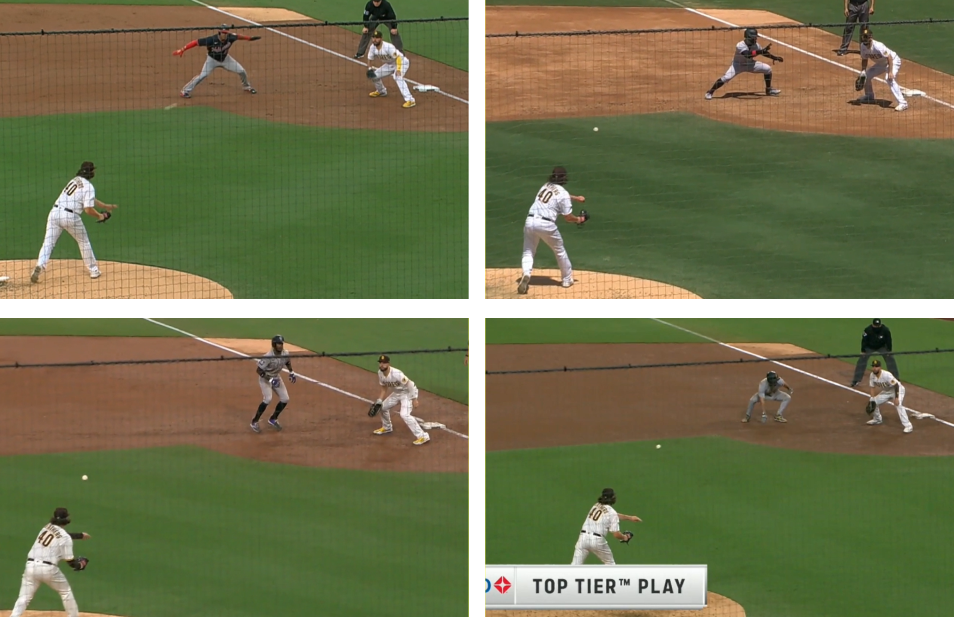
The author of that trickery is Ryan Weathers, a 21-year-old rookie for the San Diego Padres who leads all of baseball in pickoffs this season with nine. Runners have only stolen two bases off of him and he hasn’t been called for a balk yet. His pickoff proficiency has been historic, as he has retired those nine runners in only 89.2 innings, or 127 baserunners allowed. On a per baserunner basis, Weathers is having one of the best pickoff seasons of all time:
| Rank | Pitcher | Year | Baserunners | Pickoffs | BR/PO |
|---|---|---|---|---|---|
| 1 | Dave Danforth | 1916 | 131 | 11 | 11.9 |
| 2 | Steve Mingori | 1976 | 104 | 8 | 13.0 |
| 3 | Ryan Weathers | 2021 | 127 | 9 | 14.1 |
| 4 | Jerry Garvin | 1977 | 351 | 23 | 15.3 |
| 5 | Steve Avery | 1995 | 227 | 13 | 17.5 |
| 6 | Steve Carlton | 1977 | 335 | 19 | 17.6 |
| 7 | Greg Smith | 2008 | 265 | 15 | 17.7 |
| 8 | Mark Guthrie | 1990 | 201 | 11 | 18.3 |
| 9 | Jack Sanford | 1966 | 148 | 8 | 18.5 |
| 10 | Eric Lauer | 2018 | 186 | 10 | 18.6 |
That chart favors pitchers early in their careers who didn’t yet have a reputation for shutting down baserunners. Much like a catcher who becomes known for his incredible arm, runners faced with a known pickoff artist will start playing more conservatively, making it quite hard to pile up a high pickoff total. This is taken into account by our Stolen Base Runs Saved (rSB) metric, which sees Weathers as the best pitcher in baseball at preventing steals. His rookie season has taken a sour turn in the last couple months, as the 2.73 ERA he had in late July has swelled to 5.12 with equally poor peripherals. But given his age and limited track record in the upper minors, some bumps in the road were to be expected and his struggles don’t take away from how amazing he’s been at controlling the running game. Let’s take a closer look at some of the skills he uses to pickoff a runner off.
The Deception
Starting a pickoff move such that it convinces the baserunner that the pitcher is throwing home is no easy feat. It involves the pitcher trying to mimic their normal motion to the plate for as long as possible so as to let the runner think they can confidently begin taking their secondary lead. I can’t argue with you if you think that what I just described is a balk; not being allowed to intentionally deceive the runner is basically the reason the balk rule exists. Alas, this lift-and-throw maneuver is a bit of a loophole and as long as the lifting leg doesn’t cross back behind the rubber or land toward home plate (“toward” meaning more than a 45 degree angle coming from the direction of first base), a balk won’t be called. This hasn’t stopped the technique from lovingly being referred to as the “balk move.” Weathers’ balk move is a good one. This first clip shows what the baserunner, in this case David Dahl, has to deal with:
When his leg is lifted it looks like he could still be throwing to first. This is why you often see runners leaning back to first early in Weathers’ motion. But once the leg is at its peak, his body weight appears to be shifting towards home plate and after his leg starts coming down, it really starts to look like he is going to throw home. I froze that clip at a point where I think Dahl is convinced the pitch is going to home. After that, Dahl stops leaning toward first and begins to take his secondary. Dahl played this conservatively and still lost because Weathers is able to maintain the illusion of a pitch for an immensely long time.
Part of his ability to keep up the illusion comes from him hiding that he’s shifted so much of his weight toward first base. I’ve synced up two different camera angles from that pickoff of Dahl to show more of what the runner is unable to see.
Almost as soon as Weathers lifts his leg, his body weight starts moving towards first — a massive clue that a pickoff is coming — but his shift in weight is subtle enough that from the runner’s perspective, it’s hard to see it at all. The runner sees a normal leg kick and the pitcher’s weight shifting toward home.
Here’s a new perspective, this time of Weathers executing his move against Juan Soto:
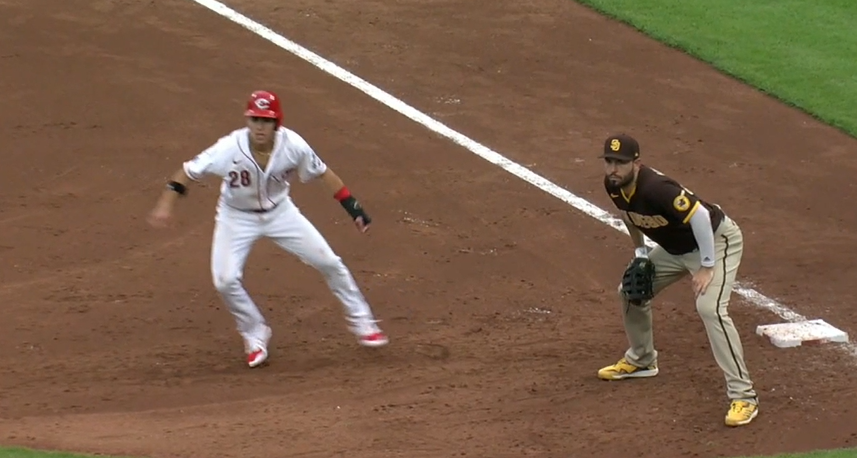
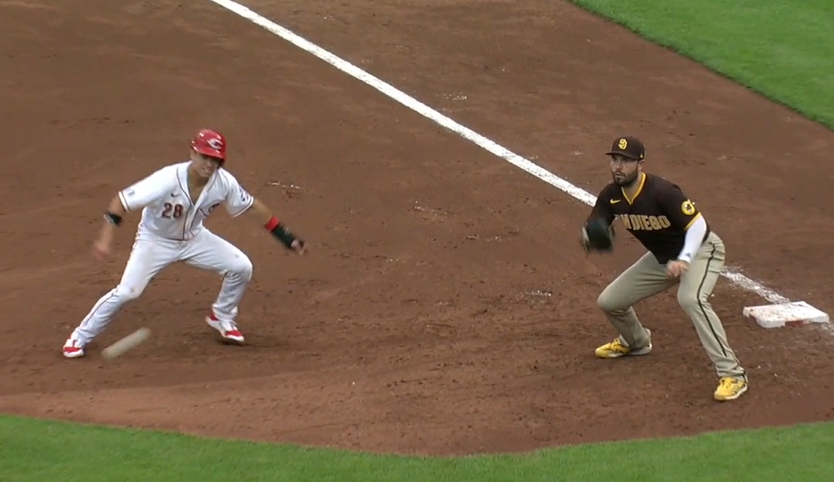
When Weathers drops his leg and shifts his body weight toward home, Soto is so confident in his secondary lead that he turns his attention to home plate. It’s a scenario we’ve seen unfold throughout this season with runners going up against Weathers. First, they’re cautiously worried about him picking over:
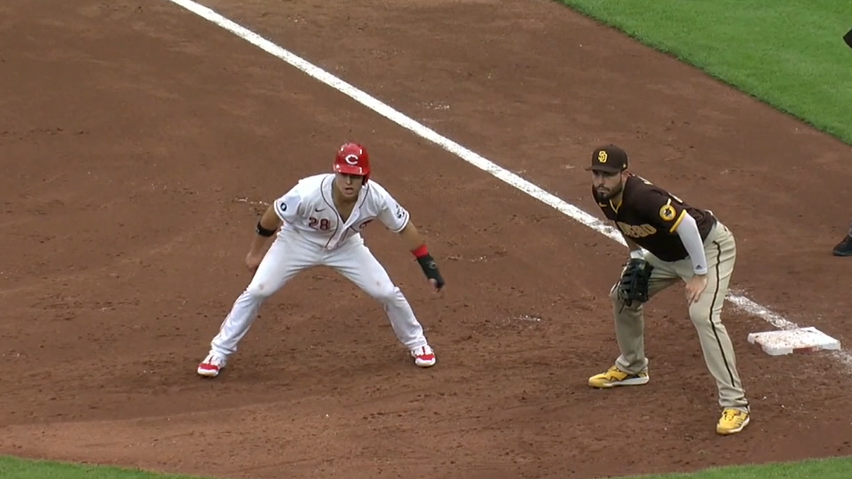
Then when Weathers’ leg starts to drive home, they become certain they are clear and take their secondary lead:
And then they’re out:
With enough experience facing Weathers, a runner would begin to notice various tells that might give his move away. I wanted to look for these tells myself. Ideally, I would’ve been able to find a few instances of Weathers pitching to home and picking over from the awesome, behind-the-runner angle that you saw in the Dahl clip. Sadly, after watching nearly every pitch that Weathers has thrown with a runner on first this season, I didn’t find a single shot from that angle. The next best thing is a shot from behind the pitcher, which does show a couple of interesting things. Take a look:
There are two things that give the pickoff move away that I think would also be visible to the runner. The first is Weathers’ shoulder movement, or the general twisting of his torso in preparation to make the throw to first. This movement happens well before it becomes obvious that a pickoff is happening. If you return to the earlier Dahl clip, you can even see a bit of this shoulder twist from the perspective of the runner. The other, more subtle difference, is Weathers separating his hand from his glove earlier when he picks. His throwing arm drops down more quickly to make the more hurried throw. Both of these differences seem like they would be hard to notice in the moment, especially with limited experience against Weathers.
The Throw
Beyond the incredible deception Weathers creates, I want to highlight the quality and strength of his throws to first base. These are no lollipops or wild heaves:
Weathers is able to get his lower body in a great position to throw the ball to first without sacrificing strength. He accomplishes this by turning his shoulders early while his lower half is able to build momentum over to the base. He even seems to push off the rubber in ways that you don’t typically see during a pickoff move. It almost looks like he’s pitching the ball to first. If you look at the pickoff move of another pickoff artist, Eric Lauer, you’ll notice more of a sidearm flip, which has less power behind it.
Eric Hosmer has an important role here as well. Defensive metrics may not view him as a Gold Glover but when it comes to receiving throws, good or bad, he’s always looked the part of a good defender. Him receiving pickoff throws is no different. Hosmer does a great job of letting the ball travel as far as possible into the runner before catching it, so as not to slow the ball down with his hand speed. He’s also very quick and accurate with his tags, seemingly always dropping the tag right “on the wallet,” as Padres announcer Mark Grant often says. These highlights also show the benefit of having a left-handed first baseman. These types of quick tags to the far side of the base are much easier for lefties and I think a few of these pickoffs simply would’ve been safe with a right-handed first baseman.
The Backup Plan
The final piece to Weathers’ historic season is what happens when runners don’t fall for his move. Some runners are so conservative in their leads against him that they never really get a secondary lead at all and don’t fall for his late throw to first:
In the above clips, Weathers has already won. Those runners aren’t even getting secondary leads; they certainly can’t steal a base like that. He still has a weapon that can pick them off though. His pre-set quick pick is great and like his normal pickoff, it comes at a time when the runner thinks they are safe:
Now watch that pick from the other side:
Mitch Haniger, seen earlier leaning heavily back to first, turns his attention to the batter for only a moment, but that’s all it takes for Weathers to deliver a strong, accurate throw for the out.
The importance of this alternate move could be amplified as Major League Baseball has been experimenting with outlawing the lift-and-throw completely. This play from Weathers gives me confidence that even after the “balk move” is dead and gone, he will continue to be difficult to run on.
Luke Hooper is a designer and writer at FanGraphs. He lives in Portland, Oregon, longing for a major league team to materialize.
Weathers put Tapia in a blender right there. Seems like the baseball equivalent of the crossover dribble where the defender stumbles or falls backwards
Amazing article, thank you
Damn I missed having Andy Pettitte in the bigs
Holy cow this was good. I’m kind of in awe of the balance and physical skill both these moves take. Looking at the first couple GIFs, my gut reaction was that if I was standing on top of a round hill and decided to shift my body one direction while 100% pretending to shift it a different direction, I would definitely fall down. Every time.
Appreciate that! Yea, I could watch his move all day. I certainly tried to recreate it in my living room, and my dog told me it was a perfect reenactment so…
These visuals are amazing. Thanks.
1977 Jerry Garvin….351 baserunners in 244.2 IP as a 21 year old. Yikes, you wouldn’t see that now. Had a really good year as a reliever in 1980, was out of the majors for good after 1982 (his age 26 season). Different times
I just looked up Garvin. He was mediocre for the 1977 expansion Blue Jays, but he did lead the team in WAR with 3.6. That is a lot of baserunners, sure. But it is a WHIP of 1.357 which is not atrocious. Ryan Weathers is at 1.349. I think most, if not all current teams would love a 1977 Garvin for the back end of their rotations. Maybe even the front end.
I agree, the 77 version of him was as competent back end starter, and 3.6 WAR isn’t at all bad. But what a lot of wear and tear on a rookie’s arm. The next year batters hit .318/.372/.495 off him.
3.6 war is good!
This article has me missing Mark Buehrle
Really cool piece, really reminds me of Jeff Sullivan pieces that I’ve missed.
Couple of thoughts:
-Could the batter/guy in the next batters circle alert the runner when Weathers is starting to lean towards first base? They may have a better angle.
-I wonder if some 1st basemen are known for having quick hands/being good at tagging runners, and as a result provide (mostly minimal) value by making runners hesitate to take an extra step lead.
I hadn’t considered before reading this that on pickoffs, the first baseman should wait to catch the ball at the last moment because the throw will always be faster than his own tag.
I wonder what percentage of MLB first basemen A) know this, or B) actually do it. Votto, Pujols, Freeman, Goldschmidt sure. But how about David Ortiz or Rene Rivera when they occasionally play 1b. I know Ortiz is retired.
I received this instruction as an infielder in high school, so I’m sure they are all aware.
On the other hand, I was also taught to catch a fly ball with forward momentum when a runner is tagging, and I almost never see this happen in mlb.
Huh? You almost always see that
One thing I noticed is that Hosmer is playing a few feet away from first base and tagging “on the wallet”. It seems like that is faster than playing closer to the bag and tagging up around the shoulder/arm/hand area.
Interesting thought on the batter. Certainly feels like they’d have the best angle but they would have to communicate that pretty quickly!
You lost me with the faint praise of Hosmer’s defense, but otherwise awesome article. It might be hard to parse the data, but would be interesting to see the chart using only baserunners on first (or 1st and 3rd) rather than all baserunners in the denominator.
I saw Clayton Kershaw do a similar pickoff move, where the weight of his body shifted forward to the plate, and he stepped towards first base for a pickoff. It looked like a balk to me. It made me review the official rule:
“Rule 8.05 If there is a runner, or runners, it is a balk when— (a) The pitcher, while touching his plate, makes any motion naturally associated with his pitch and fails to make such delivery;”
That shifting of his weight forward is “any motion naturally associated with his pitch.” That’s the motion he makes when he pitches. The umpires should be calling this “balk move” for the balk it is. It’s a balk, plain and simple.
Just another thing about baseball that they enforce wrongly, and don’t even both to try and do anything to make clearer. It would be as simple as adding a line on the mound at an angle at the 45 degree mark between home and 1st in relation to the rubber. If the foot falls on the first base side of the line, it’s good, as long as he’s not weight transferring towards the plate before his foot lands. Done and done, easiest calls in the world since the 1B ump can see if the weight transfer goes towards home, and where the foot lands. Easiest solution, but they’ll never do it because… reasons.
I see people praising Pettite and Buerhle in this section too, like 90% of their moves were balks that just never got called.
Your ‘line’ idea works only if every pitcher has the same foot placement on the rubber, which they don’t.
That is one drawback for sure, but could be fairly easily overcome. The rubber isn’t so long that it would be impossible to create something that works for the majority
The making lefties step off like rhp is one of the few rules they are testing in the minors that I like. Would add to stolen bases, which MLB wants. And mostly because usually when someone gets picked off it’s a balk anyhow.
But simply lifting your leg would count as “any motion naturally associated with his pitch” so I don’t think the shifting of the weight makes it that much more egregious. I think most are in agreement that this type of play isn’t called how the rules say it should be, but I don’t think Weathers is doing anything more egregious than others. In fact, I think he steps toward first more than most. Look at Lauer’s move for example; I think he rarely cross the 45 degree line.
Rule 8.05(c) says it is a balk if “The pitcher, while touching his plate, fails to step directly toward a base before throwing to that base…”
That’s why simply lifting the leg doesn’t count as a motion associated with the pitch. Lift the leg. Leave it hanging for a while before throwing the first or throwing to the plate. At this point a pitcher hasn’t made a motion naturally associated with his pitch and may still step directly toward a base. A number of left handed pitcher do this well.
A good rule of thumb for a balk is that it’s a balk whenever a pitcher does something to deceive a runner about whether he’s throwing to a base. Surprising the base runner is ok. Deceiving them is not.
Great article!
Legit move–as opposed to Pettite or Buehrle balk moves.
So what was happening in 1977? This list includes both Garvin ’77 and Carlton ’77. I was watching baseball then but I don’t recall any broadcast conversation about a high in successful pick-offs.
There was a notable increase in SB attempts starting in 1976 and persisted until about 1993.
This is a phenomenal breakdown. Love the different angles showing what the runner can and cannot see on these pickoffs.
Thanks! It’s definitely interesting see what you can learn from a different angle.
Terrific article with great video clips. Thanks, Luke.
Thanks Greg! Glad you enjoyed it!
Y’all jinxed him!