
Brewers, Cooper Pratt Reportedly Agree to Extension
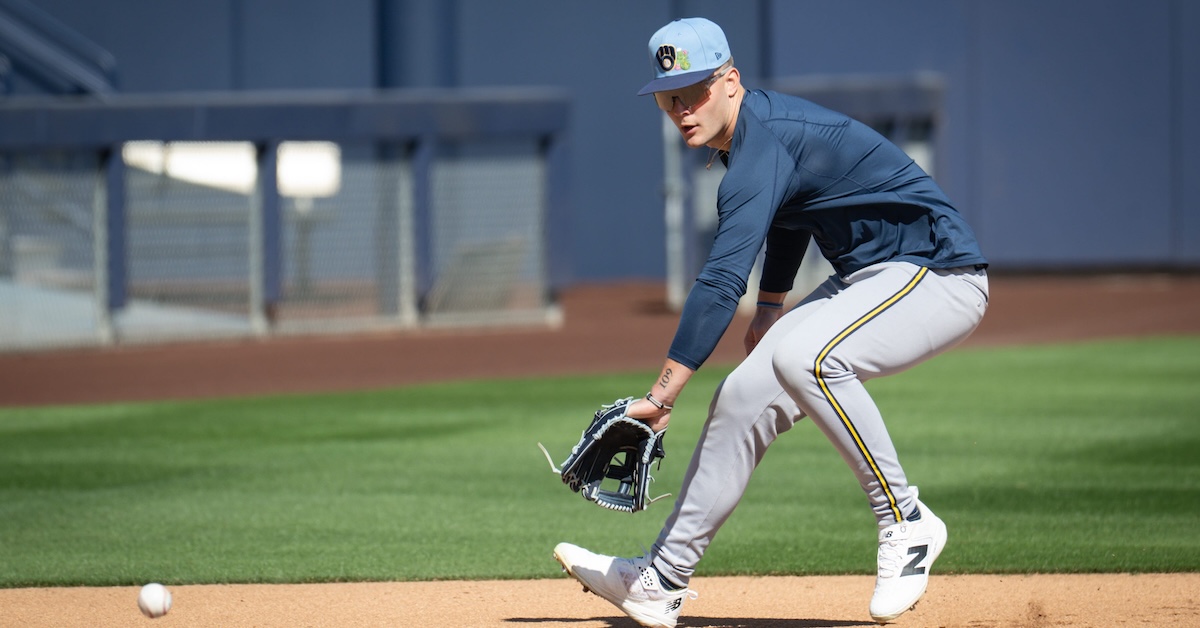
The Brewers and shortstop prospect Cooper Pratt are reportedly close to terms on an eight-year extension. The deal would guarantee Pratt $50.75 million over the life of the deal, and there are also two club options worth about $15 million apiece. As it’s a major league contract, Pratt must be added to Milwaukee’s 40-man roster. A corresponding move to make the terms work has not yet been announced.
While extensions for prospects who have yet to debut are becoming more common, Pratt’s is a little unusual. These tend to either be large deals to consensus top prospects, often with the carrot of a ticket to the Opening Day roster as a sort of signing bonus, or smaller sums for enticing but flawed farmhands. The eight-year, $82 million extension Milwaukee inked with Jackson Chourio prior to the 2024 season is a good example of the former (as is the eight-year, $95 million pact the Mariners reportedly just struck with Colt Emerson), while the six-year, $25 million pacts Seattle signed with Evan White and Philadelphia with Scott Kingery cover the latter. Pratt’s deal doesn’t fit cleanly in either category. It’s a pretty good chunk of change for a player who evaluators generally don’t see as a future star, and it’s also not a pay-for-play deal, as Pratt will likely remain at Triple-A after signing.
Pratt was taken in the sixth round of the 2023 draft from Magnolia Heights High School in Mississippi. Eric ranked him 25th on the Draft Board that year, but his $1.35 signing bonus was commensurate with more of a second-round talent. As you’d expect for a prospect in consideration for this kind of contract, he’s performed well in pro ball. After a successful cameo on the complex in his draft season, Pratt notched a 132 wRC+ at Low-A as a 19-year-old, with strong contact skills and a low walk rate. He spent all of 2025 at Double-A, where he played a clean shortstop and hit .238/.343/.348, good for a 107 wRC+. He also dropped his strikeout rate to 15.2%, impressive for a 20-year-old at that level.
Still, I was a little surprised at the terms of the deal and think Pratt did pretty well for himself; I bounced it off Eric and he’s of a similar mind. We like Pratt and ranked him 10th (45 FV) in Milwaukee’s very deep system this winter, but we wrote him up as more of a second-division guy or solid utility infielder than a frontline regular. We both see a quality defender. Eric wrote: “For an athlete his size, he has good range and actions, and the arm strength to make accurate off-platform throws. It’d be too much to call him a Gold Glove-caliber talent, but he should be above average there at peak.”
We’re less sold on his upside at the plate. For a big guy (Pratt is listed at 6-foot-4 and 210 pounds), he’s neither hitting for much power nor producing the kind of exit velocities that suggest he will. And while he’s made a ton of contact, we’re a little worried about the mechanics of his swing and how his chase rate explodes with two strikes. To quote our report again:
“Pratt’s swing has an intermission; he loads his hands and they come to a dead stop before he fires them toward the ball. It requires a ton of effort, and he sometimes loses sight of the baseball in order to swing hard. These are the traits of a hitter who we worry will be late against big league fastballs… Pratt’s chase rate explodes with two strikes, as he goes from having a slightly below-average 26% mark to a rather concerning 47% rate (56% against secondary pitches). Every hitter’s chase rate takes a leap with two strikes (it’s strategically sound to expand your zone in that situation), but that’s a big jump and suggests that some of Pratt’s early-count takes are premeditated.”
Overall, it’s the evaluation of a player we expect to help, and Pratt may well have a couple 2-3 WAR seasons during his peak. Heck, given the Brewers ability to extract the best out of so many of their homegrown players, it wouldn’t shock us if we’re light on the player and he does wind up becoming a true everyday presence. Still, we peg him as more of a 1.5ish WAR guy annually, which makes a $50 million outlay, even over an eight-year timespan, a pretty aggressive commitment to a player with no major league experience.
It’s not that the back of the envelope math doesn’t make sense. If you fix the value of a win at $9 million — it’s obviously more complicated than that, but let’s keep it simple here — and assume that Pratt accrues an average of 1.5 WAR per year over the span of the deal, that’s $135 million of production for around $80 million (before any escalators). Milwaukee stands to recoup plenty of surplus value even if you want to turn down the dials on the $/WAR equation, and the team is only on the hook for a little more than $6 million per year if Pratt falls short of this projection. It does seem like an unusual amount of downside risk for one of the few true small-market teams to take, however. Sad as it is for this prospect writer to say, most of the guys we cover inevitably fall short of their forecast. Six million dollars isn’t a major expenditure these days, even for Milwaukee, but the dead money will sting more for the Brewers than it would for most other clubs in the league if Pratt’s skills don’t translate.
The opportunity cost is tricky to evaluate. It’s not clear that the Brewers are any better off than if they had opted to take matters year-to-year. As it stands, Pratt was only due to make a couple million between now and his arb years, which likely would have started in 2030. Had he played well, an extension surely would’ve cost significantly more, though it would have also come with additional security. That we’re in the final year of the current collective bargaining agreement adds a wrinkle: Pratt’s pre-arb and early-arb salaries will likely be a little more expensive than what early-career players have earned this cycle, to say nothing of how the arbitration structure might change in the next CBA. Perhaps cost certainty had its own appeal in this case.
One other interesting dynamic to follow is how this winds up affecting Milwaukee’s other premium shortstop prospects. Jesús Made, Luis Peña, and Jett Williams were all Top 100 guys for us this year, and each had at least a shot to play short in Milwaukee. The club’s first-round pick last year, Brady Ebel, is also a shortstop. If Pratt becomes the player Milwaukee seems to think he is, the org’s top farmhands may well need to work in at other positions sooner rather than later. It’s possible that none of them are shortstops at the end of the day: Made has put on 25 pounds and looks likely to slide over to third, Peña is error prone, and Williams likely fits better at second or in center anyway. Whatever their chances of becoming the Brewers’ starting shortstop were yesterday, though, those odds have dipped a little today.
Perhaps the Brewers were reading the writing on the wall a bit. If, internally, they don’t buy any of those three as long-term shortstops, Pratt is suddenly the only upper-level player who projects there long term. Ebell is too far away and the current option, Joey Ortiz, just had a miserable season at the plate in 2025. Nailing down the position for the long haul could have been a tertiary motivation for Milwaukee.
As is usually the case, you can see the logic for both player and club here. The Brewers extend a player they see as a future regular at a premium position, making a significant but manageable financial commitment in exchange for cost certainty and the chance at a fair bit of surplus value. Pratt, for his part, has secured the financial component of the American Dream at the ripe age of 21. To whatever extent he had any underlying financial anxieties, those are presumably long gone, and he can turn his full attention to the diamond. Sometimes peace of mind is the most valuable thing of all.
Brendan covers prospects and the minor leagues for FanGraphs. Previously he worked as a Pro Scout for the Pittsburgh Pirates.
I’m utterly fascinated to see how this contract goes. The Brewers must be considerably higher on them than the public consensus.
No disrespect to Eric and Brendan, but I trust the Brewers’ scouts and analysts more. Still, he doesn’t need to be much more than an average everyday shortstop for this deal to return surplus value for the Brewers. I’m sure he can do that.
It’s pretty binary. If he makes it and sticks as a fairly regular MLB player then MIL stands to do well on surplus value. If he does not, then he’s Rusney Castillo.
I actually agree with what you’re saying and upvoted it, but I think this is a fairly safe profile. If he doesn’t pan out he’s going to be a lot like Eric Sogard or Josh Rojas.
Still a lot of money to pay for a utility infielder at that level though, so they’re hoping he does better than that.
Agree on both points. But we don’t know the Brewers budget and while they’ve probably got a pile planned for Made it feels like they might be choosing to go yr to yr with Peña and Jett rather than Pratt. That’s why it’s hard to evaluate this deal in isolation.
FG is lower than the public consensus for sure.
Pratt is #50 on BA, #62 on MLB, #63 on BPro, #70 per Kiley, #99 KLaw
It’s still a rather odd deal for someone that is in that 50-100 range.
Yes, he does need to be better than average to return surplus value for the Brewers. Significantly better.
Jeremy Peña has earned $15.8 million so far with one final year of arbitration remaining. Assuming that he gets something around $14 million in Arb3, that puts him at roughly $30 million for his years of team control before reaching free agency. Note that Peña was on the Astros’ Opening Day roster in 2022, so he will be a free agent after six seasons whereas Pratt wouldn’t reach free agency until 2034 at the earliest. Meanwhile, Eric gave Peña higher grades than Pratt in power (55 to 40) and in fielding (60 to 55).
So even if we bump Pratt up to $35 million over his arbitration years, this prices his first year of free agency at $15 million, then has another two team options of $15 million for 2034 and 2035. That’s a lot for a guy who isn’t expected to be an impact hitter. The only way this extension makes sense to me is if Milwaukee expects Pratt to dramatically improve at the plate. Given their sterling history of player development, I am willing to give them the benefit of the doubt, I’m just surprised that they would make this sizeable a financial commitment based on improvement that hasn’t yet occurred.
Yeah, I don’t understand this deal at all. Gunnar Henderson is arb1 at $8.5 million this year. Call it $18 and $30 for arb2 and arb3. That’s $56 million plus some change in the couch cushions for his first 3 seasons and he’s still short of $60 million. Obviously there are two more years tacked on for this one, but you have to be REALLY FREAKING GOOD to get $50 million pre-arb.
You’re seriously undervaluing those two years (plus options)
Lourdes Gourriel got 3/$42m.
Gleyber Torres has made $37m through his first two years.
Discount the value of Y7 and Y8 to $12m for risk…and the valuation of his arb years comes out to $26m.
Torres is a great comp here. What discount rate do you need to use equilibrate his earnings with Pratt’s? Torres was a super two, and earned like $35 million in his first SEVEN seasons, then $15 million in year 8 once he became a free agent after that SEVENTH season. I keep seeing this reported as eight years and with no indication of annual weighting for salaries, so using straight 8 x $6.25 million.
The answer is 2%. Which seems a little low for a guy not ranked in the Top 50 and never having played in MLB.
You can add 50% to Torres’s salaries to account for inflation and the answer is 22%. Which is probably more in the right risk-adjusted ballpark, but also highlights just how unlikely it is that this contract works out for the Brewers. Big risk for some potential cost savings in 2032 and 2033.
It’s important context that Pratt isn’t ranked in FG’s Top 50 (which isn’t a particularly meaningful distinction when there are only 30 55 FVs).
BA has him at 50; MLB has him at 64; and Kiley has him at 70…and the write ups basically boil down to “boring Aybar Zone guy,” who will still be worth 1.5 WAR in down years.
Definitely agree with st’s sentiment that these extensions tell us more about the next CBA than anything else.
Also, to get a discounted value of $12 from $15 and $22 million for years 7 & 8 you have to use a discount rate of 16%, which feels way too low here.
I was splitting the difference between $28m for Gurriel and $37m for Gleyber over their first two years – 24/32.5 is a 26% discount.
A quick search says something like 1-in-5 top 100 (but outside the top 40) reach 20 career WAR, which is what Torres did.
It’s only one additional year plus options, not two. Pratt would have needed to reach 172 days of service time in the 2026 season to reach free agency after the 2031 season, which obviously isn’t going to happen. The Brewers would have had him under team control through the end of the 2032 season. This extension buys out what would have been his first year of free agency in 2033, then gives them team options for $15 million in 2034 and 2035.
Pratt could certainly end up being worth that, I just don’t see the upside for Milwaukee given that he projects as a good but not elite defender and a somewhat below average bat.
Kylie and Callis think he’s an average-ish bat, while Law thinks he can get there.
Plus, I wouldn’t be surprised if he ends up qualifying for Super Two status.
That said, definitely agree with others that this is more about the next CBAx
Kylie called him “A relatively unexciting shortstop prospect who might be ready by 2027 to be a solid every-day player,” and said that “reviews still vary about exactly how much the 6-foot-3 Pratt will hit in the big leagues.”
How? These is virtually zero chance of that happening, as he’s not getting called up in April or May barring a serious injury to Ortiz.
If some people think he’s a 90 wRC+ guy and others think he’s a 105 wRC+ guy, reviews vary…and they think he’s average-ish
Separately, you seem to be ignoring the possibility that Joey Ortiz’s career .289 wOBA and .290 xwOBA accurately describe his offensive aptitude.
Kylie never said that Pratt is “an average-ish bat,” and if he did see Pratt that way then he wouldn’t have called him “a relatively unexciting shortstop prospect.”
I think it probably does, but Pratt’s offensive performance in the minor leagues has been worse than what Ortiz did in the minor leagues, and Eric rates his offensive abilities lower than he rated Ortiz. I don’t think Pratt is a 90 wRC+ guy, I think he’s below that. He had a 101.2 90EV in 2025. Ortiz had a 108.5 90EV in 2023 at Norfolk. That is a massive difference.
Pratt put up a 107 wRC+ as a 20 year old in AA.
Ortiz put up a 106 wRC+ as a 23 year old.
…and Ortiz is only 18 pounds lighter, despite being 6” shorter.
None of that matters if they don’t fix his swing, of course…but that’s another benefit of being young.
Maybe it’s a fallacy, but my immediate reaction is “What do the Brewers know that I don’t?”
Slugged .348 in AA. lol. K
Was a 20 year old with plus defense at SS and plate discipline, league average for 2025 Southern League was 23.8 years old with a .340 slug.
Top prospects hovering around league average in the minors is typically a very bad sign
Not when he was three years younger than the average Southern League hitter
It is. See: Mondesi Jr., Andrus, Fernando Martinez, Carlos Tocci, etc
Lack of production always matters
If he turns out like Elvis Andrus this deal will be a steal for Milwaukee.
Nitpicking instead of responding to overall point
Elvis Andrus of 36 career WAR?
All defense. Was billed as a hitter, too. Could never hit
Cam Collier has 55/60 raw power grades on this website and he slugged .347 in the Southern League last year at the same age as Pratt.
Recent #8 overall pick Christian Moore has 60/60 raw on this website and slugged .323 in the Southern League last year as a 22 year old.
In 146 PA? Ok.
Also, have either of those guys had success in the majors yet or nah?
Southern League really suppresses slugging, probably almost to the inverse extent that the PCL boosts slugging. Last year, only 19 players with at least 79 AB’s had a .400 SLG or better.
Drake Baldwin had a .350 SLG in 276 PAs, so there’s some precedent there
Southern League hitters are NOT good, and it’s not like the parks are all pitcher-friendly (in fact, Brewers park in Biloxi is a bandbox). This reeks of an org falling head over heels in love with THEIR player. There’s a huge risk that Pratt ends up looking like Tarzan but playing like Jane.
Normally I would agree with you, but he was also 20.
I’d be more worried that his success against older players is due to things that won’t hold at the big league level–that he might be too passive and that his swing might not work properly against big league velocity.
At the plate he looks a bit like Joey Wendle / Stephen Drew / Brandon Crawford / CJ Abrams which I think both gives a sense of the upside and the downside. None of these guys were super consistent from year to year at the plate.
There are very, very few examples of prospects who struggled for a *full season* at a level they arguably weren’t prepared for and went on to have consistent success in the bigs
Very small percentage. This is the excuse that people kept making for people like Mondesi, who was way younger than Pratt when he reached AA. It’s nearly always a bad sign regardless of age if you can’t hit over 400-500 PA
I’m not saying your conclusions are wrong. I’m saying your logic is wrong. You’re saying that the issue is that he didn’t hit well in AA, when the real problem is that he’s a prospect. And most prospects bust.
Saying there are very few players who have hit poorly over the full year at AA at a young age and it turned out well for them is correct but misleading. There are also very few players who have hit well over the full year at AA at a young age and it turned out well for them. Drew Waters, Jon Singleton, Cristian Pache, Orlando Arcia…
Meanwhile, Jose Ramirez, Andrew McCutchen, and Ketel Marte all hit worse in their age 20 season at AA than Pratt did last year.
You’re trying to ascribe something to Cooper Pratt that isn’t really a thing. If you want something to be worried about, check out Eric and Brendan’s scouting report on him. None of that stuff is something I would have seen from the stat line.
So you don’t agree that there’s a stronger correlation between success in the minors and eventual mlb production? I mean there obviously is
The less you hit in the minors, the more likely you are to fail in mlb. Irrespective of age or anything else
There absolutely is a relationship between minor league hitting performance and major league hitting performance. But that’s not the point you’re making. Your points are (1) that age in relation to level doesn’t really matter so much and (2) that the “full year” aspect of this matters. And I’m pretty sure neither of those are true.
There are only fifty-three cases where a player had 400 PAs or more in AA in their age 20 season between 2006 and 2025, so we’re averaging a little over two per year. What exactly do we learn from the fact that Pratt had a wRC+ 10 points better than Andrew McCutchen and 10 points worse than Nomar Mazara? The answer is that twofold: First, more than half of those players are going to bust because they’re prospects. And second, the fact that they got to AA that young gives them a very good chance relative to the total pool of prospects.
The case you’re making here AFAICT is just that this guy isn’t one of the vanishingly small handful of prospects who hit immediately at every level even when years younger than average, and who therefore are a great bet to succeed in the majors, relative to all other prospects. That’s not some kind of big surprise here — and the majority of major leaguers didn’t fit that profile, so it’s not dispositive either. Everyone is a likely bust compared to, like, Alex Rodriguez.
I’m only making that point because people said he was ‘young for the level.’ It doesn’t matter.
The original point was that he simply can’t hit
But that is just simply not true. He was seven percent above average last year. That is not “can’t hit”. Not what those words mean.
If you want to say that he doesn’t do enough damage on contact, that’s true. He definitely needs to get stronger to be a good major leaguer.
If you say he needs to refine his approach because he’s only walking due to being in AA, that’s also fair.
But “He can’t hit” is just verifiably not true relative to his peers.
107 wRC+ for a full season at any level in the minors is terrible for a top prospect. The average ops in a lot of these leagues is like .650
Do you know why the average OPS is .650? Because the league is hard to hit in.
One player over .900 OPS. 11 Players over .800 OPS. Only 8 with over 200 PA.
Two of those 8 were 25+ years old. Grown ass men.
So unless we’re suggesting that the only serious prospects in the entire league are Brock Wilken, Blake Burke, Luke Adams, Sal Stewart, Hector Rodriguez, and Sam Antonacci… I don’t know what we’re getting at.
Yeah, good players generally perform well at lower levels. But plenty don’t. And teams are better at adding strength/bat speed than ever before.
It’s fair to say this extension is aggressive, but your analysis is incredibly reductive. MOST players don’t hit for power in the Southern League and those who do aren’t automatically good.
No, it’s like that in a lot of leagues. It’s like that because there are a lot of really bad hitters in the minors
The southern league is 30 points of OPS lower than the eastern league and 50 points of OPS lower than the Texas league. So that is just not true.
The league especially has a couple of stadiums that absolutely kill right handed power, Pensacola being the primary one as the wind blows directly off the bay in from left field all the time.
Of course, if you bothered to do any research, you could respond to my point with the fact that Biloxi actually had the highest team OPS in the entire league. Thus he underperformed relative to the best hitters who played in his home park the most.
Which would be true. And my only counterargument would be that Biloxi had a higher number of true power hitters in the lineup than anyone else. Mostly, I’d say that Pratt definitely needs to add strength to be a good major leaguer.
Of course, that’s just me arguing with myself. You’re more than welcome to have whatever opinion you want.
Are there orgs you give the benefit of the doubt to stuff like this? I’m not voicing an opinion on it, just asking. Like if I said “X club gave a pre-service time extension to a modest player and it worked out pretty well” and you had to guess which club it was, how many would you guess before you got to the Brewers? Or the Rays? Or the Dodgers? etc.
Especially in the lens of cost control, which for a handful of the analytics forward team is more important than others (ie: the payroll gap between Milwaukee and Los Angeles vs the information gap).
But also too, I don’t know how “right” the Brewers need to be here. They don’t even need to see Pratt as some big star player. If they’ve just got an everyday regular under contract for $6.3M a year for 8 years (and two option years too) for his age 21-28 seasons, there surplus value there. And you’d imagine a team like the Brewers are happy to win at the edges and save a few million a year where for others that’s what they are paying in catering just to attract an expensive free agent.
I just don’t think you can give credit to an organization in a scouting report like that, and to Eric’s credit (and Brendan’s) they are very explicitly not doing that. They (and Dan S) may be some of the only baseball writers who don’t. It’s about having confidence in your own methods and evaluations.
Teams and their secret scouting / development/ analytics departments are only great until they aren’t. People used to give all kinds of credit to the Rays and they still kind of do. But the shine has come off, and I don’t think their front office abilities have changed at all. It’s just that the Rays were in the middle of a hot streak from a player development standpoint. Meanwhile the Pirates used to be panned by everyone and suddenly everyone is quieter now that Konnor Griffin looks a bit like Bobby Witt. But they’re probably never going to have another prospect like him in the next decade. At best it’s a lagging indicator.
Dan specifically modified his ZIPs evaluations for the Brewers to cater to things they do that don’t come out in his numbers FWIW. So this isn’t really all true.
To be clear, I didn’t mean in the scouting report like Eric or Brendan should do that. I’m more saying there are orgs who have provably squeezed more out of guys and edges than other teams, so I am curious on if you give those teams a little bit of benefit of the doubt in decisions like this. I wouldn’t change the scouting report or ranking either out of deference to the club track record.
What I was asking is that do you trust some clubs with moves like this more than others? It could be the same for doing something similar with an established MLB player, not even a prospect.
Sort of. It’s complicated.
Quinn Priester was halfway to playing overseas when the Brewers traded a couple prospects and a draft pick for him and by the middle of the year he’s Boston-era Derek Lowe.
So then the Brewers trade away their starting third baseman (and his backup) away to play a bunch of replacement level scrubs at third. And they do this to get a Kyle Harrison, a guy who has average stuff and couldn’t make his way into two different teams’ rotations last year despite underwhelming back end options.
And I say to myself, “this looks a lot like the Quinn Priester deal that made no sense last year and worked out great for the Brewers.” And what do you know, his Stuff+ on his fastball and changeup were up 20 points on where he was last year.
These deals are risky and counterintuitive and they make the team look great when they pan out and terrible when they don’t. When a deal like the Durbin – Harrison deal shows up just after the Priester trade, it forces you into a position where you have to look at it through the most charitable lens possible and trying to put yourself in the shoes of the Brewers. I think it’s good to be aware of that dynamic and to keep the pluses and minuses in mind rather than just accepting the position that it makes sense because a smart team did it.
It’s so misleading to say he’s under control for only $6.3M/yr so it’s an easy bargain. The first 5 years of team control are dirt cheap. League minimum is 780k. Average yr1 arb salary is ~3.5M, yr2 = ~7M. So you’re already guaranteed 5yrs of control for roughly 13M going year to year. And arbitration rewards power (not defense) so he’s unlikely to be setting arb records.
Guaranteeing Pratt 50M only makes sense if you believe he’s got a 6+ year career in his future as an MLB starter. The hit rate on guys from the back end of the Top 100 doing this is not great. Brewers must really really love this guy. Big gamble that Brewers only win if he hits his 80th-100th percentile outcomes.
By my napkin math he’s gonna make around$35M through arb if he’s a solid (not star) SS. So the Brewers get free agent year 1 and 2 at $7.5M /yr and 3 and 4 at $15M/yr option.
Seems like a huge downside risk just to buy themselves those cheaper cost controlled years.
Jeremy Peña is much better than solid and has only made $15.8 million through Arb2, then is expected to make around $30 million total for his team control.
This extension only buys out one year of free agency, not two. The only players who reach free agency after six seasons are ones like Peña who started Opening Day in their rookie season.
This does take the guess work out of Super Two status.
I don’t think Pratt was going to get called up soon enough for Super Two to even be a consideration.
Late to reply to this but…why does this matter? I’m not talking surplus value or value above arbitration or anything. I’m talking in total dollars paid to a player.
The Brewers are paying him $51M. This isn’t an argument about value. This is an argument about if the Brewers can live with paying Pratt $6.3M a year on their books for 8 years.
If they paid him $1M a year for 8 years, yeah it would probably be a good deal, but value isn’t the argument. I’m asking about if 1) the Brewers and some other orgs get some benefit of the doubt on stuff like this, 2) and if the Brewers are taking a ton of risk here given the low overall potential dead money (to use a football term).
Couple easy Brewers comps come to mind for me with regards to Cooper…
JJ Hardy in the years he didn’t hit for power…
2005-06 Hardy
566 PA | 82 wRC+ | +16.0 DEF | 2.1 WAR
2009-10 Hardy
840 PA | 83 wRC+ | +23.4 DEF | 3.1 WAR
2014 Hardy
569 PA | 90 wRC+ | +17.9 DEF | 3.0 WAR
2016 Hardy
438 PA | 90 wRC+ | +7.6 DEF | 1.5 WAR
I don’t think Pratt will have quite as good a glove as JJ did (his +86 DRS at SS are 6th all time since they started tracking in 2003) but Cooper should be a much better asset on the bases (Hardy was -24.0 BSR for his career), projects to walk more (Hardy only had a 6.5 BB%), and is still young enough to figure out how to maybe tap into some 20 HR power a couple tree four years down the road like JJ eventually did for five of his seven seasons from age 24 to 30.
The other is Brice Turang…
Pratt (Age 19 | A/A+ | 406 PA)
277/362/406 (123 wRC+)
10.3 BB% | 20.0 K%
Turang (Age 19 | A/A+ | 564 PA)
256/367/340 (110 wRC+)
14.7 BB% | 17.9 K%
Pratt (Age 20 | AA | 527 PA)
238/343/348 (107 wRC+)
12.7 BB% | 15.2 K%
Turang (Age 21 | AA/AAA | 496 PA)
258/347/362 (100 wRC+)
12.1 BB% | 16.1 K%
…obviously Brice has better speed/athleticism, but Pratt has better physicality and has the upside to be a plus defensive SS versus Turang as a plus 2B.
Looking at the FanGraphs leaderboard of shortstops from age 21 to 30 during the Thirty Team Era and I could see Copper doing something along the lines of Edgar Renteria with 6,247 PA of 100 wRC+ | +17.1 BsR | +58.8 DEF shaking out to 27.7 WAR.
Clay Davenport’s comps for Pratt
Franklin Barreto
Amed Rosario
Ryan Vilade
Gavin Lux
Jay Bell
Richard Urena
JJ Hardy
Specifically 2004 JJ Hardy
Prospects will break your heart.
Jay Bell actually looks like a best case scenario here though. You can’t say that about every prospect.
Weird. Joey Ortiz is actually a pretty good comparison for the kinda player I think Pratt is. I wonder if they tried extending Made and failed. Not that he and Pratt have to be mutually exclusive, but one would think if they had the money for this extension they would have tried to give that plus X to Made first.
The REALLY interesting thing to me now is that Pratt has all of 15 PA at AAA and then Colt Emerson has 42 PA and got (appropriately) more than double this deal plus apparently a no trade. I don’t recall many prospects being extended that early, and I definitely don’t remember any no trades for someone who barely touched AAA. Will be interesting to see if these are one offs or if earlier extensions become a trend. They’d, of course, potentially be a way to get even cheaper extensions but would also presumably be even more volatile than “normal” early career extensions.
Ortiz is another good comp for the general shape Pratt’s production could potentially take. So far with the Brewers Joey has 1,029 PA of 87 wRC+ | +2.8 BsR | +25.6 DEF for 4.8 WAR.
Not exactly the type of player you’d want to give $50 million to, especially as a small market team. You’d rather just go year by year and get out before the defense potentially starts to slip in the late 20’s.
Pratt should have more offensive upside that Ortiz given his stature and the fact that he is already in AAA at age 21 where Joey didn’t reach AAA until his age 23 season or get his first full time crack at MLB until age 25.
Pratt’s development is much more comparable to the path Turang has taken to this point, and the Brewers giving him this extension this early is a pretty good indicator that they believe he’ll be able to follow a similar path.
That’s a really dangerous assumption. Ortiz had much better exit velocities in the minors than anything Pratt has shown thus far. Because of the size, I get why you could dream on Pratt unlocking more, but the reality is that Ortiz had higher grades in the minors.
Re the no-trade, I think it costs the team relatively little — the whole reason to do this kind of deal is to keep the player if he performs well, and presumably if he performs poorly, he’s untradable anyhow. The upside is keeping him around, and the downside is eating the money either way.
I don’t agree with that. In the worst case scenario that he’s Scott Kingery, yes, untradeable. If he’s good, sure, you probably want to keep him, but the state of the team 6, 7, 8 years from now is basically unknowable. If they end up in a rebuilding scenario, you would at least want the option of trading a good player with limited years left on their deal. And in any scenario in-between those extremes you always want the option to make a deal. It’s not THAT big a deal, but it’s not nothing.
But the current front office of a contending team has no reason the care about the potential ramifications of a rebuild down the line. Because contending teams who rebuild almost always have front offices that get fired.
Perhaps the most stunning revelation about this rather stunning extension is that, as of September, Jesus Made looked every bit a future plus defensive shortstop, with even the most tempered prospect gurus making “Lindor Lite” allusions. One winter, no game action and 25 pounds later, apparently him even playing SS is now, what, a pipe dream? Absolutely wild.
Sure I get it. He’s only 18. Kids grow up, they fill out. But moving Made to 3B, sans a measurable jump in his game power, almost has to suck some of the juice out of his FV, no?
Would imagine that Made will still play primarily SS at Biloxi this year. There is always the possibility Jesus ends up better at SS and Cooper moves to 3B down the road.
Well, sure, but can Pratt as a 3B justify this contract commitment? Then I would just say the same thing about his game power needing to level up (granted, doable). Keep in mind, it’s not about having Pratt or not having him. The Crew already owned him from mid-2026 through 2032 at an estimated total salary of ~$30M.
To me, this extension implies a >3-WAR player assessment by the front office. That requires either plus D at SS or plus O at 3B (or, above-average O and D).
The most likely path to success for Pratt looks like a poor man’s Dansby Swanson. If Made were to block that path …
The Brewers don’t care about things like “3B has to hit for power”, value is value to them. They probably value defense more than just about any team in the league.
In 2024 their primary 3B was Joey Ortiz with 511 PA of 105 wRC+ | +2.5 BsR | +11.2 DEF for 3.2 WAR.
In 2025 it was Caleb Durbin with 506 PA of 105 wRC+ with +2.3 BsR | +3.6 DEF for 2.6 WAR.
Third base has also decreasingly been a power position leaguewide. After eleven seasons with a positional wRC+ between 100 and 107 every year from 2012 to 2022, the last three years 3B have averaged a 96, 97, 96 wRC+.
Reading between the lines it would appear the Brewers believe something in that Durbin/Ortiz range would be more of a median outcome for Cooper while something like the 4.8 and 5.6 WAR seasons Turang has notched on BRef the last two years is closer to his eventual ceiling.
I can kind of get there at face value at these $$$$ for Pratt but the roster construction implications are harder to evaluate. As Brendan says, maybe none of Made, Peña or Jett are SS in the end, but it does signal that they’ve begun to make decisions among the four of them.
Pretty much everyone expects Jett Williams and Luis Pena to wind up at second base or center field.
Right now the Brewers are sending him out Williams at third because that’s where they think there is a need but where they need to be giving him reps is in CF.
For one, I’m pretty sure that Made and Pratt are going to be regular infielders in 2027, and Williams will have to play CF to get playing time anyway.
But the other reason is current outfield mix consists of Sal Frelick (good), a guy who has so many injuries that he’s burned through three years of service time with only 456 PAs (Mitchell), a guy who has a career 67 wRC+ (Lockridge), and a guy who lost a training camp battle to the 67 wRC+ guy (Perkins). Every outfielder they have left in AAA is an org guy or not ready…they are one injury away from having to call up Luis Matos (-1.4 career fWAR). They have been playing Greg Jones in right field.
Not disagreeing with the outfield thought in general, but they do have Chourio as well, so if you believe in Frelick you have one opening for everyday outfield starts.
Yeah although that is still an opening!
I think the Brewers are very wrong thinking that they’ve got CF covered because Garrett Mitchell is finally healthy. It won’t last.
I wonder how much of this deal is due to the failure to secure a deal with Turang before he exploded. The brewers seem to be determined not to let that opportunity skip by again. Seems like some of the scouting report on Pratt could have been lifted directly from Turangs scouting report when he was in the minors.
I still think there’s room to make a deal with Turang because he is still quite a bit off from free agency. They could still get him at a discount but I am guessing the Brewers won’t want to pay it. It probably looks a bit like the Hoerner or Crow-Armstrong extensions, maybe a little cheaper. If they can lock him up for $100M I would do it and he could very well take it.
Given all the middle IF talent the brewers have I’d be surprised if they wanted to commit that much payroll to the position. And I really like Turang but that doesn’t seem to be their MO.
Great point. And while Turang is controlled through 2029, I wonder if Arnold is eyeing up trading him with 2 years left to increase the return. The Cubs were obviously not floored by any offers for 1 year of Hoerner. And the Brewers were so unimpressed by Adames offers that they (rightly, IMO) just kept him.
I am more than a little surprised by the size of this deal but I am also surprised by the size of the Colt Emerson deal that was just announced. I usually love these deals for the team but the price tags on these have gone up so much that I have real questions how much upside there is for the team.
I am higher on Pratt than Eric / Brendan but not by that much, I think he’s a classic Erick Aybar Zone guy where most of his value comes from above average defense at a premium defensive position, whose offense is maybe league average. That’s valuable in a league where shortstop hitting is more Masyn Winn than Willy Adames and where Willy Adames gets $180M.
If he develops that way it will be a great deal for the Brewers, because that’s a 3 win player. But it doesn’t have a huge amount of upside because he is also the kind of player who doesn’t get rewarded in arbitration. I question how much money the Brewers are really saving here and whether it’s worth offsetting the situation where the bat just doesn’t develop even to Masyn Winn levels.
My previous understanding was that the going rate for 50s on an early dea was the Colt Keith deal, and that for 55s it was more like this, halfway in between the Keith and Chourio deals. But that Colt Emerson deal is in the same ballpark as the Pete Crow-Armstrong extension and he just put up a 5 win season. It’s possible that the Mariners see Emerson as more of a 65 and the Brewers see Pratt as more of a 55 and that is certainly possible since their current FVs are more accounting for downside risk. But I think it’s more likely the price on these deals has gone up.
I know there’s a lot of serious sabermetrics to be discussed here but I also need an explanation for how two of these guys are named “Colt”
My theory is that the generation of boys who loved 3 Ninjas as kids grew up and became fathers and this was the result. Kind of like naming your kid Jeter except less defensible.
Do they both have exactly two siblings? If so, mystery solved.
Finally someone who mentions the fact that he’s not the kinda player who is likely to make a ton pre-free agency. All this “hey, this is a cheap price if he’s a 3 win player!” stuff is treating him like he’s a free agent
The place for upside in this deal is in the two (I think?) extra seasons of team control and the club options. But that only works if he is the kind of guy you want to pay $15M. Maybe in seven years that won’t seem like much? He still has to hit at least a little though.
It’s definitely a bet on him being a qualifying offer caliber player.
Gleyber Torres, a low-end 55, is on track to make $73m through 8 seasons.
Th Emerson deal seems really aggressive to me. This is a dude with 203 PA between AA and AAA, and 0 PA in the majors. Granted, looking good in the high minors in even those limited PAs as a 19-20 year old is impressive. But prospects with longer track records bust all the time.
This is easily one of the most surprising signings ever for me. On par with the Rockies giving Ian Desmond 70M to play 1B or Chris Davis getting 161M from the Orioles. The obvious difference here is that those front offices were poor and the Brewers are one of the best.
This is such a head scratcher though. Pratt is not an elite prospect or on the doorstep of the majors. If he got an inflation adjusted Kingery/Evan White deal (~30M guaranteed) then that’s fine. But $50M guaranteed to this profile? Of course the Brewers are higher on him than all the public analysts, but his stat line is not in question … full year wRC+ of 123 in 2024 and 107 last year. Granted, he was young for his level, but he’s not exactly setting the world on fire.
So he has been pretty good so far but is only 3 games into AAA and has legit questions about his power and swing mechanics. If he wouldn’t accept 30M now then why not just wait and see how he does this year in AAA? I feel like he would still accept this deal in 3-4 months. And if a deal doesn’t get done and he’s everything the Brewers think he is, he’ll still be cheap for the first 5 years.
Love this deal for Pratt, but truly shocking gamble by the Brewers.
There are many ways to finish that sentence.
When teams act differently immediately before a CBA negotiation, I always get that “what do they know that we don’t” sort of feeling.
I’m not smart enough to understand why these deals would be relevant in that context, but I’m having a hard time ignoring that factor.
That was my thought.That leads me to maybe The Brewers think the service time for arbitration or to become a free agent is going to be lowered.
If that’s the case & Pratt, if he succeeds, will be making more $$ earlier under the new CBA then this contract makes more sense.
One important lesson I learned in business class was that the alternative to committing to a project A today isn’t to never embark on A, but rather giving yourself the option of committing to project A tomorrow (or not.)
If Pratt has a largely expected 2026 without the extension, would $51M/8 year with two club options at $15M be enough to seal the deal a year from now? I think so.
If Pratt has a top 20% outcome in 2026 without the extension, what would it take? Maybe an extra $20M or so?
Conversely, what if he has a bottom 20% outcome? Would the Brewers want to sign him to an extension at all?
I just find it difficult to understand why the Brewers felt the need to lock him up now at that price point.
If a team like, say, the Angels or the Rockies did something similar, this move would be widely panned. I’m not saying the Brewers do not deserve some benefit of the doubt, but smart FOs can and do make bad moves, just like the greatest clean hitter most of us has seen strikes out quarter of the time.
I can squint and see some of the logic here — the math works, he’s got a defensive floor so this is less likely to totally bottom out, I imagine they are higher on the bat becoming more impactful. The upside is it is the clearer part — if he ends up being a 110 wr+ SS with good D, those FA years are mighty cheap. But plenty of “he’s useless” downside here.
The weirdest part to me is they’re gonna be paying him to play a half year to year at AAA — it’s not like these other deals where the guy is MLB ready. Lotta burn for no production.
Are they? I was under the impression that the contract would begin next season and not this season.
Edit: Spotrac has it as starting this year. I haven’t seen official communication either way but I really dislike this deal if it begins this season and not next.
My theory: the Brewers went so far under budget for 2026 roster, they decided to essentially buy back shares of own stock with the cash. Thus they put a chunk of the remaining unspent 2026 money into Pratt.
Look up Mark Pawelek and his draft story. When Scott Boras thinks a player can’t play he does early deals. Boras does not do contracts like this. He thinks Pratt can’t play.
Referencing Made he looks to have put on 15 lbs since last year (as in muscle) Suspect the Brewers think he is not a SS long term if he keeps filling out
As for Pratt folks have referenced and yes pretty clear the Brewers believe that if you hold your own playing against guys several years older when you are 19/20 come age 25 you will be pretty good maybe really really good. Assuming health, the player puts in the work and supplemented by the organizational infrastructure.
Not claiming Milwaukee management is right. Just that this is likely their mindset.
I recall in an earlier post someone asserting that Milwaukee believes they are smarter than everyone else given their offseason moves. I disagree. I think Milwaukee management believes it needs to take more chances given the financial constraints from ownership and a desire to be highly competitive.
As a Brewer fan I appreciate Matt and his team taking a “F it” approach. Every year the national baseball pundits pick the Cubs to win the division. Even though the Brewers won 97 games last season and got to the NLCS with the Cubs and Reds also making the playoffs folks even here think the NL Central is pretty blah. (Jay J in his chat earlier this week saying it’s a low bar for the division) So it makes sense to me that if your organization isn’t deemed a serious player what is there to lose in taking risks? If you end up with 80 wins few expected much more anyhow.