
Bringing Back Kyle Finnegan Was an Easy Decision for the Tigers
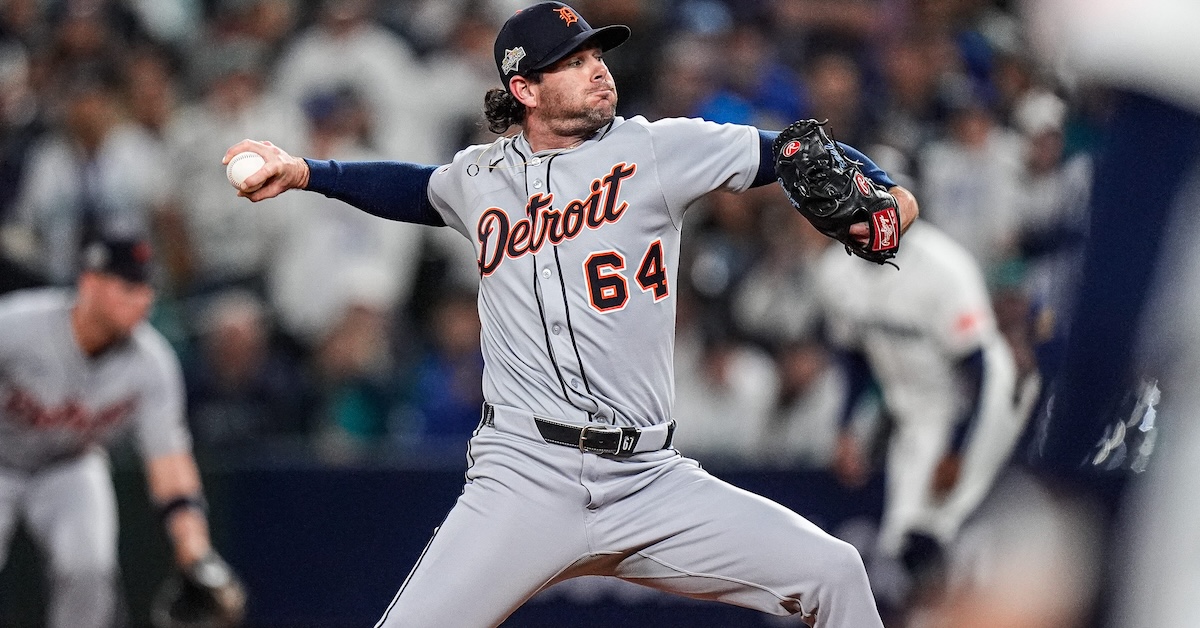
Re-signing Kyle Finnegan to the two-year, $19 million contract that was reported Tuesday night makes a ton of sense for the Tigers. Reliable relievers don’t grow on trees, and the 34-year-old right-hander has a track record that includes 90 saves and 3.65 ERA over the past three seasons, a span in which he’s averaged 63 appearances annually. Moreover, prior to suffering an abductor strain that landed him on the shelf for much of September, Finnegan pitched well after being acquired from the Washington Nationals at last summer’s trade deadline.
Finnegan won’t need to do all of the heavy lifting at the backend of Detroit’s bullpen. Will Vest emerged as the club’s primary closer last year, racking up 23 saves and registering a 3.01 ERA and a 2.71 FIP over 68 2/3 innings. He then shoved in October, too, allowing just three baserunners over eight scoreless frames between the ALDS and ALCS. As things currently stand, Vest and Finnegan profile as a formidable right-handed duo to finish off games for a starting staff that may or may not include Tarik Skubal. Reports are rampant that the Tigers are considering trading the back-to-back Cy Young Award winner, who is heading into the final year of his contract. Doing so would not only be bold, but it also would greatly impact the team’s chances of contending in 2026.
The success Finnegan had upon reaching Detroit — a 1.97 FIP and a 34.8% strikeout rate in 16 appearances — was influenced by meaningful tweaks to his pitch usage. He already had those alterations in mind when he changed teams.
“It’s something I’ve been wanting to do for a while, but I was having success and didn’t really want to mess with it, especially pitching the ninth inning over there [in Washington],” Finnegan told me late in the regular season. “I knew that it was something I would need to do eventually. This is a fastball-hitting league, so anything you can do to get them off of that pitch can help.”
As noted when we ranked Finnegan no. 47 on our Top 50 Free Agents list in early November, the Detroit native threw 67.7% four-seamers and 29.6% splitters this season with the Nationals, compared to 40.9% four-seamers and 54.8% splitters after joining his hometown team. And while the big changes came as a Tabby, he’d already tinkered a bit toward the tail end of his Nats tenure.
“I had some struggles for a week or two in Washington, so I started to make some transitions,” Finnegan explained. “I started throwing my slider more. Then, when I got over here, they really loved my splitter. We bumped up the usage of that quite a bit.”
While the slider has long been his third-best pitch, the splitter has consistently been his most dangerous weapon. Just this past season, it elicited a .217 batting average, a .325 slugging percentage, and a 37.3% whiff rate. Along with being his most effective offering, it has been an integral part of his repertoire for much of his career.
“I’ve been throwing the same splitter for awhile — same grip, same everything — so it’s something that I feel really confident with,” Finnegan said. “I can throw it for a strike, which allows me to use it more. If the zone rate wasn’t very good, then maybe it wouldn’t be a good idea to bump up the usage, but since I’m able to throw it for a strike, doing so is something that made sense.”
Throwing fewer fastballs also makes sense, even though the effectiveness of a splitter is heavily influenced by the heater. Finnegan’s fastball is firm — at 96.3 mph it ranked in the 82nd percentile for velocity last year — so his ability to use it optimally is mostly a matter of sequencing and command. Movement does matter, though, and that is something he has been working to improve. Ride was on his mind when he trained last winter at The Lion’s Den, which he described as “a small pitching lab back home in Houston.”
“Getting more vert on the heater kind of stemmed from showing flashes of it in the past,” said Finnegan, who averaged 17 inches of induced vertical in 2025 after averaging 15.8 the year before. “I’d have games where I was 15, but I’d also have games where I was up to 20. We kind of dove into why that was, to see if I could repeat the 20 more often. We found out that it was an axis thing for me. Any time I could get the axis inside one o’clock, the vert went up a fair amount, so the question became, ‘Is it just a hand positioning issue? Is it the way I’m delivering the ball?’ With a lot of work, I’ve been able to make some gains this year.”
But again, the most meaningful gains have come from upping the usage of his best pitch. Finnegan understands that as well as anybody.
“I’m basically doing what I’ve always done well, but maybe I just haven’t utilized my splitter to its full capabilities,” the righty reasoned. “Sequencing was probably the lowest hanging fruit coming over here. Throwing a lot of fastballs in the major leagues can be tough at times, especially if you’re not ahead in counts. The Tigers have a lot of trust in my offspeed, and have been telling me to go out there and use it.”
That Finnegan will be returning to Detroit shows that the Tigers trust him for more than just his splitter. They believe that both his experience and pitching profile can help them compete for a division title and beyond. For a team that has relied heavily on its bullpen in recent years, bringing back a well-established reliever of Finnegan’s quality was an easy decision — certainly easier than deciding whether or not to trade Tarik Skubal.
David Laurila grew up in Michigan's Upper Peninsula and now writes about baseball from his home in Cambridge, Mass. He authored the Prospectus Q&A series at Baseball Prospectus from December 2006-May 2011 before being claimed off waivers by FanGraphs. He can be followed on Twitter @DavidLaurilaQA.
Baumann Headline: “Tigers and Finnegan Begin Again”
Detroit Bullpen Improves in Finnegan’s Wake