
Carlos Correa Is Going Out on a High Note

This is Davy’s first piece as a FanGraphs contributor. Davy is a writer and musician who lives in Brooklyn. He has previously written for Baseball Prospectus, where he contributed to the Too Far From Town series about the contraction of the minors. He bakes fancy cakes and plays guitar for The Subway Ghosts, a punk rock band whose other members are also baseball writers. Davy grew up in Falls Church, Virginia, and his earliest ballpark memory is of boos raining down on Glenn Davis at Memorial Stadium.
Carlos Correa picked a great time to turn things around. The 28-year-old is widely expected to opt out of his three-year contract with the Twins this winter, and he’s primed to hit the free agent market on an absolute tear. Correa is slashing .377/.438/.663 in September, good for a 216 wRC+. That’s the sixth-best mark in all of baseball and second among shortstops, behind only the red hot Bo Bichette.
Like Bichette, Correa faced a rough time earlier in the season. Where did things go wrong for the future former Twin? It’s time for some fun with 15-day rolling averages!

Correa soared in May despite missing time with a finger contusion, crashed and burned in July, and rose from the ashes in August. Hey, maybe he should sign in Phoenix. Let’s see if Correa’s just getting unlucky:

Well that was easy. He’s got a case of the BABIPs. Sometimes you just need to hit ‘em where they ain’t, Carlos. Case closed, I guess. I’ll just check some monthly splits real quick and then we can knock off early:
| Month | Soft% | Med% | Hard% | Barrel% | LD% | wOBA | xWOBA |
|---|---|---|---|---|---|---|---|
| Apr | 18% | 40% | 42% | 4% | 20% | .284 | .292 |
| May | 9% | 49% | 42% | 15.1% | 19% | .384 | .409 |
| Jun | 12% | 56% | 33% | 16.4% | 23% | .430 | .411 |
| Jul | 15% | 50% | 35% | 10.6% | 12% | .267 | .353 |
| Aug | 24% | 46% | 30% | 8.8% | 20% | .345 | .348 |
| Sept | 20% | 40% | 40% | 13.3% | 27% | .468 | .375 |
Shoot. Back to work. Correa definitely experienced bad luck in July, but something else was going on as well. His barrel rate and line drive rate fell off a cliff in July, while his soft contact rate climbed to dizzying heights in August. Hey, maybe he should sign with Colorado.
It turns out that Correa’s batted ball profile changed drastically because his plate discipline changed drastically:
| Month | BB% | K% | Swing% | Whiff% | Z-Swing% | O-Swing% |
|---|---|---|---|---|---|---|
| Apr | 9% | 30% | 47.3 | 30.1 | 66.7 | 29.5 |
| May | 8% | 18% | 49.3 | 21.6 | 68.2 | 31.4 |
| Jun | 10% | 21% | 45.7 | 23.8 | 69.5 | 25.2 |
| Jul | 11% | 17% | 41.7 | 20.1 | 58.2 | 27.6 |
| Aug | 15% | 18% | 37 | 18 | 52.5 | 21.9 |
| Sept | 8% | 20% | 48.6 | 18.8 | 70.3 | 27.5 |
This is where it gets interesting. Correa’s walk rate increased and his strikeout rate fell because he stopped swinging as much. Correa knows that’s a good thing. “The walks mean the plate discipline is there, and walking is a big part of today’s game,” he told the St. Paul Pioneer Press a few weeks ago. “It has a lot of value, it has a lot of projection – it’s a skill.”
Justin Choi taught us that swinging is generally a bad idea because pitches out of the zone are on the rise. In July, Correa didn’t stop chasing balls; he just stopped swinging at strikes. Then in August, he dropped his chase rate as well. During these months he specifically eschewed pitches in the bottom two-thirds of the zone. Time for some heat maps!
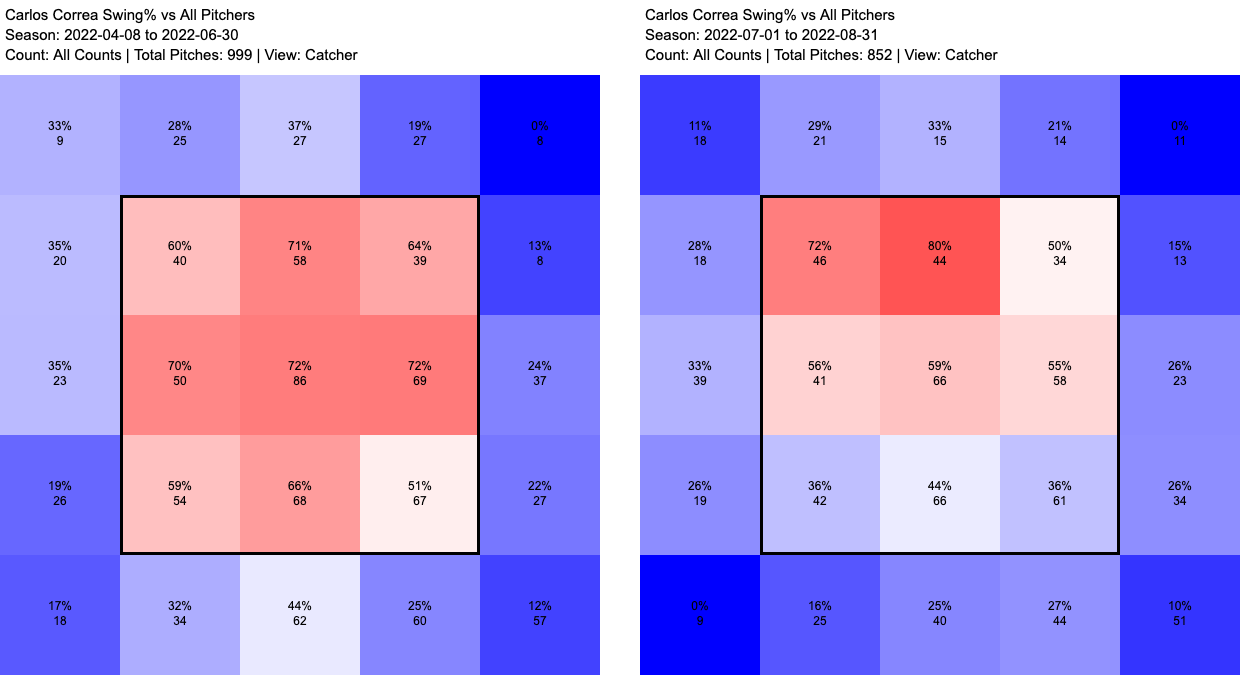
On the left is Correa’s swing percentage from April to June. On the right is July and August. He swung 3% more at pitches in the upper third, 15% less at pitches in the middle third, and 20% less at pitches in the bottom third.
Let’s find out of that was a good tradeoff. The three heat maps below cover Correa’s entire career. On the left is his slugging percentage on balls in play. On the right is his Runs Above Average per 100 pitches. In the middle, so it’s easy to compare, is his swing percentage:

Would you look at that? They line up pretty much perfectly. It’s a good policy to swing at the pitches you’re most likely to crush, and that’s what Correa has done for most of his career. He also did that for the first couple months of this season. Here’s what he swung at in July and August:

Yikes. Correa was lost at sea. As we know, he swung at a lot more pitches up. His swings outside the upper third of the zone were much more concentrated low and away, where he’s historically been the very worst. More walks and fewer strikeouts are great, but they came at the expense of Correa’s overall effectiveness on balls in play. He navigated away from the spots where he does the most damage and his wRC+ quickly sank. Hey, maybe he should sign with Seattle.
Checking in on his batted ball stats, a few more patterns start to emerge:
| Month | LD% | LD EV | LD LA | LD xwOBA | FB% | FB EV | FB LA | FB xwOBA |
|---|---|---|---|---|---|---|---|---|
| April | 20% | 100.7 | 18.1 | .628 | 22% | 94.5 | 41.7 | .370 |
| May | 19% | 102.8 | 14.8 | .806 | 32% | 96.3 | 36.1 | .678 |
| June | 23% | 94.9 | 16.4 | .732 | 44% | 94.2 | 35.5 | .656 |
| July | 12% | 100 | 15 | .794 | 44% | 92.2 | 37.6 | .473 |
| Aug | 20% | 87.4 | 16.1 | .535 | 39% | 93.5 | 34.7 | .610 |
| Sep | 27% | 95.0 | 14.0 | .645 | 38% | 95.1 | 37.1 | .526 |
Correa’s line drive rate cratered in July, coinciding with reduced aggressiveness against changeups. Meanwhile, a drop in exit velocity made his fly balls much less valuable. He swung less against fastballs in August. While his fly balls got back to normal, he also hit more popups and his line drives lost all their exit velocity and much of their value.
The good news is that Correa is inching back toward his old ways. His increased aggressiveness at the plate is paying dividends. Here are the first two swing percentage heat maps we looked at, along with September’s:

And for good measure, here’s the fancy version of the swing percentage heat map for this month:

The swings are starting to trend down toward the middle of the zone. The even better news is that Correa’s still got room to improve. His hard hit rate, barrel rate, and exit velocity are still a bit below where they were in May and June.
Going forward, it might also be worth keeping an eye on Correa’s aggressiveness against changeups in particular. Over the course of his career, Correa has swung at 44% of changeups, and he’s been excellent against them, ranking 22nd in pitch value since 2015. Since July, he’s swung at just 26.5%. As changeups are generally lower in the zone, this might account for some of the upward drift in his plate discipline stats. Though his hot September has come with increased aggressiveness against every other pitch, he’s swinging at fewer changeups than ever.
To go with his rejuvenated approach, Correa is seeing his wOBA outpace his xWOBA by nearly 100 points in September. All that good luck has very nearly balanced out the bad luck he faced in July. As the season nears its close, his totals are looking very familiar:
| Year | HR | BB% | K% | AVG | OBP | SLG | wOBA | xwOBA | wRC+ | WAR |
|---|---|---|---|---|---|---|---|---|---|---|
| 2022 | 21 | 11% | 20% | .288 | .365 | .467 | .362 | .365 | 140 | 4.1 |
| Career Average | 19 | 11% | 20% | .278 | .357 | .479 | .357 | .363 | 129 | 3.9 |
Correa is on track for the third-best season of his career by WAR and wRC+. Despite the dual nature of this season, it looks like his 2022 stats and his career averages will be pretty much identical. Hey, maybe he should just re-sign with Minnesota.
Davy Andrews is a Brooklyn-based musician and a writer at FanGraphs. He can be found on Bluesky @davyandrewsdavy.bsky.social.
I’m curious if a front office would read this for insight. Do they already know this? Is this the same type of analysis they would do?
Boston, yes; Mets, no; Colorado, what? why would you graph fans??
Colorado: Can he play first base?
Excellent. So in July and August Correa was playing in B flat major.
Not sure how the SS market will playout this year but Minn is probably hoping he moves on. They undoubtedly like his bat but his salary has better uses.
That might have been the original plan if Lewis had shown he was ready. Right now, Lewis looks as injury prone as Buxton and it’s hard to count on him. Correa is third on the team in games played, leads in offensive and defensive WAR, and is considered a clubhouse leader. If the Twins want to contend next year, they’ve either got to sign him or else have several free agent signings work out. As always, it will probably depend on what kind of contract they offer.
Every team can afford to pay a lot of money for a player that performs like a star. Minnesota would love for him to opt-in. And if they for some reason didn’t want him, they could trade him.
This is right. He has surplus value on a short-term deal. Not a huge amount, but enough so that they could get an FV45ish prospect back, at least.
If he doesn’t opt out, Correa’s deal has full no-trade protection for 2023-2024.
That as my thought, that whether he goes or stays is solely his choice.
Not entirely sure why he’d opt out this winter when Trea Turner is clearly a better option and he had a worse year in basically every way than he did last year.
Correa’s basically brought himself back up to the same stats he had last year. Slash line looks worse but given this year’s run scoring environment, his wRC+ is actually 8 points higher this year versus last year (132 in 2021, and 140 today), and 11 points higher than his career figure of 129. He’s still a top shortstop on both sides of the ball, he’s been a consistent 4-6 fWAR per season kind of player when healthy. Teams looking for middle infield help are going to offer him a huge chunk of change for his services.
Correa is productive but he has only played a full season twice in his career.
He usually misses about a month.
(This year is actually classic Correa: some time down, some time underperforming, some time over performing. Valuable over the season but his best came as the team underperformed.)
And any day that could mean a full season.
Any long term deal he gets will *need* insurance and that cost will come off the total contract.
He’s played a full season the last 3 years. Unless you are holding the shortened 2020 to be his fault. He played 58 of 60 games that year. 148 of 162 last year, and 127 of 152 so far this year. So maybe not a completely full year this year, but 135+ games is close enough for any team looking to contend.
2020 was nobody’s full season.
It just didn’t last long enough for him to get hurt. 😆
That could be a fun offseason article- how has playing time distribution changed over time? Definitely fewer iron man guys playing 160, but I imagine there are interesting clusters of frequency to see
All the good free agent short stops play for teams that will be trying to compete next year. And there are plenty of other teams that could look to upgrade at short stop. Also, after the big free agents, the rest of the short stop crop is garbage. Elvis Andrus might be the best option once you get past Dansby Swanson.
Correa probably only ended up in this position because of the lockout. That won’t happen this year. He will opt out and will get a huge payday. I imagine he also won’t wait around forever. If $350 million isn’t there, I think he’ll take $300 million and will be signed by the end of January.
No one in their right mind is giving a 4-5 win SS turning 28 $300m. Teams are also figuring out that SS is one of the easier positions to put a WAR floor under, by turning it over to a glove gazelle who can hit at least a very little bit. Once you have a decent chance of getting a couple of wins from a MI position (Cleveland is already scooping 8 wins from Giminez + Rosario), why pay an extraordinary premium for the extra wins, especially to a guy entering his post-peak years and who has gotten hurt a _lot_ during his career, missing about 45 games a year since the start of 2017?
Yeah, nobody is going to give Corey Seager….errr, I mean Carlos Correa $300 million. 🙃
How’d that turn out?
Or how did Arod’s Texas deal turn out?
You’re confusing my prediction that Correa will get $300 million with a prediction I did not make: that it will be a good idea.
But also, Arod’s deal in Texas wasn’t the problem. Blaming Texas’ problems on the guy averaging 9.0 WAR is smooth-brained nonsense.
A-Rod’s Texas deal turned out to be a huge bargain for the team, at least partly because he juiced like crazy.
They didn’t get a winner, though.
And they had to pay to get rid of him.
There’s more to baseball than numbers.
The on field outcome is what matters most.
He performed as well in Seattle before he said he started using steroids. How did the steroids help make the contract a bargain?
I wouldn’t mind Jose Iglesias on a short cheap contract.
He’s a year younger than Turner, and that has value. He waits another year, it’s another year off the big deal. Of course, a $35M payday isn’t so bad either, so he could wait. He’s also healthy, and I don’t think he really wants to wait around and see if he gets hurt again.
In the worst case scenario–where the Dodgers, Red Sox, Braves, Giants, Phillies, and Yankees aren’t interested in a massive long-term deal (which could happen if they all spend money on a different player like Aaron Judge and/or retain their own shortstops), Correa probably winds up signing another deal like the one he did last year (either with one of those teams that didn’t land Bogaerts, Swanson, and Turner or back with the Twins). And there’s always a chance one of those six teams is willing to put down for a long-term deal. So I don’t see much of any downside here.
The big questions about Correa heading into free agency last year were that he’s been inconsistent and injury prone, and this year didn’t make him look better in either of those areas. I just can’t imagine there being a better market for him this year than there was last year.
If he opts out, he might find the Twins reevaluating their position on the competition curve. They’ll be a year older and the competition will be tougher with KC showing sings of life and Cleveland no longer rebuilding .
The Twins signing him at that price struck me more as a statement (we’re not ready to give up on this core) than a long term commitment. It’s not his faut the team has fallen apart in the last two weeks but management now has to consider what they really have on their hands. If he leaves they might just move on. As the old saying goes “we lost with him, we might as well lose without him”. And save $35M.
The team has some thinking ahead, more about player floors than ceilings, methinks.
I really like your writing style.
Maybe you should sign indefinitely with fangraphs.
I don’t watch a lot of Twins games so don’t know how he has looked on defense but by all the advanced metrics his defense has taken a real step back this year, I wonder with the defensive numbers looking worse and his injury history if he won’t get the mega offers he is looking for this offseason. Although it only takes one team willing to make a big offer and with so many big shortstops being free agents this year someone probably will offer her big money and term.
Defensive stats from year-to-year are pretty noisy, but it is a skill that deteriorates faster than hitting. Still, average/above average defense at short with the bat Correa has makes for an elite player. He’s been close to Bogaerts’s and Turner’s level by the metrics, all within a couple of runs of each other.
I was thinking about this, too. I saw that his baserunning value is also the worst of his career. Defensive stats are super noisy, so the fact that he just put up an excellent year last season leads me to think he’s still above-average.
Shortstop is one of those positions that players can quickly age out of, though, and with the shift being neutered, players are gonna have to rely less on positioning and more on athleticism. Maybe a couple of teams will consider him elsewhere at the end of any possible deal, but his bat plays anywhere.
Sure, but he isn’t going to to want to be paid like a 1Bman or corner OFer.
It takes two to tango.
That’s how he finished at the Twins.
To me, he’s always looked more like a 3B long term.
The Cubs might take him as a 3B.
Or, the Brewers are in need of offense so they might give him a decent deal. Doubtful it’ll be $35M or even close but who knows.
Or they might choose to rebuild.
His bat does not play anywhere for $250 mil +.
Depends on the years.
$250M/10 might work. 😁
Would be nice for the copy to describe the takeaways from the charts and tables as is the standard in any sort of technical writing that involves charts and tables.
Welcome aboard, Davy!