Archive for Organizational Rankings

Shutdowns, Meltdowns and Making the Playoffs

Earlier this season, I brought up my dislike for the Saves statistic. Then, Tom Tango got the ball rolling (here and here) on creating a better way of measuring relief appearance success and, within a couple of days, the statistics Meltdowns and Shutdowns were available here at Fangraphs.

Shutdowns were supposed to mirror the total number of holds and saves in a season. As of yesterday, a total of 3403 number of shutdowns have occurred so far this season compared to a total of 3142 saves and holds. With only about 8% more shutdowns being recorded compared to saves and holds, the logic behind the values seem to be holding up fairly decent.

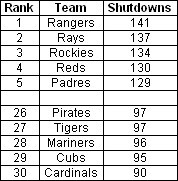
To see how teams stack up comparably, here is a look at the leaders and laggards in shutdowns across the league:
shutdowns

It seems the cream rises to the top as the top five teams have made the playoffs or are still in contention, while the bottom five teams are not going to make the postseason.

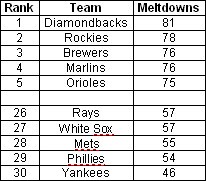
Along with shutdowns, meltdowns were created to measure the relief appearances that significantly hurt a team’s chances of winning. In comparision, here are leaders and laggards in the number of meltdowns:
meltdown

All the teams with the most meltdowns won’t make the playoffs, except maybe Colorado. Three of the five teams with the least number of meltdowns will make the playoffs with the Mets and While Sox being the exceptions.

Finally, the best way to see how the pen has done as a whole is to get the ratio of the number of shutdowns compared to the number of meltdowns. So far this season the league average is 1.73 shutdowns for every meltdown. Again here is a list of the top and bottom teams in the league:

ratio_leaders

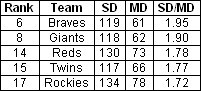
No real surprise here with five playoff or likely playoff teams making the top list and five non-playoff teams at the bottom. Besides the top-five teams, here are how the rest of the possible playoff teams rank:
ratio_rest

Having a capable bullpen that keeps its team in games (compiling shutdowns) and doesn’t blowup (meltdowns) isn’t all that a team needs in order to make the playoffs, but all the teams making the playoffs have addressed it nicely during this season.


Organizational Rankings Recap

Three weeks and one mildly controversial ranking later, we’re finished with the 2010 organizational rankings series. You can find links to all the recap posts below. Next week, when we’re not talking about what’s actually happening on the field, I’ll do some posts on the questions raised during the series. But now, it’s your turn. If you want to weigh in with what you think the order should have been, you can fill up the comments thread with your thoughts.

#1 – New York Yankees
#2 – Boston Red Sox
#3 – Tampa Bay Rays
#4 – Texas Rangers
#5 – Minnesota Twins
#6 – Seattle Mariners
#7 – Colorado Rockies
#8 – Atlanta Braves
#9 – Philadelphia Phillies
#10 – St. Louis Cardinals
#11 – Anaheim Angels
#12 – Milwaukee Brewers
#13 – Cleveland Indians
#14 – Los Angeles Dodgers
#15 – New York Mets
#16 – Arizona Diamondbacks
#17 – Baltimore Orioles
#18 – Chicago Cubs
#19 – Oakland Athletics
#20 – Cincinnati Reds
#21 – Detroit Tigers
#22 – Florida Marlins
#23 – San Francisco Giants
#24 – Chicago White Sox
#25 – Pittsburgh Pirates
#26 – Toronto Blue Jays
#27 – San Diego Padres
#28 – Washington Nationals
#29 – Kansas City Royals
#30 – Houston Astros


Organizational Rankings: #1 – New York Yankees

I have a lot of respect for Brian Cashman, and I think he’s tremendously under-appreciated as a GM. Under his watch, the Yankees went from an erratic money pit into a dominant machine, and he’s put processes in place to ensure that the team is permanently good. Everything I said about the Red Sox is also true about the Yankees now. They do everything well.

And, yes, they’re disgustingly rich. They outspent the #2 team in 2009 opening day payroll by $52 million. They outspent the Red Sox by $80 million, or, essentially, they spent as much on their 2009 team as the Boston and Milwaukee combined, and the Brewers have a league-average payroll. It’s just a monstrous advantage, and they take full advantage of it.

This isn’t to say that the Yankees haven’t earned their championships. The Mets have access to the same media market and spend money like drunken sailors, but they don’t win, because they’re not using their resources well. The Yankees are using their resources very well, and there is no reason to disrespect their accomplishments simply because they have access to more capital than every other MLB team.

But there’s a reason I said that the Red Sox were the model franchise for a big market team. The Yankees aren’t, because they don’t fit into that category. They’re a you-can’t-build-a-market-like-this team, and there’s no point for anyone trying to recreate what they’re doing, because it’s impossible. You can’t recreate 100 years of history. You can’t fix your organization’s past and make sure it includes Babe Ruth, Mickey Mantle, and Yogi Berra. The Yankees have a tie to the roots of the game itself that no other club ever will.

It’s not just the size of the Big Apple that gives the Yankees the advantage they enjoy. It’s their place in the history of the game, and how well they’ve leveraged that into developing a fan base that perpetuates itself constantly. The combination of the market, the nostalgia, and the winning have created a perfect storm, and the result is a franchise that towers over the rest. The Red Sox do everything right, and they still aren’t the Yankees. They can’t be. No one can.

We talk about dominant eras in sports history. The Brian Cashman-era Yankees are going to take their spot someday, because with the way the organization is structured, they’re going to be scary good for the foreseeable future. This is what happens when you spend $200 million really, really well.


Organizational Rankings: Future Talent – Yankees

The New York Yankees club is clearly the No. 1 organization in baseball and it has remained a powerhouse for as long as it has because of its ability to sustain itself through in-house player development. The club has done this both by slotting home-grown talent into key roles and by trading prospects for proven veterans.

General manager Brian Cashman does not get the credit that he deserves, partially because he has been overshadowed by the Steinbrenners, and in part due to the fact that he has a large budget to work with. Make no mistake about it, though, he rarely makes a bad move.

Damon Oppenheimer enters his sixth season overseeing the amateur draft. The club has done a respectable job in recent years despite having one of the last selections in the first round. The club picked up some interesting talent in ’09, including outfielder Slade Heathcott, catcher J.R. Murphy, and pitcher Bryan Mitchell. The club’s ’08 effort was a little ugly when the club failed to sign top pick Gerrit Cole and second rounder Scott Bittle. It found some later-round diamonds-in-the-rough to help compensate (Brett Marshall, D.J. Mitchell).

The team also spends a lot of money on the international market. Recent signings include Gary Sanchez, Gian Carlos Arias, Ramon Flores, Jackson Valera, Yeicok Calderon, and Anderson Felix.

The organizaiton has perhaps the best catching depth in baseball, with the likes of Jesus Montero, Austin Romine, Gary Sanchez, and J.R. Murphy. A lot has been made about a possible move from behind the plate for Montero, but he has the bat (and massive power) to play anywhere, while Romine could develop into a Grade-A catching prospect to help fill the gap left behind.

The starting pitching depth in the system is down a bit but the club has spent a lot of money in the free agent market so that’s not a great concern, either. The club does have some talented arms that can help out in the bullpen, including David Robertson, Mark Melancon, and good ol’ Joba Chamberlain. Phil Hughes is a rare youngster that has been able to crack the veteran-laden starting rotation after cutting his teeth in the bullpen in ’09. And don’t forget that he’s still just 23 years old.

The starting lineup does not feature many young players, but left-fielder Brett Gardner is expected to play regularly for the club. He should much-needed speed on the base paths. New center-fielder Curtis Granderson was acquired this past off-season for young players Austin Jackson, Phil Coke, and Ian Kennedy. All three players have potential but they had greater value to the organization as trading chips. And Granderson could absolutely explode playing in Yankee stadium and with the lineup protection around him.

The main core of the Yankees big league club is getting older, but the team’s ability to compete is not going to disappear any time soon. It has the resources and know-how to ensure that the organization remains a powerhouse for years to come.


Organizational Rankings: Current Talent – Yankees

It turns out even the Yankees have a budget. After years of steady increases in payroll, the Yankees have topped out around $200 million for each of the past five seasons, the most recent of which saw them reclaim a championship. At an estimated $212 million though, the Yankees 2010 payroll looks to be their highest in history trumping 2008 by a couple million.

The Yankees clearly had a successful season last year with 103 wins and a playoff championship. Our varied projection systems do not expect much of a drop off this year. You the readers ended up with 98 wins for the Yankees, four more than any other team in baseball. CHONE pegs New York at 99 wins, six more than any other team. CAIRO agrees with 99 wins and once again, six more than any other team.

What’s there to say about the Yankees current talent? Given the nature of the team, it’s not like there are any big surprises lurking on the roster that people haven’t heard of. It’s hard to find fault with players the like the Jorge Posada, Mark Teixeira, Robinson Cano, Derek Jeter and Alex Rodriguez around the infield, but one issue that might come up for New York is their depth behind the starters. Aside from Cano, none of the starting five are young pups.

Teixeira is probably a good bet to stay healthy, but he’s also the one with the best backup, either Nick Johnson or Nick Swisher. Ramiro Pena, currently the backup 2B, SS and 3B overproduced last season thanks to his .340 BABIP. He isn’t bad as a backup but would be highly exposed if pressed into a starting role due to injury. Francisco Cervelli looks like a fine enough insurance policy on Posada that catching shouldn’t be much of a concern.

The outfield will depend a lot on how Gardner does with a full time role for the first time at the big league level. His bat strikes me as mostly average, but he’s a good fielder that can play in center and that will help overcome the positional hit in left field and should make him a roughly average player overall. Granderson is a nice upgrade over Melky Cabrera and with Randy Winn as a roving backup, the outfield defense should be very good this season.

In the rotation, the Yankees brought in Javier Vazquez for another go-around hoping that it works out better than the first time. even if it doesn’t, Vazquez should provide his steady 200 innings. For the “oh” decade (2000-2009), Vazquez was second only to Livan Hernandez (by 38 IP) for total innings pitched. Joba Chamberlain is out (for now) and Phil Hughes starts the year as the fifth starter.

Mariano Rivera, Joba Chamberlain, Sergio Mitre, Damaso Marte, Alfredo Aceves and David Robertson were all above average last season in relief and should provide the bulk of the relief innings. Whether a Boone Logan or others fills out the back end is entirely negligible. It will be a solidly above average unit provided they do a better job avoiding the Jonathan Albaladejo’s and Jose Veras‘ of 2009 this time.

Great hitting, improved fielding, improved starting pitching and a decent bullpen. $200 million helps a lot, but the Yankees have assembled a great team with that money.


Organizational Rankings: Future Talent – Boston

Boston is an organization that has a lot of money but it is also a very smart organization; it’s run by people that could probably turn a team with a $40-million budget into a World Champion.

Much like the Tampa Bay Rays, whom we looked at yesterday, the organization is led by a young, aggressive general manager: Theo Epstein. Although a lot of the organization’s front office talent has been picked through over the past few years – including Jed Hoyer and Jason McLeod – the club still has some very smart men overseeing the club’s future stars. Mike Hazen continues on in his role as director of player development, while the scouting department will have a new leader in 2010 with the loss of McLeod to the San Diego Padres organization.

The club on the field consists mostly of veteran players. Younger, home-grown talent includes outfielder Jacoby Ellsbury and second baseman Dustin Pedroia. Jon Lester has developed into a legitimate No. 2 starter in the rotation, and Clay Buchholz also has promise and has been coveted by a number of teams in trade talks. Closer Jonathan Papelbon, another home-grown talent, is no longer a “young player” but his eventual replacement – Daniel Bard – is.

The organization has done a nice job of developing both top tiered amateur talent (Casey Kelly, Derrick Gibson) and lower round selections (Josh Reddick). With money to burn, the club has used its monetary advantage to sign some high-risk, over-slot player such as Ryan Westmoreland, Lars Anderson, Ryan Kalish, and Anthony Rizzo. Over the past three seasons, the club has handed out more over-slot deals (outside of the first three rounds) than any other team in baseball: 16. Along with the amateur draft, the club is a major player in the international market with the signing of players such as Junichi Tazawa, Stolmy Pimentel, and Jose Iglesias.

The club is not afraid to use its young players as bargaining chips in trades for proven talent, such as catcher Victor Martinez. The organization sent young pitchers Justin Masterson, Nick Hagadone, and Bryan Price to Cleveland. One player that Boston would like to have back is shortstop Hanley Ramirez, who was part of the loot sent to Florida for pitcher Josh Beckett in 2005.

This club may technically be a veteran team, but the organization knows how to acquire, develop and utilize young talent to its fullest.


Organizational Rankings: #3 – Tampa Bay

And now, for the American League East.

On future talent, the Rays are the only organization that the Rangers envy, as they boast the same ridiculous depth of position player talent and then add in a better crop of young arms. It’s easy to get lost in the never ending sea of talent in Tampa Bay, as they have stars-in-the-making everywhere you look. And they’re not sitting around waiting for these kids to develop before making a run; this team is really good right now.

They had seven players post +3 WAR or better seasons last year, and that doesn’t include Carlos Pena or B.J. Upton. Evan Longoria is the most valuable commodity in the game, a franchise player being paid like a middle reliever. They are getting so much value from cost controlled players that they could afford to spend 23 percent of the budget on Pat Burrell and Rafael Soriano.

In any other division, they’d be monstrous favorites. But they don’t play in any other division, they play in the AL Beast. So, to make the playoffs, they have to climb over one of the only two teams who rank ahead of them on this series. When your parents told you that life was not always fair, this is what they meant.

But just because the task is a challenge, don’t write off the Rays. They aren’t that far behind the Big Two in terms of true talent, and with two playoff spots up for grabs between the three teams, there is a good chance you’ll be seeing Tampa Bay in October. The simulations run by the guys over at RLYW had the Rays making the playoffs 46 percent of the time.

This is a roster that can win this year, even with the extra hurdle of having to beat out Boston or New York. While they’ll have to make some changes at years end, likely replacing the likes of Carl Crawford and Carlos Pena, they have another wave of premium young talent coming, and they shouldn’t see too steep of a drop-off. Their payroll limitations will always be a hindrance, but the management staff is adept at finding value.

It’s a good team with a great young core and a top notch front office that is setup well for the present and future. They have a couple of behemoths to topple, yes, but they have have the ability to do so.


Organizational Rankings: Future Talent – Tampa Bay

To say the future is bright in Tampa Bay is a bit of an understatement. Youth is front-and-center with the Rays organization; the club has done an enviable job of developing its home-grown talent. Both the scouting and the player development staffs should be given gold medals.

The youth movement actually begins with Andrew Friedman, one of the brightest, young front office men in the game. Although he hasn’t done a ton of wheeling and dealing, Friedman has managed to score interesting prospects such as Sean Rodriguez, Matt Sweeney, Alexander Torres, and Aneury Rodriguez.

Scouting director R.J. Harrison enters his fifth season in the role and has overseen the selecting of players such as David Price, Evan Longoria, Desmond Jennings, and Matt Moore. Mitch Lukevics, director of minor league operations, is in charge of the prospects once they enter the system; players such as Jennings, Moore and even Jeremy Hellickson are prospects that have been drafted outside the first three rounds and developed into top prospects. Although the club has received favorable drafting slots in recent years, it clearly makes great use of later round picks.

The draft hasn’t always gone smoothly for the organization, though. The club hit a huge speed bump in 2009 when it failed to sign its first two selections in LeVon Washington and Kenny Diekroeger, both interesting selections to begin with. The organization made up for it, to some degree, by nabbing some higher-ceiling (but higher risk) players in later rounds: catcher Luke Bailey, first baseman Jeff Malm, and pitcher Kevin James.

Not known as an international powerhouse, the organization has one Latin player amongst its Top 10 prospects (pitcher Alexander Colome). The club did break into the European market this past off-season by signing Czech left-hander Stepan Havlicek.

On the big league squad, the team boasts some exciting talent, including the enigmatic B.J. Upton, third baseman Longoria, and second baseman Rodriguez. Young position players marching through the minor league system include nearly-ready Jennings, Tim Beckham, and Reid Brignac. The depth isn’t great, but Jennings has the chance to be a special player.

The starting rotation is the backbone of this club. James Shields is the old man of the group at 28, followed by Jeff Niemann, 27, Matt Garza, 26, Wade Davis, 24, and David Price, 24. All five pitchers arguably have the ceilings of at least a No. 2 starter. Looking down into the minor leagues and the club has a ton of pitching depth, including Hellickson, Moore, Colome, Nick Barnese, Kyle Lobstein, and even Jacob McGee, who is making his way back from injury.

This club can compete with the best organizations in the Major Leagues right now, and it should continue to be a powerhouse for years to come.


Organizational Rankings: Current Talent – Tampa Bay

Beginning with the obvious and oft-repeated: The 2010 Tampa Bay Rays have the third best current talent in the American League.* But they are also the third most talented team in their division. This team has far too much talent to get any pity from me, though.

* I’d say “all of baseball,” but one could make an argument for the Phillies (Thanks, Doc!).

Straight up (not considering contracts or age), I’d probably take the 2010 Rays’ position players as a group over just about any other in baseball. They have something of a hole with Pat Burrell (possibly platooning with [shudder] Hank Blalock) at DH, although they could do much worse. Matt Joyce is probably around an average performer in right field, although if he’s platooned with ageless defensive-whiz Gabe Kapler, the Rays could get above-average performance out of the position. Those worried about Kelly Shoppach’s contact problems forget that even with his worst offensive projection (ZiPS), he’s an above-average catcher. It’s a cliche to say that a team has bench players “that could start for a lot of teams,” but it’s true of Willy Aybar and Sean Rodriguez.

The next “rung” for most teams contains a few above-average players. The Rays, in contrast, have five “above-above average” players here, guys who are around 3.5-4.5 WAR: Jason Bartlett, Carlos Pena, B.J. Upton, Ben Zobrist, and Carl Crawford. I know that is inadequate praise, but if I went on about all the individual talents on this team, this post would be 2,000+ words.

That’s it for the position players. Oh, yeah. Evan Longoria is the best third baseman in baseball. No, not just the “best value.” The best third baseman in baseball. Period.

Pitching lets the Rays down. Put away the torches and pitchforks. The bullpen is good enough (despite J.P. Howell’s injury concerns) with off-season acquisition Rafael Soriano and Grant Balfour both being strong options. Many, many teams would love to have James Shields and Matt Garza at the top of their rotations, not to mention Jeff Niemann and (especially) youngsters like David Price and Wade Davis. What I mean by “lets the Rays down” is that when I look at the Rays’ projections next to New York’s and Boston’s, the biggest difference is in the starting pitching. Again, it isn’t that Shields, Garza, et. al. aren’t good. But there is a sizeable gap between, say, Shields and Garza (each project at around four WAR) and guys like CC Sabathia, Jon Lester, Javier Vazquez,* and Josh Beckett (each project at around five WAR).

* I actually had a Tampa Bay fan bring up Javy’s 2004 in New York as a reason he won’t be good for the Yankees in 2010. C’mon, Rays fans, I expect that kind of thing from Red Sox and Yankees fans, but not you, too!

I am not claiming that the Rays are “doomed because of their pitching.” They are definite contenders for the wildcard and even the divisional title. It is tough going up against Boston and New York, but the Rays have substantial hope. While the Rays’ rotation may not project to be as dominant as those of their chief rivals, it is younger. This means that there is more variance in the projections, and thus they have a greater chance of might be better than projected (of course, it also means they might be worse). The relative youth of the team as a whole means likely continued improvement and less attrition. While some might think the Rays have to “win now” (2010) because of Crawford and Pena’s expiring contracts, some of their best players are still developing, and much near-ready talent looms in the minors, as well: Jeremy Hellickson, Reid Brignac, and, above all, Desmond Jennings (who might show up sooner rather than later).

The Rays might not be the divisional favorites in 2010, but they are contenders, and they will be in 2011, and… well, that’s for the “Future Talent” post.


Organizational Rankings: #4 – Texas

What do Frank Francisco, Darren Oliver, Colby Lewis, Michael Young, and Vladimir Guerrero have in common, besides being members of the Texas Rangers? They were born in the 1970s. Why is that interesting? Because they are the only five players on the Rangers 40-man roster that you can say that about. The Rangers have five guys in the organization in their thirties. Five.

Name a position, and the Rangers almost certainly have a good player either in his prime or headed towards it. You would start your team with their double play combination before any other organization’s in the game. They have a a couple of all-star slugging outfielders that can drive in runs in bunches. They have a deep stable of starting pitchers, as they can easily pick between eight or nine guys, depending on who is healthy and throwing well. They have a kid throwing 100 in the bullpen.

Oh, and they have perhaps the best farm system in the game, led by a few more premium talents, one of whom could take the team’s first base job later this summer. The talent that the Rangers have to build around is ridiculous in both depth and ability. And they may be ready for prime time as early as this year.

Not only are the Rangers young and talented, but they’re also pretty good. If there’s a favorite in the AL West, it’s probably them, as they’re generally at the top of the pre-season projections, even if only by a game or two. Their commitment to defense has given them the ability to keep opponents from turning games into a slugfest, but they still have enough juice in their bats to put runs on the board themselves. They’re counting on the maturation of several young pitchers, which is always risky, but the talent is there for the Rangers to win the division and make some noise in the playoffs.

While Jon Daniels has taken a bit of flack for several trades gone wrong over since he took over at GM, the positive has far outweighed the negative, and the scouting staff around him have done tremendous work in reloading the system. The Rangers are legitimate contenders in 2010 and have a remarkably strong base to build off of for the future. They’re good now and could be great in a year or two, and that’s why they rank as the fourth healthiest organization in baseball.