
Chris Archer’s Sinker Has Him Sinking
Do you remember when Chris Archer was really good at throwing baseballs? You should, because it was very recent! From 2014-17, only 12 pitchers across the majors accumulated more WAR than Archer. He was a strikeout maestro who kept his FIP consistently low with a knack for gobbling up innings and a sweet head of hair to boot, looking like an ace in pretty much every sense of the word.
Those days feel far away now, however, after a disastrous start on Tuesday brought his rough season with the Pittsburgh Pirates to a crescendo — he surrendered five home runs to Braves hitters in six innings, leading to an ugly seven-run outing. He has now allowed 16 homers in just 59.2 innings, giving him the fifth-highest HR/9 rate among all big leaguers with at least 50 innings pitched. His ERA of 5.79 is actually outperforming his 6.15 FIP. The old Archer seems long gone, but what caused him to vanish?
Typically, when a player regresses this swiftly and severely, there can be multiple issues to blame for their struggles. If you squint, you can see a few present with Archer. His four-seamer has lost two miles per hour in velocity over the past two seasons. He’s also throwing fewer strikes than he has in past years — something that is evident in his skyrocketing walk rate, up at 4.53/9 from a career average of 3.03/9 — but just 1.5% less than his career average. We can nitpick and analyze a million different data points to paint a picture of why Archer has lost his groove, but instead, let’s just talk about the issue right in front of us: His sinker has been absolutely dreadful.
I’ll admit his sinker has accounted for just 22% of his pitches this season, and that’s if you go by Baseball Savant’s pitch tracking. Our own Pitch Info data says he’s thrown it less than 15% of the time. How bad can a pitch be to be singled out as possibly the biggest cause of a player’s struggles if he throws it with less than one quarter of his pitches? In this case, extremely bad! In 2019, Archer’s sinker has resulted in a .370/.485/.815 slash line for opposing hitters. The Statcast data for the pitch is equally gruesome: .403 xBA, .761 xSLG, .522 xwOBA.
One of the reasons Archer’s sinker has performed so poorly — as well as a reason for why there’s not always a consensus on whether he’s thrown a two-seam or four-seam fastball — is the fact that it just doesn’t seem to move. According to Statcast, he generates 5.4 fewer inches of vertical movement on his sinker than the MLB average, the 10th-worst figure in baseball. It also generates the 16th-worst horizontal movement. To make matters worse, here’s where those pitches are ending up:

As pitches add up over the course of a season, it makes sense that a lot gather into the middle of the plate. Look at the heat maps for even the best pitchers in baseball and you’ll see the darkest spot in the center of the zone. But even with that caveat, the height of these pitches is a big concern. Compare, for example, Archer’s heat map with that of Atlanta’s Mike Soroka, who Ben Clemens wrote about earlier this week:
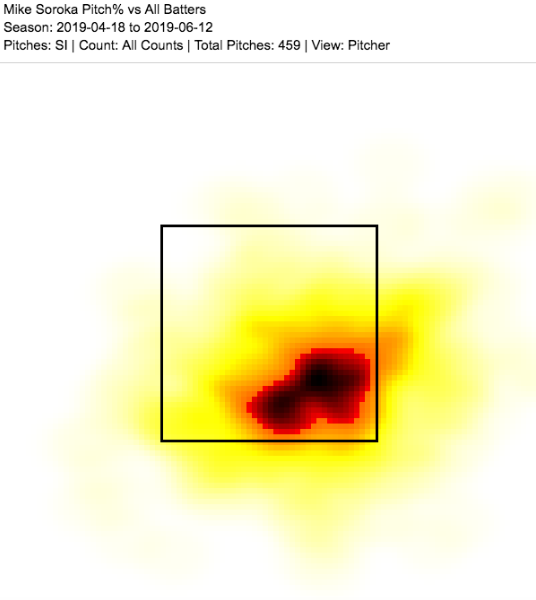
That’s where a sinker is supposed to finish. A successful sinker will dive at or below the knees, but Archer’s is hanging thigh-high. Because of its lack of movement, that makes it a meatball. Here are two examples courtesy of Baseball Savant.
The sinker isn’t Archer’s only problematic pitch, but it is his newest one. His four-seamer has resulted in a .380 wOBA this season, which is obviously suboptimal, but it’s also pretty much in line with the .372 wOBA it resulted in during the 2017 season, when he was a 4.5 WAR pitcher. And his slider — easily his best pitch throughout his career — has held up pretty well, holding opposing hitters to a .292 wOBA and generating more whiffs than at any point in his career. Archer can succeed with one bad fastball, even when he’s throwing it nearly half the time the way he did two years ago. It’s adding a second, even worse fastball to the mix that has seemed to unravel his game.
Archer’s sinker isn’t exactly new, per se. He threw a good number of them from 2012-14, and in fact, he was pretty successful with the pitch. In 2014, he limited opponents to a .258/.342/.333 line with the pitch, relying upon it as his primary weapon (41% of all pitches thrown). But the next year, he ditched it, opting to focus on his four-seamer, his slider, and his changeup. It remained that way until he was traded at the deadline last year to the Pirates, an organization who has dug its heels in on focusing on a two-seamer, get-ground-balls approach while the rest of baseball has shifted to a four-seam, strike-guys-out mentality.
Because of Archer’s past success with the sinker and his aforementioned subpar performance with his four-seamer, it was understandable for Pittsburgh to tweak his arsenal in this way if the organization itself was indeed the one that insisted upon the change. It isn’t, however, the first time the Pirates have had similar struggles in attempting to shift a power pitcher’s repertoire toward this direction. In an ironic twist, Tyler Glasnow — one of three players the Pirates traded to the Tampa Bay Rays in exchange for Archer last July — spent the 2017 season splitting his fastballs between the four-seamer and the sinker, and he watched both suffer, with the sinker getting teed off on at a .422/.456/.663 rate. In moving back to a four-seam/breaking ball combo with the Rays, he was one of the best pitchers in baseball this season before getting injured in May.
As this year goes on, perhaps Archer and the Pirates will attempt to reverse course on his retooled approach. In the meantime, there’s no telling how far he might sink.
Tony is a contributor for FanGraphs. He began writing for Red Reporter in 2016, and has also covered prep sports for the Times West Virginian and college sports for Ohio University's The Post. He can be found on Twitter at @_TonyWolfe_.
Ugh, how can everyone see this except the Bucs? I have been on board with Huntington and Hurdle for a decade, but its time to move on. It will be somewhat ironic that the trade that brings Huntington down was the all in move that so many yinzers wanted for so long. I realize the GM with that owner has it tough, but if TB can do it with even less budget, then there is another path.
Well, the Rays have another pitcher, Chirinos, who uses his sinker in combination with a good 4 seamer and an average to slightly positive breaking ball and has a lot of success. I’m quite sure the Pirates won’t stick with this strategy forever, but if Archer CAN recapture his sinker and combine with a 4 seamer up and his slider then he can change eye level and succeed. The issue is he needs a 3rd pitch, always has. If the changeup isn’t working, then it’s worth trying the sinker. Frustrating to watch though, I’ll give you that.
There is absolutely nothing ironic about Glasnow succeeding in TB and Archer struggling in Pittsburgh. The Pirates are almost incapable of working with strikeout-oriented starting pitchers. Whether that’s Searage, Hurdle, or something else wrong in the organization, it’s abundantly clear that there is a problem.
Admittedly, the Cole, Glasnow, and Archer track record is ugly but your comment would lump in guys like A.J. Burnett and Francisco Liriano that had a resurgence in Pittsburgh despite being “strikeout-oriented.” In a way, that makes the recent results even more baffling.
That was in a different era with a different ball and different defense.
I’m not sure what the difference in the ball would do, since Cole and Glasnow have to contend with that with their new teams. Both have struggled at times with the long ball with their new teams (2018 for Glasnow and 2019 for Cole), so I don’t think the difference is primarily in homer suppression.
The 2019 Pirates have certainly been bad defensively so far but the 2017 and 2018 Pirates rank as the 2 best defensive years for the Pirates since 2009. That should’t explain what happened to Cole and Glasnow either. Its really all about the strikeouts, not the era.
I think the biggest answer is that both Cole and Morton have given interviews where they publicly complained that the Bucs didn’t let them pitch they way they wanted (specifically, up in the zone). Searage’s success with Burnett, Happ, Volquez and others is excellent, but it seems like he views his philosophy as one-size-fits-all, and he also is much better with established pros than young guys. Maybe he defers to vets and lets them pitch the way they want while helping fix a mechanical flaw, but he doesn’t let young guys have that flexibility? It’s a mystery to me.
Yeah that seems plausible.
Elias Diaz looked to the dugout before calling every pitch of Keller’s start last night and I’m pretty sure it was the 17th pitch he threw that was the first non-fastball of the game. Analytics and data are great but if you use that data to create such a hard line, rigid dogma regarding pitch usage then it becomes plain as day to the rest of the league what you’re trying to do and makes it so much easier to prepare and gameplan.
I thought about those guys, but I think two key differences are that 1) both guys were established starters before getting to Pittsburgh who just needed tweaks, and 2) Liriano’s strikeout pitch was a slider, the other guys are fastball/sinker pitchers. In terms of development, we heard so much about the Fastball Academy, and by and large, the returns have been disappointing.
I just really don’t want to see Taillon and Mitch Keller become all-stars somewhere else.
I’m a fan of sinkers but it seems pretty clear that the Pirates are asking their pitchers to do things that do not play to their strengths.
A sinker that doesn’t sink is an…er?
ER for sure. Stinker?
“According to Statcast, he generates 5.4 fewer inches of vertical movement on his sinker than the MLB average”
Less upward deflection, doesn’t that mean it sinks a lot? I’m confused.
No, because its vertical movement is downward. No idea why one would think a sinker has upward vertical movement.
FYI a sinker has backspin and upward Magnus force, as well as sidespin and arm-side deflection. Typically about 5 inches of upward movement relative to a pitch with no effective spin. Whereas a four-seam is around 8 inches upward.
Homer
He gives up a lot of hard contact and generates little soft contact. At some point you can’t say that is bad luck. Has always been overrated because of the ks. FG WAR really overvalues him based on hypotheticals. 12.9 career WAR in 1175 innings. That’s under 2 WAR for 175 innings. Obviously worth having, and even provided good value given how low his contract is, but should never be mentioned with top pitchers.
He was awfully good from 2015-2017 by both fWAR and WARP. It’s true that he’s given up a lot of hard contact, but it’s also not that hard to be elite when you’re striking out 10-11 batters per nine innings.
It’s also worth noting that right now, his walks and his hard-hit rate have both skyrocketed, so his value is qualitatively different now than it was before.
I remember reading on this very website that league wide, the sinker has the highest average against of any pitch. Its trajectory plays right into the bat trajectory of the flyball launch angle swing. In this day and age, it should not be used very often.
I haven’t updated this since LY, but here are Archer’s TB and PIT [pre- and post-trade] pitch-type choices by count:
There’s definitely a ‘Pirates dogma’ angle to this, and Archer does appear to have a crummy sinker by the objective measurements of pitch quality, but he’s also throwing the sinker much more in ‘behind’ counts which inflates the wOBA-against we’re seeing.
I wish the Pirates were only one of cheap and dumb.
the good news for pirates fans is that this colossal screwup by the bucs may mean the end of the neil huntington era in pittsburgh, the bad news is that their ownership will stay the same