
Complete Game James: James Shields Unlearns Us
Education consists mainly of what we have unlearned.
-Mark Twain
In 2010, James Shields led the league in hits allowed, home runs allowed, and earned runs allowed. Many among the Rays faithful protested last year when Joe Maddon tabbed Shieldsy to start game two of the ALDS, wherein he failed to complete five innings.
“He’s broken,” said some. “He shouldn’t even be on the playoff roster!” fumed others.
He finished the 2010 season somehow once again topping 200 innings, but his ERA was over 5.00, his FIP was above 4.20, and his fans were frustrated. Despite his career-best 3.55 xFIP, a career-low LOB%, and career-high BABIP (a whopping .341), many — even among the sabermetric-slanted — doubted he was merely a product of bad luck.
Well, in 2011, his statistics have sung, “Cy Young!” all season long: 2.96 ERA, 3.36 FIP, and 3.11 xFIP. And most impressively: a league leading 10 complete games and 4 shut outs.
For a guy who has pitched 200+ innings in 5 straight seasons, he sure never showed a knack for complete games before:

He went two years without a single complete game, and then BAM! suddenly he has 10 in one season (at least; he starts again tonight). How’d he do it?! Is it just a luck swing-around?! Did he change his approach?! Is his Bradley Woodrum-esque quasi-Amish beard to blame?
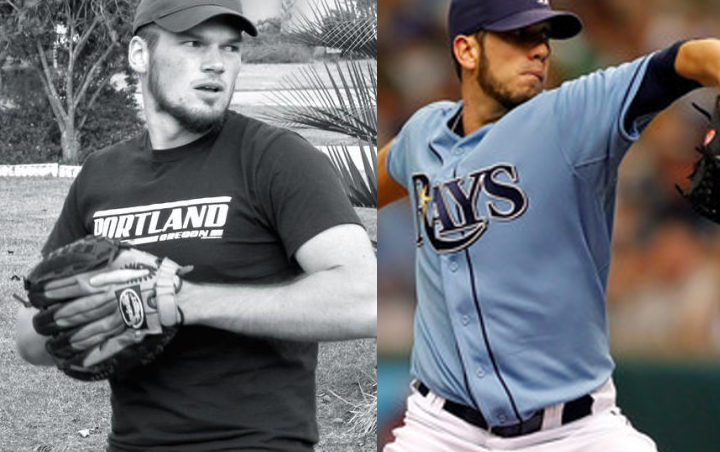
The answer: Yes to all.
Firstly: Let’s give Shields some proper credit for 2010. He may have had a ghastly ERA and a below average FIP (105 FIP-), but the dude had the major luck components — BABIP and LOB% — going in the nasty direction from his career norm.
Despite that, Shieldsy still managed an above-average start length:

NOTE: The decimals represent percentages of the innings, not outs. That is: 6.2 means 6 and 20%, not 6 and 2/3 innings.
The average MLB start length since 2004 is around 5.9 innings, and this year it’s 6.1. What with his absurd 10 complete games, Shields is now flirting with 7.5 innings pitched per game. However, his previous seasons have all been above average as well — he certainly doesn’t Oops! his way in 200 innings year-after-year.
But 2011 is clearly different. Not only is he pitching like a madman, he’s pitching like a different man, giving hitters more curves and changes than they can handle:

James is throwing his fastball — his most pedestrian pitch — and his cutter much less, choosing to pump his knee-buckling curve and Jose Bautista–infuriating change-up instead. This is the right choice, one must think.
Holding game theory constant (in other words, assuming the players don’t adjust to his new approach and then suddenly learn how to hit his curve and change), it makes sense that Shieldsy would want to use his best two pitches more.
So does this explain it? More good stuff, less feh stuff equals New James Shields? Well, not quite. The truth is — though his change-up has always been a doozy and his curve has usually been dominant — they did him few favors last year:

He could have thrown more changes in 2010, but he couldn’t throw only changes. None of his other pitches were apparently working, but as a starter, throwing one pitch is akin to watching Corky Ramano: There’s just no hope of survival. So pitch selection has been a part of Shields’ newfound awesomeness, but it alone cannot explain everything.
In 2010, only his change was working; there are two possible explanations for that:
1) Location: Fans roundly critiqued Shields for placing fastballs, cutters, and curves in the heart of the strike zone last year. A quick look at his heat maps, however, does not seem to provide the evidence that ought to be pretty damning. So, then, we must consider…
2) Bad luck: Yeah, those pitch values have a pretty bad shot at being positive when over 33% of the balls in play go for hits and nearly 14% of each fly ball goes for a home run.
This present James Shields is a product of several factors: (a) A good, new approach, (2) superior facial hair, and (d) a LOB% 10 colossal percentage points higher than last year (68.4% vs. 78.4%) and a BABIP 22% lower than last year (.341 vs. .267; sweet Moses, that’s a big swing!).
So what have we unlearned here? Simply this: There is always a perfectly logical rationalization or narrative for an unlucky or extraordinary season — but that doesn’t make it worthy or capable of forecasting.
Joe Maddon was right to start Shields in the ALDS; he rightly knew that all the predictive statistics Shields had were pointing up. Now, they’re pointing kind of obliquely downward, but in the meantime, Shieldsy fans: Enjoy the ride; it may never get better than this.
you probably mean 2/10 or 20% in “That is: 6.2 means 6 and 2%, not 6 and 2/3 innings.”
Right oh! Thanks for the heads up.
I hate to sound so stupid , a bet on the line for a bottle of cheep wine, did shields win every one of his complete games in 2011??
This was highly entertaining, especially the punch at Corky Romano. I’m curious, where did you make those graphs. They’re great looking.
Thanks, Nick! Just Excel, actually.
I am a proponent of 8-bit and 16-bit characters in stat graphics.
This must be one of those “it sounded funnier in my head” pieces. Not sure why this needed the “comedy” prop, as James Shields’ 2011 has plenty of narrative for this site to pick apart.
I recall reading JS worked with Jim Hickey on simplifying his delivery last offseason. Perhaps that’s vastly improved his command of all pitches (as your graph shows). Maybe that also lends credence to anecdotal accounts where he was leaving meat over the plate in 2010. It’s feasible that he didn’t have as much confidence in pitches he knew the situation dictated he throw, and if AJ Burnett is a decent testimonial, no confidence = terrible results.
I’ve paid attention to a handful of his starts in 2011, and he seems to have confidence with any pitch in any count this season. I’ve watched him get out of jams behind in the count using front door cutters on RHBs – a very difficult pitch to execute for strikes given the situation and the fact it’s very hittable if held too long on release point.
I wonder what carry over (if any) will occur in 2012… players who refine their mechanics always seems to be an incalculable variance in expected performance. We may be seeing the new norm in JS, rather than using the canned “regression back to the mean” statement.
I watched probably all but one or two of his starts since… Maybe 2008? Wow. That makes me a special kind of nerd. I think.
Well, anyway, in the 2010 season, it seemed like every single time Shields missed his location, the opposing hitters made it hurt — bad. Pitcher, even the most elite, miss locations all the time — sometimes their stuff overcomes the mistake, but oftentimes the hitters can’t take full advantage. In 2010, it seemed like the hitters ALWAYS took advantage.
Granted, that’s just my anecdotal observation. Maybe his Pitch F/x data shows his pitches weren’t moving as much (I didn’t notice it earlier, but who knows?). Still, I feel like the narrative has tried to merely cover up the statistics.
Especially given how Maddon continued to have faith in Shields, I would not be surprised if the mechanics adjustment was more of a placebo to try to get Shields confident again. Only Maddon and Hickey know, though.
The “comedy” “prop” is one affixed to my penchant for writing. Sorry if you found it distracting, but it makes it more fun for at least me. 🙂
Speaking of Pitch F/X – I remember when there were F/X – centric posts on FG all the time. What happened?
I’ve been a big James Shields fan since he came up and took his licks in ’06 and have watched many of his starts since I moved to Orlando and adopted the Rays as a second team. I thought after the ’08 season that he was going to make the jump into the elite class of master pitchers such as Roy Halladay and Greg Maddux. He fits the mold well with his pitch repetoire and mastery of changing speeds. The only thing I thought was missing was pinpoint command. James always pounds the zone but he has a knack for grooving a belt-high meatball at the wrong time. This especially happened in 2010 and I contribute it to his infatuation with the cutter and John Jaso.
James was hooked on the cutter after he had so much success with it in ’08. Like a bad crack addict, Shields just couldn’t get enough. it’s by far his worst secondary pitch. I think in 2008 he got away with it because the book on him was his change up. He used the cutter where he usually uses the change to catch batters off guard. He got too cute with it. James loves to throw back door cutters to lefties and front door cutters to righties for a strike three looking or to get back in the count. He used to use his change up to get a swing and a miss or a ground out. When he threw his cutter prior to this year, it often just bled right into the happy zone, flat and straight, like a BP fastball.
Now James is throwing his curve and change much more often and they are his most effective pitches. His change up is so good sometimes the catcher can just tell the batter it’s coming and he’d still whiff or roll over on it. This lets him selectively work in the cutter in the appropriate spots. Shields’ command is what really sets his 2011 season apart from the rest. He gets ahead in the count and finishes off the batter instead of letting him back in the count or giving him the two strike mistake pitch. His lack of command in 2010 is what killed him. Way too many full counts and way too many mistakes thrown in those counts. Jaso didn’t help with the pitch selection.
John Jaso should just cut off every finger on his hand besides his index finger. In 2010 Navarro and Shoppach were pretty much gone the whole year so Jaso had full reign of the pitching staff. Maybe it was because he was a rookie, but I though his game calling sucked with the whole Tampa rotation but especially Shields. Jaso loves calling the fastball which is not so bad for Price, Niemann, Davis, and Garza but murder on James Shields when the batter knows it’s coming. Shields fastball is league average at best. Maybe James should have shook off Jaso but he looked like he didn’t trust himself anymore after he got rocked a lot in late May/early June. Every 3-2 count Jaso would throw down ole number one, and like clockwork, Shields would give up a homer or rocket to the gap or down the line.
I think Jaso grew up a little and James is more in control of his pitch selection this year. Maybe it was the mechanical tweak in his delivery, maybe it was experience, but James Shields has mastered command of his pitches this year and he has now become worthy of the elite group of non-power pitchers of Roy Halladay, Cliff Lee, and Jered Weaver (that Romero kid in Toronto may be next). I think his strand rate goes down next year and he let’s a few more cross the plate, but I think the James Shields of 2011 is here to stay.
Bautista’s struggles actually started when he shaved off his 9 o’clock shadow. Pitchers now confuse him with the younger, less-intimidating pre-Joey Bats player and are more aggressive in their approach.
Well put together!
Very well done. Visuals are always helpful, and any Mario reference will get an instant ‘like” out of me.
Mario graphics are awesome, but “Shieldsy” must be stopped. People don’t actually call him that, right?
While I’m thinking of it, why can’t a guy with a cool last name like “Shields” get a better nickname. The Missile Shields. The Agent of Shields. Blue Cross Blue Shields. I’m just spitballin here…
That is indeed his Joe Maddon-certified nickname.
“nearly 14% of each fly ball” went for a home run last year? The hitters must have been doing more damage than merely tearing the cover off the ball.
Zing!
Nice debut (you’re new, right?). “Ought”, not “aught” :).
Thanks! I’ve been around since February, in fact, but I’ve only written 25 Fangraphs pieces thus far — which is not much in the grander scheme.
Oh, sorry about that!
Clearly the problem is that in the offseason after ’08 he was assaulted by a small, pixelated, Italian plumber.
I see he has already thrown 6 more innings than last year while facing 71 fewer hitters. He’s also thrown 368 fewer pitches this year, and interestingly he’s thrown almost the identical percentage of strikes (65.44%), and the strikeout rate is essentially the same as last year (8.57 vs 8.28). So it seems to be what happens after the ball is hit. The BABIP seems as unsustainable this year (.265) as last year’s was (.341), while his career BABIP is .301. And thus the key question – is this sustainable? Or will he revert to his career average with a 4.00 ERA next year (or even a 3.50-3.60 as his 2010 xFIP indicated)?
All I know is, he blew away my Rangers last night. Dude was in the zone, pitch it, catch it, nod his head for the sign and pitch it again. All night long. Were it not for the oppressive heat, I don’t think he’d have broken a sweat.
I love Shields, and he pitched 8 innings last night as well.
But isn’t he overly “lucky” this season? Perhaps not to the extent he was unlucky last year though.
Don’t doubt the Maddon. Again showing why he’s the best manager in the league. He invented Danks Theory for Mo’a sake!
I saw the extra life mushroom on his change-up and couldn’t resist looking it up. Indeed, he IS putting a little extra life on his change-up this year, as it’s up to an average velocity of 83.9 mph, compared to 83.2 last year and 82.8 for his career. 🙂