Detroit Tigers Top 47 Prospects

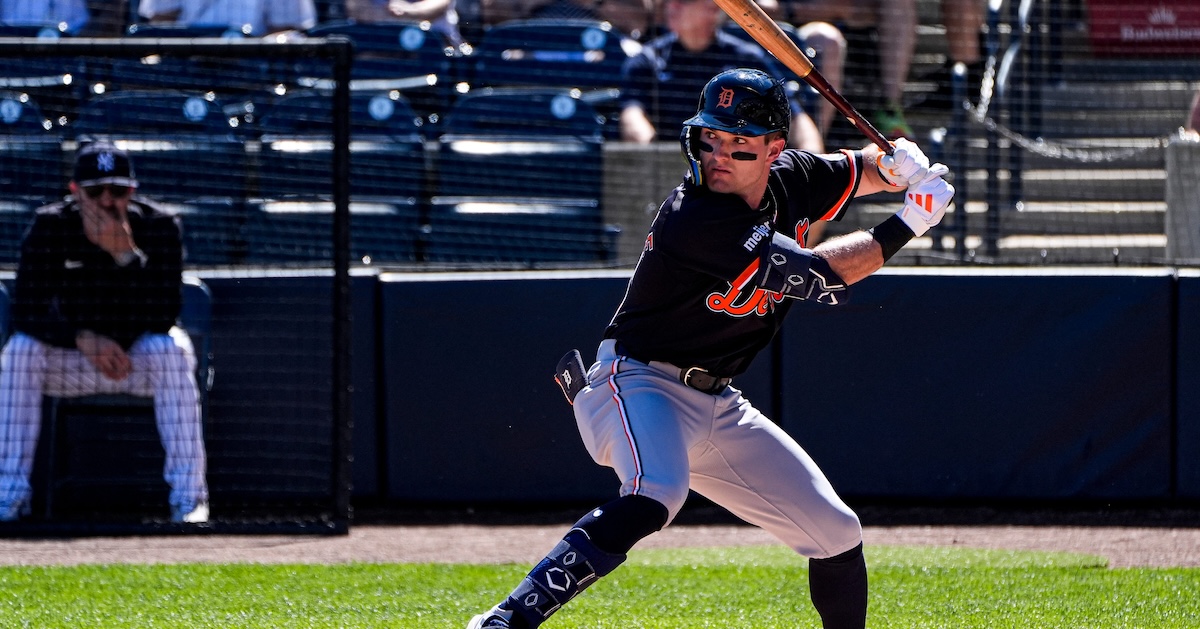
Kevin McGonigle Photo: Junfu Han/USA TODAY NETWORK via Imagn Images

Below is an analysis of the prospects in the farm system of the Detroit Tigers. Scouting reports were compiled with information provided by industry sources as well as our own observations. This is the sixth year we’re delineating between two anticipated relief roles, the abbreviations for which you’ll see in the “position” column below: MIRP for multi-inning relief pitchers, and SIRP for single-inning relief pitchers. The ETAs listed generally correspond to the year a player has to be added to the 40-man roster to avoid being made eligible for the Rule 5 draft. Manual adjustments are made where they seem appropriate, but we use that as a rule of thumb.

A quick overview of what FV (Future Value) means can be found here. A much deeper overview can be found here.

All of the ranked prospects below also appear on The Board, a resource the site offers featuring sortable scouting information for every organization. It has more details (and updated TrackMan data from various sources) than this article and integrates every team’s list so readers can compare prospects across farm systems. It can be found here.

Tigers Top Prospects
Rk Name Age Highest Level Position ETA FV
1 Kevin McGonigle 21.5 AA 3B 2026 60
2 Max Clark 21.2 AA CF 2027 60
3 Bryce Rainer 20.6 A SS 2028 55
4 Josue Briceño 21.4 AA 1B 2027 50
5 Thayron Liranzo 22.6 AA C 2027 50
6 Jordan Yost 19.2 R SS 2031 45
7 Cris Rodriguez 18.1 R RF 2031 45
8 Eduardo Valencia 26.1 AAA C 2026 40+
9 Hao-Yu Lee 23.1 AAA 2B 2026 40+
10 Max Anderson 24.0 AAA 3B 2026 40+
11 Andrew Sears 23.5 AA MIRP 2026 40+
12 Michael Oliveto 19.1 R C 2031 40+
13 Angel De Los Santos 18.0 R SS 2030 40+
14 Randy Santana 17.4 R CF 2032 40+
15 Manuel Bolivar 17.5 R C 2032 40+
16 Malachi Witherspoon 21.5 R SIRP 2028 40+
17 Kelvis Salcedo 20.1 A SIRP 2028 40+
18 Oscar Tineo 17.0 R SS 2032 40+
19 Owen Hall 20.3 A SP 2029 40+
20 Lucas Elissalt 21.6 A+ SP 2028 40
21 John Peck 23.6 AA SS 2027 40
22 Franyerber Montilla 20.9 A SS 2028 40
23 Jude Warwick 20.5 A SS 2030 40
24 Ben Jacobs 21.7 R SP 2029 40
25 Gage Workman 26.3 MLB 3B 2026 40
26 Jackson Strong 22.5 A+ CF 2028 40
27 Ty Madden 26.0 MLB SP 2026 40
28 Jake Miller 24.7 AA MIRP 2026 40
29 Paul Wilson 21.2 A SIRP 2028 40
30 Michael Massey 22.9 R SIRP 2026 40
31 Ethan Schiefelbein 19.9 R SP 2028 40
32 Trei Cruz 27.6 AAA SS 2026 35+
33 Izaac Pacheco 23.3 A+ 3B 2028 35+
34 River Hamilton 19.4 R SP 2031 35+
35 Ryan Hall 18.9 R SP 2031 35+
36 Jhonan Coba 19.6 R SP 2030 35+
37 Gabriel Reyes 22.7 A SP 2027 35+
38 Drew Sommers 25.5 MLB SIRP 2026 35+
39 Moises Rodriguez 24.0 A+ SIRP 2027 35+
40 Dylan Smith 25.7 MLB SIRP 2026 35+
41 Joseph Montalvo 23.8 AA SP 2026 35+
42 Jaden Hamm 23.5 AA SP 2027 35+
43 Tyler Owens 25.1 MLB SIRP 2026 35+
44 Luis Aguilera 19.1 R SS 2030 35+
45 Josueth Quinonez 19.0 R CF 2030 35+
46 Andy Mata 18.4 R CF 2031 35+
47 Kenny Serwa 28.6 AA MIRP 2028 35+
Reading Options
Detail Level
Data Only
Full
Position Filter
All

60 FV Prospects

Drafted: 1st Round, 2023 from Monsignor Bonner HS (PA) (DET)
Age 21.5 Height 5′ 10″ Weight 187 Bat / Thr L / R FV 60
Tool Grades (Present/Future)
Hit Raw Power Game Power Run Fielding Throw
55/65 55/60 45/55 50/50 40/50 40

It’s far too early to say, but there’s a chance that Detroit selecting McGonigle and Max Clark in the first round of the 2023 draft will wind up being a single-night turning point in the franchise’s trajectory. And while Clark is an excellent prospect in his own right, it’s actually the guy they took second who headlines a deep group of Tigers prospects. Built like a stocky, scaled-down version of Luka Dončić, McGonigle has a case as the best pure hitter in the minor leagues. Short-levered with plus bat speed, elite hand-eye coordination, and a great approach, he’s the total package at the plate. As you’d expect from someone with a 47% hard-hit rate, McGonigle is able to barrel all pitches in all quadrants. He’ll track and line a back door slider to left in one at-bat, and then hammer heat on the inside corner out to right in the next. He’s difficult to pitch around because he’s both selective on pitches off the plate and aggressive when he gets a ball he wants to drive.

He’s raked since he signed, and he found another gear last season when he torched every level. It’s tough to pick our favorite of his stops. Perhaps it was when he notched a 215 wRC+ at High-A, or when he bashed 12 homers with more walks then strikeouts in 46 games following a promotion to Double-A. Or maybe it was the .362/.500/.710 line he produced in 19 Arizona Fall League games, a run during which he was a mouthy, ultra-competitive spitfire in a league many players sleepwalk through. You can’t really go wrong — they were all excellent.

Shortstop defense is the only blemish here. McGonigle has soft hands and can transfer the ball quickly, but he often doesn’t, and his arm and range look light; he also doesn’t have the kind of frame or build you’d project to get any more nimble with maturity. The Tigers have mostly had him run out to short thus far, but he played third base a dozen times in the Fall League, where he was spotted doing infield work with Alan Trammell. He looked comfortable making throws at third with his body moving toward first. He position may be dictated more by Detroit’s needs than McGonigle’s best fit in a vacuum. Regardless of where he plays, McGonigle offers a great blend of a high floor with star upside. Nobody is a lock to hit, but guys with this kind of visual report and statistical performance at the ripe old age of 21 are as likely to do it as anyone. McGonigle projects as a middle-of-the-order bat, and he should be ready for the big leagues by summertime.

You Aren't a FanGraphs Member
It looks like you aren't yet a FanGraphs Member (or aren't logged in). We aren't mad, just disappointed.
We get it. You want to read this article. But before we let you get back to it, we'd like to point out a few of the good reasons why you should become a Member.
1. Ad Free viewing! We won't bug you with this ad, or any other.
2. Unlimited articles! Non-Members only get to read 10 free articles a month. Members never get cut off.
3. Dark mode and Classic mode!
4. Custom player page dashboards! Choose the player cards you want, in the order you want them.
5. One-click data exports! Export our projections and leaderboards for your personal projects.
6. Remove the photos on the home page! (Honestly, this doesn't sound so great to us, but some people wanted it, and we like to give our Members what they want.)
7. Even more Steamer projections! We have handedness, percentile, and context neutral projections available for Members only.
8. Get FanGraphs Walk-Off, a customized year end review! Find out exactly how you used FanGraphs this year, and how that compares to other Members. Don't be a victim of FOMO.
9. A weekly mailbag column, exclusively for Members.
10. Help support FanGraphs and our entire staff! Our Members provide us with critical resources to improve the site and deliver new features!
We hope you'll consider a Membership today, for yourself or as a gift! And we realize this has been an awfully long sales pitch, so we've also removed all the other ads in this article. We didn't want to overdo it.

2. Max Clark, CF

Drafted: 1st Round, 2023 from Franklin HS (IN) (DET)
Age 21.2 Height 6′ 1″ Weight 205 Bat / Thr L / L FV 60
Tool Grades (Present/Future)
Hit Raw Power Game Power Run Fielding Throw
50/60 50/55 40/50 70/70 40/50 50

In a normal year, Clark would have been a 1:1 candidate out of high school. In the 2023 draft, with Paul Skenes, Wyatt Langford, and Dylan Crews lurking around, he had to settle for third overall and the draft’s fourth-largest bonus at nearly $7.7 million. Even as that class has already produced multiple stars and nearly a dozen big leaguers, it still looks like Detroit chose well. And after hitting .271/.403/.432 across stints at High- and Double-A, Clark enters 2026 with a shot to debut later this summer.

Clark has a mature blend of tools and skills that belie his young age. His feel to hit stands out, and has since he was a high school sophomore. He’s a quick rotator with lightning-fast hands and a great ability to track the ball. He has a quick bat with a level stroke that facilitates contact up and down the zone, and he’s strong enough to pull his hands in and drive pitches on the inside corner. Clark has grown into more power than we forecast last year, comfortably average already, and at this point is likely to grow into more. He could be a 20-homer guy at maturity and if he falls a little short, the reliability with which he squares up the ball should still lead to plenty of line drive doubles and triples. A good approach helps all of this play up. It’s perhaps a tad passive, but Clark doesn’t swing at garbage, and he walked more than he struck out last season.

Defensively, Clark’s 70 speed facilitates above-average to plus range. His reads and routes are still maturing, but the overall package is that of an above-average outfielder, with a chance for more if he really takes to the finer points of the job. Ultimately, no one aspect of Clark’s game stands out because he’s so good across the board. He’s skilled on both sides of the ball, he has a bunch of ways to impact the game, and he’s had the production to match his quick ascent through the minors. He’s been preparing for the highest level for a long time now — he has a crew that travels with him everywhere and takes care of his social media accounts — and it won’t be long until he and his entourage reach Motown.

55 FV Prospects

3. Bryce Rainer, SS

Drafted: 1st Round, 2024 from Harvard-Westlake (CA) (DET)
Age 20.6 Height 6′ 3″ Weight 195 Bat / Thr L / R FV 55
Tool Grades (Present/Future)
Hit Raw Power Game Power Run Fielding Throw
30/40 50/60 35/60 55/55 40/55 70

Rainer pitched and played all over the field with high school Team USA, and he was generally seen as a pitching prospect until things began to shift in the fall and winter of 2023, when he was suddenly hitting for big power against good varsity prep pitching. He solidified himself as an early first round hitter at 2024 NHSI, was drafted 11th overall, and got $5.8 million to sign. His Lakeland debut in 2025 was cut short by a dislocated shoulder suffered diving back to a base just 35 games into the season. Rainer needed surgery and missed the rest of the year, but he hit .288/.383/.448 (with a 52% hard-hit rate to boot) during the window when he was healthy.

How Rainer will end up trending as a hitter is still up in the air. Despite his slash line, his underlying data and spray charts had some warning signs in 2025. He only managed a 71% contact rate (he was sub-70% on the high school circuit), and his long levers make it tough for him to time fastballs, which he tends to pepper down the left field line. Once he gets his hands moving, however, his bat speed is pretty nutty, and while his swing is noisy, it’s possible he’ll be able to tone it down without neutering his power once he gets stronger and can shorten up. If he can do that and get his contact performance closer to average, he’s going to be a star.

Rainer’s arm strength is incredible. He was pumping mid-90s gas off the mound in high school, and he can sizzle the baseball across the diamond with the flick of his wrist. His hands and actions need polish, but that’s fine; this was a pretty serious two-way prospect not long ago. Lefty-hitting shortstops with this kind of size and power projection are rare, and this FV grade reflects a combination of Rainer’s upside as a 30-homer shortstop, as well as the risk that his hit tool is sketchy but yet to be exposed due to a lack of actual playing time.

50 FV Prospects

Signed: International Signing Period, 2022 from Venezuela (DET)
Age 21.4 Height 6′ 4″ Weight 220 Bat / Thr L / R FV 50
Tool Grades (Present/Future)
Hit Raw Power Game Power Run Fielding Throw
35/50 60/60 45/60 30/20 30/40 50

Briceño hails from Miguel Cabrera’s hometown of Maracay, Venezuela. Strong as an ox, he’s done nothing but hit since coming stateside, and he shrugged off an injury-plagued 2024 campaign last year to post his best numbers to date. He hit .266/.383/.500 and notched a 153 wRC+ between High- and Double-A, with decent walk and strikeout numbers even after the promotion.

Briceño is a bat-first player. He has plus power, line-to-line in games, and generates it with an easy, manipulable swing. He covers the plate, isn’t especially vulnerable to the soft stuff, and projects to hit for a blend of average and power. His production dipped noticeably following the jump to Double-A, but he was still an above-average hitter there, and may just need a little more time at the level before his next jump.

Briceño is still catching, but he did so less than half the time at each stop in 2025. For us, he’s not a fit there long-term. He has a strong arm, but both his receiving and blocking are substandard. It usually doesn’t make sense to try to shoehorn a bat-first guy into a tricky defensive position, all the more so when it’s behind the plate, where slower development timelines and injury risk augment the toll the job takes on anyone’s offensive game. Briceño projects as a first baseman, and perhaps just a fringy one. It’s all about the bat here, though, and there’s 30-homer upside if everything clicks. We’ll be monitoring Briceño to see if a full-time switch to an easier defensive home brings with it another gear at the plate.

Signed: International Signing Period, 2021 from Dominican Republic (LAD)
Age 22.6 Height 6′ 3″ Weight 200 Bat / Thr S / R FV 50
Tool Grades (Present/Future)
Hit Raw Power Game Power Run Fielding Throw
20/35 55/60 35/55 30/30 30/50 60

Liranzo entered 2025 as a Top 100 Prospect thanks to his size and rare switch-hitting power for a catcher, though his profile featured hit tool risk and he had a substantial amount of developing to do on defense. He then had a bizarre 2025 season. He got off to a rough start in Double-A, which is normal enough, particularly given Erie’s weather. But after a few months where he looked like one of the better hitters in the league, Liranzo’s bat cratered down the stretch, a period that coincided with the end of his season behind the plate and a shift to exclusively pinch-hitting and DH’ing. On the whole, he hit .206/.308/.351, with 125 punch outs in 394 plate appearances, a big step back after emerging as one of Detroit’s top farmhands in 2024.

There was always hit tool risk here. Liranzo swings hard and indiscriminately from both sides of the plate. His path is grooved, and he’s mostly been a mistake hitter. All of that was true a year ago as well, but the degree to which he got beat by all manner of pitches was startling, even factoring in the jump in competition. During the construction of the Top 100, we learned from a report on MLive that Liranzo dealt with family issues (including the loss of his longtime trainer, whom he considered a father figure) and a shoulder injury, which helps explain why he stopped catching. He also totally changed his diet and conditioning during the offseason and lost 35 pounds. It was a tumultuous year that we’re inclined to flush. It’s common for catchers to deal with bumps and bruises that impact their output on offense, though of course in Liranzo’s case we’re talking about a myriad of issues and circumstances that impacted his 2025.

On defense, Liranzo’s developmental imperatives remain his ball-blocking and throwing accuracy. When he has a clean exchange, his arm is lethal. He has uncommon athleticism for a guy his size and is capable of firing rockets from his knees or from funky arm angles, à la Patrick Bailey, with some pop times hovering around 1.80 seconds late in the 2024 season. But he too often fumbles his exchange and can’t even get a throw off, or has the carry on his throw impacted by having a poor grip on the baseball. His stone-handed issues are evident when he tries to pick short hops, too, though Liranzo began receiving on one knee in 2024 and is learning how to use his size as a ball-blocking barrier from this body position. We’ll see how Liranzo’s new physique impacts his ability to handle the burden of catching and whether his power output has taken a hit from the lost weight, if only temporarily. But at this stage, we’re just encouraged that Liranzo is willing to make changes and adjust in an attempt to succeed, and think it bodes well for his continued ability to do so as he attempts to play a power-hitting catching role starting some time in the next three years now that his option clock is ticking.

45 FV Prospects

6. Jordan Yost, SS

Drafted: 1st Round, 2025 from Sickles HS (FL) (DET)
Age 19.2 Height 6′ 0″ Weight 170 Bat / Thr L / R FV 45
Tool Grades (Present/Future)
Hit Raw Power Game Power Run Fielding Throw
20/50 30/45 20/40 55/55 45/60 60

Yost was a 2025 pop-up high schooler in Tampa who climbed to the draft’s 24th pick and signed for $3.25 million rather than head to Florida. A very skinny, super projectable shortstop, Yost is a near lock to stay at the position. He’s a silky smooth defender with plus body control, impressive bend and hands for his size, and a short, consistent arm stroke that produces strong, accurate throws right into the chest of the first baseman.

He’s more of a long-term projection play on offense, raw and skinny enough that Yost might have been relegated toward the bottom of Florida’s lineup as a freshman had he matriculated. While he has feel for adjusting his body’s posture to help mitigate his own lever length, his slow-twitch in-the-box athleticism puts him at risk of being habitually late to the contact point. He has comfortably below-average power right now, but his frame has all kinds of projection. Yost had less of a showcase track record than is typical for an elite high school prospect, but he hit well in the little bit he participated in. His defense gives him a floor of sorts, but his offensive upside is dependent on Yost developing functional strength that can help him shorten up.

Signed: International Signing Period, 2025 from Dominican Republic (DET)
Age 18.1 Height 6′ 4″ Weight 200 Bat / Thr R / R FV 45
Tool Grades (Present/Future)
Hit Raw Power Game Power Run Fielding Throw
20/35 60/70 25/60 50/40 35/60 60

Rodriguez signed as perhaps the most physically impressive prospect in the 2025 international class, built like a young Larry Fitzgerald and possessing enormous power and impressive speed for a prospect his size. He signed with the Tigers for a little more than $3 million and then basically had the first pro season you’d would hope for from a top-of-the-class bonus baby, as Rodriguez slashed .308/.340/.564 and finished second in the DSL with 10 homers.

Rodriguez has plus power right now and is very likely grow into even more as he keeps filling out. He posted an absurd 108 mph EV90 and hit a ball 113 in 2025, both incredible marks for a DSL hitter. The way Rodriguez’s body unwinds as he swings is remarkable for a hitter his size, and he has 30-plus homer upside if he continues to make a viable rate of contact. Whether or not he will is still debatable, however. Rodriguez’s hands fire from a dead stop, which typically isn’t a feasible mechanical feature when you’re facing better velocity. He also has some scary underlying data in his 68% contact rate and chilling 40% chase rate. Rodriguez’s plate discipline splits against breaking balls and with two strikes are even more concerning, two standard deviations worse than the big league average even though he was facing DSL pitching. His physical prowess will likely enable him to have surface-level statistical success at the lower levels, but readers should be warned that these subcutaneous problems exist and create real risk for his long-term prospects.

On defense, Rodriguez runs well enough to merit development in center field, but it’s likely that he’ll be so big at physical maturity that he’ll need to move to right, where he could be a plus defender with a plus arm. He arrived to camp in Lakeland with the rest of the minor leaguers, a sign he’ll be in Florida for the duration of 2026, and hopefully hit well enough to reach A-ball by the end of the summer. His tools and projection are loud enough for Rodriguez to remain graded like a mid-to-late first round draft pick.

40+ FV Prospects

Signed: July 2nd Period, 2018 from Venezuela (DET)
Age 26.1 Height 6′ 2″ Weight 180 Bat / Thr R / R FV 40+
Tool Grades (Present/Future)
Hit Raw Power Game Power Run Fielding Throw
40/45 55/55 45/50 20/20 40/45 40

A $10,000 signee all the way back in 2018, Valencia entered 2025 with 1,000 career plate appearances under his belt, more than 900 of which were at the lower levels. Promoted to Erie to begin last season, he proceeded to hit 24 homers between Double- and Triple-A, which tripled his career total. He posted a 159 wRC+ between the two levels, with a 9.9% walk rate while striking out only 19.9% of the time. Mr. Valencia, you have our attention.

Valencia is looking to do damage in the box. A big leg kick and hand move leads to an uphill swing, and while he can flatten the bat path a tick, he’s trying to lift the ball. He isn’t hacking recklessly, either. Valencia recognizes spin and can make mid-flight adjustments. He can also take fastballs outside his wheelhouse early in counts, pitches that he’s likely to miss, or worse, pop up. His contact rates aren’t great — 74% overall, 80% in zone — but they’re good enough to let the power play in some kind of role.

Defensively, Valencia has played a mix of catcher and first base. Behind the plate, he’s an adequate framer, though not especially mobile on balls in the dirt. More troubling is his control of the running game. While his arm is strong enough for the job, he only tossed out 14% of runners last year and put several poor throws on tape. Valencia has a low hand transfer, and in his rush to deliver the ball quickly, he doesn’t always get on top of the ball. The Tigers are still developing him back there — he started behind the plate in the club’s spring opener — and if they can clean up his throwing a bit, he could be serviceable, if not a guy you want catching every day.

How high is the ceiling here? After a brutal run of injuries, Valencia had a healthy 2025 season and mauled the upper levels. There’s enough hit risk from his bat path to think he probably isn’t a regular, but between his power and ability to catch, he could make for a pretty interesting reserve. The Tigers think so anyway, as they protected him this past offseason and added him to the 40-man roster.

9. Hao-Yu Lee, 2B

Signed: International Signing Period, 2021 from Taiwan (PHI)
Age 23.1 Height 5′ 9″ Weight 225 Bat / Thr R / R FV 40+
Tool Grades (Present/Future)
Hit Raw Power Game Power Run Fielding Throw
35/40 55/55 45/50 40/35 40/40 50

Lee does a lot of things well, but he lacks a carrying tool that would facilitate an everyday regular projection. He makes a fair amount of contact, has above-average raw power, can get to that pop in games from line to line, and has a little defensive versatility. The way Lee swings — open stride, high-effort and rotational cut out of a low load — has us a little concerned about his ability to cover the outside part of the plate and elite velocity, though he has enough feel for the barrel to make it work despite his mechanics. Oddly for a guy pulling off the plate, a lot of his power has been up the middle or to the right side of second base, a function of the inside-out elements in his bat path, as well as his position in the box when he makes contact.

Defensively, Lee has played second and third base, and in both places, his lack of mobility makes him a fringy defender. At the plate, he’s performed much better against lefties than righties throughout his minor league career, and if you take it all together, he has the look of a solid weak-side platoon bat who can handle a few spots on the diamond and offer a little thump off the bench on the days he doesn’t start. There’s second-division upside if we’re light on the hit tool.

One other note: Lee has hurt his lower back twice as a professional, and knowing that, the huge torque in his swing almost makes us wince. Boxy, physically mature, and already on the slow side, there’s some risk that he loses mobility early, which would put even more pressure on the bat.

10. Max Anderson, 3B

Drafted: 2nd Round, 2023 from Nebraska (DET)
Age 24.0 Height 6′ 0″ Weight 215 Bat / Thr R / R FV 40+
Tool Grades (Present/Future)
Hit Raw Power Game Power Run Fielding Throw
30/40 60/60 40/50 40/40 40/45 60

Anderson is a compact and burly second baseman. He’s among the most aggressive hitters in minor league baseball — he had the highest swing rate among all Tigers farmhands — and combines above-average power with a knack for making contact. It’s worked so far, as Anderson has produced above-average lines at every stop. The big question going forward will be whether he’s able to maintain that tricky balance against elite pitching, and there are markers in his swing that give us pause.

Anderson’s load looks like it contributes to a tendency to be late on good velocity. Think of the way Gary Sheffield used to cock his bat. Anderson doesn’t have the same violent, repetitive waggle, but he does have a similar late load where the cup of the bat is still moving toward the first base dugout even as the pitch is already in flight (Tyler Locklear used to do this in a very pronounced way as well). It’s tough to pull off, particularly if you don’t have Sheffield’s generational bat speed, and it’s amazing that Anderson has been able to complete his load on time and reliably make contact thus far. In looking at his Triple-A tape, though, he was often late on good velo, and his bat path might also be limiting his ability to hold up against hard spin as well.

Defensively, Anderson has split his time between second and third base. He’s primarily played at the keystone, where his hands are reliable enough for the job but his range is light. He projects as a multi-position utility player, there for his bat but with enough versatility to let managers get creative defensively. He crushed lefties last season and perhaps the best fit in the end is as a productive role player who does a lot of his damage against southpaws.

11. Andrew Sears, MIRP

Drafted: 10th Round, 2023 from Connecticut (DET)
Age 23.5 Height 6′ 3″ Weight 200 Bat / Thr L / L FV 40+
Tool Grades (Present/Future)
Fastball Slider Changeup Cutter Command Sits/Tops
50/55 55/60 40/50 45/50 35/40 92-96 / 97

Sears was arguably the system’s biggest riser in 2025. After an effectively wild 2024 season in Lakeland, he stormed his way to Double-A last year on the strength of newfound control. He nearly halved his walk rate, down to 7.7%, while still striking out more than a quarter of opponents.

Sears is a low-slot lefty with a funky look. He works from the extreme third-base side of the rubber, and has a big cross fire and a low release. He’s neither a great athlete nor a precise strike-thrower, but he tends to hit the box and hitters don’t seem to pick up the ball well against him. He’s capable of running his upshot fastball up to 97, albeit with more velocity variation than most guys. His primary secondary is his slider, an east-west offering that gives lefties in particular a ton of trouble. He’ll also work in a cutter and change, the latter of which flashes but is inconsistent and can flatten on him. Between fringy athleticism, the volatility in his velocity, and a relatively light workload thus far in his career, it’s hard to project Sears as a starter in the long run. He could do it — there’s enough stuff here for a five-and-dive backend type — but the likelier outcome is that he’s a good lefty reliever with paths toward being a short-stint guy or a hybrid arm.

Drafted: 1st Round, 2025 from Hauppauge HS (NY) (DET)
Age 19.1 Height 6′ 3″ Weight 185 Bat / Thr L / R FV 40+
Tool Grades (Present/Future)
Hit Raw Power Game Power Run Fielding Throw
20/50 40/55 20/50 30/30 20/40 30

Oliveto ranked 59th on the 2025 Draft Board and signed for just shy of $2.5 million rather than go to Yale. He’s a big-framed, lefty-hitting catcher with a gorgeous swing, but a light high school showcase résumé. He raked at the World Wood Bat Championships the October before his senior year, but was otherwise mostly absent from those kinds of events and had to be tracked during varsity play in New York instead.

Oliveto has a beautiful swing and rare offensive potential for a catcher. He unfurls with his athletic lower half, his hands follow his hips through contact, and which hand does the driving depends on the pitch location, which is a rare skill. Oliveto can flatten his path to cover the top of the zone or dip into his lower body to scoop lower ones. There are times when it looks like he’s doing a Juan Soto impression. Obviously it’s not that explosive, but it does look like Soto mechanically, so you can see why folks could get excited about his bat.

His defense is about as raw as a soon-to-be-pro catcher’s defense can be. Oliveto has a wildly inaccurate arm due to messy footwork leaving his crouch, and his ball-blocking also looked rough last fall and will probably be worse handling pro stuff. These are the markers of a slower-developing player, but there’s legitimate enthusiasm around Oliveto’s offensive potential. He’s likely to spend most of 2026 on the complex in Lakeland.

Signed: International Signing Period, 2025 from Dominican Republic (DET)
Age 18.0 Height 6′ 1″ Weight 161 Bat / Thr R / R FV 40+
Tool Grades (Present/Future)
Hit Raw Power Game Power Run Fielding Throw
25/50 40/55 20/50 55/55 35/50 55

De Los Santos got a decent bonus ($387,500) as part of Detroit’s 2025 international class. He went nuts in the DSL, hitting .370/.465/.543 with encouraging measurable power for his age and size. It comes with a little swing and miss, particularly on spin, but he’s a good athlete with a nice swing; it’s what you want to see at this level. It also looks like he might stick at shortstop. We don’t want to go crazy projecting off of grainy DSL video, but it appears that De Los Santos has the mobility and arm strength to stay at short and perhaps be pretty good there. He’s among the DSL graduates we’re most excited to see in 2026, and was a Pick to Click candidate for Brendan.

14. Randy Santana, CF

Signed: International Signing Period, 2026 from Dominican Republic (DET)
Age 17.4 Height 6′ 3″ Weight 185 Bat / Thr R / R FV 40+
Tool Grades (Present/Future)
Hit Raw Power Game Power Run Fielding Throw
20/45 45/60 25/55 60/60 40/50 60

Santana ranked seventh in the 2026 international class thanks to his cartoonish tools and physical prowess. He’s built like someone who would be going to an SEC school on a football scholarship had he been born in the US. Plus speed, power projection, and arm strength headline his profile right now, and the speed portion gives him a shot to develop in center field. Santana’s hitting hands are deft and powerful enough that he might also make a decent rate of contact. His top hand drives most of his contact, allowing him to be short to the inner third of the zone. He was one of the better sub-$2 million players in the 2026 class, as Santana signed for just $1.1 million.

Signed: International Signing Period, 2026 from Venezuela (DET)
Age 17.5 Height 6′ 3″ Weight 200 Bat / Thr R / R FV 40+
Tool Grades (Present/Future)
Hit Raw Power Game Power Run Fielding Throw
20/40 45/60 20/55 45/40 40/60 60

It’s common for amateur catching prospects, regardless of their locale, to be more physically mature than many of their peers, but Bolivar is so angular and trim that you’d believe it if someone told you he was a shortstop, center fielder, shooting guard, or quarterback. He has that all-sport athlete look, as well as a couple of plus baseball tools in his power and throwing arm. Still, a tendency to be whiff prone in games put a damper on his overall profile. Bolivar signed for $2.3 million as part of the 2026 international class and has a shot to be a primary catcher several years from now.

Drafted: 2nd Round, 2025 from Oklahoma (DET)
Age 21.5 Height 6′ 2″ Weight 230 Bat / Thr R / R FV 40+
Tool Grades (Present/Future)
Fastball Slider Curveball Command Sits/Tops
55/60 50/60 50/50 30/40 94-97 / 99

Cue the Witherspoon family Doublemint commercial. Like twin brother Kyson (a Top 100 prospect), Malachi began his career at Northwest Florida State before transferring to Oklahoma. He had an ERA over 5.00 in both seasons at OU, with the latter spent in the rotation. Despite this, there are scouts who like him enough that he was among our sources’ Picks to Click for 2027.

Witherspoon has a big arm but reliever-quality command, at least right now. He displays scattered control of a mid-90s fastball, grazing 99, with tailing action from a low-three-quarters arm slot. His fastball and slider dramatically wishbone away from one another, giving hitters a lot of lateral ground to cover. Witherspoon’s slider is hard, consistently in the upper-80s, and he commands it in the zone better than he can locate it just off the plate for chase. Though he throws a lot of non-competitive pitches that are obvious balls out of hand, there might be some ways to improve this with pro development, even if that just means throwing his slider more often. There was a stretch during the second half of the 2025 college season when Witherspoon cut his walks, but it was a problem again at the very end. By that point, he had nearly tripled his innings load from the prior year, and it’s possible that fatigue, and not a lack of skill, was why he struggled to throw strikes again at the very end of the season. Witherspoon has barely thrown a changeup, but he should be able to create big tailing action on one from his arm slot.

There’s still a lot about Witherspoon’s profile that is shifting and changing. He’s pitched like a good middle reliever to this point, but he has some late-bloomer traits (initially at a small school, just one season of big college starting experience), and there are clear avenues for development that would allow him to start.

17. Kelvis Salcedo, SIRP

Signed: International Signing Period, 2023 from Venezuela (DET)
Age 20.1 Height 6′ 0″ Weight 240 Bat / Thr R / R FV 40+
Tool Grades (Present/Future)
Fastball Slider Changeup Command Sits/Tops
45/50 50/55 55/70 30/45 92-97 / 98

Salcedo is a physical marvel who is as loose and fluid as you’ll see an athlete built like he is be, in the Frances Martes mold at a catcherly 240 pounds. After two years in the DSL, Salcedo spent 2025 in Florida, pitching in the FCL before a six-outing pot of coffee at Low-A capped his season. He carried a 1.83 ERA across 68.2 innings and K’d 85 against just 25 walks.

Salcedo’s fastball had natural cut in 2024, but featured more generic rise/run movement in 2025. He hides the baseball well and will peak in the 97-98 mph range, but his fastball’s lack of carry made it somewhat hittable last year. His secondary stuff, however, was fantastic. He’ll flash a plus slider in the 83-88 mph range and as hard as 92, and his changeup is already often plus and has a chance to mature into a 70-grade pitch. His arm slot varies some depending on which pitch Salcedo is throwing — he’s more vertical when he turns over his cambio and more three quarters when he throws his slider — but his arm stroke happens quickly enough that it might not tip off hitters as to what’s coming. Even though he has had strike-throwing success so far, it’s much more common for a pitcher built like this to move into the bullpen at some point, and if his fastball keeps playing down, then a relief outcome is an all but foregone conclusion. Still, if Salcedo ends up throwing harder in relief, and if his changeup indeed becomes a plus-plus weapon as we’ve projected here, he’s going to be a really good reliever, potentially a setup man.

18. Oscar Tineo, SS

Signed: International Signing Period, 2026 from Venezuela (DET)
Age 17.0 Height 6′ 2″ Weight 165 Bat / Thr S / R FV 40+
Tool Grades (Present/Future)
Hit Raw Power Game Power Run Fielding Throw
25/55 30/45 20/40 60/60 45/60 55

Tineo is an athletic, switch-hitting shortstop with electric range and defensive actions. He has very little power right now, but at a skinny (really very narrow) 6-foot-1, he has room to add strength without losing the agility that makes him a potentially special defender. Tineo’s swing is already geared for launch, and if he starts getting stronger, the power might show up on the field right away. He signed for just shy of $1.5 million in January of 2026.

19. Owen Hall, SP

Drafted: 2nd Round, 2024 from Edmond North (OK) (DET)
Age 20.3 Height 6′ 3″ Weight 185 Bat / Thr R / R FV 40+
Tool Grades (Present/Future)
Fastball Slider Changeup Cutter Command Sits/Tops
45/60 45/60 30/50 40/50 30/45 92-94 / 97

A prototypical high school arm, Hall ranked 32nd on the 2024 Draft Board due largely to his projectable build and exciting natural breaking ball quality, but it only took a modest $1.75 million (closer to the 50th pick’s slot amount) to sign him away from a Vanderbilt commitment. He did not pitch at an affiliate after the draft, and broke camp with Low-A Lakeland to start 2025, a pretty aggressive assignment made bolder by the big, proactive changes that had been made to Hall’s stuff and delivery. A subtle tweak was made to Hall’s position on the rubber, and more substantial changes were made to his stride direction (now cross-bodied), arm angle (lower, more true three-quarters), and the velocity of his breaking balls (which are now about five ticks harder than before). All of these changes were evident in the nine innings Hall threw before he was shut down for the year with a shoulder stress reaction.

This isn’t to insinuate the changes were the cause of Hall’s injury — in fact, his new breaking balls coaxed some ugly swings out of Konnor Griffin last April — but rather to highlight the accelerated pace of Detroit’s development plan for him. The Tigers liked Hall enough to pry him away from Vandy, but they still made multiple changes before he’d ever thrown a pro pitch, and they felt confident enough in those changes to assign him to full season ball rather than see how they took in extended spring training, a more controllable environment, before promotion. We’re in a holding pattern, waiting to see how a healthy Hall looks, and how his new secondary stuff plays once he can deploy it for a prolonged period of time. We like him as a future rotation piece even though things misfired out of the gate.

40 FV Prospects

20. Lucas Elissalt, SP

Drafted: 13th Round, 2024 from Chipola JC (FL) (13)
Age 21.6 Height 6′ 4″ Weight 190 Bat / Thr R / R FV 40
Tool Grades (Present/Future)
Fastball Slider Curveball Changeup Command Sits/Tops
40/45 40/50 60/60 30/45 30/50 90-93 / 94

Just a year after plucking him from a junior college in the Florida panhandle, Elissalt looks like a great 13th round pull. It took him about a month to find his footing at Low-A Lakeland, but from mid-May to mid-August, Elissalt was cruising and carried a 1.09 ERA and 0.85 WHIP. He was promoted to West Michigan toward the end of that dominant window and struggled with walks during his final few starts. He worked 89.2 innings (up from 65 the year before) in a pro starter role just a year after pitching JUCO ball, and is tee’d up to start 2026 as a 21-year-old at High-A.

Elissalt is a graceful 6-foot-4 righty who looks like he’ll be able to withstand a pro starter’s workload despite being a good bit skinnier than is typical for a big league workhorse. He doesn’t throw all that hard, but his fastball plays up a tick thanks to plus extension, and because Elissalt creates movement and angle that lets him attack at the belt even though he’s sitting 91. Off of that he spins two breaking balls, the best of which is easily an upper-70s curveball, which played like a plus-plus pitch in 2025. It sometimes has too much two-plane break for Elissalt to control and is a little too slow to comfortably project as a 70-grade pitch against big league hitters, but it’s a weapon. His slider (which spins 600 rpm slower than his curve) isn’t as nasty but is easier to command, while he barely throws a changeup. Detroit has taken a 13th rounder and, in a year, turned him into a college-aged pitching prospect who’d reasonably be projected to go in the third round as a quick-moving backend starter.

21. John Peck, SS

Drafted: 7th Round, 2023 from Pepperdine (DET)
Age 23.6 Height 6′ 0″ Weight 210 Bat / Thr R / R FV 40
Tool Grades (Present/Future)
Hit Raw Power Game Power Run Fielding Throw
30/35 55/55 35/45 45/45 40/45 55

A seventh rounder in 2023, Peck has made brisk work of the low minors. He reached Double-A last season, where he managed a 108 wRC+ in 106 plate appearances and bopped a couple of homers in the playoffs on top of that. Despite hitting .301 across two levels, he isn’t a guy we’re inclined to project on in the box. We’re fine with aggressive hitters, but Peck’s ability to tell a ball from a strike collapses when he’s behind in the count, and spin in particular gives him trouble. His contact rates — 70% overall and 78% in zone — are low for a big leaguer and concerning in this case, given that most of those whiffs came in A-ball. He has a little pop, with average raw already and a knack for hard contact when he does connect. Defensively, he has a strong arm and can play an average short. The power and the glove give him a chance at a lengthy career off the bench.

Signed: International Signing Period, 2022 from Venezuela (DET)
Age 20.9 Height 6′ 0″ Weight 175 Bat / Thr S / R FV 40
Tool Grades (Present/Future)
Hit Raw Power Game Power Run Fielding Throw
30/45 40/45 30/40 55/55 45/55 60

Montilla is a slick-fielding, switch-hitting shortstop who hit his way to full season ball at the end of 2024 when he was still just 19. In 2025, he broke camp there and needed to play shortstop more often after Bryce Rainer’s shoulder injury. He was slashing .271/.368/.395 into July when he blew an ACL and missed the rest of the year.

Though his ultimate offensive upside might be capped by a lack of size and room for strength, Montilla’s defensive ability and switch-hitting doubles pop should allow him to be a good utility infielder. Montilla has plus range, hands, actions, and arm strength, the last of which is remarkable for an athlete his size. He plays low-to-the-ground defense and makes accurate throws on a line from deep in the hole. Montilla is a great high-ball hitter who, as a lefty, tends to inside-out the baseball to left field. His hitting hands have exciting explosion through contact, though his stature limits how much full body power he can generate. Montilla swings and misses a ton from the right side of the plate, and he’s a candidate to give up switch-hitting in the future, but the injury limited his reps from the right side (he took fewer than 100 swings), enough that it’s too early for that. The 2026 season is Montilla’s 40-man platform year, but if he isn’t back until the middle of the season, it’s going to be tough for him to be promoted quickly enough to actually have a shot to be added to the roster this winter.

23. Jude Warwick, SS

Drafted: 12th Round, 2024 from Downers Grove North HS (IL) (DET)
Age 20.5 Height 6′ 1″ Weight 170 Bat / Thr L / R FV 40
Tool Grades (Present/Future)
Hit Raw Power Game Power Run Fielding Throw
20/50 30/45 20/40 60/60 40/50 50

The Big Ten could use more athletes like Warwick, who signed for just under $250,000 in 2024 rather than go to Michigan State. Warwick has the physical tools to play a big league shortstop, and though he’s still clearly growing into his body, he has the footwork, range, and athletic actions to not only be a viable shortstop, but a good one. A gating factor might be his pure arm strength, though he’s not far from having enough and should grow into more as he matures.

Though he was clearly a little overwhelmed (33.7% K%) by the quality of pitching in the Florida State League during an 86-plate appearance sample, Warwick slashed .262/.414/.379 on the complex before his promotion, which is enough to call his debut season a rousing success. Warwick tracks pitches well and has barrel feel, but he’s a longer-levered cat with below-average bat speed right now. If he can shorten up via improved strength, there might be a well-rounded contact/power blend at the end of his prospect rainbow. Warwick has a little more ceiling than some of the smaller-framed Tigers middle infielders who spent 2025 at one of the rookie levels.

24. Ben Jacobs, SP

Drafted: 3rd Round, 2025 from Arizona State (DET)
Age 21.7 Height 6′ 1″ Weight 190 Bat / Thr L / L FV 40
Tool Grades (Present/Future)
Fastball Slider Curveball Changeup Command Sits/Tops
45/45 45/50 40/50 50/60 30/45 91-94 / 95

Jacobs transferred from UCLA to ASU after his freshman year, then moved into the Sun Devils rotation halfway through the 2024 season and was dominant down the stretch. He entered his draft spring as a potential late first rounder, but he was inconsistent in 2025 (he walked nearly five batters per nine) and fell to the third round, where he signed for $722,500; he didn’t pitch after the draft.

Jacobs has a low-90s fastball with flat angle and ride, and he uses it with a power pitcher’s style of attack at the top of the zone. It punches a little bit above its weight for a pitch that only averaged 92 mph in 2025. His breaking balls, which run together in the 77-83 mph range, will flash plus, but Jacobs’ ability to locate them is inconsistent. The curveball collects strikes in the zone, while his slider usage is diverse and less predictable. Jacobs’ best pitch is his changeup, a tailing 82-86 mph string-puller that generated a 50% miss rate in 2025. The direction of its movement is variable, and his command of it isn’t great (it was a strike just 50% of the time last year), but it has the potential to carry his entire profile if he can sharpen his feel for it. Jacobs is a smaller-framed guy who’ll probably always live in the low 90s, and his control was spotty enough for all three years of college to conclude it will be something he battles. He has no. 4/5 starter stuff with spot starter control.

Drafted: 4th Round, 2020 from Arizona State (DET)
Age 26.3 Height 6′ 4″ Weight 220 Bat / Thr S / R FV 40
Tool Grades (Present/Future)
Hit Raw Power Game Power Run Fielding Throw
20/20 55/55 40/45 55/55 70/70 70

As you can glean from the tool grades, Workman is a player of extremes. His grooved uphill path produces above-average raw and actionable power, but his tendency to swing and miss — particularly on soft stuff, which constantly gets him off balance — has consistently led to bottom-of-the-scale contact rates and just about untenable strikeout totals. Unlike most large guys with that kind of offensive profile, though, Workman is a very good defensive infielder, and his work at third in particular is just a notch below some of the game’s best defenders at the hot corner. His 2025 campaign was revelatory in the sense that you can see why both of the Chicago teams gambled on the guy as a Rule 5 option — but also why each experiment was short lived. Workman will likely remain an intriguing option and peculiar roster fit throughout his prime.

26. Jackson Strong, CF

Drafted: 7th Round, 2024 from Canisius (DET)
Age 22.5 Height 6′ 1″ Weight 185 Bat / Thr L / L FV 40
Tool Grades (Present/Future)
Hit Raw Power Game Power Run Fielding Throw
20/30 45/50 35/45 60/60 45/55 40

Strong slowly improved as a hitter at Canisius and stole 42 bases his junior year, but he barely played after he was drafted. In 2025, his first full season, he slashed a combined .264/.370/.434 at a mix of Low- and High-A, and continued to slug after he was promoted. Strong does have a lovely low-ball swing and generates roughly average bat speed, but his carrying tool is his defense. He has above-average range and looks like he’s lounging on the couch as he glides into the gaps to run down would-be doubles. His defensive ability is going to allow him to play a reserve role in the big leagues, but Strong has had trouble adjusting to pro secondary pitches, posting a sub-70% contact rate in 2025, and will probably strike out too much to be an everyday player. It’s plausible that because we’re talking about a small college hitter, it will just take Strong a little longer to adjust to pro stuff, but it’s more likely that he turns into a 30-grade hitter with roughly average power, in the mold of Brett Phillips without the arm strength.

27. Ty Madden, SP

Drafted: 1st Round, 2021 from Texas (DET)
Age 26.0 Height 6′ 3″ Weight 215 Bat / Thr R / R FV 40
Tool Grades (Present/Future)
Fastball Slider Curveball Changeup Cutter Command Sits/Tops
45/45 55/55 50/50 50/50 40/50 45/45 93-95 / 97

Madden made two spring appearances and then missed the rest of the 2025 season with a strained rotator cuff. Entering last year, we projected him as a backend starter or quality swing guy with a deep six-pitch arsenal highlighted by a slider that flashed plus. His fastball doesn’t have bat-missing shape, so even though he has had above-average velocity, he has increasingly leaned on the secondaries throughout his career; this in turn has led to deeper counts and more walks, even as it has helped him miss bats. Healthy again, Madden made his first spring appearance the week of list publication. His velo was down a tick, but he worked all of his offerings into the mix and missed a bunch of bats with the cutter; more than anything, it was encouraging just to see him throw again. For now, Madden’s grades and projection remain the same as they were on last year’s report, though Detroit’s needs could see him wind up in middle relief this year.

28. Jake Miller, MIRP

Drafted: 8th Round, 2022 from Valparaiso (DET)
Age 24.7 Height 6′ 2″ Weight 185 Bat / Thr L / L FV 40
Tool Grades (Present/Future)
Fastball Curveball Changeup Cutter Command Sits/Tops
45/50 45/50 50/55 50/55 45/55 91-94 / 95

Miller broke out in 2024, climbing three levels while posting a dominant 1.85 ERA with equally sterling peripherals across 87.1 innings of work. He was off to another fast start at Double-A Erie when a twinge in his back sent him to the injured list and kicked off a scramble to find the source of the pain. He underwent back surgery and returned in time to make a couple of rehab appearances, but as it turned out, the real trouble was actually a torn labrum on both sides of his hips. He had two more surgeries this winter and has not yet returned to the mound.

When healthy, Miller again pitched well. His clean mechanics foster an above-average command projection, and despite pedestrian velocity, his quick arm path and hidden stroke seem to have hitters more than a tick late on the fastball. He has a deep mix of secondaries, all of which are average and flash a little better when he executes; the sheer amount of sweep on the slider is enough to make you do a double take, but it’s slow enough that it’s probably more of an interesting pitch to look at than a wipeout offering. Miller hasn’t pitched a ton in his career — just 72 innings in college and another 150 and change since Detroit drafted him in 2022 — and hasn’t yet proven he can handle the volume of innings a backend starter needs to throw. He could get there, but that’s more the ceiling than the projection, which is that of an interesting hybrid arm.

29. Paul Wilson, SIRP

Drafted: 3rd Round, 2023 from Lakeridge HS (OR) (DET)
Age 21.2 Height 6′ 3″ Weight 205 Bat / Thr R / L FV 40
Tool Grades (Present/Future)
Fastball Slider Command Sits/Tops
55/60 55/60 30/40 94-96 / 97

Wilson, who signed for just shy of $1.7 million in 2023, had a rough pro debut in 2024, as he walked a batter per inning and had an ERA over 6.00 on the Florida complex roster. It was a surprise considering that he seemed like one of the more advanced prep pitchers in the 2023 draft class. In addition to being quite wild, Wilson’s velocity was down from the 92-94 mph range he showed in high school and was more often in the upper 80s. In 2025, he was suddenly throwing very hard and touched 97 multiple times before he was shut down for the year with an elbow strain. Wilson was also throwing harder breaking balls in 2025, with some of his hardest sliders surpassing his worst 2024 fastball velocities. Across a very small sample, his mid-80s slider played like a plus-plus pitch. It’s tough to elevate Wilson ahead of this FV tier considering he’s either been bad or hurt for all but six pro innings, but he had the stuff of a 40+ arm when he was healthy last year.

30. Michael Massey, SIRP

Drafted: 4th Round, 2024 from Wake Forest (DET)
Age 22.9 Height 6′ 5″ Weight 230 Bat / Thr R / R FV 40
Tool Grades (Present/Future)
Fastball Slider Curveball Command Sits/Tops
40/40 50/55 60/60 30/40 92-94 / 96

Massey spent his freshman season at Tulane before transferring to Wake. He spent his sophomore season in the Demon Deacons’ bullpen and was utterly dominant — 76 strikeouts, 41.2 innings — in a long relief role. He moved into their rotation in 2024 and struggled with walks. Hamstring and back issues shelved him for about a month, and he was put back in the bullpen upon his return. Massey still hasn’t thrown a pro pitch because he was shut down after the 2024 draft, and then missed all of 2025 with an oblique strain. When healthy, his stuff is exciting. Massey has a cut/carry fastball up to 96, he added a vertical curveball in 2024 with plus depth in the 77-80 mph range, and his 81-84 mph slider has short glove-side break. Massey could conceivably be developed as a starter in pro ball, but his body and level of mechanical consistency are more typical fits in the bullpen. Here he’s projected as a solid middle reliever.

Drafted: 2nd Round, 2024 from Corona HS (CA) (DET)
Age 19.9 Height 6′ 2″ Weight 180 Bat / Thr L / L FV 40
Tool Grades (Present/Future)
Fastball Slider Curveball Changeup Command Sits/Tops
30/40 25/55 50/55 40/50 30/55 88-92 / 95

Schiefelbein was a year ahead of Seth Hernandez and Billy Carlson at Corona High School in California. He signed for just shy of $1.8 million as a second rounder in 2024, but made just three starts in 2025 before he was shut down for the year with a shoulder impingement. He was assessed as more of a low-variance backend starter prospect who will show you lots of 88-92 (albeit with above-average carry even though it’s a two-seamer) and bump 95.

Schiefelbein’s mid-70s knuckle curveball has above-average depth and bite. Its shape pairs nicely with his fastball, and the quality of his curve allows for projection on a second breaking ball. He also commands an upper-70s circle changeup that lacks bat-missing movement right now, but should improve with reps because of his compact arm stroke and general feel to pitch. Schiefelbein has a lower center of gravity and his build is atypical compared to most high school pitching prospects. We aren’t sure how projectable he is, but he also has precocious touch-and-feel command, and an effortless and fluid delivery. Schiefelbein has a pretty high floor for a high school draftee thanks to the quality of his secondary stuff and his command. Several non-velocity aspects of his skill set are already place, so if he can somehow throw harder (again, given his build, that’s not a slam dunk), he could be in line for a sizable breakout.

35+ FV Prospects

32. Trei Cruz, SS

Drafted: 3rd Round, 2020 from Rice (DET)
Age 27.6 Height 6′ 1″ Weight 205 Bat / Thr S / R FV 35+
Tool Grades (Present/Future)
Hit Raw Power Game Power Run Fielding Throw
35/40 50/50 40/40 50/50 45/45 50

The son of José Cruz Jr., Trei has slowly matriculated through Detroit’s system and is now on the cusp of the big leagues. He has actually performed better as he has ascended the minor league ladder, and hit .279/.411/.456 at Erie and Toledo last year. Cruz is a switch-hitter with marked platoon splits. All 22 of the homers he’s clubbed over the last two years have come from the left side, where he’s (obviously) much more capable of lifting the ball. He only managed an empty .245 average from the right side — a marked improvement from 2024 — with worse walk and strikeout numbers; whether he should drop the righty swings or not, he’ll primarily hit left-handed. As a lefty, Cruz is a front-foot drifter who can produce good contact when he’s on time, but the soft stuff tends to leave him off balance. Overall, there’s more swing and miss than you’d like for a guy with average pop, but for a player who can handle premium defensive positions, there’s enough stick here to profile.

Cruz has played all over the field, including at short and in center, where he’s capable but unspectacular. At short, he’s reliable on balls he reaches under control but is stretched at the peak of his fringy range, with just a fair arm. It’s a similar story in center, where good routes only compensate somewhat for average speed. He would’ve been an ideal roster fit in the three-man bench era, but he still projects to contribute as a 25th-man type with a lot of versatility. He was added to the Tigers’ 40-man roster this winter.

Drafted: 2nd Round, 2021 from Friendswood HS (DET)
Age 23.3 Height 6′ 3″ Weight 225 Bat / Thr L / R FV 35+
Tool Grades (Present/Future)
Hit Raw Power Game Power Run Fielding Throw
30/30 65/65 40/50 45/40 40/45 50

Pacheco has been a slow burn thus far, as injuries, underperformance, and too much swing and miss have kept him in the low minors for far longer than most in his draft orbit. But even though his whiff and strikeout numbers were still pretty bad in 2025, Pacheco finally found a way to get to his immense pop with some regularity. He has some of the best raw power in the system — he had the fifth-highest max exit velo in the org and the very best hard-hit rate, at 54% — so we’re interpreting any sign that he’s able to get the bat on the ball more often as a positive. His swing is grooved and he’s not especially balanced — it shows up especially on pitches low where he’s often lunging — so he’ll need to thump to contribute. Defensively, he’s adequate at third base and has also seen a little time at first. Might it be worth exposing him to the outfield? He projects as a dangerous bat off the bench, and it’d be a boon to his profile he could play four corner spots instead of two.

34. River Hamilton, SP

Drafted: 11th Round, 2025 from Sam Barlow HS (OR) (DET)
Age 19.4 Height 6′ 3″ Weight 185 Bat / Thr R / R FV 35+
Tool Grades (Present/Future)
Fastball Curveball Changeup Command Sits/Tops
40/55 45/50 30/50 20/50 91-93 / 94

Hamilton quickly stood out among 2025 high school pitchers for his projectable frame, lovely arm action, and naturally cutting low-90s fastball. An elbow injury plagued his senior year and likely impacted his draft stock, as it took just shy of $500,000 to sign Hamilton away from an Oregon State commitment. His spindly frame and efficient arm action portend greater future velocity, though he probably needs a stronger lower body to get there. On the showcase circuit, Hamilton threw some curveballs as slow as 74 mph and some sliders as hard as 85. His feel for glove-side location is crude, and too many of his breaking balls back up into the heart of the zone, but he can create enough action that he could have a good one at peak. For now, he’s a high-variance dev project with some injury risk dusted on top.

35. Ryan Hall, SP

Drafted: 5th Round, 2025 from North Gwinnett HS (GA) (DET)
Age 18.9 Height 6′ 1″ Weight 175 Bat / Thr R / R FV 35+
Tool Grades (Present/Future)
Fastball Slider Changeup Command Sits/Tops
40/50 45/50 40/50 20/50 90-94 / 95

Hall was something of a senior pop-up arm, as his fastball averaged 88 mph on the showcase circuit, then was comfortably in the low-90s during his draft spring. His arm slot seemed to drop a tad during his senior year, coinciding with he velo uptick. Hall has a biting, two-planed slider in the low-80s that is frequently average, and he can turn over a changeup pretty well for his age. Nothing he’s working with is plus, and modest size caps Hall’s projection to a degree, but he’s well-rounded prospect with a shot to have at least three average offerings and deal sufficiently with lefties. He signed for just shy of $1 million rather than head to Georgia Tech, and will make his affiliated debut in 2026.

36. Jhonan Coba, SP

Signed: International Signing Period, 2024 from Venezuela (DET)
Age 19.6 Height 6′ 0″ Weight 150 Bat / Thr R / R FV 35+
Tool Grades (Present/Future)
Fastball Slider Command Sits/Tops
55/60 45/55 35/45 92-95 / 96

After a walk-prone pro debut in 2024, Coba had a better second season, as he K’d a batter per inning and allowed a 1.38 WHIP and 3.41 FIP in 42 frames. He has a lightning-fast arm that generates good velocity for such a slender young pitcher, with his fastball in the 92-95 mph range. The shape of its movement is inconsistent, and it often features a rise/tail mix even though Coba’s arm slot is very vertical on release, a sign he tends to pronate over top of the baseball, but at its best, it has plus life. Coba’s gyro-style slider is also inconsistent, but both it and his changeup generated huge miss results in the DSL. His slider has slightly below-average spin and might not be a dominant weapon as he climbs, but Coba’s arm speed gives his changeup big long-term ceiling. For now, he’s an athletic arm-strength sleeper in the lower minors who is likely headed for the FCL in 2026.

37. Gabriel Reyes, SP

Signed: International Signing Period, 2020 from Dominican Republic (DET)
Age 22.7 Height 6′ 1″ Weight 180 Bat / Thr L / L FV 35+
Tool Grades (Present/Future)
Fastball Slider Changeup Command Sits/Tops
40/40 50/50 45/55 40/50 91-94 / 95

Reyes is a loose, low-release-height lefty who returned from Tommy John surgery to throw a ton of strikes down the stretch in 2024. The Tigers were conservative with his 2025 deployment, as Reyes was in Low-A all year, pitched more than five innings in just two starts, and wasn’t put on the 40-man roster after the season. Though he’s a little behind the developmental curve, we still like Reyes’ pitch mix and (especially) his delivery, which is as loose and fluid as any pitcher’s in the Tigers system. He has a three-pitch mix with a potentially plus changeup thanks to the quality of his arm action. For now, Reyes’ modest arm strength puts his projection into the no. 6/7 starter bucket.

38. Drew Sommers, SIRP

Drafted: 11th Round, 2022 from Central Arizona College (TB)
Age 25.5 Height 6′ 3″ Weight 250 Bat / Thr L / L FV 35+
Tool Grades (Present/Future)
Fastball Slider Changeup Command Sits/Tops
55/55 50/50 45/50 45/50 92-95 / 96

Sommers is huge but deceptively athletic. He has good body control and generates plus extension out of a low-three-quarters slot, which also helps his average fastball velo play above the number. While he’ll mix in a four-seamer upstairs, the sinker is his bread and butter, and he’s good at keeping it down. The change and especially the slider played well against minor league hitters, but we’re a little skeptical either is more than an average pitch. The slider in particular looks vulnerable unless it’s down and away, where he’ll get some chase but probably not as much against big leaguers. He debuted last season and projects to contribute as a third-lefty type, and will likely bounce between Triple-A and the majors during his pre-arb years.

39. Moises Rodriguez, SIRP

Signed: International Signing Period, 2020 from Venezuela (DET)
Age 24.0 Height 6′ 2″ Weight 170 Bat / Thr R / R FV 35+
Tool Grades (Present/Future)
Fastball Slider Command Sits/Tops
55/60 45/55 35/45 96-99 / 101

Rodriguez is a bit of a pop-up guy, a hard thrower who breezed through both A-ball levels last year after struggling on the complex in 2024. Primarily a two-pitch guy, Rodriguez throws strikes with a mid-to-upper-90s sinker and a slider that flashes above average. His low slot is conducive to generating late run on the fastball, and he showed an ability to miss bats upstairs with a flatter fastball, at least in spurts. Doing so reliably will be key going forward, as the control is ahead of the command here. Rodriguez is an average athlete and has time on his side; if he reaches the command projection above, he has a shot to turn into a grounder-generating middle reliever.

40. Dylan Smith, SIRP

Drafted: 3rd Round, 2021 from Alabama (DET)
Age 25.7 Height 6′ 2″ Weight 215 Bat / Thr R / R FV 35+
Tool Grades (Present/Future)
Fastball Slider Curveball Splitter Command Sits/Tops
45/50 55/60 50/50 45/50 40/40 93-96 / 98

The oft-injured Smith made the inevitable transition to relief last year, and despite more time on the shelf with a shoulder strain, he dominated the upper levels enough to earn his first cup of coffee with Detroit. He saw a velo bump with the move to the ‘pen. He’ll have days where he’s 93-95, which is up a tick from where he was in the rotation, and others where he’s 95-96 and bumping 98, and looks pretty nasty. He has good feel for his sweeping breaking ball, a pitch he can work to both sides of the plate while adding and subtracting velo and movement. Less frequently, he’ll mix in the splitter and curve.

Smith has a few paths forward. Even when he has his good stuff, he tends to work with the cadence and effort level of a starter; might he sit 95-97 more often if he really let it go? Then there are the other secondaries. On any given day, he’ll show you an above-average 11-5 hook to go with the sweeper, and his best splits are at least average as well. The rotation isn’t in the cards at this point, but a hybrid role might be, and he has the arsenal depth to keep lefties honest regardless of where he ends up. Smith isn’t a budding star, and his inability to miss bats in the majors (four strikeouts in 13 innings) highlights the importance of getting to the top of his velo band more often. But he has a couple routes to being useful, which should keep him on someone’s 40-man for a while.

41. Joseph Montalvo, SP

Drafted: 20th Round, 2021 from Central Pointe Christian (FL) (TEX)
Age 23.8 Height 6′ 2″ Weight 185 Bat / Thr S / R FV 35+
Tool Grades (Present/Future)
Fastball Slider Changeup Command Sits/Tops
40/45 50/55 50/55 40/55 90-93 / 94

Montalvo came to Detroit as part of the 2024 Andrew Chafin deal. He had a torn ligament in his foot at the time, which limited him to a handful of starts at West Michigan. He was promoted to Double-A last season, appearing 11 times and struggling to miss bats across 44 mediocre innings. His velo was down a couple ticks — his average fastball was 90-93, similar to 2024, but he was unable to rear back for more like he has in the past — and then he began to deal with elbow inflammation in June, which ended his season.

Montalvo is very lean, which makes these injuries both a little less surprising and more worrying than they would be for the average bear, er, Tiger. On paper, he looks like a backend starter: He has a low-maintenance delivery and the athleticism to repeat it well, along with projectable, if inconsistent, secondaries. But thus far, Montalvo hasn’t shown the health or the length that makes us especially confident he’ll be able to handle that kind of workload.

42. Jaden Hamm, SP

Drafted: 5th Round, 2023 from Middle Tennessee State (DET)
Age 23.5 Height 6′ 1″ Weight 190 Bat / Thr R / R FV 35+
Tool Grades (Present/Future)
Fastball Slider Curveball Changeup Command Sits/Tops
40/45 40/45 50/60 50/50 35/45 89-92 / 94

Hamm entered 2025 as something of a pop-up prospect who had taken well to pro ball after the Tigers selected him from Middle Tennessee State. The big story for him last year was that he lost two ticks on everything, dropping from 91-93 mph with the fastball to either side of 90, with a corresponding dip in sharpness on everything else. Though he still survived Double-A, practically every number went the wrong direction. Hamm didn’t see a meaningful innings increase nor any kind of velo shift on either side of a midsummer injury that knocked him out for a month, which means we don’t really have the kind of satisfying explanation for the loss that would lead us to project a bounce-back. Instead, the softening of the curve in particular (which was graded plus last year) limited his ability to miss bats. Oddly, he’d have outings where it sat 79-80 and looked quite sharp, and others in which it stayed in the mid-70s and rolled like a 40. Hamm has always managed to throw strikes despite a high-effort delivery, but less wiggle room also exposed fringy command. It’s always possible that he gets that arm strength back, and with it the backend starter ceiling we forecast last year, but at this point, Hamm looks more like a depth arm.

43. Tyler Owens, SIRP

Drafted: 13th Round, 2019 from Trinity Catholic HS (GA) (ATL)
Age 25.1 Height 5′ 10″ Weight 185 Bat / Thr R / R FV 35+
Tool Grades (Present/Future)
Fastball Slider Splitter Command Sits/Tops
55/55 55/55 35/50 40/40 94-97 / 99

With the aesthetic of Forrest Gump after three years and two months of running, Owens comes at hitters with a hard two-pitch mix. He sits in the mid-90s and touches 99 with a fastball that has a little natural cut. He primarily pairs it with a sharp two-plane slider that flashes plus. There’s also a split here, though he has limited feel for it and it was a tertiary offering for him last year. This all sounds like the description of a grip-‘n-rip guy just trying to hit the box, but Owens is an average athlete who repeats his drop-and-drive delivery pretty well. He works the edges, and while he’ll nibble his way into a few walks, he’s also got fair feel for finding both sides of the plate, and working up and down. A hip injury pushed Owens off the 40-man last summer after he’d made his big league debut, and he’s still recuperating from offseason surgery, though he should be ready to throw in games soon. It’s a concerning enough injury that we’re rounding down on his FV grade here, though you could just as easily value him in the tier above.

44. Luis Aguilera, SS

Signed: International Signing Period, 2024 from Venezuela (DET)
Age 19.1 Height 5′ 11″ Weight 170 Bat / Thr L / R FV 35+
Tool Grades (Present/Future)
Hit Raw Power Game Power Run Fielding Throw
25/55 35/45 20/40 55/55 40/50 50

Aguilera has had two DSL seasons of plus contact hitting but little power. In 2025, he slashed .253/.326/.337 with as many walks as strikeouts (10.5%) and posted the best contact rate among Detroit’s two DSL rosters (unless you count Josueth Quinonez, who was acquired at the trade deadline) at 80%. This is a classic lefty-hitting, short-levered middle infield prospect with modest physical projection, though a source indicated to us that Aguilera has become meaningfully stronger during the offseason and weighs a good bit more than his listed 145 pounds. He split time pretty evenly between second base and shortstop in 2025 and is likely to play a mix of both as he climbs and matures into a utility infielder.

Signed: International Signing Period, 2024 from Venezuela (PHI)
Age 19.0 Height 6′ 1″ Weight 172 Bat / Thr R / R FV 35+
Tool Grades (Present/Future)
Hit Raw Power Game Power Run Fielding Throw
25/60 20/30 20/30 45/55 30/45 55

The Tigers acquired Quinonez from the Phillies at the 2025 trade deadline in exchange for Matt Manning, who had recently been DFA’d. Quinonez has had the best pure feel to hit among Philly’s DSL contingent the last two years, and for the second consecutive season, he had a single digit strikeout rate (8.1%). As you might expect, he tracks pitches to the contact point incredibly well, and moves the barrel around the zone. He doesn’t have great bat speed right now, but he’s long and lean, and might grow into some. Long strides help Quinonez glide into the gaps. He doesn’t have huge pure speed, but again, it’s possible he’ll get faster as he matures. For now, Quinonez is a young, contact-driven rookie ball prospect who should play stateside in 2026.

46. Andy Mata, CF

Signed: International Signing Period, 2025 from Dominican Republic (DET)
Age 18.4 Height 5′ 9″ Weight 155 Bat / Thr S / R FV 35+
Tool Grades (Present/Future)
Hit Raw Power Game Power Run Fielding Throw
20/50 35/50 20/45 50/50 30/50 50

Mata was shuttled back and forth between both Tigers DSL rosters throughout his age-17 2025 pro debut, and slashed .242/.326/.398 combined in 145 plate appearances. He creates pre-swing tension with his hips and has exciting hand speed for such a young hitter, though he is a smaller prospect whose ultimate strength projection might depend on him having a late growth spurt. Mata’s contact performance (72%) was only fair, with some of it caused by length entering the hitting zone, some by chasing bad pitches. The quality of the contact he makes for his age and size is still really promising, enough to rank Mata even though he had an 87 wRC+ last year.

He’s also athletic enough to play all over the diamond, and Mata has, with starts at second, third, short, center and right on his ledger in 2025. It’s possible he’ll repeat the DSL in 2026, and if that’s the case, we want to see Mata cut his strikeout rate way down into the teens, and hopefully get a better feel for what he can do at shortstop, assuming some of the logjam the Tigers had there in the DSL will be cleared by the promotion of older players.

47. Kenny Serwa, MIRP

Undrafted Free Agent, 2025 (DET)
Age 28.6 Height 6′ 3″ Weight 205 Bat / Thr R / R FV 35+
Tool Grades (Present/Future)
Fastball Slider Curveball Splitter Command Sits/Tops
30/30 35/40 30/35 60/60 50/55 89-92 / 93

Serwa was 27 when he signed with Detroit before the 2025 season, his first in affiliated ball. He’s a knuckleballer with a mix of other sneak-attack pitches that are nothing special on their own but play a role in keeping hitters off balance. Serwa will tell you that he actually has two knucklers: A traditional one (if such a thing exists) in the upper-70s and a “Yoshi,” where he slows his arm a little and really lets the ball dance. As you might have inferred, the guy adding and subtracting on his knuckleball has great feel to pitch, and the way in which he’s able to maintain arm speed on all of his non-Yoshi offerings is remarkable. He only allowed two homers in 131.2 innings last year (including his Fall League stint), and while we’re not in any way confident that this will work, we see a lot of the same characteristics that other knuckleballers have had success with. It’s a big deal that Serwa has 30-grade arm strength in particular, and while the role we’re forecasting here probably belongs in the Honorable Mentions section, this is too good of a story to bury. We project that Serwa will carry the torch to another generation in some kind of up-down role.

Other Prospects of Note

Grouped by type and listed in order of preference within each category.

Projectable Youngsters
Douglas Olivo, OF
Albert Ramos, RHP
Grayson Grinsell, LHP
Yowander Mercedes, LHP
Anderson Diaz, LHP
Andres Ortiz, RHP
Andrew Pogue, RHP
Ericksson De Los Santos, LHP

Olivo is a projectable 6-foot-2 outfielder who signed for $800,000 in January. Ramos is a very loose and projectable 6-foot-3 teenage righty who will begin his third pro season in 2026. His stuff is currently below-average across the board, but we like his build and delivery enough to consider it possible he might enjoy a big velo spike as he matures. Grinsell was Detroit’s sixth rounder last year out of Oregon, a vert-slot lefty with a good changeup. His fastball only sits 89 right now, but he was a two-way high schooler and has a good looking delivery; he might have another gear. Mercedes, 20, walked more than a batter per inning in his 2025 DSL debut, but the older signee will scrape 95 mph with an uphill fastball, he’s built like a big league power pitcher at a strapping 6-foot-5, and he generates nearly 6 feet, 10 inches of extension. He’s someone to monitor for strike-throwing improvement in 2026.

Diaz pitched his debut season at age 17 and struggled to throw strikes, but his size (6-foot-3), extension (roughly 6 feet, 9 inches), and breaking ball depth make him a player to monitor as he matures. Ortiz, 19, is a 6-foot-6 righty with a tall-and-fall style delivery, creating a release height over 80 inches. He sits about 88 right now, but he moves pretty well. Pogue is an undrafted free agent from Colorado Mesa who touched 98 after the draft and seemed to be working on a new cutter. De Los Santos, 19, has walked more than a batter per inning in each of his three pro seasons, but he’s also a 6-foot-6 lefty sitting 94-96 early in outings.

Outfield Depth
Justice Bigbie, LF
Seth Stephenson, OF
Ben Malgeri, OF
Jack Penney, 2B
Jose Ramirez, CF

Bigbie continues to stand out on the spreadsheet, but a downhill swing path prevents him from leveraging plus raw power. He’s also exclusively playing in a corner now. Stephenson is a speedster with prolific stolen base totals, but he’s a singles hitter who tends to expand the zone and his feel for center field is just okay; he looks like an up-down guy. Malgeri is in the midst of his physical prime. He has plus power and is coming off of a productive Double-A season where he had an 81% contact rate. He doesn’t get to that power in games much, though, and his swing is grooved. He has moonlighted in center but fits best in a corner. He has a short-side platoon ceiling if he can find a way to lift the ball more often. Penney is a patient, lefty-hitting middle infielder with strength-driven oppo doubles power. He slashed .243/.372/.340 during the regular season, but his underlying metrics are more favorable: 76% contact rate, 45% hard-hit. We have concerns about his defense (which is why he’s clustered with the outfielders) and the length of his swing. Ramirez is a 17-year-old center fielder who plays good defense and posted a .262/.358/.376 line in his DSL debut. He’s smaller, but he should be monitored in case he ends up outpacing our strength forecast.

Depth Starters
Troy Watson, RHP
Hayden Minton, RHP
Lael Lockhart, LHP
Max Alba, RHP
Carlos Rodriguez, LHP
Eddy Felix, RHP
Wuilberth Mendez, RHP

Watson has above-average arm strength, which is atypical for an upper-levels depth starter. He has a decent sweeper, but otherwise hasn’t found a way to convert his feel for spin into a breaking ball likely to miss big league bats. Perhaps a shift to the bullpen would help, but you can understand why Detroit prefers to keep him stretched out as a spot starter option. If nothing else, Asian teams should be lurking here. Minton is tracking like a spot starter. He has fringy arm strength, but carry, extension, and good fastball command help the pitch play up, and he has a deep mix of fringy and average secondaries. Lockhart has good command and shapely stuff, but 30 arm strength limits him to an emergency depth role. Alba has a textbook, flowing delivery; phrased differently, he lacks deception. There are enough traits — 19 inches of vertical break on the fastball, a hammer curve, good arm speed on a change that flashes above-average — to keep tabs on him, but he was hit hard in Double-A last year.

Rodriguez is a graceful lefty sitting 88-92 with flat angle and command of a good changeup. He’s a little less projectable than the main section of the list demands of a pitcher who K’d just seven per nine in 2025, but his delivery is beautiful and he has as high a floor as any of Detroit’s DSL arms from last year. Felix is a 22-year-old Mexican righty who’ll bump 97. He spent 2022-2024 in the DSL, with 2023 missed due to injury. He has always thrown strikes, but aside from his mid-90s velocity, he lacks a standout offering that would give him comfortable big league projection. Mendez is a 6-foot-3, 21-year-old righty who spent most of 2025 as a starter on the Florida complex. He has an average curveball and will scrape 98, but his fastball plays way down due to shape and angle. He’s now had three years of starter-quality strike-throwing.

Sketchy Hit Tools
Peyton Graham, 2B
Roberto Campos, OF
Nick Dumesnil, OF
Cristian Perez, OF
Nestor Miranda, 1B

Oddly for a second-rounder who once had a lot of projection, Graham has turned into a skills-over-tools player. He has a good approach at the plate and makes all kinds of instinctual plays at second and on the bases. He played just about everywhere last year and could turn into a poor man’s Jared Triolo. Campos is a physical 22-year-old outfielder with above-average raw power. He’s struggled to make enough contact to tap into it in games, and he’s slugging a shade under .400 for his career. Dumesnil was Detroit’s 2025 eighth rounder out of Cal Baptist, a physical outfielder who had a great sophomore year (including the summer) but then struck out much more as a junior. Perez and Miranda are rookie ball mashers with big bat speed and whiff rates already in a red flag area.

Sleeper Relievers
Antonio Florido, RHP
Marco Jimenez, RHP
Ricky Vanasco, RHP
Tim Naughton, RHP
Trevin Michael, RHP
Yosber Sanchez, RHP
Woo-Suk Go, RHP
Rayner Castillo, RHP
Tanner Kohlhepp, RHP
Tyler Mattison, RHP
Jorger Petri, LHP
Omari Daniel, RHP

Florido’s velo tapered throughout 2025, as he sat 94-98 and touched 99 at times, but he was more 93-95 when he finished the season at Lakeland. He’s a 21-year-old relief prospect with a promising splitter. If his velo rebounds into the mid-to-upper 90s and stays there, he’ll be more prominently on the radar. Jimenez touches 100 and throws strikes, though with below-average command. A-ball hitters couldn’t touch his slider, but it looks average visually. He could be an optionable reliever. Vanasco can sit in the mid-90s with a plus curve at his best, but he’s been hurt and inconsistent lately; he hasn’t looked sharp in big league camp thus far. Naughton is 30 with a fringy fastball and a cutter/slider and change that flash above average. Plenty of guys with worse stuff have gotten a cup of coffee, and Naughton could be in the mix to get his in 2026. Michael has fringy arm strength but great feel for spin, which helps his sweeper and cutter play. Everything has late movement, and after he crushed the high minors, it’s worth a shot to see how this all plays against elite hitters. Sanchez endured a slew of injuries in a lost 2025 season. At his best, he touches 100, albeit with just fair shape, and flashes a plus slider.

Go, a former LG Twin, throws everything and the kitchen sink, a deep mix of average and fringy offerings. Castillo throws strikes, but the round-down aspects of his fastball and lack of an out pitch are not a rotation fit; it’s worth seeing if everything plays up in relief. Kohlhepp sits in the mid-to-upper 90s out of a low slot, and flashes a plus change and average slider. He’s also had two elbow surgeries and his command is well below average. A velo breakout in 2023 propelled Mattison onto Detroit’s 40-man roster that winter and into the Top 15 of our 2024 Tigers list. He blew out soon after, missing all of the 2024 campaign and most of last season as well. Upon returning, his velocity had dipped back into the low-to-mid-90s, and neither of his secondaries looked particularly sharp. He’s back in camp on a minor league deal. Petri is a 21-year-old Venezuelan A-ball lefty with a great curveball. Below-average command and fastball velocity have him in the lefty specialist mix. Daniel was a Twins high school draftee as a hitter but moved to the mound in 2025 and bumped 98, though he would often live more 92-94 and struggled to throw strikes. Year two on the mound for him will be big; the arm strength to move through the minors appears to be here.

Injured Pitching
Andrew Dunford, RHP
Blake Dickerson, LHP
Zach Swanson, RHP
Branell Anderson, RHP

This group either had an abbreviated 2025, or none at all, due to injury. Dunford is super projectable, a 6-foot-7 righty who signed for just under $370,000 as a 12th round high schooler in 2023. He has thrown just 4.1 pro innings due to injury (he missed 2025 recovering from elbow surgery), but we want to keep his name alive here because his size/athleticism combo was notable before he blew out. Dickerson was drafted out of a Virginia high school by San Diego in 2023 and was traded to Detroit for international bonus pool space in February of the following year. He had elbow trouble in 2024 and missed 2025 recovering from surgery. He’s a 6-foot-6 dev project with upper-80s velocity. Swanson was the Tigers’ 2024 ninth rounder out of a high school about halfway between Seattle and Vancouver, WA. He got a little over $700,000 to sign rather than go to Oregon State. His fastball creeps into the mid-90s but requires a ton of effort. Anderson is a 6-foot-4 Nicaraguan righty who generates nearly seven feet of extension. He sits about 90 and missed most of 2025 with injury.

System Overview

This is almost certainly the most hitter-heavy system in baseball. We can’t recall publishing a list with no pitchers in the top 10, or one with only a single arm in the top 15. Of the teams we’ve covered this cycle, even position player centric groups like the Mariners and Dodgers had five pitchers in their top 15. This is mostly a good thing for Detroit, as they have one of the best systems in the game. Guys with a chance to really hit are scarce and highly valuable; it’s nice to have a lot of them.

For a variety of reasons, it’s easier to develop arms than bats, so it makes sense to prioritize the latter in the draft, trades, and the international market. The Tigers have consistently done so in recent years, and as you can see from the top of the list, they’ve crushed. Max Clark and Kevin McGonigle are the best one-two punch in the minors, and the other three Top 100 guys could all hit in the middle of the order at maturity. Critically, the Tigers’ tolerance for acquiring high-upside, and at times risky, hitters is fueling their depth. They don’t always nail it: Jace Jung has stalled, Nestor Miranda got seven figures two years ago and is only an Honorable Mention, etc. But while you can sometimes make a pitcher, you generally have to go get the hitters. Detroit has done a great job of it.

Still, it’s worth asking: Where are the arms? We first started wondering about this when we noticed that we only had a couple middle relievers in the 40 FV group, but we soon realized that the question applied broadly. Part of the answer is that Troy Melton, Jackson Jobe, and Sawyer Gipson-Long are all recent graduates, so there are young pitchers lurking around the big league club, even if they’re not eligible for our list. And to some degree, it’s not surprising that a front office aggressively prioritizing position players in all phases doesn’t have a ton of blue chip hurlers.

The less flattering part of the equation is that 2025 wasn’t a great year on the farm for pitchers. A ton of guys got hurt — we’re not sure what to make of the spate of hip injuries — and the pop-up arms tended to be types who enhance the organization’s depth rather than ones playing themselves into contention for a big role. Andrew Sears is arguably the story of the year on the mound, and he’s our choice for the team’s top pitching prospect. We like him a good bit, but he also may just be a middle reliever. There’s not much depth here.

While it’s lopsided in the right direction, the Tigers system is imbalanced. The imminent consequence is that Detroit is less able to lean on its farm system to supplement the big league club than everyone else gunning for a deep October run. The Tigers have up-and-down types who can eat innings in lower-leverage spots, but if they need someone to make a big impact later this summer, they will probably need to look externally.


8 Comments
Oldest
Newest Most Voted
Inline Feedbacks
View all comments
sadtromboneMember since 2020
1 hour ago

I have been seeing a lot of lists doing farm system rankings and they usually put the Tigers somewhere between #6 and #8. But I think anyone who would want the Guardians, Cardinals, Dodgers, or Nationals systems over the Tigers is crazy.

The Brewers are obviously #1, and I think I’d put the Mets at #2. I more or less understand why someone would want the Mariners or Pirates over the Tigers, even if I disagree. But I can’t see any reason at all to put the Tigers lower than #5.

Even if you aren’t crazy about the high-upside, high-variance prospects like Rainer, Liranzo, Yost, and Rodriguez I think there’s enough with McGonigle, Clark, and Briceno to be comfortable saying that this system likely has three plus or better regulars in it.

sadtromboneMember since 2020
53 minutes ago
Reply to  sadtrombone

When you have three guys in your system who look like they have a good chance to make all-star teams, I think at least 25 teams in the league would trade places with you. They’re more than their top 3 guys, but their top 3 guys are really good.

-Clark is a prototypical center fielder. 60 hit, 50 game power, 50 defender in CF and 70 runner is a 4+ win player, in the mold of someone like Grady Sizemore with league average defense, or Jim Edmonds his last few years in Anaheim except he steals bases too. And if the defense plays up because of the speed you really could be looking at another Grady Sizemore.

-I’m high on Briceno–he and Ralphy Velazquez have a good case to be an FV55. He doesn’t seem like the kind of guy who is going to confound pitchers like Votto, nor is he likely to smash 40+ homers a year like Prince Fielder or Ryan Howard. But his offensive upside is sky high because he doesn’t look like has any weaknesses–enough power to scare hitters, enough bat control and plate discipline to take advantage of it. Guys like this where absolutely everything clicks wind up hitting like Anthony Rizzo or Adrian Gonzalez.
He probably won’t be that good, but it’s definitely possible. Nathaniel Lowe got non-tendered this offseason but he has a career wRC+ of 117, and I think Briceno is probably going to be a little better than that because I think he gets to more power. And it’s hard for me to imagine what “busting” would look like in his case–it would probably be that the power doesn’t play up and he’s only a DH. Someone like Gavin Sheets in 2025, and he put a 111 wRC+ while underperforming his xwOBA this year.

-I think McGonigle is a 65, and is either the second or third best prospect in baseball depending on what you think of Made.
He looks like Chase Utley with the bat. Probably not this year, but at his peak he’s probably going to hit 20+ homers even playing half his games in that huge home stadium, and he will run high OBPs in the .350-.380. That OBP is probably about as high as you can expect to go without terrifying opposing pitchers with 70 grade raw, there are exceptions but that’s just what they are–exceptions. That’s a wRC+ in the 130-140 range, which is just about the best offensive second baseman in the league.
I have no idea about McGonigle’s defense, but if he’s league average at second base you’re looking at a guy who is going to regularly put up between 4 and 5.5 WAR a year.

bubblesMember since 2024
15 seconds ago
Reply to  sadtrombone

I much prefer Detroit over Pittsburgs system. Griffin is most likely a star, but I like the quantity of starting players here more than Pitt. For Pitt I really only see Griffin as a 50 + regular while for Detroit I see the same group of 5 FG has here. The system also has really good upside players though with McGonigle and Clark as well who both could be 4+ WAR guys