Ranked and briefly analyzed below are the prospects who have been traded during the loosely defined “2026 deadline season,” which for simplicity’s sake we consider all of July. Most of the deals these prospects were a part of have been analyzed at length on this site. An index of those pieces can be found here; you can also click the hyperlink in the “Trade” column below, which will take you to the relevant article. We’ve moved all of the 35+ FV and above players listed here to their new orgs over on The Board, so you can click through to see where they rank among their new teammates and read their full scouting reports. You can also view all of the traded prospects on the 2026 Trade Deadline tab. The Farm System Rankings, which update live, also reflect these changes, so you can see where teams’ systems stack up following the draft and the deadline. Read the rest of this entry »
Since the draft concluded last week, the two of us have been working to add the newly-minted pro players to their team lists (you can find them here), move this year’s graduates to their own tab on The Board (which you can find here), and make a sweeping update to our Top 100 Prospects List. Below you’ll find the updated list, followed by notes on who moved and why via a rundown of the clusters of players that formed around similar profiles throughout the rankings. As a reminder, we rank however many players we have graded as 50 FV or better in our Top “100,” and as of this update, that’s 111 guys. Players whose grade have changed have a “↑” or “↑↑” in the trend column of the table, with the latter designation noting cases where the re-evaluation is quite dramatic; players dealing with full-season injuries are indicated with a bandaid.
If you want more information about these players, please head over to The Board, where you can find full scouting reports, tool grades, pitch repertoires and more. We proactively added a few players to the Graduates tab who are quite close to reaching the at-bat or innings pitched graduation threshold, or who have obviously spent enough days on the active big league roster to have exhausted prospect eligibility. Lastly, you can see the real-time farm system rankings here, with the rankings from before the graduates were pulled off and the draftees were added here. Read the rest of this entry »
Below is a team-by-team analysis of last night’s draft activity. Remember that you can find more detailed scouting reports and tool grades for the players drafted yesterday over on The Board. The positions below are what we have them projected as on The Board, not necessarily what the player was announced as. For pitchers, we have a role designated below: starter (SP), or single-inning or multi-inning reliever (SIRP and MIRP).
Arizona was in a tough spot, caught in the middle of the round just after the more skillful hitters (who are usually their type) were picked. They were left with a choice between a few hitters with balanced skill sets but bottom-dwelling defensive fits (like Logan Hughes) or good up-the-middle defenders with hit tool risk. They ended up taking a player from the latter category in Helfrick, who can frame, throw, and has power that he might not tap into consistently due to strikeouts. He could be a Mike Zunino reboot of sorts, which would be a good outcome at the 15th pick. Bryant has a nasty fastball/curveball combo and a projectable frame. We had him ranked 20 spots lower than he was picked, but we don’t really consider him to be a reach; the players in that range are comparable. Kerce has a good shot to be a speedy utility guy, Dowd needs to get stronger, and McDevitt is a test for a player dev group that hasn’t done well with pitchers. His fastball plays, but can they find a secondary pitch? — ELRead the rest of this entry »
Below is an analysis of the prospects in the farm system of the Baltimore Orioles. Scouting reports were compiled with information provided by industry sources as well as our own observations. This is the sixth year we’re delineating between two anticipated relief roles, the abbreviations for which you’ll see in the “position” column below: MIRP for multi-inning relief pitchers, and SIRP for single-inning relief pitchers. The ETAs listed generally correspond to the year a player has to be added to the 40-man roster to avoid being made eligible for the Rule 5 draft. Manual adjustments are made where they seem appropriate, but we use that as a rule of thumb.
A quick overview of what FV (Future Value) means can be found here. A much deeper overview can be found here.
All of the ranked prospects below also appear on The Board, a resource the site offers featuring sortable scouting information for every organization. It has more details (and updated TrackMan data from various sources) than this article and integrates every team’s list so readers can compare prospects across farm systems. It can be found here. Read the rest of this entry »
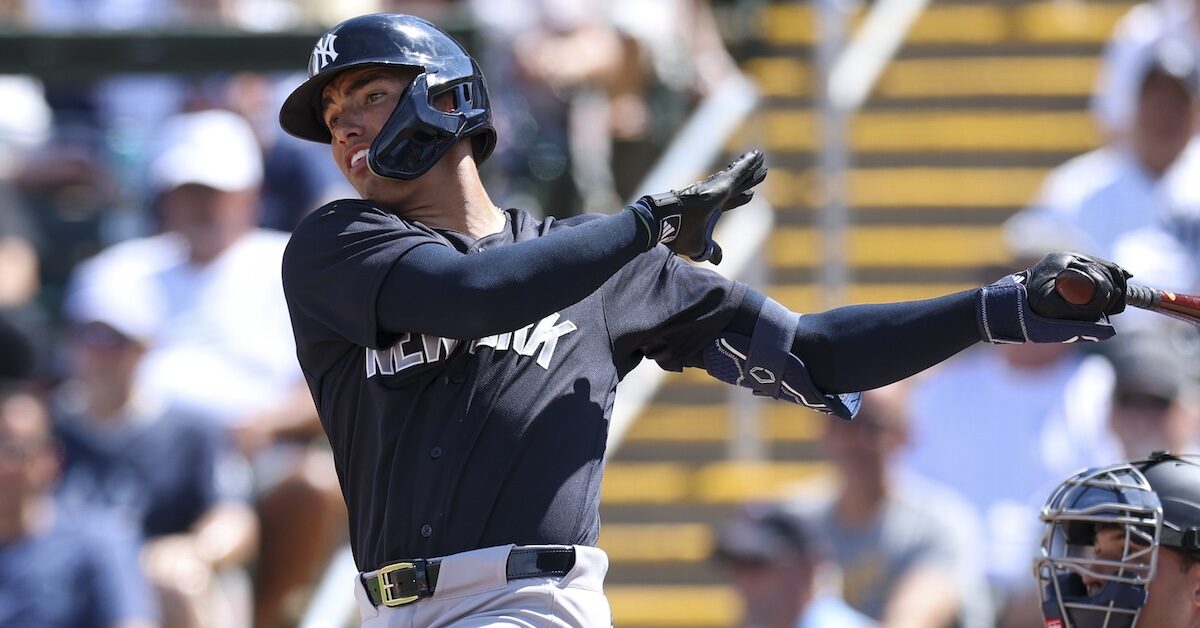
George Lombard Jr. Photo: Nathan Ray Seebeck-Imagn Images
Below is an analysis of the prospects in the farm system of the New York Yankees. Scouting reports were compiled with information provided by industry sources as well as our own observations. This is the sixth year we’re delineating between two anticipated relief roles, the abbreviations for which you’ll see in the “position” column below: MIRP for multi-inning relief pitchers, and SIRP for single-inning relief pitchers. The ETAs listed generally correspond to the year a player has to be added to the 40-man roster to avoid being made eligible for the Rule 5 draft. Manual adjustments are made where they seem appropriate, but we use that as a rule of thumb.
A quick overview of what FV (Future Value) means can be found here. A much deeper overview can be found here.
All of the ranked prospects below also appear on The Board, a resource the site offers featuring sortable scouting information for every organization. It has more details (and updated TrackMan data from various sources) than this article and integrates every team’s list so readers can compare prospects across farm systems. It can be found here. Read the rest of this entry »
Below is an analysis of the prospects in the farm system of the New York Mets. Scouting reports were compiled with information provided by industry sources as well as our own observations. This is the sixth year we’re delineating between two anticipated relief roles, the abbreviations for which you’ll see in the “position” column below: MIRP for multi-inning relief pitchers, and SIRP for single-inning relief pitchers. The ETAs listed generally correspond to the year a player has to be added to the 40-man roster to avoid being made eligible for the Rule 5 draft. Manual adjustments are made where they seem appropriate, but we use that as a rule of thumb.
A quick overview of what FV (Future Value) means can be found here. A much deeper overview can be found here.
All of the ranked prospects below also appear on The Board, a resource the site offers featuring sortable scouting information for every organization. It has more details (and updated TrackMan data from various sources) than this article and integrates every team’s list so readers can compare prospects across farm systems. It can be found here. Read the rest of this entry »
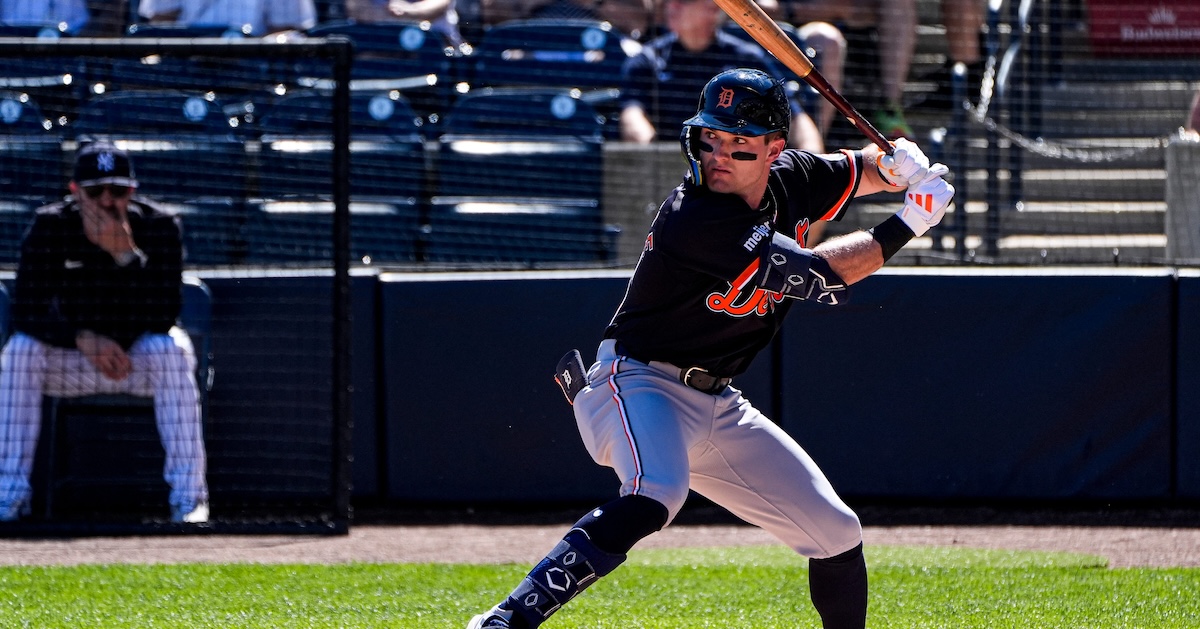
Kevin McGonigle Photo: Junfu Han/USA TODAY NETWORK via Imagn Images
Below is an analysis of the prospects in the farm system of the Detroit Tigers. Scouting reports were compiled with information provided by industry sources as well as our own observations. This is the sixth year we’re delineating between two anticipated relief roles, the abbreviations for which you’ll see in the “position” column below: MIRP for multi-inning relief pitchers, and SIRP for single-inning relief pitchers. The ETAs listed generally correspond to the year a player has to be added to the 40-man roster to avoid being made eligible for the Rule 5 draft. Manual adjustments are made where they seem appropriate, but we use that as a rule of thumb.
A quick overview of what FV (Future Value) means can be found here. A much deeper overview can be found here.
All of the ranked prospects below also appear on The Board, a resource the site offers featuring sortable scouting information for every organization. It has more details (and updated TrackMan data from various sources) than this article and integrates every team’s list so readers can compare prospects across farm systems. It can be found here. Read the rest of this entry »
No two scouts or evaluators are going to agree on everything, and we’re no exception. We get asked all the time about who liked which player more, or who was more lukewarm on this guy versus that one — not to mention the steady stream of “Outlet A ranked Player B here, but you had him there, what gives?” questions that populate our chats. These are especially compelling and relevant inquiries this time of year, because inevitably we had to resolve a degree of disagreement as we compiled our list of the Top 100 prospects in baseball.
This year, we’ve decided to address those questions head on. Throughout our list-building process, we came to similar, or similar enough, conclusions about most players. Oftentimes Eric was a tick higher on one player here, or Brendan the high man there, and usually a quick back and forth was enough to bridge any gaps. In a couple cases though, we didn’t reach consensus. There were a handful of players that Brendan was happy to rank, but Eric would have preferred to leave off, and vice versa. We think offering a peek into those discussions will prove insightful for readers. These back and forths highlight the types of players who are generally more difficult to evaluate, as well as the metrics and scouting practices that guide decision-making when you have to make a call one way or the other. Through it all, we hope you’ll arrive at a conclusion that most scouts and analysts eventually reach: That spirited debate is a healthy part of the evaluative process, and disagreements without clean resolution are occasionally the cost of doing business in an uncertain world.
Kendry Chourio, RHP, Kansas City Royals
Brendan: Let’s start with a pitcher who ultimately didn’t make our list. I never caught Kendry Chourio live, but I adored his stuff when I put on the tape. He throws hard, I see a path to a plus curve and changeup, and he’s advanced for someone who played all of last season as a 17-year-old. The Royals rightly promoted him off of the Dominican complex, and then he dominated in Arizona to the point that he actually wound up in Low-A down the stretch. And you can see why: For his age, his ability to command the ball and execute his secondaries stands out immediately. His line – 51.1 innings, 63 strikeouts, 0.95 WHIP, just five walks – was incredible. I think we both agree that there are a lot of good things going on here. Can you elaborate on why you were still a little skeptical of him when it came time to build the list? Read the rest of this entry »
Eric A Longenhagen: Hello everyone, hope you had a nice weekend and enjoyed some combo of college baseball, the Olympics, and NBA All Star stuff (or non-sports delights) as I certainly did.
1:03
Eric A Longenhagen: The top 100 was published today! Brendan and I are here to talk about it with you, as well as whatever else might be on your mind.
1:03
Eric A Longenhagen: It can be procedural stuff, questions specific to players, your dynasty roster, whatever. We know a lot of you may be stopping by for the first time today because the Top 100 list brought you here. Thanks for coming, please look around and make yourself at home.
1:05
Guest: how close is Jojo Parker to being on the list?
1:05
Brendan Gawlowski: Parker was very close, Eric and I went back and forth on it while I was doing the Toronto list. At the end of the day, we didn’t have anything new on him to bump him from the post-draft updates. Good reminder that the gap between player 90 and player 135 is tiny.
1:05
Eric A Longenhagen: Parker’s good, probably a little less projectable than most of the same-age infielders who made the list.