
New York Yankees Top 30 Prospects
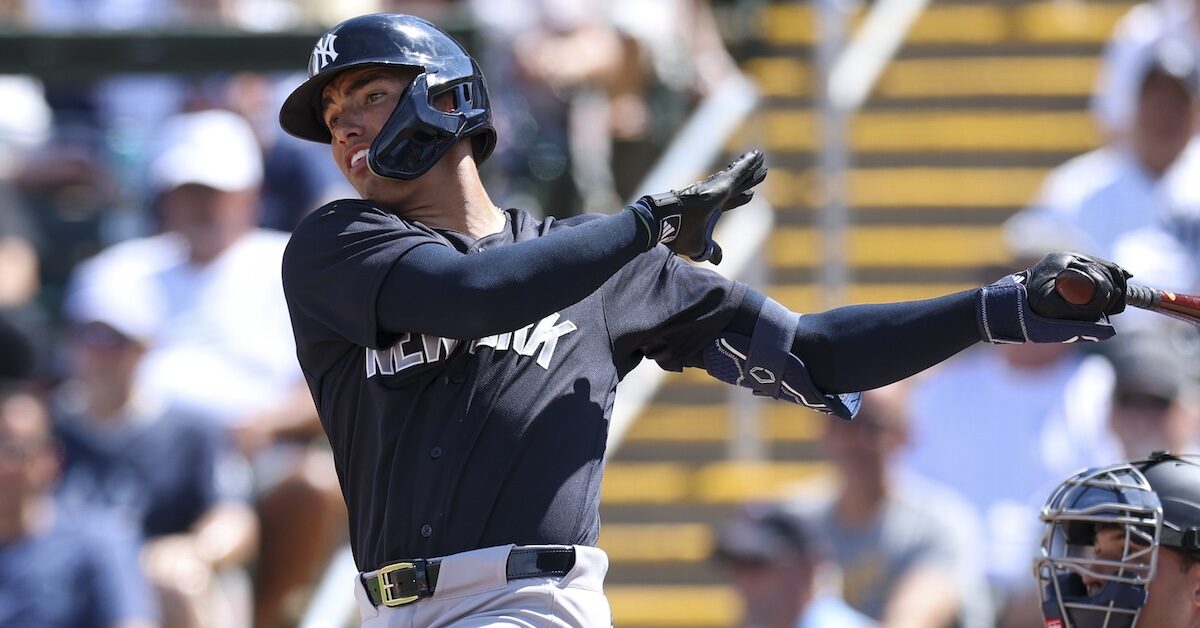
Below is an analysis of the prospects in the farm system of the New York Yankees. Scouting reports were compiled with information provided by industry sources as well as our own observations. This is the sixth year we’re delineating between two anticipated relief roles, the abbreviations for which you’ll see in the “position” column below: MIRP for multi-inning relief pitchers, and SIRP for single-inning relief pitchers. The ETAs listed generally correspond to the year a player has to be added to the 40-man roster to avoid being made eligible for the Rule 5 draft. Manual adjustments are made where they seem appropriate, but we use that as a rule of thumb.
A quick overview of what FV (Future Value) means can be found here. A much deeper overview can be found here.
All of the ranked prospects below also appear on The Board, a resource the site offers featuring sortable scouting information for every organization. It has more details (and updated TrackMan data from various sources) than this article and integrates every team’s list so readers can compare prospects across farm systems. It can be found here.
| Rk | Name | Age | Highest Level | Position | ETA | FV |
|---|---|---|---|---|---|---|
| 1 | George Lombard Jr. | 20.8 | AA | SS | 2027 | 50 |
| 2 | Elmer Rodríguez | 22.6 | AAA | SP | 2026 | 50 |
| 3 | Dax Kilby | 19.3 | A | SS | 2030 | 50 |
| 4 | Carlos Lagrange | 22.8 | AA | SIRP | 2027 | 50 |
| 5 | Ben Hess | 23.5 | AA | SP | 2027 | 45+ |
| 6 | Spencer Jones | 24.8 | AAA | CF | 2026 | 45+ |
| 7 | Bryce Cunningham | 23.2 | A+ | SP | 2028 | 45 |
| 8 | Chase Hampton | 24.6 | AA | SP | 2027 | 45 |
| 9 | Allen Facundo | 23.5 | A | SIRP | 2027 | 40+ |
| 10 | Cade Smith | 23.9 | A+ | SP | 2027 | 40 |
| 11 | Kaeden Kent | 22.5 | A+ | SS | 2029 | 40 |
| 12 | Cade Winquest | 25.9 | AA | SIRP | 2026 | 40 |
| 13 | Thatcher Hurd | 23.3 | R | SP | 2028 | 40 |
| 14 | Alexander Almonte | 19.5 | R | MIRP | 2031 | 40 |
| 15 | Wilberson De Pena | 19.3 | R | RF | 2031 | 40 |
| 16 | Henry Lalane | 21.8 | A | SIRP | 2027 | 40 |
| 17 | Sabier Marte | 22.1 | R | SP | 2028 | 40 |
| 18 | Chalniel Arias | 22.5 | R | SP | 2028 | 40 |
| 19 | Brock Selvidge | 23.5 | AA | SIRP | 2028 | 40 |
| 20 | Brendan Beck | 27.4 | AAA | SP | 2026 | 35+ |
| 21 | Carson Coleman | 27.9 | AA | SIRP | 2026 | 35+ |
| 22 | Rory Fox | 22.1 | R | SIRP | 2029 | 35+ |
| 23 | Tony Rossi | 26.7 | A+ | SIRP | 2028 | 35+ |
| 24 | Stiven Marinez | 18.6 | R | SS | 2031 | 35+ |
| 25 | Dexters Peralta | 18.7 | R | SS | 2030 | 35+ |
| 26 | Richard Matic | 18.6 | R | 3B | 2030 | 35+ |
| 27 | Jack Cebert | 24.0 | A+ | SIRP | 2029 | 35+ |
| 28 | Chris Kean | 23.8 | A+ | SIRP | 2027 | 35+ |
| 29 | Luis Velasquez | 24.7 | AA | SIRP | 2027 | 35+ |
| 30 | Thomas Balboni Jr. | 25.7 | A+ | SIRP | 2027 | 35+ |
Other Prospects of Note
Grouped by type and listed in order of preference within each category.
Fallen Famous Names
Brando Mayea, CF
Roderick Arias, SS
Ruben Castillo, CF
Francisco Vilorio, OF
Mani Cedeno, SS
Luis Serna, RHP
Jerson Alejandro, RHP
Mayea signed for more than $4 million in 2023 and initially looked like an Albert Almora Jr. or Manuel Margot type of outfielder, but he quickly started whiffing too much for that to hold. He was having a better 2025 (at least on the surface), with an .830 OPS, before an ankle injury ended his season. Mayea’s contact rate repeating the FCL was still well below 70%, so it’s tough to include him on the main section of the list as if he’d still be valued in a trade. Arias, who signed for $4 million in 2022, repeated Low-A in 2025, but once again made contact at a rate (65%) that is too low to consider him a prospect. He still has low-ball power and arm strength, the latter of which might facilitate a move to the mound. Castillo is a good athlete and a plus runner who can play center. He has a manipulable but long swing, and he needs to get stronger to make it work in the long run.
Vilorio is tall, with big league size and exit velocities, and projects to have plus power. His swing is grooved and spin poses a real problem for him. Cedeno got $2.5 million in the international market. He’s athletic with projectable power, but he doesn’t look comfortable in the box, and the 75% whiff rate he registered on spin is the reddest flag we’ve seen this list cycle. Serna is a 5-foot-11 Mexican righty with a good changeup. He returned from elbow surgery late last year and got shelled. At his peak, he looked like a no. 5/6 starter type, and some of our sources like him more than that, but he hasn’t been consistently healthy and effective for a few years now. Alejandro is a gigantic college-aged righty with a good slider who popped on the radar in 2023. He regressed as a strike-thrower in 2024, then missed 2025 due to elbow surgery.
Lefty Relief Prospects
Kyle Carr, LHP
Geoffrey Gilbert, LHP
Pico Kohn, LHP
Franyer Herrera, LHP
A former third-round pick out of Palomar College, the 23-year-old Carr posted a 1.96 ERA at Hudson Valley last year. He’s a vert slot lefty who sits about 90 and will flash an above-average slider. If his stuff ticks up in relief, he could be a lefty specialist. Gilbert, a 2022 13th rounder out of Clemson, is a soft-tossing lefty with a great slider who could also become a lefty specialist. He’s been throwing his changeup a ton in his Grapefruit League outings so far this spring, as if the Yankees are trying to find something that can keep hitters off his 89-mph fastball. Kohn, the Yankees’ fourth rounder last year, is a physical (but athletically stiff) lefty with a good slider. He sat 90-93 working as a starter at Mississippi State and is back in that range this spring. He looks like — you guessed it — a potential lefty specialist. After a successful, healthy 2024 season as a DSL starter, the Yankees moved the 20-year-old Herrera to the bullpen last year as he got his first taste of pro ball in Florida. He has a good changeup, but the rest of his mix is a little below average.
Rookie Arms
Rafael Arias, RHP
Randy Angomas, RHP
Enixon Sanchez, RHP
An older signee with two DSL years under his belt, Arias touches 96 and misses a lot of bats with his slider, and his velo was also up a tick last year. Angomas is a low-slot righty who touches 95. He gets nearly 3,000 rpm on his sweeping slider, which overwhelmed DSL batters, and he has a functional change as well. He didn’t throw a ton of strikes, though, and he’s not especially projectable. Sanchez is a good athlete who can spin it, and both his change and slider flash above average. He’s up to 95, albeit with bad shape, and he’s not holding his best stuff deep into games.
Position Player Sampler Platter
Leni Done, 3B
Core Jackson, SS
Jace Avina, CF
Jackson Castillo, CF
Estivenzon Montero, RF
Jackson Lovich, 1B
Juan Torres, 2B
Done has average power already and room for more. He didn’t debut until he was nearly 18, so keep in mind that he was a little more physically developed than your typical DSL rookie. Jackson is a slick-fielding shortstop who was off some teams’ draft boards because he drew a swastika on a Jewish classmate’s door while he was a freshman at Nebraska; he had an impaired driving incident at Utah a couple of years later. The Yankees used a fifth-round pick on him last year and assigned him to Hudson Valley, where he struggled to hit. We’re skeptical he’ll make enough contact against pro pitching. He is good defender, however, and posted some big top-end exit velos at Utah.
Avina was a Brewers’ high school draftee in 2021 who was traded to the Yankees for Jake Bauers late in 2023 and reached Double-A last year. He’s a fringe center field defender who is geared to pull in the extreme on offense. Despite middling raw thump, his extreme pull/lift approach has allowed him to hit for some power in the mid-minors. Ultimately, we think Avina’s swing will be too vulnerable against high fastballs for him to have consistent big league success. A junior college draftee out of Southern Nevada, Castillo is a compact, lefty-hitting outfielder who has the offensive skills (50 hit, 40 power) to be a part-time piece if he develops in center field, where he’s currently quite raw. Montero had a serious uptick in production in his second DSL season, with a .287/.389/.510 line and eight homers, but he still had a contact rate well under 70%. Lovich is a physical, 6-foot-4, righty-hitting slugger out of Missouri who may not get to his power because of excessive strikeouts. Torres, a small-dollar signee, was the Yankees’ best statistical performer in the DSL last year. He has short levers, good bat control, and can play second base. He hit a few homers, but he isn’t especially strong or projectable.
Righty Relievers
Jose M. Rodriguez, RHP
Harrison Cohen, RHP
Mac Heuer, RHP
Zach Messinger, RHP
Michael Arias, RHP
Eric Reyzelman, RHP
Hayden Merda, RHP
Chris Veach, RHP
Matt Keating, RHP
Rodriguez is a little bit behind the developmental curve as a 22-year-old who only left rookie ball in the middle of last season. His control and fastball velocity are below average, but his changeup and curveball are both plus pitches, and if he’s able to throttle down his walks (46 in just 72 innings last year), the Yankees might have a Tommy Kahnle sequel on their hands. Cohen is a cutter-heavy reliever with a deceptive, quick-armed delivery and an average changeup. He struck out a little more than a batter per inning in the upper levels of the minors last year, but also walked nearly 15% of opponents, a little too much for the main section of the list from a guy sitting 93. Heuer, an over-slot eighth rounder last year, is a square-bodied righty with a naturally cutting fastball that will peak at 98 mph. He struggled as a starter at Texas Tech, but teams, including the Yankees, have taken undercooked ingredients from Lubbock and whipped them into something before.
Messinger has been on the periphery of Yankees lists as a depth starter since 2023. He moved to the bullpen in 2025 and had a velo spike throughout the season, which he started sitting 90-93 and ended sitting 94-95. That has continued into the start of 2026, as Messinger has been in the 94-97 mph range with his fastballs in early Grapefruit League outings, and he now appears to have a higher arm slot. More important than Messinger’s velo is how his secondary pitches will play from the new slot, as they’ve generated generic swing and miss results in the past. He needs a second plus pitch to profile as a big league bullpen arm. Arias was originally a shortstop in the Blue Jays system but was released before he ever took a pro at-bat. He ended up moving to the mound and signing with the Cubs, becoming an exciting low-slot reliever with a plus fastball/changeup combination. Arias was put on the Cubs’ 40-man after the 2023 season but struggled to control the baseball, so he was eventually DFA’ed, traded to the Yankees, and was brought back on a minor league deal this offseason.
Reyzelman looked like he was in the express lane to the back of the Yankees bullpen in 2024, as his fastball and slider played like elite pitches and he K’d 14 per nine at Double-A. In 2025, he lost nearly three ticks from his stuff and walked a batter per inning. He’s purely in bounce-back territory now. Merda, who spent 2025 split between High- and Double-A after missing the prior season with injury, has a deadly slider and will top out at 98 (sitting 93-95). Veach is a 2024 undrafted free agent out of South Carolina who K’d 75 guys in 57 A-ball innings last year thanks to heavy use of a funky changeup that’s often 15 mph slower than his fastball. Keating is a former ninth rounder out of USC whose slider/cutter combo generated plus-plus miss in A-ball last year; the rest of his repertoire is below average.
System Overview
The Yankees have a top-heavy system that resides among the bottom handful in baseball, but only part of that is due to strategic missteps and an actual failure to cultivate talent. This system is one of the shallowest in the league mostly because of trades to add to the big league team. Four prospects in the Ryan Weathers deal, four in the Camilo Doval trade, two for Jake Bird, three for David Bednar, two each for Ryan McMahon and Amed Rosario — that’s half a farm system dealt away since last July. The Yankees’ ability to turn later draft picks into something of value on the trade market is still a steady aspect of their operation.
That’s part of why their approach in the international market has been so frustrating. Teams with good player development tend to feed their systems with depth, and then apply good coaching and training to as many viable prospects as possible. Since MLB adopted its current international signing format, the Yankees’ strategy has often been to pay just a couple of players, and sometimes just one guy, a huge chunk of their annual bonus pool. That approach makes it important for the high-dollar signees to pan out, or else you’ve whiffed on an entire class in a talent-rich market, and in the Yankees’ case, they’ve failed to hit on those guys too often of late. The club chose not to renew the contract of longtime international scouting director Donny Rowland, who had been with the club for 23 years, after last season. Though this might ultimately be the right decision, it did have an immediate negative consequence, as Wandy Asigen, the Yankees’ top 2026 commit and arguably the top player in the entire class, backed out of his deal and sought employment across town in the aftermath of Rowland’s dismissal. Asigen would have ranked seventh here.
The Yankees need to find a way to inject this system with position player talent. They’ve graduated Austin Wells, Ben Rice, Jasson Domínguez and Anthony Volpe since 2023, and though that group has had growing pains, that’s a pretty good three-year chunk of position player rookies (Will Warren and Cam Schlittler are good, too). But now the cupboard is bare while a third of their projected starters (Paul Goldschmidt, Trent Grisham, and Jazz Chisholm Jr.) are set to be free agents after this season, and ownership seems less apt to solve the club’s problems with money than they were when George was alive. Spencer Jones and George Lombard Jr. are arguably in position to replace Grisham and Chisholm, but both have hit tool risk and we’d be surprised if they both hit the ground running. This feels like a do or die year.
The Yankees system has been pumping out catching prospects regularly for the last few years. Its wild that there’s not a single catcher in the top 30 or the others of note section this year.
Well, when you trade, like, all of the catchers, it’s not that surprising. But it’s definitely different.
Yankee C traded in the last ~3 years:
Jesus Rodriguez (to SFG for Doval)
Rafael Flores (to PIT for Bednar)
Edgleen Perez (same)
Jose Trevino (to CIN for F. Cruz)
Carlos Navarez (to BOS for E. Rodriguez)
Augustin Ramirez (to FLA for Jazz)
Ben Rortvedt (to TBR in 3-way trade for Jon Berti)
Kyle Higashioka (to SDP for Soto)
Luis Torrens (to NYM for $)
That’s nine, six of whom were developed solely in your system. They also graduated Wells, Rice and Escarra in that time.
Twelve total, eight from the Yankee system entirely used in trades, on the Yankee roster, and/or both.
Not shocked there are no C of note left in the system.
Thanks for compiling this list!
What’s surprising is that they haven’t backfilled behind the guys they traded. For a long time they seemed to work magic developing catchers who were not top draft picks or top money international signings. I guess the magic has stopped working.
They pivoted to SS and Pitchers recently.
They did trade three at least nominal catching prospects (two for Bednar, one for Doval).
Yep – a bunch of random small dollar signings will pop as 40+ catchers this season, along with the mid round college arms who’ve added two ticks and a sweeper.
Kilby and Lombard are the exciting prospects here but Elmer Rodriguez looks like he’s going to be an enjoyable starter as a Quinn Priester type who forces the ball into the ground and lets his fielders scoop it up. Going to be a lot of action on days he is pitching.
Brandon Webb and Derek Lowe are probably the peak version of this archetype, at least among recent right handers. Guys like Felix Hernandez and AJ Burnett had much better stuff and didn’t rely on ground balls to nearly the same extent, same with Yamamoto and Logan Webb.
These guys who get by with throwing strikes and watching guys put the ball directly into the dirt are some of my favorites.
Brandon Webb was so, so good. Shame about his shoulder.
Thank god Derek Jeter is retired
At least Jeter could hit. Volpe seemingly can’t get it done on either side of the ball.
MIL: 309.5
DET: 291
NYM: 277.5
STL: 275
CLE: 268
LAD: 248
SEA: 241.5
CHWS: 197
TOR: 179.5
CIN: 174
AZ: 171
PHI: 158.5
NYY: 142.5
LAA: 121
ATL: 114.5
Thanks. I’ve developed a routine when these drop now. 1. Read the system overview. 2. Read the “matt” comment for quantitative context. 3. Go back to the top and check out some of the top guys.
Yes I try to read the overview first too and I like this standing comment
I am drunk as hell on Dax Kilby. Recognizing the small sample point, even if he regresses a good bit, he’s still shown elite (or at least plus) contact and plate discipline. He’s also shown power, he can run, and he’s got a good frame. Give me every single bit of stock on him
What’s Kilby’s ceiling? If he can change his attack angle and get to all or most of his power, I think we’re looking at a perineal all-start.
I’m not sure what the spot between his butt and his balls has to do with it, but yeah, big ceiling in addition to the solid floor
Kids built like Kilby aren’t supposed to have his bat to ball skills.
Very excited.
Of course he has a solid floor, he’s been doing his kegels.
Oh God! This is concerning. I don’t think this is the first time I’ve made this mistake, just the first time I’ve been called out for it.
I think he’ll be good, too. But I just want to add a pissy, irrelevant comment in re Kilby review. Lines like this bug me more than they should:
Why the passive language? Sure you could have expected it; since many others did expect him to stick on the dirt you all could have, as well. Perfectly possible. Why not just say “we got that evaluation wrong” rather than this convoluted, passive language?
It’s a minor gripe I know, but it just seems like we now live in a world of gaslighting. Every analyst of minor leaguers gets a ton of evaluations wrong. No crime in that as a highly imperfect science. Also no harm in just saying: got that one wrong (or, if you prefer, “looks like we may have got that wrong, but time will tell”).
End of old man yelling at the clouds rant!
“Gaslighting?” Come on, man. That’s way over the top. You can grammar police it, but it’s not trying to fake you out. BG wrote a whole ass article a few weeks ago about how he got a specific evaluation wrong and what it taught him, and Eric did the “How’s my Driving?” article again. They’ve been incredibly transparent and I’ve (among others, surely) have learned a bunch from it.
Yankee fans are probably still a bit salty about FG listing Volpe as a 2B in their prospect writeups repeatedly.
I’ve a grammar police badge, but I do pick up what anthony’s laying down when it comes to the passive voice…and I understand that he’s not classing Eric and BG gaslighters so much as saying “Please own your shit, because one else does these days!”
Well to be a little fair he’s a ways from a finished product. They could end up correct too.
Oh, for sure!
But yer man’s just asking that they say “We had him pegged (em added) as 2B/CF only, but he looks like a potential SS now.”
Look I’m not saying you’re wrong about the passive voice, I’m saying that (1) these guys own up to their own errors more than any other public facing analyst, and (2) you want them to get these lists out before May, right?
Fair. And I admit I wrote that in a grumbly mood due to far more important geo-political “not owning up to mistakes” issues. But that’s for another forum!
I think Kilby/lagrange/hess deserve a grade higher. Lagrange may have relief risk but he also has among the 5 best raw stuff in all of the minors, and has at least 3 plus pitches. Kilby was always billed as a good hit tool guy and decent athlete, but fact that he’s hit the ball so hard is a bit surprising and speaks to tantalizing upside. Hess is a classic number 3 starter with lot of above average important traits.
I can see the argument for Kilby at 55 and Hess at 50 but Lagrange is exactly where he should be. Aside from the inherent risk of pitchers throwing 100 MPH regularly he’s almost guaranteed to be a reliever. I don’t think you can put him any higher than 50 unless you think he’s Mason Miller.
How is he guaranteed to be a reliever? The guy has 4 plus to ++ pitches. He has good mechanics and threw 120 healthy innings last season.
“Almost” guaranteed. If you think he can fill up the zone and dare hitters to try and hit it then sure, although that requires the ability to fire the ball right down the middle and the stuff to be so crazy that nobody can hit it anyway. That’s what Randy Johnson and Kerry Wood and Mark Prior did, just fill up the zone and the batter couldn’t handle it. And every so often you get an “effectively wild” starter like Blake Snell or Dylan Cease or Francisco Liriano who makes it work because their stuff is so crazy.
But these are some real edge cases, the track record of guys who are like this almost always wind up as relievers, and usually busts. The list of guys with 40 command or under is awful, even with fastballs of 65 or higher. The best case scenario is they wind up like Emmanuel Clase (without the fixing stuff), Pete Fairbanks, Devin Williams, or Andres Munoz, or a guy who can be a starter for a couple of years like Luis Gil before it all catches up to him (Mick Abel and Edward Cabrera might be on this path). But the list of other guys like this is awful: Luis Medina, Yadier Alvarez, Brailyn Marquez, Touki Touissaint, Kyle Muller, Sam Hentges, Jackson Rutledge, Sam Bachman, Ryan Cusick…
The most reasonable high-end outcome for this profile is an up or down starter like Joe Boyle, or a high leverage reliever like Abner Uribe. And if you’re picking pretty much every team would rather have Uribe over Boyle. Which is why it’s almost guaranteed he’s going to wind up as a reliever. Sure, maybe he could hack it as a starter, but guys like Robert Stephenson are just better bets in the bullpen.
Randy Johnson also took forever to get his walks under control—I’m not sure that teams today would have the patience to let someone flounder as a starter until they’re 29. And that’s presuming that a starter with that kind of stuff keeps it that long without breaking.
Randy Johnson helped his cause by being hard to hit even when he couldn’t hit the strike zone. From 1990 through 1992 he walked almost 6 batters per nine innings but had the third most strikeouts on a rate basis and his BABIP was 25th out of 103 (minimum: 300 innings as a starting pitcher). He gave up more home runs than the average pitcher, but it wasn’t extreme at all, and it left him as a roughly average starting pitcher by both ERA- and FIP-.
And then he changed his arm slot, worked with Nolan Ryan and the Rangers’ former pitching coach for an offseason, and then he came back and started throwing strikes. And there was nothing hitters could do.
There are starters in the bigs with low zone %s that have success, chase rates matter more than filling the zone. Rodon/Peralta/Cease are all quite good with sub 40% zone rates.
Those lads are outliers, though…and if Lagrange turns out to “just” be Dellin Betances, that’s a massive freaking win.
From 2014-18, Dellin put up the same RE24 as Dallas Keuchel…and a good chunk more than Gerrit Cole!
Betances is a tempting comp because of the three plus (or better) pitches, velocity, and height. He also provides a template for the sort of player I was talking about in another comment: Throw it for strikes and let them try and hit it.
But I think guys like him and Mason Miller are probably giving more value than a 50. At least an 55, potentially more like an 50. And I also think they are super rare.
I also think that in general a team would rather have a 1.5-WAR closer than a 2 WAR starter who pitches twice as many innings. Which is why I think Lagrange is going to be a high leverage reliever.
Meant to type 60 there the second time, whoops
Was about to say – Betances produced RE24 like a #2 starter during that 5 year run!
…and Billy Wagner’s normal was better than that for 15 years!!!!!!!!
Betances was at least a 55. He was in the range of what a 55 starter would do in WAR alone, and when you take into account the flexibility of inserting him into the game in high leverage spots he was probably a 60.
I think there’s a lot of other relievers in recent years you could say are in that bucket in terms of value. Zack Britton, Andrew Miller, Aroldis Chapman, Wade Davis, Emmanuel Clase and Jonathan Papelbon are the ones I’m thinking of. Although some of them were late bloomers and didn’t have their peak years during their initial years of team control.
I don’t really think we’re seeing anyone like that in the game right now, at least since Clase was suspended. Although Cade Smith and Mason Miller could get there.
I think Kenley Jansen and Craig Kimbrel were 65s. Probably Edwin Diaz too.
You can absolutely be higher than a 50 as a reliever, I just don’t think there’s any real way to put a grade higher than 50 on a reliever prospect. Most of these guys throw so hard that serious injury feels inevitable, and it’s such small samples so a few bad games can wreck your whole year’s value.
All of the yes to this…and you can see it in how teams pay relievers!
A “HashtagProvenCloser” gets 60 money in FA…and the true elites don’t make it to FA in their prime.
Reliever valuation isn’t a “flaw” in WAR so much as the entire structure of the model is incompatible with teams’ valuation of relievers.
Yeah but you have to make it close enough to get hitters to swing. Deception helps too. But if you can’t hit your spots and you’re throwing it out of the zone then you’re Wily Peralta or Tyler Chatwood.
Cease is a bit of an anomaly as a guy who makes it work with 40 command but I think Peralta and Rodon are above that.
Here’s hoping that homer off Crochet last week is an augur of things to come for Lombard – 96 and letter high!
Anyway, I expect a couple of their mid-round college righties to suddenly start throwing 95 with a nasty sweeper, get to that 45/50 FV range by mid-year, just in time to get traded for big league help.
I’ll also add that it’s more than a little absurd that they let Rowland go before the signing period…only to go with an internal hire.
The Yankee system is now largely a couple of boom-bust bats and a sampler platter of mid-round/low-dollar IFA pitchers who they’ve coached up.
There’s no position player depth whatsoever at any position. The Yankees have shipped out or shipped up anyone with a pulse.
That having been said, I will stay on Jones because I can’t let that kind of raw go. I’ll take a couple of peak Joey Gallo seasons. Elmer strikes me as a “better than the sum of his parts” type guy who has some really good seasons in his future. I think Lagrange would be more valuable as a dominant bullpen piece versus an inefficient five-and-dive (I still think the same about Luis Gil, to be clear).
There isn’t anyone lower in the system who I’m specifically keeping an eye on; I’m going to have to find some dudes to get overly excited about to help pass the summer.
Yankees fans like to imagine that some other front office is going to dream on Spencer Jones turning into another Rangers-era Josh Hamilton or Joey Gallo but I think everyone else can see what the detractors see: That 60% contact rate the last couple of years.
He’s got a ways to go before he’s even Oneil Cruz, who was putting up 70-73% rates in the upper minors at age 22. Judge was putting up similar contact rates at that level too. I’d be shocked if you could find more than 3 or 4 other guys who had a 60% contact rate in the upper minors and had 2-3 full seasons where he was running a wRC+ meaningfully above 100.
At least for the majors, if you set the minimum to 500 PAs (we’ll call that a full season), there are amazingly only six seasons in total where a player even put up a Contact% under 63% in SIS’s database (which I think goes back to 2002). Everyone else got pulled and didn’t make it to 500 PAs! Of those six seasons, three belong to Mark Reynolds (wRC+ of 97, 127, and 96) and two belong to Joey Gallo (wRC+ 119 and 108). The sixth was Javier Baez (117 wRC+), who immediately afterwards signed with Detroit and stopped hitting entirely. You can add another Gallo season if you raise the threshold to less than 64%, and he did well there (123 wRC+).
Unless something changes pretty radically, his career outcomes are going to look like the 2017-2018 version of Joey Gallo (maybe 10% chance) or the 2022-2024 version of Joey Gallo (when he was barely a platoon-capable hitter). I think the Yankees are going to have to ride it out with him with the hopes that he can raise his contact rate into the Matt Wallner zone before he burns through his options and becomes a capable platoon masher.
The functional CF defense raises his floor above that Wily Mo Pena zone…but I don’t see a best case that beats Justin Maxwell.
Justin Maxwell…now that’s a deep cut. I barely remember him.
Maxwell also had a Contact% of 68%-70% in the upper minors.
I still think the best case is Matt Wallner with tweener outfield defense, and that would be a legitimately good outcome 2+ WAR outcome even if he’s only playing 450 PAs a year. But I do not think that is likely. Guys with contact rates like him are like Jabari Blash, they probably have to play overseas to get regular playing time.
I was so happy when Maxwell had that run for the tanking Astros!
But yeah, I just don’t see a path to him “only” striking out 35% of the time in The Show.
Call Miguel Sano’s 2020 the best case, haha?
I think you are underrating the centerfield defense. Hes closer to above average than fringe in my opinion, though that could change as he ages
If NYY isn’t going to give him a shot they should trade him to an org that needs OF help. I think he’s going to struggle but but but I kinda want to see if he can survive and crush the ball in the majors. His profile is an extreme risk and doesn’t fit well with an org that is trying to be one of the top teams year after year. Going to a rebuilding team would benefit everyone
Do you think teams will be lining up for the second coming of Estevan Florial?
I’m not expecting much of a return. His profile is incompatible with the club:s profile. I could see him getting called up if they are basically out of all other options but to the Yankees is value is basically zero to a rebuilding club he’s worth a lottery ticket.
Fair!
I’d use the Narvaez trade framework, knowing we’re not getting an ER.
I think they will give him a shot if he can make the minimum amount of contact to be a viable hitter in MLB. Luke Raley, Miguel Sano, and Matt Wallner are or were all in the 64%-65% range, so that’s probably the minimum you can do and get away with it unless you’re Joey Gallo.
But unless he can get into Matt Wallner territory with his contact rates, your scenario is probably what is going to happen after his options start running out. I just don’t see them trading him before that, not when the upside is a 3+ win outfielder and teams are going to value him like a fourth outfielder.
The problem is that most rebuilding teams also don’t really have the development staff to get him to improve. It’s hard to imagine the White Sox or Angels helping him to figure things out.
I guess he could go to a place where there’s a new development team in place. Maybe the Cardinals once they give up on Victor Scott, or he could platoon with Josh Baez once they give up on Jordan Walker.
I think there’s a reasonable case that Jones could still see a meaningful improvement to his contact rate.
A guy as big as him is probably going to need more time to find the mechanics that work for him than most players. That’s why he’s changed his mechanics so drastically every year. In addition to that, since he was a two-way guy in college and has had a lot of injuries, he doesn’t have as many reps as your average 25-year-old in AAA.
Now, I’m not expecting him to suddenly have a 40 hit tool anytime soon, but he only needs a 30 to be a legitimate Major Leaguer. I don’t think it’s out of the question that he could get there.
He’s not just a college guy – he’s a Vandy guy.
And he’s not just a Vandy guy…he’s a baseball-only, SoCal baseball prep school Vandy guy.
I’ll grant that I said similar things about Jalen Hurts…but Hurts had won his first NFC Championship by the time he was Jones’ age.
This is a good time to separate out things that are “impossible” from things that are “unlikely, but it has happened” to “unlikely, but we still shouldn’t be surprised if we see it.” I would put Spencer Jones getting his contact rate into the Matt Wallner area in that middle category.
I can’t say for sure right now what the success rate is of players who got up to AA / AAA with contact rates in the 60% area because it’s hard to pull that information. But we can do it for Swinging Strike % pretty easily. I did it for AAA and set the minimum number of PAs to 150 (he had close to 300 there last year). We can use that to screen players and then look individually at what they did.
Out of 3,663 seasons Spencer Jones had the 21st-highest swinging strike % going back to 2007, which is horrific. Unsurprisingly, every single player above him was a bust. The only players within about a percentage point of him in either direction that hit decently in MLB were Gallo (who is a huge outlier because he didn’t improve and still succeeded) and Luis Robert, whose contact rates were a lot higher than his in the minors (around 70%). I kept scrolling and occasionally came across a player who didn’t bust completely at the plate and most of them had much higher contact rates (Avisail Garcia, Luke Raley, Adolis Garcia. Kris Bryant, Ian Happ, Brian Anderson, JD Maritnez).
I stopped screening when I got below 15% Swinging Strike %, a good 4.6 percentage points better than what Jones did in AAA last year and about 300 spots down. There are only two guys who managed to improve his contact rates to avoid busting at the plate.
One is Javier Baez, who is another anomaly like Gallo where he did stuff that nobody else has gotten away with.
The other was Brent Rooker, who posted a 62.2% Contact% in his first go-around in AAA at age 24. He improved in his second time in 2021 at age 26, up to about 70%. Then he took another couple ofyears to figure out how to hit at the major league level, finally becoming an above average hitter at age 28.
I think this gives you a sense of the likelihood of him improving his contact rates enough to avoid busting at the plate. There is only one player that I can find in a 15+ year span who was in anything like Jones’s situation and who improved his contact rates enough to be viable. That guy managed to improve enough in his second year at AAA (which was two years later, due to COVID restrictions) at the age of 26, and then took another year of struggling before he finally figured it out at age 28. It’s not impossible to improve his contact rates, it’s just unlikely, to the point that I would be surprised if it happened.
This one is interesting. It diverges from most other system rankings in big ways, and you are surprisingly low on a lot of backend guys (Lovich, Avina, Serna, Kohn, Heuer, and more). Tejeda, Rivas, Pineda, W. Rodriguiez, and Landry aren’t mentioned at all which is even more surprising.
Agreed. It feels like there’s a section missing in HM’s of all the low-draft (10th rd or later) arms in A+. A bunch lit-up the lower levels, in addition to Rivas and Landry that you mentioned I was curious about.
Agreed. The Yankees may not be flush with higher ranked prospects, but year after year they have a system filled with talent as opposed to minor league filler
Prospect lists struggle to adequately portray this from org to org.
What happened to that Yankees fan that commented on every prospect article about how Jasson Dominguez was criminally under-ranked? Haven’t seen much of that guy lately. Wonder what happened.
…what an odd comment.
Not only do I spend way too much time on this website…I’d already commented.
You seem smart!
Anyway:
I was operating under the belief that he was a fringey CF who would be plus in a corner.
I had formed this belief based on every publicly available scouting report.
With functional defense, his rookie season would have looked a lot like Wyatt Langford’s.
Instead, his defense was frighteningly bad…which completely changes the profile!
That said, I’m certainly not out on a 23 year old switch hitter with 400 games’ worth of career OF innings, because of a rookie year that featured league-average hitting, plus baserunning, and horrifying LF defense.
I am nearly certain that it was not you – this person would spam every prospect article and make it about Dominguez.
I’m certainly not out on Dominguez being a useful MLB player, but I’m not seeing a perennial all-star, as this was seemingly Dominguez’s floor according to this person.
I could probably look the comments up but I am too lazy. They also reminded me of the relentless Tim Anderson defender. Everyone has their thing, I suppose.
How dare you suggest Tim Anderson won’t make the Hall!!!!!!!
But yeah, I was more on the “How the fuck do you rate Mayer a grade above JD, given the former’s cocktail of more injury and less performance?” train, ahaha!
Expected him to be a safe 2-4 WAR starter, before the defensive numbers arrived.
Agree with the overall read of the system, but the last paragraph feels over dramatic.
– Goldschmidt is on the small side of a platoon
– Dominguez will slid into LF and Belli to CF when Grisham departs
– Chisholm will be very difficult to replace
The rest of the offense will still be around as will the pitching. This team’s window resides on Judge and the healthy of its 3 very expensive starters.
My sense is Jazz will re-sign with them.
He feels like a guy that belongs in pinstripes & enjoys being in NY.
I love Jazz.
He feels like a guy who will be sacrificed on the altar of the “payroll flexibility” that let the Yankees pay Hicks and DJ $25m last year.
George Lombard Jr reminds me a lot of Volpe with maybe slightly better defense. I think that something is off with the Yankees’s hitting program
Ben Rice is the only recent success and we will see weather or not he regresses this season. Even when they called him up it was as a stop gap that a whole lot was not expected out of fv35+.
Hitting is difficult. I mean the Dodgers are the gold standard and who have they really produced recently? Andy Pages? Michael Busch? It’s not like they’re churning out a bunch of good players. All their best players were mostly signed in free agency.
The Venn diagram of Lombard and Volpe only lines up on defense.
Volpe’s “Ideal Attack Angle” numbers are unreal…but he’s not strong enough for the elevate and celebrate approach to work as a righty in YS3 and he doesn’t have the contact ability to go gap-to-gap.
GLJ is a strapping 6’2, with room to fill out – Volpe’s approach on that frame is named Willy Adames.
I have heard a lot about them emphasizing exit velo for hitters, like having them do simulated at bats and counting it as a “win” if they hit the ball over X mph regardless of where it actually goes. I do wonder if that philosophy has negatively impacted all their power over hit guys. Or maybe that philosophy is leading them to acquire power over hit guys and they’re failing to adequately develop the hit. Or both
It’s probably both…but the real silliness is teaching that shit to 5’9 righties whose max effort exit velo comes out as 40th percentile, when they play in YS3!!!
If you can go full Paredes or you can learn the Gleyber inside-out to the short porch, you can still be a YS RH power hitter with Volpe’s raw. The problem is Volpe doesn’t have anything resembling a consistent approach — he’s always changing something.
First, Paredes and Bregman have BRUTAL YS3 splits.
Second, the scouting report on him before his 23/25 approach was precisely his 2024.
Volpe doesn’t have Gleyber’s contact or Paredes’ raw, much less the reverse…so his only real avenue towards the Aybar Zone is his current approach in a friendly stadium.
I’ve seen Lombard multiple times in person and hes a significantly better defender at shortstop than Volpe right now. He’s the shortstop prototype that every team is looking for and I’d be surprised if he isnt the OD starter by 2027.
I can assure you that Rice was not viewed as a stopgap by the Yankees internally. They knew they had a legit bat by the time he reached AA. He was the most complete hitter on a Somerset team that included several highly ranked prospects, many of whom were traded away while Rice was kept. Nearly all publications whiffed on Rice (somewhat understandably) but that doesnt mean he was some flash in the pan. He looked the part if you saw him in person and all the data backed up his production. The Yankees scouting and player dev deserve recognition here.
Is LaGrange following a Betances-like path for was the latter always going to be a reliever?
They were certainly trying to develop Betances as a starter. But he didn’t develop his incredible breaking ball until he was being moved to relief. It was the history as a starter that allowed him to post huge IP totals in his first couple seasons.
I’d like Thatcher Hurd’s nickname to be “the Third”
The guys I’d see as maybe worth a grade – even if only 35+ – are Carr, Xander Rivas, Heuer, and maybe Cohen. But that’s not much of a quibble, and unfortunately all are just more pitchers.
There are a number of lower level and/or injured pitchers here not featured much elsewhere. But they all strike me as “let’s sees”
Perhaps the 10 spot demotions are hurting.
As much as the use of them bug me as tax avoidance, the Yankees might need to get over their conservative contractual approach and start utilizing deferrals. This seems to me a Hal thing, but grow up – it’s what all the cool rich kids are doing!
Not that they are likely to slip under that level before ‘28 (Belli’s short term tax treatment really doesn’t help and seems like a mistake by the org). It does suggest to me there could be an intra-owner battle in this CBA over lux tax levels vs a salary floor structure with 10 teams nearing tax payor status and flowing cash to the 9 clubs below $125 mil (5 below $100). Perhaps bleeding into the expanded sharing discussion.
Ah, the rich kids aren’t doing deferrals – it’s the adults who have their current position by being good at [anything]!
If I weren’t a Yankees fan, how bad Hal is at the basic mechanics of parasitic ownership would be really fucking funny.
Wonder how secure Volpe’s job is now with these top SS prospects looking close to ready. He’s never truly had it going as a hitter, and last year his defense tanked completely.
He’s in big trouble, for sure. I’m not entirely sure that’s owed to Lombard, who’s really the only one close to ready, as much as Volpe’s own sucking. It’s gonna be hard to figure it out this year, though, since he’s gonna be coming off an injury. If he doesn’t hit again this year, it wouldn’t be unreasonable to think his struggles last year and this year were influenced by the shoulder.
Kinda expecting them to go into 2027 with Volpe on his last shot and Lombard supplanting him if he doesn’t hit immediately.
He was hurt last year, but yeah if his defense isn’t coming back post-injury he’s going to be an up-and-down utility infielder the moment Lombard is ready. Because he’s not there for his hitting.
Even if the defense comes back he still might be an up and down utility infielder, although they also don’t really have a plausible candidate to take over for McMahon at third base either.
Ah, sure – 85 wRC+ with solid defense was his draft write up!
…but I do believe he can deliver value in a park more suited to small and weak elevate/celebrate hitters.
He’d do a lot better in the places with a short left field like Boston, TB, and Houston. Also the homer-friendly stadiums in PHI and CIN, although pretty much everyone who elevates does better in those stadiums. A lot of the other stadiums it looks like he’d do similar to his current home park.
Yep.
There are five stadiums where someone with Volpe’s contact skills and physicality can be a plus starter.
This is about right. I mean this is what happens when you constantly trade away your prospects and are in perpetual win-now mode. The Yankees don’t get access to top talents in the draft and are limited in IFA as well. Also the Yankees graduated Cam Schlittler, Will Warren, and Jasson Dominguez last year.
As Eric said in his chat, they’re only limited in IFA by their approach of spending all their money on “big fish,” rather than being intentional and trusting their system.
Here’s hoping the new IFA director uses his perspective of having worked for the Yankees, Yankees, Yankees, and Yankees to pioneer a new approach!