
Emilio Pagán Returns to Cincinnati
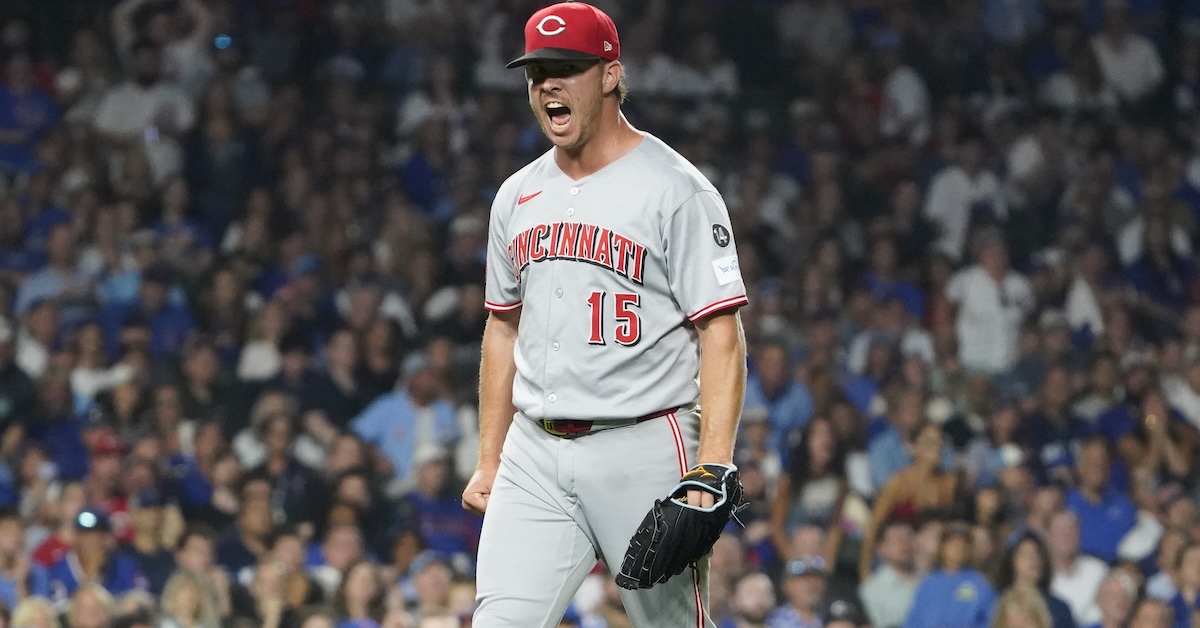
It’s been a busy December for free agent relievers. Ryan Helsley and Devin Williams, two of the most interesting names on the market, each signed with new clubs, and they each got multi-year guarantees despite shaky 2025 results. The next shoe to drop wasn’t quite as heralded of an option, but he too got multiple years and beat market consensus. The signing in question: Emilio Pagán and the Reds agreed to a two-year, $20 million deal, with an opt out after the first year.
Pagán was a far more effective reliever in 2025 than either of the two splashier names ahead of him. He had one of the best seasons of his career at age 34, in fact: 68 2/3 innings pitched, a 2.88 ERA and 3.72 FIP in hitter-friendly Cincinnati, and 32 saves in his first full-time closing job since 2019. He bounced back from an injury-interrupted 2024 with better fastball velocity and better pitch shape across the board, and got richly rewarded for it with a 30% strikeout rate. Is he homer-prone? You bet, thanks to a 0.51 GB/FB ratio. But a .200 BABIP and a solid HR/FB% (10.8%) meant that he actually allowed fewer homers per nine innings (1.31) than his career mark (1.51), and not by a small amount, despite pitching in a launching pad.
When things are going well for him, Pagán makes everyone think they can hit a home run, then pulls the rug out. He runs his four-seamer high and spots a heavy splitter off of it, a classic fly ball pitcher mix. It’s one of those strategies that looks awful when it isn’t working, and yet seems to come through most of the time anyway. More specifically, Pagán went through a three-year stretch of terrible form from 2020-2022, posting a 4.61 ERA and 4.71 FIP. Then he broke out in 2023 and has been solid since. The weirdest part of it all? His stuff and command metrics barely budged between those two wildly different stretches.
Reversals like that go a long way toward explaining why reliever performance is so difficult to predict. When Pagán has it, he’s a worthy late-inning reliever. His ERA- was 40th among relievers last year, and it’s 60th over the past three years, even with his ineffective 2024 in the mix. He’s pitched like you’d expect a closer or setup man to, in other words. His FIP tells a broadly similar story, and I’m willing to believe that pitchers with his extreme tendencies outperform their FIP in the long run. If you get good Pagán, he’s a very useful bullpen piece, the kind any team would love to have in the bullpen and many fringe contenders would love to have as a closer.
That’s the calculus from the Reds’ perspective. They’ve managed their payroll tightly in the early years of Elly De La Cruz’s team control window, hovering around the $100 million mark with wiggle room in either direction. With that budget constraint in mind, the top five or so relievers in this free agency class were presumably off the board. The next tier down is a mixture of interesting pop-up arms, aging closers, and reclamation projects. Would you rather have Kenley Jansen or Pagán? Seranthony Domínguez? Kyle Finnegan? Phil Maton? Maybe Drew Pomeranz? I think I’d take Pagán or Jansen over the field – I ranked them that way in my Top 50 Free Agents list – and as an added bonus, he’s already familiar with Cincinnati. I’d take Raisel Iglesias over him – rankings, again – but he signed for one year and $16 million, probably outside of this team’s price range. The Reds probably could’ve gotten some solid lefty specialists for the $10 million or so annual salary that they gave Pagán, but that’s not what they were in the market for this winter. They needed a bankable closer, and in the aisle they were shopping in, there weren’t that many options.
This team really does need relief arms. The Reds didn’t have to cover many bullpen innings in 2025, but even then they struggled to piece it all together. Pagán, Tony Santillan, and Graham Ashcraft formed an effective three-headed monster at the top, but the rest of the pen was ineffective even in limited time. With a bandbox for a home stadium, it’s hard to expect a similarly limited need for relief pitching in 2026. This was the path of least resistance for a team that really does need to do something to challenge for the NL Central title in 2026 and build on its surprising 2025 Wild Card berth.
Now, the risks? They’re real. It was only a year ago, after his down 2024 performance, that Cincinnati fans were lamenting Pagán’s decision to pick up his player option for 2025. More innings and a .200 BABIP turned that frown upside down, but it’s not like it’s impossible to imagine an ineffective Pagán. Would you be shocked if he had an uneven, homer-prone 55 innings in 2026 and then picked up his option? I certainly wouldn’t be. We just saw that!
That leaves me in the situation of liking this deal more for Pagán than for the Reds, and yet I’d make this offer if I were in their shoes anyway. Figuring out which relievers will be good in a year’s time is incredibly difficult. If it were easy to solve, the Dodgers wouldn’t have signed Tanner Scott and Blake Treinen last winter and then spent this entire October hiding them. Despite that difficulty, relievers are integral to a contending club. If you aren’t winning the close games, it’s hard to make the playoffs. The Reds likely wouldn’t have done that last year if not for Pagán.
With that backdrop, what were the Reds supposed to do? Sign a different, similar guy for slightly less? Sign two reclamation projects on one-year, $5 million deals? It’s not even like the second year is that much of a disaster; in a year’s time, they’re going to be contending with a core built around De La Cruz and looking for relievers, and I don’t think the market rate is likely to plummet in the meantime or anything. Sure, you might get bad Pagán in 2026 and then have him opt in, but the inherent volatility of relievers means that even that isn’t a tragedy. It worked out last time!
There’s some chance that Cincinnati could have waited longer, negotiated more stingily, and reached a slightly more team-friendly deal with him. So far, Pagán is the early signing whose market has most outstripped my projections. But who cares? What were the Reds going to do, save a million dollars or two? From their perspective, the risks were greater, because if they dragged their feet in negotiating with Pagán and he signed elsewhere, they’d suddenly be sifting through a variety of relievers they’re presumably less interested in with a strong need to find a deal. I’d prefer to overpay slightly for a guy I’m comfortable with than hunt for unknown bargains to fill an essential role, and it seems the Cincinnati front office thinks similarly.
I’m not convinced that this is a great long-term way to run a team. It certainly wouldn’t be my preference in a vacuum; I’m a Rays/Dodgers/Brewers-style bullpen guy at heart. I love reclamation projects and throwing a lot of relievers at the wall to see what sticks. I love betting on guys with elite stuff and seeing if they can figure out how to throw strikes, or betting on guys with elite command and seeing if they can figure out how to throw harder.
I’m also not running the Reds, staring at two superstars in De La Cruz and Hunter Greene and trying to make the playoffs again after a miracle run. Sure, it would be great to build an incredible pitching development system from the ground up. But it’s December, and the season starts in four months, and that’s not enough time to overhaul an entire organization, not even close. The Reds needed a reliever. They got a guy they’re comfortable with at a rate that won’t force them to cut back elsewhere. Maybe it’s a slight overpay, and maybe he’s more volatile than his 2025 results would suggest, but for the Reds? He’s just what they needed.
Ben is a writer at FanGraphs. He can be found on Bluesky @benclemens.
I mean good for Pagan but c’mon let’s be real, he’s definitely not worth it.