
A Changeup Is Gonna Come to Queens
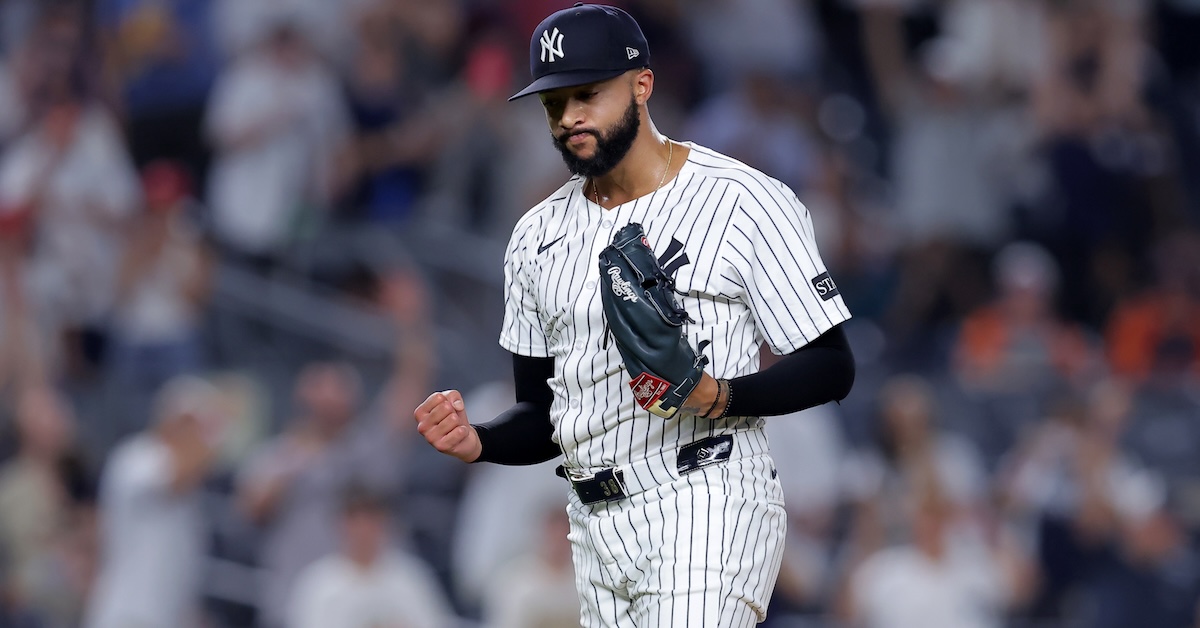
Devin Williams, the lights-out reliever with the M. Night Shyamalan changeup, has agreed to a three-year deal with the Mets. A two-time All-Star, Williams earned NL Rookie of the Year honors in 2020 and scored a down-ballot MVP vote as recently as 2023. Even after a disastrous 2025 season kicked his career ERA all the way up from 1.83 to 2.45, he still has a career ERA of – you guessed it – 2.45. Here’s my first piece of analysis: That’s so good, you guys! Assuming he won’t keep running a 55% strand rate from here on out, the Mets just signed up for three years of one of the best relievers in baseball; meanwhile, Williams just signed up for a quick ride from the Bronx to Flushing, but it’s important to note that the ride is always going to be longer than Google Maps predicts, because the odds of actually catching an express 7 train rather than the local are vanishingly small.
Let’s start with the terms of the deal and the credit for who reported which parts of those terms, and then we’ll take a nap and perform some more light analysis. Cool? Cool.
The deal is for $51 million. That would work out to a tidy $17 million per year, but because $5 million per year will be deferred for 11 to 20 years, the net present value and the average annual value for luxury tax purposes drop to a bit under $14.8 million. Also, $2 million per year will take the form of a signing bonus. The deal doesn’t include a no-trade clause or options, but it does have a $1 million assignment bonus in case Williams gets traded. How do we know all that? We know because Anthony Franco of MLB Trade Rumors told us that Will Sammon of The Athletic broke the news that Williams was signing a three-year deal, Jeff Passan of ESPN broke the news that the dollar value was above $50 million, Jon Heyman of the New York Post reported the actual terms of the deal, and Ken Rosenthal of The Athletic broke the news about the assignment bonus, and also because Jon Becker of our very own FanGraphs calculated the AAV down to the cent: $14,792,239.20. See, didn’t all that make you want a nap?
Story lines should wake you up, and you can really take your pick here. Williams is now the ninth former Brewer David Stearns has reconnected with in New York, according to Curt Hogg of the Milwaukee Journal Sentinal. He’s also the first reliever for whom Stearns has ever shelled out serious money. It’s fun that Williams is staying in the big apple because, like so many players who struggle in their first season wearing pinstripes, Yankees fans quickly decided that he just couldn’t handle the outsized expectations and corresponding pressures of playing in New York City. It’s even more fun that Williams was the impetus for the Yankees’ ending their decades-long facial hair policy, only to put up the worst season of his career for them and then decamp to their crosstown rivals. More importantly for Mets fans, as soon as the news of the signing broke, so did reports that the signing won’t preclude the team from re-signing Edwin Díaz. Should that come to pass, the Mets bullpen would boast one of the most devastating one-two punches in the game.
Let’s analyze all those dollars. First, we should note that ever astute FanGraphs readers pegged Williams for a median contract of three years and $42 million. Good work, team. Next, we should note that Ben Clemens had Williams at two years and $24 million, while MLB Trade Rumors had him at double that, four years and $68 million. That’s quite a bit of variability. As Andrew Mearns noted for Baseball Prospectus, Williams didn’t get the megadeals of Díaz and Josh Hader because he entered free agency after his age-30 season and because he put up an ugly platform year. How ugly was it? How does a 4.79 ERA, a WPA of just 0.08, and losing the closer job twice in one season sound to you? Here I’ll quote BP’s Ginny Searle: “You could add up Williams’ ERAs from his final three seasons as a Brewer and they wouldn’t come to the mark he posted in his single (and likely only) season in pinstripes.”
On the other hand, how does a 2.68 FIP and being above the 96th percentile in chase rate, whiff rate, and strikeout rate sound to you? You know about this dichotomy already. Michael Baumann wrote about it. Ben Clemens and Eric Longenhagen wrote about it. Mario Delgado Genzor wrote about it twice at BP. For that reason, I won’t dive too deeply into it here, but the point is that while the Mets are spending quite a bit of money, they’re still buying pretty low on a truly elite reliever coming off a fluky season. Somebody was always going to pay Williams closer money on the assumption that one bad season didn’t completely change who he is as a pitcher. In that sense, it’s a little surprising that Williams signed so early. It’s not hard to imagine another team offering opt-outs, an extra year or two, or a guaranteed closer role. Sammon reported that five other teams were interested, including one that tried to swoop in with a competitive offer on Monday night.
Time for the baseball analysis. I mentioned strand rate in the first paragraph, but let’s make sure we hammer that point home. Some pitchers really are worse with runners on base, but strand rate is a classic indicator of bad luck. Over the first six years of his career, Williams ran a strand rate of 81.8%. In 2025, he was at 55.2%. That’s a drop of 26.6 percentage points. It’s impossibly large. Since 2000, we’ve seen 6,897 different player-seasons of at least 60 innings pitched. Williams’ 55.2% mark ranks 6,888th. That’s 10th from the bottom. It’s impossibly low. No matter what happens next year, even if Williams is actively bad all of a sudden, we should still expect his strand rate to jump way, way up (and his ERA to fall).
That’s not to say Williams’ 2025 numbers contained no smoke at all. Both his fastball and his changeup lost some induced vertical break, and the fastball lost some horizontal break too. In other words, the fastball was just a bit straighter, and stuff models accordingly graded it just a hair worse than they had in seasons past. Williams’ arm angle also dropped down to an average of 21 degrees, the lowest mark of his career. That more horizontal arm angle could render his trademark wild horizontal movement a bit more predictable for hitters. Lastly, although his fastball velocity has stayed more or less constant over the past four years – he averaged 94.1 mph in 2022, then 94.2, 94.7, and 94.1 again – the league’s average fastball velocity hasn’t remained constant. In 2025, that 94.1-mph mark meant that his fastball was below average in velocity for the first time ever.
All that showed up in the numbers. Although they were fantastic, his 34.7% strikeout rate and 40% whiff rate were his lowest since since his 13-game debut in 2019. The bigger problem was what happened when batters didn’t miss. In 2025, Williams ran the highest exit velocity (89.5 mph), hard-hit rate (35.7%), and barrel rate (9.3%) of his career. As a result, his .367 xwOBA on balls in play was the highest of his career too. That was the exact league average in 2025.
To be clear, none of this really needs to change in order for Williams to get back on top. If you can run absurd strikeout numbers while giving up league-average contact when batters do put the ball in play, you’re going to be just fine (unless you have some abysmal luck). While the Mets would love nothing more than for Williams to turn in yet another season with a sub-2.00 ERA, they’re probably not expecting that either. They would surely settle for three years of mere excellence.
Davy Andrews is a Brooklyn-based musician and a writer at FanGraphs. He can be found on Bluesky @davyandrewsdavy.bsky.social.
Absolutely insane that he ran a 4.79 ERA while allowing a .271 wOBA, haha.
Good signing for Stearns.
It was 100% not shaving his beard. How else could anyone explain what happened?
Great signing for the Mets. He’s a top 5 reliever in baseball, possibly top 3, and he’s being paid much less than the other guys in that tier. I understand Mets fans are going to want to bring back Diaz, but it doesn’t make sense to have both when the Mets have so many other holes to fill. I would much rather have Williams on this contract than Diaz on whatever he ends up signing for, plus the Mets will net a draft pick.
In addition to being the ninth former Brewer Stearns has brought to Queens, Williams is the seventh former Yankee for Stearns, eighth if you count Carlos Mendoza. And they might get Cody Bellinger, too!
Reports are the Mets still wanna bring Diaz back and have a monster 1-2 punch in the pen. They want Edwin on a three year deal with a high aav while Diaz wants five years. I could see them signing Suarez or Fairbanks on a short term deal to pair with Williams. I agree with you on this deal I love it and expect Williams to put up great numbers here. I’m not real crazy about Bellinger as his home-road splits scare me among other things.
Assuming the Mets stick to the same payroll range as previous years, they have about $60 million to spend. They need at least one infielder, at least one outfielder, at least one starting pitcher, and relievers.
Spending $20 million of that budget on a second elite closer just doesn’t make sense, especially when the reports were that they really went out of their way to gun for Williams. I’m sure they would like Diaz back, but I can’t see it happening.
Why assume Steve Cohen wants to stick to the same payroll range after missing the playoffs?
I mean, of course they want Diaz back in an abstract sense, in that they’d be a better team with him than without him. But are they really going to be his high bidder after this signing?
Reading through the news reports and between the lines it looks like the Mets have a price, and it’s something like three years, $70M, probably with money deferred (I would a similar percentage as Williams, but that’s literally just a guess).
I think he can probably get a larger guarantee from another team over 4 years though. And I don’t think the Mets will go above the number they set.
They absolutely should be. There is no reason whatsoever that the Mets shouldn’t be the high bidder. Even if it means having a bid-off with the Dodgers.
Always weird to me when you see a team wanting a higher salary (bad for the team) and fewer years (years of control, years when the player is obliged by contract to work for them)
Like, I dunno, I get that the total outlay is usually higher when you add the extra year, but *in itself* the extra year is to the team’s benefit??
Presumably they see it as a way to give the player something back in the negotiation that he values more highly than they do, but yeah, when what you’re giving him is his age-36 season…
Do we really need to be talking about age all the time? Hall of Fame talents don’t exactly follow the aging curve.
Yeah but like, if I could get a player for 4/$80 or 5$90, say, then I’m only paying $10 for that age-36 season which is not a lot!
Yes, I am basically in agreement with you. But making the former offer would suggest they think the player values that season more highly than that, so if it’s a sticking point in the negotiation, then they’re happy to give it up.
defense ain’t got no splits
Payroll limits are largely optional for the Mets now. That doesn’t mean they’ll give everyone their desired contract but it largely makes ideas like “opportunity cost” less useful.
It’s endearing until they start actually winning pennants and then it will be infuriating.
From your mouth to Jah’s ears!
That gives us three teams that are in this zone: LA, Toronto, and the Mets. The weird thing is, feels like the Yankees don’t really fit in this class.
It is hard for me to figure out whether LA and Toronto treat payroll limits as optional or if their payroll limit is so high it just doesn’t matter.
I am fairly confident the Mets lost money in 2025. Probably them and the Padres, and then a few teams that burned all their goodwill with their fanbases like the A’s and Marlins.
And I am pretty sure that the Blue Jays and Dodgers did not lose money, even if you subtract the playoff money. Their business arrangements are set up so that they are basically printing money. Not only am I confident they make a profit, it is quite possible that they are the two teams that make the *most* profit, even before playoff money. And that gives them flexibility to say “I will splurge now” even if theoretically a payroll limit exists somewhere. Opportunity cost probably exists somewhere for them and they are aware of it but it is farther away than for most teams.
The Yankees absolutely *should* be in the same category as them because they print money too. But they have decided to sit on that mountain of cash instead. Which is their right under this whacked out cartel system that means no new MLB teams will open up anywhere near their territory but the fans typically don’t like it.
“I am fairly confident the Mets lost money in 2025″. Not trying to be a d*ck, just genuinely curious: what makes you feel this way? Again – all due respect, you seem to be a reasonable and well informed person.
The Mets have been losing money every year since Cohen bought them. According to the Forbes annual MLB reports, the Mets have lost over 100 million a year for like 5 consecutive seasons so it’s a pretty safe bet they repeated that. In 2024-2025 their operating income was -262 million, and in 2023-2024 it was -292 million. They just added a fairly large player expense in Juan Soto, and missed out on playoff revenue so honestly it wouldn’t be surprising if they had a net of -300+ million this season.
I think when the Mets traded for Helsley, they were hoping he could fill this role – affordable, powerful 8th inning guy or potential closer if Diaz prices himself out. Unfortunately, it just didn’t work out.
You make a good point on his salary relative to his tier. I admittedly watch more Mets games than Yanks games, and maybe I’m cherry-picking, but it seemed like Dev started losing some confidence as the season wore on. The velo dropped, HH has steadily increased if you remove the injury-plagued 2024, GB/FB steady decline, too.
I hope he’s able to reverse the trend and have a successful run in the coming years as a Met.
I don’t remember ever seeing a Sam Cooke reference on a baseball site. Thank you for correcting that egregious omission
Has no one worked “bring it on home to me” into a story about stealing home?
Nor “Chain Gang” in an article on bullpen construction, nor “Twisting the Night Away” in an article on screwballs, nor “Wonderful World” in an article about how analytics is ruining the game.
One day I will write an article about aggressive third base coaches and it will be called You Send Me and that will be the act that gets me into heaven.
I will spend Another Saturday Night reading it
For a large part of last season he had no idea where the fastball was going. If he doesn’t locate that, it all falls apart very quickly because he lacks a meaningful third pitch.
The evidence doesn’t really support that, though. 49 of his 62 outings were clean, where he gave up no runs. In those outings he had a BB/9 that would have ranked in the top 20% of all pitchers.
His bigger problem is that he had way more bad outings where he gave up 3-4 runs than he ever had before in his career. I think there were nine of them, which is Tanner Scott level bad.
But if he can reverse a little of his BABIP luck, I could easily see him sliding back to the upper tier of relievers.
His control problem was resulting in balls getting smashed when he tried to come into the zone, not walks.
It wasn’t luck, these were hard hit squared up line drives.
If he isn’t spotting the 4 seam fastball on a corner, the rest just falls apart.
I have noticed that the Mets shy away from signing free agents with a QO under this ownership, with the big exception being an enormous deal that lasts forever for Juan Soto.
I suspect part of the reason why they are going after the bullpen early instead of starters is that all of the best options (Diaz, Suarez, and Williams) won’t cost them their second round pick, although if Diaz signs somewhere else I think they get a 4th rounder.
I don’t really see them going in on *any* of the top free agent starters except Imai for this reason (although Imai has his own issues too). I have to imagine that they are letting the posting process for Imai play out, monitoring the market for Ponce and Bassitt.
I don’t disagree with you about this, as a description of their revealed preferences, but it seems weird to implicitly value the QO draft picks, specifically, that highly given that they’re already sacrificing so much of the rest of their draft to the CBT penalties in recent years. Why are these picks so valuable that you’d want to let them significantly constrain your strategy, when the other ones aren’t?
They might view the 2nd as especially important, given that they can’t really play the comp pick game themselves and pick later in the 1st.
The way teams value draft picks is incredibly irrational across the league. Take a look at the caliber of prospects that get picked in the second round. Giving up a prospect from that range to secure many QO caliber players isn’t all that different than trading a prospect for them. But teams are often much more likely to trade a prospect at that level than give up a draft pick.
It’s even more irrational when you’re talking about teams giving up a fourth rounder.
I think it has to do with the mystery-box feel to draft picks. Teams must think they can do better with all these options in front of them than what they already have.
How much of that irrationality is just cover for “we didn’t want to pay him what he was looking for”?
If so it’s more that they’re lying to themselves than to us. I think admitting that would be the opposite of a “we tried.”
I’m not sure if it’s the 2nd round pick so much as the 2nd round pick bonus allotment which allows them to be creative with how they use their $$.
Kind of silly? Yep, but, I think what a lot of these teams want is flexibility to be creative & not having a path taken away. Losing a 2nd rd pick takes away/narrows the path.
I won’t attempt to claim that I can predict how relief pitchers are going to perform in any given year but Williams offers us a conundrum the likes of which I can’t remember ever seeing before. Is he good or is he shaky and that can be expanded to is he really good or is he just plain bad? In 10 games in 2025 he gave up multiple runs. Maybe a good way to say it is that when he wasn’t awful he was good, or is it that when he wasn’t good he was awful? This is the third major free agent pitcher to be signed for substantial money and each carries a huge question mark. Cease looks like an overpay even if he performs at a reasonably expected level. If Helsley doesn’t fill the closer’s role then he is getting too much also. I am the last person on this site to look beyond performance and rely on the peripherals to measure future value but I am also rational enough to see the gross outlier that Williams 2025 appears to be. Of the three deals I am casting my lot with Williams as the one with the best chance of working out.
It looks like Devin Williams was no longer as wild as he was in the past and as a result he got hit harder. We usually think of wildness as being a bad thing but I suspect when you only have two pitches the wildness helps keep hitters guessing. That EV increase was really big!
If it’s just an arm angle issue then it really should be fine. The stuff is basically the same as before. I have to imagine that a team wouldn’t be investing this much in a pitcher if they didn’t think they knew what went wrong before and how to fix it. Having a plan and executing a plan doesn’t always mean the same thing, but I still think this a gamble worth taking.
He was actually extremely good when he wasn’t bad. Like lights out good.
As good a first graf as any I’ve read on this site
Great idea for content in slow stove season. Set up a nomination process and let the people speak!
I said when the Orioles signed Helsley that I would have preferred to pay more to get the better reliever in Williams. Given the amount of deferrals, it ended up being even less than I expected. This is a fantastic deal for the Mets.
For almost equal AAV Williams would seem to be the better gamble. The variability of almost all relief pitchers not named Mariano Rivera, please explain the 2025 season of Chapman, causes me to withhold any judgment stronger than seems to be, but Williams “airbender” comes close enough to Pedro’s changeup that he gets the nod.
What’s interesting to me is that people are acting like relievers don’t tend to have up-and-down careers, alternating completely dominant seasons with wtf is he doing seasons. Only a few guys at the very, very top have consistently produced as a closer for a long period of time. And even some of those guys occasionally had a bad one. Edwin Diaz, the other half of this two-headed monster the Mets want to build, had a higher FIP last year than Williams did this year. And a lower fWAR. I don’t recall people saying he was washed.
A+ title…now I want to go listen to the cover by Sananda Maitreya for the 562nd time
I abhor the hot take culture and endeavor not to participate in it, so I plead one doesn’t misconstrue my intent, as my take on Devin Williams is admittedly unscientific and rather conclusions based on following his career with the Brewers. There are elements of his profile one can’t glean from the surface numbers alone and are only apparent when you watch him pitch every day.
What I don’t think the wider world realized about Williams prior to him joining the Yankees is that there is an inherent volatility in his makeup that is always threatening to unravel him. He would generally post a frame that was pristine in the box score but ulcer-inducing if you watched it in real time. I’ve seldom seen a reliever of equivalent talent so frequently create a high stress situation, then throw 30 pitches to erase any memory of it. I was pleading for Megill to usurp him as closer even when Williams was still in Milwaukee.
His implosion in the WC notwithstanding, this is the same guy that missed a postseason because he put his pitching hand through a barroom wall. Conclusion: A closer who struggles to handle stress. I suspected the magnifying glass of New York would cook him like an ant, and I believe I was correct in that analysis.
David Stearns is a brilliant executive; Devin Williams is an extraordinary talent; thus I wouldn’t be surprised if last season was an anomaly and this ends up being an excellent signing. I’m just saying if it’s anything but, I won’t be surprised at that either.
Is that observation something that’s quantifiable by like pitches/PA or wild pitches or exit velo on foul balls? I’ve thought this about some pitchers and haven’t thought enough about how quantifiable it would be.
I was wondering about the same thing.
I thought of maybe you could look at runners on base. Devin Williams’ strand rate was huge, which is common when you strike out 13-15 over nine innings, but the walks seem to have put a lot more runners on base than other closers of the same caliber.
But then again it’s not stressful if you just walk one guy, it’s stressful if a runner is in scoring position. So what you would really want to do is see how many PAs had a runner in scoring position.
And with relievers this just so quickly runs into sample-size issues.
I appreciate everything Devin did in a Brewer uniform. He was a great player and teammate
That being said I think whatever bounceback he has will be less than wanted/expected.
I have no support for the above save instinct and being a fan of many decades. Think Devin enters a Sergio Romo mode of the career where he lurches between ok and blah after a several year run of awesome. But hits 30 and things erode just enough to make consistent excellence no longer possible
Hope I am wrong. Wish him the best
Was curious about the other seasons with the lowest strand rate. It turns out that Williams was the only pitcher who had a decent performance outside the strand rate. Williams had a 2.68 FIP for 1.4 fWAR; the only other pitcher with a bottom-ten strand rate who broke 0.3 fWAR was Ross Stripling in 2024, who put up 1.1 fWAR with a 3.89 FIP; but Stripling was getting rocked pretty hard on contact, with an xERA of 4.75, and wound up retiring after a disastrous spring training with the Royals the next year.
The very worst performance among the bottom-ten strand rates was Edwin Jackson in 2019, who stacked his 54.7% strand on a 7.65 FIP to knock his -1.1 fWAR down to -2.4 bWAR. But even worse than Jackson’s 9.58 ERA was Roy Halladay’s 10.64 ERA on a 48.7% strand rate in 2000 (-0.3 fWAR, -2.8 bWAR). Halladay wound up improving. Single worst strand rate was Luis Mendoza in 2008 with an unbelievable 45.7% strand rate. Mendoza was mostly in the minors the next three years but did fight back to have a season as a pretty average starter for the Royals in 2012.
Just put Sam Cooke into the queue at the bar. For a second I figured this was a Baumann title. Kudos to Davey
This is a grave insult to ATLA fans.
Yip Yip!
This is a disgustingly good deal for the Mets. He finished out this season really, really strong. The last two months, really, he went like three weeks at one point without allowing a run and only one hit.