
Please Help! My Devin Williams, He’s Not Well!
On Wednesday, the Yankees went to Daikin Park for the middle game of an important three-game set against the Astros. The Yanks were 2 1/2 games behind the Blue Jays in the AL East with the two divisional foes scheduled for three games in the Bronx this weekend, so maybe this matchup with Houston wouldn’t have a direct impact on their place in the standings, but every win helps at this point in the season.
With the game tied 4-4 in the bottom of the eighth, manager Aaron Boone called on Devin Williams to hold the line. Williams, a two-time All-Star and the 2020 NL Rookie of the Year, came to New York this past offseason after posting an ERA under 2.00 in each of his last three seasons with Milwaukee. This season, his last before he hits free agency, has been… uneven, let’s say, and I’ll get to that.
Still, through all the ups and downs, Williams has remained one of Boone’s high-leverage guys. He’s a big-time reliever, and a tie game on the road against a major postseason rival is a big-time situation. So on Williams came.
He quickly got up 0-2 on Carlos Correa with a pair of his signature Airbender changeups. Correa declined to chase a third, so Williams came back with a fastball.
Not a great pitch — probably caught too much of the outside corner — and while Williams put it in a place that was hard to pull for a home run, Correa has been tucking his hands in and flicking outside fastballs down the right field line since the latter days of the Obama administration. It happens. We go again.
Williams walked the next batter, Jesús Sánchez, on five pitches. Statcast shows that the first two fastballs caught the upper corners of the zone, but were called balls by home plate umpire Brian Walsh. Williams would have reason to be aggrieved, but the first pitch, especially, had such wicked late movement I see why Walsh missed the call.
Also, Austin Wells has done better framing jobs in his career. Tough break for Williams getting down 2-1 in the count, but once there, he followed with two not-especially competitive changeups.
A leadoff double is an issue. A leadoff double followed by a five-pitch walk is a snowballing crisis. Williams did well to retire Yainer Diaz on a nine-pitch strikeout. In the interest of balance, I’ll show you the positively nasty right-on-right changeup that did Diaz in.
But now Williams, as pure a one-inning reliever as you’ll find, was already up to 18 pitches with two more outs to get. And when he walked Christian Walker on six pitches to load the bases, his arm only got more tired as his predicament got worse.
Williams climbed the ladder on Ramón Urías and got him to chase a 2-2 fastball, leaving him one batter from escape. Retire Taylor Trammell and everything would be fine.
Unfortunately, Trammell drove in the go-ahead run without taking the bat off his shoulder. Williams got squeezed again on an up-and-in fastball — almost a carbon copy of the borderline call he’d lost against Sánchez. And when the decisive 3-1 pitch came, Williams threw a pretty good changeup: nasty movement, just below Trammell’s knees.
But let’s get into Trammell’s shoes here for a moment. You’re up 3-1 in the count, with the bases loaded, against a pitcher who’s already thrown 33 pitches and walked two batters in the inning. I wouldn’t go out of my way to defend the edges of the zone in that situation. Neither, it seems, would Trammell.
Never interrupt your enemy when he’s making a mistake.
That was enough for Boone, who replaced Williams with Camilo Doval, then watched as Doval immediately made the situation worse. A single, a bases-loaded balk, and a wild pitch brought home all three inherited runners and gave the Astros just enough margin to survive a Yankee comeback in the top of the ninth.
Williams has had a hard time of it over the past week; in his last outing before the meltdown in Houston, he blew a save against the White Sox. That means that over the past week, he has allowed five earned runs and eight baserunners over the course of 11 batters faced. His ERA has leapt up nearly seven-tenths of a run, to 5.60.
That’s a nightmare, especially in a position — “Yankee closer” — where the standard is literally perfection. Nowhere else in baseball have the fans been so completely spoiled by a historical outlier. Nowhere is the curve so entirely broken.
It’d be one thing if Williams were just completely cooked, if the Brewers had gotten out of the Devin Williams business at exactly the right moment. But I’m not convinced that’s true.
Wednesday’s outing was a microcosm, you see. I’m not going to say that Williams, who allowed three walks and an extra-base hit in a high-leverage situation, deserved better than what he got. The last time I was on Effectively Wild, Meg asked me what the worst way to lose a baseball game is. My answer was basically what Williams put the Yankees through: when a high-leverage reliever just cannot stop walking people. It’s the kind of excruciating slow-motion death that makes a person believe in Hell.
For that reason, I don’t expect Yankee fans to give a little bit of a crap whether Williams has been truly bad or just unlucky this year. High-leverage relief is a results-based business. Anyone who says the words “BABIP monster” after a closer blows a lead is probably going to get (deservedly) a drink thrown in their face.
But the difference between disaster and a routine clean inning was three borderline strike calls and maybe a couple inches of movement on the 1-2 fastball to Correa. Moreover, the inning didn’t turn into a nightmare until Doval came in and poured paint thinner on the embers. A poor performance was made to look like a total fiasco through factors that were at best only kind of within Williams’ control.
What am I talking about? Take a look at this.
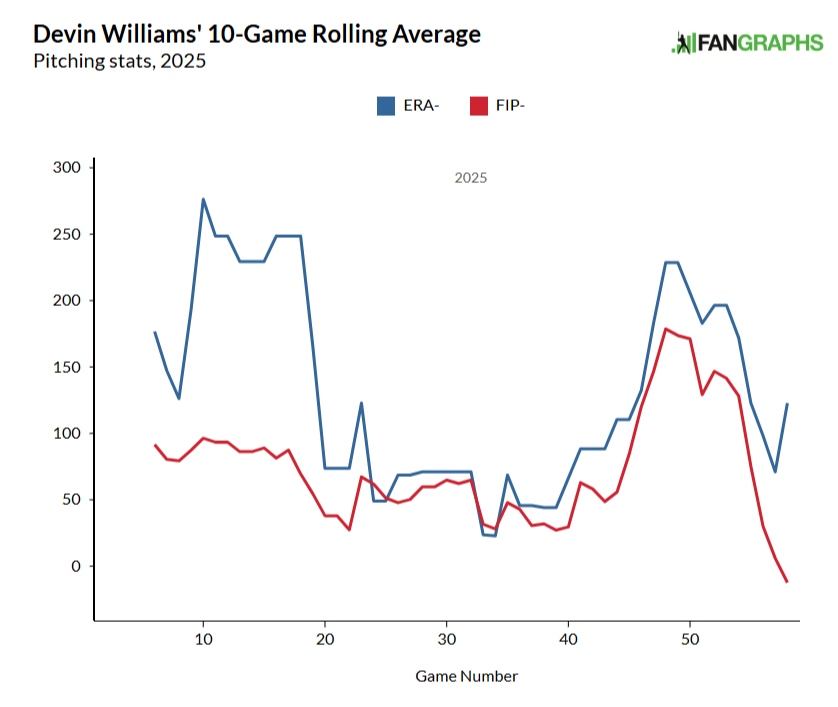
Williams got off to a rough start this season. In his first 14 games, he allowed three or more earned runs as many times as he pitched a clean inning (four times each). His ERA was over 10.00 as late as the first week of May.
But over his next 42 appearances, Williams had an ERA of 3.40, with 61 strikeouts and only nine unintentional walks in 39 2/3 innings. In those 42 appearances, the Yankees went 30-12, a winning percentage of .714. Over parts of six seasons, the Brewers went 191-64 when Williams pitched, for a winning percentage of .749. If he was worse during that stretch than he was at his peak, it wasn’t by a huge amount.
In fact, that blown save against the White Sox busted up a run of eight appearances in which Williams had struck out 18 of the 25 batters he faced, while allowing just three baserunners and a single unearned run.
Even if you factor in the rough patches at either end of the season, Williams’ underlying numbers remain respectable, if not downright good. He’s still striking out 34.7% of opponents, which is down from his peak in the low 40s, but still seventh among qualified relievers. It’s fair to ding Williams for his double-digit walk rate (especially after what went down on Wednesday), but his K-BB ratio is still 14th among qualified relievers.
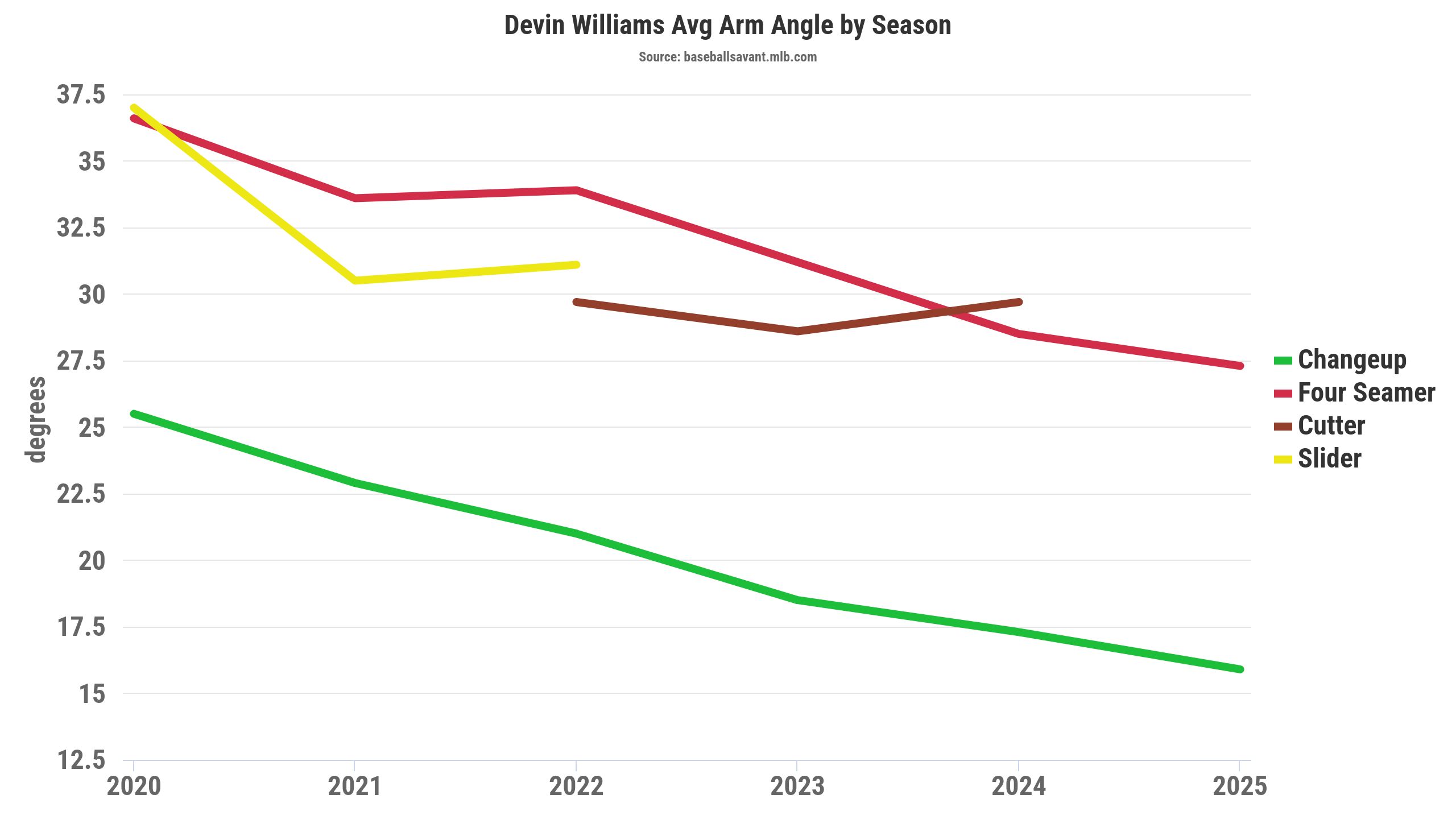
Mechanically and stuff-wise, the only yellow flag I see from Williams is that his arm angle is sagging a little. It’s dropped about two degrees a year since his rookie season, and it’s down to 21 degrees in 2025. But that’s a gradual process that’s unfolded over his entire career, not a sudden change in release point that came out of nowhere this spring.
Is the lower release point messing with Williams’ stuff? I guess it’s possible, but he’s still in the 98th percentile for chase rate, whiff rate, and strikeout rate. His fastball and changeup are still coming in at the same velocity they always have, with the same movement.
What’s really cooking my noodle, so to speak, is this: Williams has a 5.60 ERA this year, but only a 2.95 FIP and a 3.17 xERA. As many of you probably already know, that is a massive, massive incongruity on both counts.
It’s the fourth-biggest discrepancy between xERA and ERA this year. The only players who are getting screwed more by luck and/or clustering this year are Cole Ragans (injured), Bradley Blalock (pitches for the Rockies), and Jordan Romano (don’t ask, I don’t want to talk about it). The difference between Williams’ ERA and FIP is the third largest among pitchers who have thrown at least 40 innings, trailing only Romano and Ragans.
So is it luck, or is it clustering?
Well, there are a couple fluke indicators. Williams is running a .304 BABIP this year, which is higher than his .250 mark last year and his career average of .260 heading into this season. Opponents are also making contact on 56.4% of swings outside the strike zone, which is not unusual globally but it’s downright bizarre for Williams, who’s one of the chasiest and whiffiest pitchers in all the land. His O-Contact% last year was 44.9%, nearly identical to his career average of 44.8%.
When hitters make contact outside the strike zone against Williams this year, they’re hitting .325 and outproducing their xwOBA by 50 points. The league-wide batting average on contact outside the zone this year (including foul balls) is .282. From 2022 to 2024, Williams’ opponents hit just .169 on contact outside the zone.
But the outlier fluke indicator that got me worried was Williams’ left-on-base percentage: 50.0%, the second worst of any qualified reliever in baseball. Only Romano, with his ERA of 8.23, has been worse in this respect.
That’s so far outside the norm it has to be a bad sign. If you roll snake eyes twice in a row, that’s bad luck. Even two, three, maybe four times in a row. If you roll snake eyes 18 times in 20 throws, there’s something wrong with the dice.
| Runners? | wOBA | xwOBA | Whiff% | HardHit% |
|---|---|---|---|---|
| Bases Empty | .245 | .243 | 38.8 | 30.8 |
| Runners On | .334 | .335 | 36.3 | 41.8 |
| RISP | .311 | .317 | 36.3 | 35.1 |
What’s going on with Williams with men on base?
Well, the place I wanted to start was the more than 11-degree difference in arm angle depending on whether Williams is throwing a fastball or a changeup. That’s visible to the hitter for sure. Kirby Yates, to give another example of a fastball/offspeed reliever who’s struggled with men on this year, has less than a one-degree difference.
But that separation not only persists regardless of base-out state, it’s been there throughout Williams’ career.
Let’s see if anything goes haywire with Williams’ control, based on who’s on base and where.
They’d Have To Call in the Military Police, Part 2
| Runners? | FF Zone% | CH Zone% | FF In-Zone wOBA | CH In-Zone wOBA | FF O-wOBA | CH O-wOBA |
|---|---|---|---|---|---|---|
| Bases Empty | 50.4 | 43.6 | .269 | .292 | .328 | .098 |
| Runners On | 51.7 | 39.1 | .198 | .447 | .462 | .268 |
| RISP | 51.1 | 39.2 | .168 | .286 | .502 | .315 |
In the process of making this chart, I accidentally sliced the pie so thin I was able to find out that Williams is getting killed on changeups in the zone with a runner on first, and only a runner on first. That’s a sample of just 24 pitches all year, and included in those 24 pitches are just six balls in play.
Included in those six balls in play are four of the 17 extra-base hits Williams has allowed this year, including two of his five home runs. Opponents have a wOBA of .904 when Williams throws a changeup in the zone with a runner on first, which is interesting, but perhaps not predictive.
My next theory was that Williams’ opponents were profiting by doing what Trammell did: Forcing him to throw strikes with men on base. With the bases empty, what the heck, go do the best you can. But when a walk can load the bases or force in a run, why give Williams what he wants?
| Year | Total Chase% | Bases Empty Chase% | Runners on Chase% | RISP Chase% |
|---|---|---|---|---|
| 2020 | 33.6 | 32.9 | 34.9 | 30.8 |
| 2021 | 31.9 | 29.6 | 35.0 | 33.6 |
| 2022 | 32.3 | 32.4 | 32.2 | 29.8 |
| 2023 | 32.6 | 32.9 | 32.2 | 31.0 |
| 2024 | 29.4 | 35.4 | 20.9 | 23.3 |
| 2025 | 34.3 | 32.5 | 36.2 | 35.3 |
Not so. If anything, opponents have been more aggressive this year against Williams, not less, with men on base.
But those pesky chase pitches are what’s killing him. From 2020 to 2024, Williams allowed six hits and two sacrifice flies, total, on pitches outside the strike zone with runners on base. In 2020 and 2024, hitters didn’t get a single productive outcome by chasing with runners on base.
This year, Williams has thrown 254 pitches outside the zone with men on base. From those pitches, he’s drawn 92 swings, generating 22 balls in play. That alone is unusual; it’s the highest figure since his 2019 call-up, both in raw numbers and as a percentage of total swings.
The real problem: Those 22 balls in play included 10 hits, or four more than Williams allowed in those circumstances across the rest of the 2020s put together. From 2020 to 2024, his opponents hit .143 with an xBA of .206 on balls in play from pitches outside the strike zone with runners on. This year, they’re hitting .455 with an xBA of .303.
Nine of those 10 hits were singles. Only one had a triple-digit exit velocity, and only four had an exit velo over 80. But those 10 hits drove in 10 runs, or 27% of the total output against Williams this year.
I think it’s fair to conclude that Williams is somewhat less than what he was at his peak. But he’s still doing what he’s always done, which is getting hitters to swing at pitches outside the strike zone in massive volume. I just didn’t know that it was possible to do that and get shelled anyway.
Michael is a writer at FanGraphs. Previously, he was a staff writer at The Ringer and D1Baseball, and his work has appeared at Grantland, Baseball Prospectus, The Atlantic, ESPN.com, and various ill-remembered Phillies blogs. Follow him on Twitter, if you must, @MichaelBaumann.
Boone should’ve pulled him after the walk to Walker. He gambled that his unreliable reliever could get two outs from mediocre hitters. He couldn’t.
I can sympathize — I’ve done the same too many times in OOTP
His struggles pale in comparison to Ryan Helsley’s the last six weeks but still pretty ugly. Who could have seen Durbin having the best year out of him, Williams and Cortes?
Helsley might be having one of the worst stretches from a high-leverage reliever we’ve ever seen. He has four blown saves in his last 10 games and an ERA of 16.43. First reliever to do that since 2006.
He’s been the Mel Rojas redux and Mendoza using him over Raley or Rogers down by one with a day off coming up was idiotic.
With the way relievers are, if I need relievers I’m going hard after both Williams and Helsley. They still have the stuff, and their peripherals are down just a touch but they’re still great. And both of them are basically unhittable between 2022 and 2024. Relievers work in such small samples, you can’t overreact to them melting down a few times when they have so many things going for them.
But that’s still not much consolation right now.
Helsley has to be tipping. There’s no way this is just volatility.
Ah, an article about a struggling Yankees reliever. I expect the comments to soon be full of balanced, well-reasoned discussion.
Relievers are so, so, so volatile. You can do basically everything the same as always, and the results of ~30 balls in play over a full season can turn you from elite to terrible.
At times it’s very much looked mental just from his body language, but by-and-large Williams is struggling because of poor luck. It’s just that nobody, and especially not Yankees fans, ever wants to admit luck plays a huge role in baseball. Why is the team underperforming its run differential and especially BaseRuns dramatically? Ask a Yankee fan, and he’ll say it’s roughly 0% luck and 100% Aaron Boone.
I’m still trying to figure out why Andrew Friedman saw all those years of Joe Kelly and then decided to double down on Tanner Scott AND Kirby Yates.I’m perfectly fine with throwing $300m at a guy who can win a CYA when healthy, but relievers are relievers because they are inherently volatile…
Honestly, because they print money and don’t need to be efficient with their spending.
Williams seems to be a character guy, I listen to FAN mornings and he seems to always be available post blowup, saying the right things. Hope he gets squared away. I think the Brewers had a significantly better defense than the Yankees, is the sample size too small to know if this is a factor?
If the hits Williams were given up were ground balls, maybe, but that doesn’t seem to be the case. I’d be curious in batted ball data from his hitters (are they hitting it harder/better than they used to against him wrt ev, barrels, etc.)?
Brewers 2024 OF defense +6 runs. 2025 Yankees -29 runs.
Doesn’t explain the men on base thing though
Where’d you get -29 runs?
Yankees outfielders have -9 DRS and -3 FRV this season
The whole team is at -12 OAA. Fascinatingly, that’s almost entirely occurred with two specific pitchers on the mound: Fried (-7) and Leiter Jr. (-10).
It includes the positional adjustment
I haven’t paid all that much attention to the Yankees this year outside of national articles, so my main impression is that of a poor defensive club without great fundamentals. Seeing Williams’s BABIP jump that much from a relatively stable for multiple years number (playing for a team known to emphasize athleticism and defense) to over .300 makes me wonder the effect of the Yankees defense on Williams. Maybe I can take a look during lunch, but any ideas how to separate signal from noise, given that both stats (BABIP and pretty much any defensive stat in small sample sizes) are kinda messy?
The Yankees defensive issues basically are:
1) Jasson Dominguez
2) Volpe going through error funks
3) Rough edges on Rice at 1B/Stanton in LF
4) Did I mention Jasson Dominguez?
It’s just that every mistake (error, base running or otherwise) seems to have happened in higher leverage spots and is, of course, blown up to massive proportions because NY. They also clustered at a time where the team was playing at its worst.
For what it is worth, Statcast’s FRV for the Yankees while Williams is on the mound this year is 0. +1 from range, -1 from framing (which honestly could have all been that appearance). His career in Milwaukee: net 0 every season (it’s hard to move the needle much in that few IP). There’s some plus 1 cancelling out some minus 1, but it wasn’t as if there was some huge difference surfacing there.
Peripherals are slightly worse with men on base but that’s leagues wide. The .377 BABIP explains why the team expects positive regression
Ok, so I see a statement that 24 pitches is a huge burden on a pitcher…but also a reference to something called a “carbon copy,” so I’m confused as to what year it is.
I believe every non Yankees fan refers to this as heaven.
Reliever blows a few games in tiny sample size, news at 11:00.
Even the great Mo shat the bed in the 2004 playoffs.
It is very, very annoying to have these video clips start automatically. I would like to make the decision how to read the article, and when to play, or not play, these clips.
That’s a browser setting somewhere; I’ve the same bias but mine do NOT play upon loading of the page.
Chrome no longer lets you disable auto play (because it was harming ad revenue), so you’ll either need a different browser or an extension.
“High-leverage relief is a results-based business. Anyone who says the words “BABIP monster” after a closer blows a lead is probably going to get (deservedly) a drink thrown in their face.”
I chuckled, but also this is ironic since the takeaway of the analysis seems to be the difference has been….BABIP luck? Lol. Idk.