
For Nationals Prospect Seaver King, Discipline Is the Key to His Ceiling
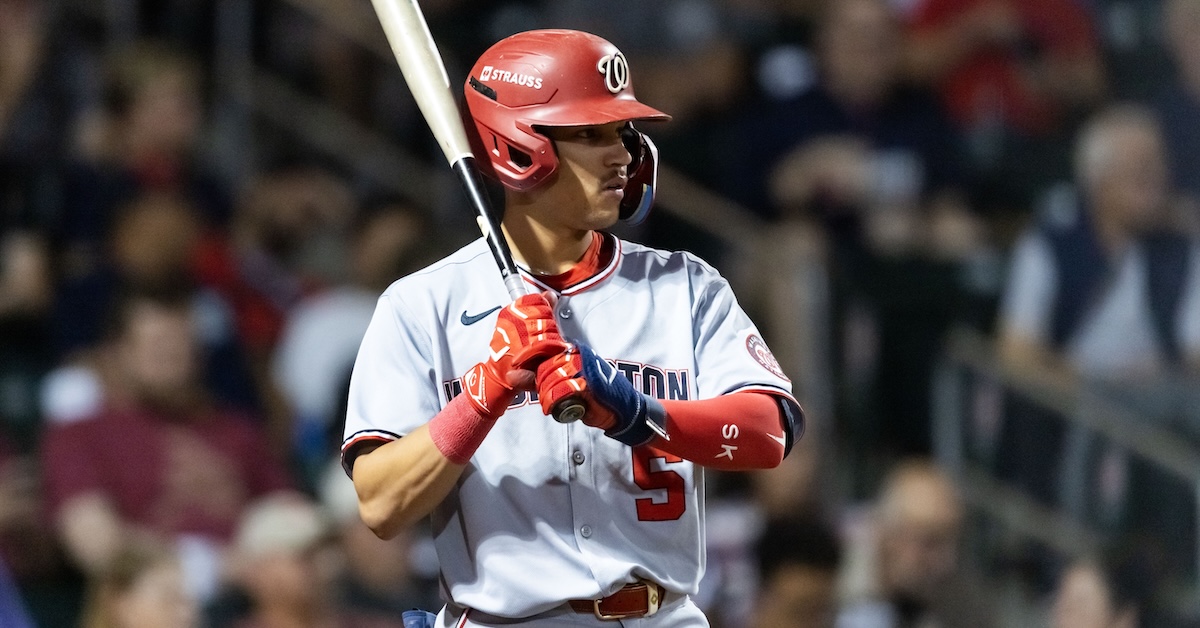
Seaver King will head into the 2026 season looking to improve on a 2025 campaign that saw him fail to impress at the plate. Across 551 plate appearances split between High-A Wilmington and Double-A Harrisburg, the 22-year-old shortstop slashed a lackluster .244/.294/.337 with six home runs and an 88 wRC+. There is certainly more in the tank. Drafted 10th overall by the Washington Nationals out of Wake Forest University in 2024, King has both the résumé and the raw tools to profile as a solid hitter at the big league level.
He flashed some of that promise in the admittedly hitter-friendly Arizona Fall League. As our lead prospect analyst Eric Longenhagen put it, King “rebounded in a big way,” raking to the tune of a 1.031 OPS and eight extra-base hits over 79 plate appearances with the Scottsdale Scorpions. Just as importantly, he displayed the smooth right-handed stroke that allows him to shoot balls to all parts of the field, which is what he does when he’s at the top of his game.
He isn’t lacking in confidence, nor is he afraid of some honest self-assessment. Reportedly selling out for power early last season, the Athens, Georgia native has come around to realizing that staying true to himself is what will produce the best results.
“I feel like I bring a lot to the table,” King told me early in his AFL stint. “Defense. Leadership. I am still finding my way in the box, obviously. It’s tough playing against elite competition, so I have to go out there and play my game. That’s hitting line drives. I’ll maybe mix in a couple of home runs with the right launch angle, but mostly I’m trying to get on base and move around them as fast as possible.”
Motoring is among his better attributes — a 60 runner on the 20-80 scouting scale, he swiped 30 bags and was nabbed just four times in 2025 — as is his glove. Rated the best defensive infielder in the Washington system by our friends at Baseball America, King has good hands, as well as solid range and a plus arm. He also has versatility in his tool box. While he projects best at his current position, King saw more time at third base and in center field during his draft year at Wake Forest, as slick-fielding 2025 Minnesota Twins first-rounder Marek Houston was firmly ensconced at shortstop.
A similar situation could arise in D.C. Not only do the Nationals currently employ the 25-year-old CJ Abrams (57 home runs and 109 steals over the past three seasons) at the position, they drafted 18-year-old shortstop Eli Willits first overall this past summer. While Willits is still a few years away, his ceiling is every bit as high as Abrams’ and loftier than King’s.
As for King’s offensive abilities, he acknowledged that trying to hit for power isn’t in his best interest, though that isn’t to say he lacks juice; he went yard 16 times with the Demon Deacons in his draft year.
“The more I try to launch, the more my swing gets out of whack,” King explained. “Basically, the deeper I let the pitch travel, the better results I have. When I try to pull the ball, my direction gets off, so I need to be focused toward right-center. If I can hit every fastball to right-center, I’ll be fine. And then, if I end up pulling the baseball, I pull the baseball.
“My goal is to hit the ball as hard as possible all the time, and whatever the result is, that’s the result,” he added. “For the most part, I want to keep the ball low and in the gaps. I also want to move the ball as soon as possible and not have to work too deep into counts. I’m an aggressive hitter.”
Aggression isn’t a fault in itself, but swinging out of the zone at a high clip rarely leads to success. King’s chase rate last year was 37%, which was not only far from ideal, it represented a potential red flag going forward. No shortage of young hitters have had their plate discipline inefficiencies exploited by more experienced pitchers as they’ve climbed the minor league ladder.
I asked King why he doesn’t want to work deep counts.
“I’m not a patient guy,” he admitted. “It’s hard for me to sit there and be picky, be super picky. I mean, I can work deep into counts, but I also don’t want to miss a cookie or be late on a pitch I can move. Waiting for your pitch… these guys are too good for that, especially when you get to two strikes.”
King experienced that first hand in his first full professional season. After fanning in 14.4% of his plate appearances (and logging a 121 wRC+) with Fredericksburg in 2024, he saw that number climb to 21.1% in 2025. Moreover, his walk rate dipped from 10% to a free-swinging 5.8%. Somewhat surprisingly, he looks back at that first summer as being the less selective of the two.
“When I signed, I was just swinging,” remembered King, who’d had 78 strikeouts and 55 walks to go with a .362 batting average over 683 plate appearances across his three collegiate campaigns. “If it looked like a strike, I was going. That got me in trouble, obviously, because I was falling behind in counts. I could get away with that in college — just putting the bat on the ball and maybe getting lucky — but especially with wood, I want to get a pitch I can handle. Then, with two strikes, I just battle. But like I said, I’m an aggressive hitter. I want to move the ball.”
As of now, Longenhagen expects to assign King a 45+ FV when our 2026 Nationals list publishes in the coming months. Further polishing his approach will only help the athletically-gifted infielder achieve a higher grade. More meaningfully, it would also improve his chances of one day becoming a regular contributor to the Nationals lineup, rather than just a speedy and versatile role player. Despite the underwhelming performance with the stick in his first full season, the potential for that happening remains.
David Laurila grew up in Michigan's Upper Peninsula and now writes about baseball from his home in Cambridge, Mass. He authored the Prospectus Q&A series at Baseball Prospectus from December 2006-May 2011 before being claimed off waivers by FanGraphs. He can be followed on Twitter @DavidLaurilaQA.
Awesome! Thanks! I’m glad the AFL was helpful to King, but my expectations are very high he will be a star.
Frankly he needs to be good enough in 2027 to bump CJ to second. That would be ideal!