
Help Us, Andrew Painter, My People Cry Out for Salvation!
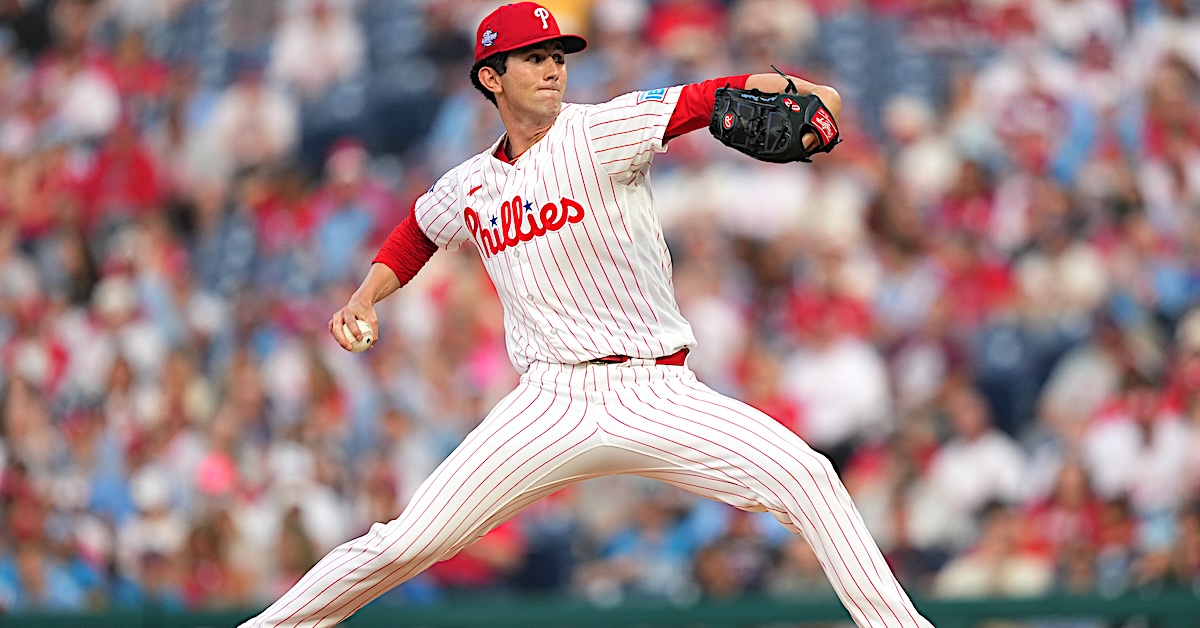
Andrew Painter made his major league debut on Tuesday, as the Phillies were coming off a three-game losing streak. That’s a tough assignment; I know it’s the first week of the season, but that has never stopped Phillies fans — who even in the best of times are always looking for a reason to jump off a bridge — from declaring the team irretrievably cooked.
Not so fast, my friends. Because anyone who’s willing to overreact to a one-game sample in April must be over the moon about Painter.
Painter, who turns 23 next month, was one of the top pitching prospects in the entire sport in the 2022-23 offseason. At age 19, he was promoted to Double-A, where he posted a 2.54 ERA in five starts and struck out 37, while walking just two, in 28 1/3 innings. As 2023 dawned, there was a not-unreasonable expectation that Painter would contribute down the stretch in his age-20 season, perhaps as a bullpen stopper, like a young David Price or Adam Wainwright, or perhaps in the rotation. (Remember, this was before Cristopher Sánchez turned into the world-destroying ace he’s become.)
But Painter’s elbow started barking, and an early hesitation to sending him to get Tommy John surgery led to both 2023 and 2024 being written off. With two years of rust, Painter struggled in 2025, pitching to an ERA over 5.00 across two minor league levels, and the first single-digit K/9 ratio of his professional career. The Phillies pitched well last postseason, but they still could’ve used Painter. He simply hadn’t earned the call-up that he’d seemingly had in the bag since early 2023.
He dropped his arm slot and lost a ton of life off his fastball while returning from Tommy John, but the promise remained. He was no longer the top pitching prospect in baseball, nor the top prospect in the Phillies’ system, but he rated no. 27 overall this past offseason and eighth among pitching prospects, with a 55-FV grade. This is still Philadelphia’s most anticipated rookie pitcher since at least Cole Hamels.
It speaks to the Phillies’ faith in the young right-hander that they did not go out and get anything resembling a like-for-like replacement for the departing Ranger Suarez. With Zack Wheeler on the mend from thoracic outlet syndrome, that left Painter in the big league rotation with no safety net. I genuinely do not know who starting pitcher no. 6 is for the Phillies right now, but I am confronted with the possibility that it might be Bryse Wilson if 40-man roster glut were not a consideration.
So, yeah, there’s a bit of pressure on Painter.
If he was feeling that pressure, you couldn’t tell. Painter, who stands an Ent-like 6-foot-7, strolled serenely to the mound for his first competitive big league action. And as good as the stuff and the results were — don’t worry, I’m getting there — Painter’s composure seemed to impress his teammates most.
Remember, the Phillies are, generally speaking, old as hell. They’ve been around the block. Matt Gelb of The Athletic noted before the game that Tuesday’s was the first Phillies lineup in five and a half years to feature two players aged 22 or younger. Gelb quoted Jesús Luzardo, Brandon Marsh, and J.T. Realmuto praising Painter’s composure in his gamer. Kyle Schwarber and Adolis García echoed those sentiments in their postgame remarks.
But it doesn’t matter how calm a rookie pitcher is if he’s throwing slop and getting shelled. So let’s check Painter’s stuff and results.
Yes, the Nationals’ lineup isn’t that good overall, but it features a few challenging hitters: CJ Abrams, Daylen Lile, and the genuinely capital-D Dangerous James Wood. Joey Wiemer is coming off a run of literally not making an out for 10 straight plate appearances, though it looks like the magic (or quantum ray power) has finally worn off.
The value proposition for Painter is that there’s nothing weird about him. He’s just what an ace looks like. He’s huge, he throws hard, he has a varied arsenal of six pitches… there’s just nothing to talk yourself into on the scouting report.
Painter throws two fastballs, a four-seamer and sinker, both of which sat 94-97 and topped out at 98.7 mph. He hit that figure twice in the first inning, when he was freshest and the adrenaline was surely pumping hardest, but he got back to 98.6 mph in the fourth.
Like a lot of modern starters, Painter has one look for left-handed hitters and another for righties. The platoon advantage works because breaking balls move away from same-handed batters and toward opposite-handed hitters. So pitchers like Painter, who have multiple fastballs and breaking balls, want to work side-to-side against same-handed batters and up-and-down against opposite-handed ones. That means four-seamer, sinker, slider, sweeper against righties, and four-seamer, slider, curveball, changeup against lefties in Painter’s case.
Nationals manager Blake Butera loaded up on the former. With six lefties and two switch-hitters in the lineup, Wiemer was the only right-handed batter Painter faced all evening, so we saw a lot of his four-seamer, slider, curveball, and changeup, and relatively little of his sinker and sweeper.
Painter was kind enough to get at least one strikeout on each pitch from that first group of four, so that you can see all of them in this highlight video.
Painter’s first and last strikeouts came against Wood, and both came from working fastball up, curveball down, to change Wood’s eye level and mess up his timing. He struck out in the fifth inning after taking an 80.6-mph curveball for a strike, and then chasing a 97.2-mph four-seamer up and away.
With the fastball and curveball established, Painter could tunnel his changeup into a middle ground in terms of movement and speed. The scouting report on Painter has “FASTBALL VELOCITY” and “NASTY CURVEBALL” written in all caps, but the changeup is a new weapon, perhaps the only positive development from his forgettable 2025 season in Lehigh Valley.
He was able to paint the bottom left-hand corner of the strike zone with his changeup to get Luis García Jr. looking in the third, and he did it again to Jorbit Vivas in the fourth. Both of those pitches were right on the edge of the zone, but Painter worked there so effectively that the Nats were out of challenges when Vivas tried to summon ABS to bail him out.
And when Painter did allow contact, it was pretty innocuous. He let up 12 balls in play out of 21 batters faced. Only three of those batted balls had an xBA of .100 or higher, and only one reached Baseball Savant’s hard-hit threshold of 95 mph. That was the last pitch Painter threw all night: Abrams ripped it to right for a single, and Phillies manager Rob Thomson, wanting his rookie starter to go out on a positive, pulled the plug.
The damage the Nats did against Painter, such as it was, didn’t do much to discredit the rookie’s effort. Lile seemed to have Painter’s number, reaching twice, but one of those two came on a popup that four different Phillies lost in the lights. As a general rule, when someone tags Jon Bois on social media with “watching baseball,” it doesn’t speak well of what’s depicted.
@jonbois.bsky.social watching baseball
— buck_knife (@buckknife.bsky.social) 2026-04-01T02:17:28.626Z
The state of perpetual garment-rending around the Phillies might be unhelpful, as I mentioned up top, but as debuts go, at home in April against the Nats is a pretty soft assignment for a rookie. Painter aced it, so to speak, but that success only earns him a new set of questions to answer. Can he get it done against deeper lineups? Can he survive a third time through the order? Can he hold his velocity? If so, how far up the rotation can he climb — a question that could become quite relevant given the questions about Wheeler’s health and Aaron Nola’s getting abducted by aliens last year.
But that’s life in the big leagues. The hits just keep on coming. Or, in Painter’s case, maybe they won’t.
Michael is a writer at FanGraphs. Previously, he was a staff writer at The Ringer and D1Baseball, and his work has appeared at Grantland, Baseball Prospectus, The Atlantic, ESPN.com, and various ill-remembered Phillies blogs. Follow him on Twitter, if you must, @MichaelBaumann.
He was fun to watch, and I’m wondering if Painter’s performance against the Nationals has Taijuan Walker contemplating which retirement home he will take his 72 million friends when this season is done.