
How Long Could Joey Wiemer Have Kept Getting on Base Before You Suspected the Involvement of Shadowy Outside Forces?
Over the past few years, one thought has kept bouncing around in my mind: “I must be taking crazy pills.” Don’t run off to the comments to complain about this post getting political, because that’s not the point I’m trying to make. Over the past few years, longstanding institutions and norms have come crashing down without so much as a peep from the people charged with defending them. Whether you think that’s good or not, it’s a matter of historical fact.
Therefore, we live in disconcerting times. COVID, AI, mass media consolidation, man’s inhumanity to man… it messes with one’s sense of order in the universe. We’re rapidly approaching an era in which battery tech and solar power actually make electricity too cheap to meter, but NATO and the Washington Post might not exist by the time we get there.
It’s unsettling. There have been times when I’ve looked around and found that the most logical explanation is that I am, genuinely, being slipped crazy pills without my knowledge. Because surely this must make sense to someone.
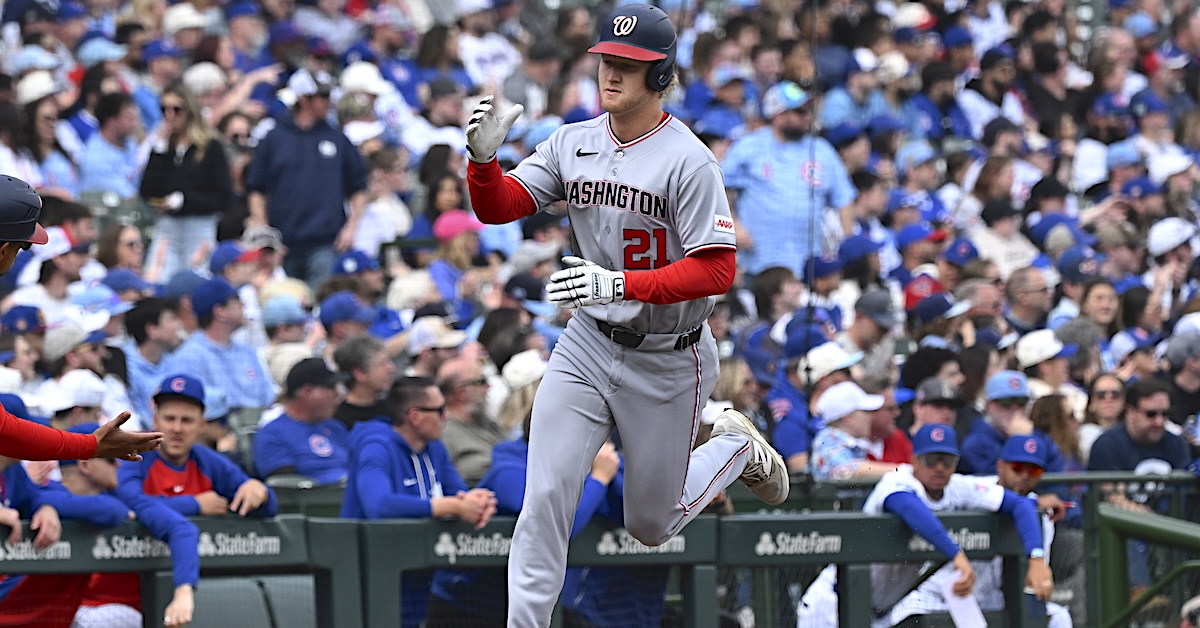
Then Joey Wiemer reached base 10 straight times to start the season.
That’s quite an achievement; Wiemer’s hot streak tied the record for most consecutive times on base to open a season, set by Carlos Delgado in 2002.
And here’s where we run into the crazy pills problem. I have no problem accepting a world in which Delgado gets on base 10 times in a row. Early-2000s Carlos Delgado was awesome. He got on base constantly. The year he had that record on-base streak, he had a .406 OBP. Two years earlier, he’d hit .344/.470/.644, which was heady stuff even in 2000, when muscles were cheap and pitching as we know it had not yet been invented.
I don’t want to be unkind to Wiemer, so I’ll just say he’s not that kind of player. In his one kind-of-full season in the majors, 2023, he hit .204/.283/.362 with a 28.3% strikeout rate. He’s big, and fast, but he’s also gotten passed around from the Brewers to the Reds to the Royals to the Marlins to the Giants, and now to the Nats. All of those teams would’ve held on to him if he were even an average outfielder.
Suffice it to say this record gets more or less believable based on who holds it. To the original point: How long would different players have to go without making an out before you thought you were actually taking crazy pills? Not “oh, that’s unusual” or “wow, that’s fascinating, let me tune in to see if he draws a walk in the seventh inning of an 8-1 game between two teams I don’t care about.” I’m talking genuine climbing-the-walls, spiders-behind-the-eyeballs stuff. Truly losing your grip on reality.
Because that number, for me, with Wiemer, is less than 10.
Wiemer’s first hit was a blast, a 110.5-mph home run well into the Wrigley Field seats on a day when the wind was knocking down fly balls left and right. Wiemer’s a big, strong dude; he can do that. His second time up, he walked. That’ll happen too. But both his second and third hits of the day were Baltimore chops — the kind of infield hit that hasn’t been replicable in 120 years.
No matter; worse hitters than Wiemer go 3-for-3 with a walk and a homer all the time. Anything can happen over one game.
But Wiemer not only stayed hot after he slept on it, he had to sleep on it three times. Wiemer is the short end of a platoon situation that involves a bunch of moving parts; he started Opening Day against the left-handed Matthew Boyd but sat for Game 2 against the right-handed Cade Horton, then started again in the final game of the series against the left-handed Shota Imanaga.
Wiemer homered again in his first at-bat on Sunday, then tripled to the gap, and this is about where I start to question reality: six or seven plate appearances. You’re telling me this combination of rocket contact and fluky John McGraw small ball stuff is happening normally? To a ballplayer from Washington? At a time in our country’s history where government oversight is limited, leaving DARPA free to run all sorts of nefarious cosmic experiments?
Wake up, sheeple. Joey Wiemer can’t control his BABIP, but the government can.
A word of advice to the men in white coats: You might think that a platoon outfielder for a team expected to finish last is a ripe candidate for some X-Files action. Slip him the super soldier shot, or mess with his quarks until he becomes the luckiest man in baseball, and nobody will even notice. Wrong.
The record for consecutive times on base without recording an out is 17, set by Frank “Piggy” Ward in 1893. Ward went 8-for-8 with eight walks and a hit-by-pitch over a three-game span during which he actually got traded from the Baltimore Orioles to the Cincinnati Reds. This is so long ago that, well, first of all, we had ballplayers named Piggy. But also, Ward’s Orioles are not only not the current Baltimore Orioles, they’re not the Baltimore Orioles that played in the American League for two seasons before being replaced by the team that’s now the New York Yankees. This is three Orioles teams ago. Five, actually, if you count the two International League teams that played in the city in the first half of the 20th century and employed, at one time or another, Babe Ruth, Lefty Grove, and Home Run Baker.
The modern record for consecutive times on base is 16, set by Ted Williams in 1957. Barry Bonds, Frank Thomas, and John Olerud all got to 15 around the turn of the century. And you’d expect that — those are four all-time great on-base guys. Williams is literally the all-time major league leader in OBP, and Bonds is fourth among AL/NL players since 1901.
I think a player like that could get a lot further than 16 plate appearances before that streak made national headline news, let alone touched off speculation about the influence of nefarious outside forces. Whereas I was on to DARPA a game and a half into Wiemer’s streak, I think they could stretch things out quite a bit if they picked the right player to mess with. Here are some suggestions:
| Player | Team | Career OBP | Maximum On-Base Streak (PA) |
|---|---|---|---|
| Joey Wiemer | WSN | .293 | 6 |
| Heilot Ramos | SFG | .318 | 15 |
| Rob Refsnyder | SEA | .342 | 18 |
| Kevin McGonigle | DET | .471 | 20 |
| Bo Bichette | NYM | .335 | 25 |
| Nick Kurtz | ATH | .380 | 30 |
| Aaron Judge | NYY | .412 | 40 |
| Shohei Ohtani | LAD | .375 | 250 |
Ramos is my stand-in for an anonymous average player. He was bad in 2025, but for the two years before that, he had a healthy batting line. If he got into double digits, I’d think it was odd, but I wouldn’t suspect anything truly bizarre until he troubled the all-time record.
Refsnyder is a relative unknown outside of baseball sicko circles, but he’s a killer platoon guy. If a smart manager found the right matchups for him, he could go quite a ways without making an out. In last year’s playoffs, Alex Call got through two whole rounds without making an out, and nobody batted an eye. Refsnyder could go three times that far in the regular season before I felt the urge to call Ghostbusters.
After that, we’re into the realm of how long you could trust a great player. McGonigle reached base four times in his very first big league game. If he’d extend that streak to 20, it would’ve been a huge story — but only in the sports pages. Bichette (or Trea Turner or Jacob Wilson or whatever bat control sicko you want to use, if Bichette’s current slump scares you off) could hit-‘em-where-they-ain’t for another game or so without raising suspicion.
Kurtz had a 14-game hit streak as a rookie in which he hit .527/.581/1.236. He famously went 6-for-6 with four home runs in one of those games; a walk in his first plate appearance the next game actually ran his on-base streak to seven. Kurtz went 3-for-5 in the game before his career night, and 2-for-4 with a walk the day after. I think a 30-plate appearance on-base streak could be explained by natural phenomena. Or a streak of 40 plate appearances for Judge, who’s the same value proposition as Kurtz, only more so.
But Ohtani could go weeks without making an out, and I’d be like, “Sure, whatever.” I was on board with him being elite on both sides of the ball; the same freak athleticism that allows him to throw 100 mph surely has some benefits when it comes to hitting the ball as well.
That said, his first season with the Dodgers broke me. Ohtani didn’t pitch that year, and he just up and decided to lead the National League in home runs while also stealing 59 bases in 63 attempts, despite never showing anything like that aptitude previously. Ohtani has always been fast, sure, but he had not, to that point, even been an above-average basestealer in terms of success rate.
After that, I realized the rules don’t apply to Ohtani anymore. He can do whatever he wants, and it’s just part of the game now. Or maybe whoever’s been futzing with Wiemer’s bat over the past few days actually got to Ohtani first. Wow, this conspiracy goes all the way to the top!
Michael is a writer at FanGraphs. Previously, he was a staff writer at The Ringer and D1Baseball, and his work has appeared at Grantland, Baseball Prospectus, The Atlantic, ESPN.com, and various ill-remembered Phillies blogs. Follow him on Twitter, if you must, @MichaelBaumann.
With a title like that, I’m expecting the Feds to shut down Fangraphs any minute now… It’s been a good run.