
Hunter Greene Has Bone Chips. Will the Reds’ Fortunes Take a Dip?
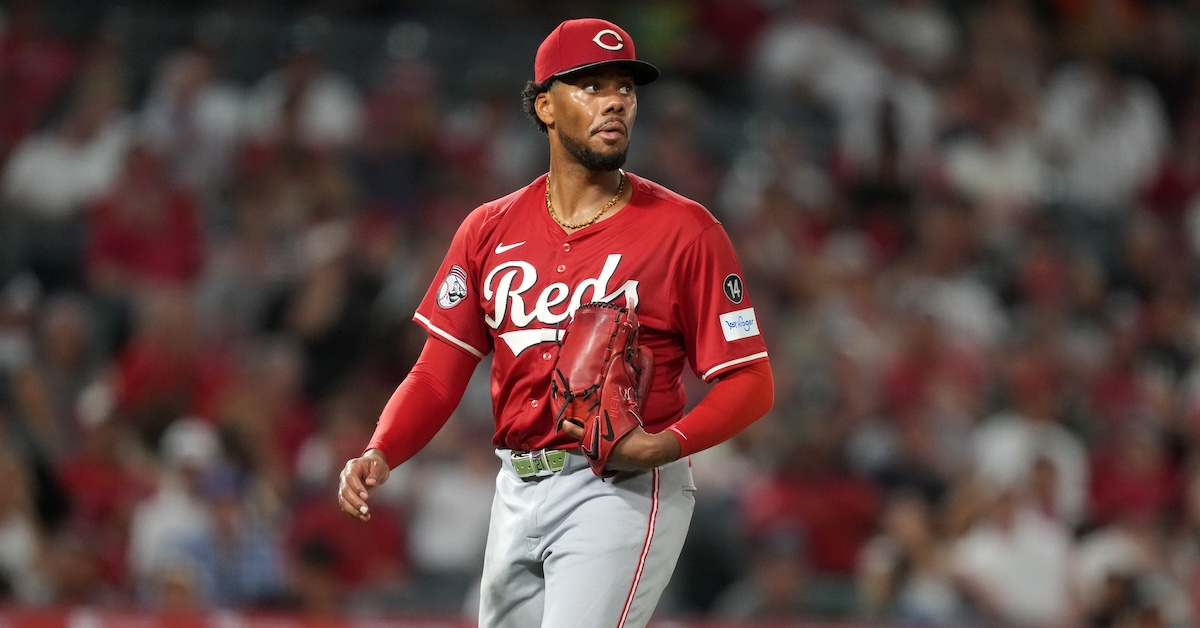
Last week, the Reds sent Hunter Greene for imaging on his throwing elbow. Never a good sign for the no. 1 starter on a team that made the playoffs last season. In those situations, we on the outside are usually conditioned to fear the worst, or at least Tommy John surgery, recovery from which — while all but routine these days — takes more than a year.
Only in that context could Tuesday’s news be taken as positive: Greene will have surgery to remove bone chips from his elbow. (In fact, as you read this, he may have already undergone the procedure.) The recovery time is expected to be on the order of three to four months, but losing an ace until the trade deadline is much better than losing him until 2027.
This is a banner year for bone chips and loose bodies. The Braves alone have two starters — Hurston Waldrep and Spencer Schwellenbach — on the IL after receiving similar treatment. Actually, since we’re talking about bone chips, this feels like a good excuse to talk about Dazzy Vance.
If you’re a baseball history nut, you probably already know the Dazzy Vance story, but it’s one of my favorite wild, old-timey baseball tales, and it bears repeating. Vance was a hard-throwing pitching prospect in his early 20s, but in 1915, he tweaked something in his arm and lost his fastball almost overnight. He got a cup of coffee in the majors, but by 1920, he was toiling anonymously for New Orleans of the Southern Association.
One night, Vance was playing poker and accidentally banged his throwing arm on the table. The pain went from chronic to debilitating, and he saw a doctor the next morning. The doctor — the way this story gets told, it seems like this guy was some rando working out of a basement, like Jeremy Piven in Heat — cut open Vance’s elbow, cleaned out all the crap that had accumulated there after a decade of pitching in the Deadball era, and rode off into the mist, never to be heard from again.
Once Vance healed, he was astonished to learn that the pain that had ended his big league career had vanished. He had a monster season in 1921, got bought by the Brookyln Robins, and led the National League in strikeouts in each of his first seven years back in the majors. Vance built an entire Hall of Fame career from nothing in his 30s, a unique accomplishment among players who didn’t start their careers in the Negro Leagues, and pitched in the majors until he was 44.
In most respects, baseball is better now than it was 100 years ago, but I do regret that we don’t have this kind of Dudes Rock career path anymore. If I ran HBO, the first thing I’d do would be to order a prestige series about early 20th Century baseball, full of lightly fictionalized retellings of stories like Vance’s.
Anyway, back to Greene. Presumably he didn’t aggravate his elbow injury by playing cards, but Vance’s story shows that it’s much easier and more comfortable to throw 100 miles an hour when your elbow isn’t full of gravel. When Greene returns to Cincinnati’s rotation, he’ll not only be healthy, but well rested for the pennant race.
Greene’s fate this season is pretty straightforward. The much more interesting question, at least to me, is what state the Reds will be in when he returns.
At this point in the season, both Central divisions look fairly similar to me. There’s one team in each (the Tigers and Cubs) that made the playoffs in 2025 and clearly invested in going back. Maybe not to the extent that some of the big coastal teams have, but both Detroit and Chicago retained their own near-free agent starters rather than trading them, signed at least one major free agent, and used their farm systems either to reinforce the major league roster or trade for such reinforcements.
The other teams in both divisions are, to a greater or lesser extent, just along for the ride. According to our playoff odds, all five NL Central teams’ projected win totals fit neatly between third and fourth place in the NL East, or between first and second place in the NL West. It is a division of the average.
I like what the Pirates have done this winter a lot, for instance. I don’t think it’s enough to haul in the teams that finished ahead of them last year, even with that talented pitching staff. The same with the Reds; Eugenio Suárez is tons of fun, and signing him is exactly the kind of opportunistic move a team like Cincinnati ought to be making. They still probably need another outfielder, an exorcism for Matt McLain, and a new hitting coach for Ke’Bryan Hayes.
The plan seems to be: Put together an OK team and wait for a playoff spot to fall into our lap.
To be clear, there are worse plans. For starters, just from the point of view of a fan, an 83-win team is usually more fun to watch, day in and day out, than a 63-win team. You show up at the park, you buy your peanuts and Cracker Jack, and there’s about an even chance you go home happy. I can think of worse fan experiences.
The other thing to remember is the Reds actually had a playoff spot fall into their laps just last season.
This was one of my pet storylines in the second half last year; the Mets had the last NL Wild Card spot all but sewn up in mid-August, and then they biffed it. Contrary to their neighbors in Cleveland, who scythed down all and sundry en route to a stunning September comeback, the Reds were exactly at .500 in the last two months of the season, 14-11 in September with a +2 run differential, and 3-3 in the last week of the season.
But 14-11 in September, while hardly reminiscent of the 1995 Mariners, was good enough to pick up a game on the Giants, a game and a half on the Diamondbacks, and four games on the Mets. “I don’t have to outrun the bear…” says the proverb. So it proved in last year’s NL Wild Card hunt.
That could happen again, though I suspect this year’s Wild Card race will be a bit tougher. Maybe the Phillies, Brewers, and Padres take a step back, but all of those teams should still be good. The Pirates and Marlins are showing flickers of competitiveness, the Giants are at least talking a big game, and the Mets and Braves can’t both be as hapless as they were last year. They just can’t. I think there will be more than five good teams in the NL this year, even if I don’t know which five to pick.
So if the Reds finish 83-79 again, they’ll probably end up further down in the standings than they were last season.
That means the Reds are going to need every win — every out — they can squeeze out of this roster if they’re going to get back to the playoffs. Losing one of their best players for at least half the season is not going to help; the exact damage is hard to predict, but three or four months of Hunter Greene probably comes to somewhere between two and three wins above replacement.
On the other hand, looking at Cincinnati’s roster… I don’t think it’s actually going to hurt that much.
I worry this is going to sound a little nuts, given the scarcity of quality starting pitching across the league, but here it goes: The Reds can afford to live without Greene for a while. They have the depth.
Even after losing two decent starting pitchers — Nick Martinez and Zack Littell — in free agency, the Reds have five guys I’d feel good about having on the mound. I’d argue that Andrew Abbott, not Greene, is actually Cincinnati’s top starter. Behind him, they’ve got Nick Lodolo, Brady Singer, and former top-10 draft picks Rhett Lowder and Chase Burns.
Lowder and Burns are the key here, because both of them have encountered some bumps in their brief careers. Lowder looked dominant in a six-start audition in 2024, then got hurt in 2025 and barely pitched at all. Burns allowed seven runs while recording just one out in his second career outing, and through his first six major league starts, his career ERA was 6.26. Two starts after that, he went on the IL with a minor arm injury.
But Burns dominated out of the bullpen after his return, and at any rate, I’ve already nailed my colors to this particular mast: I am a massive Burns fan and will go down with the ship if I end up being wrong.
He and Lowder have earned an extended look out of the major league rotation. If there was any doubt as to whether they’d get it, Greene’s injury erased it for good.
Nothing is certain in the world of pitching prospects, but the Reds are in a put up-or-shut up moment with their two top young arms. If they’re going to survive without Greene, they need Lowder and Burns to be good. But that was probably true even if Greene had stayed healthy. The Reds spent back-to-back top-10 picks on two dominant college arms; if both of these guys turn out to be busts, the Reds are screwed anyway.
The assumption that the Reds can stay afloat until Greene’s return does require quite a bit of faith. They had some safety margin with this rotation before; no longer. And the risk of Lodolo getting hurt again, or Burns losing his command, or Singer getting homered to death, is ever-present. The next Jenga tile to experience forearm discomfort might send the whole tower crashing down.
The Reds are in a precarious position now, but sometimes, you have to gamble. Just ask Dazzy Vance.
Michael is a writer at FanGraphs. Previously, he was a staff writer at The Ringer and D1Baseball, and his work has appeared at Grantland, Baseball Prospectus, The Atlantic, ESPN.com, and various ill-remembered Phillies blogs. Follow him on Twitter, if you must, @MichaelBaumann.
I don’t really think the “one more injury and it’s over” statement is particularly true, as they also have Brandon Williamson back from Tommy John. Pre-TJ, Williamson was a viable backend MLB SP (96 ERA-, 106 FIP-, 109 xFIP-), and he has come back from TJ looking really sharp, plus with his velocity finally back to his 2021 breakout prospect days (roughly 2 MPH higher than where it sat when he was last pitching). Not bad when your #7 guy has legitimate breakout potential.
They also have Julian Aguiar back from TJ, as well as Jose Franco and Chase Petty on the 40-man, which gives them three 40 FV or better MLB-ready guys chilling at AAA (though obviously much less comfortable with these guys than the top 7). Losing Greene sucks for multiple obvious reasons, but they’re built better than most to outlast multiple injuries.