
I Hope He’s Not Broke-i Sasaki
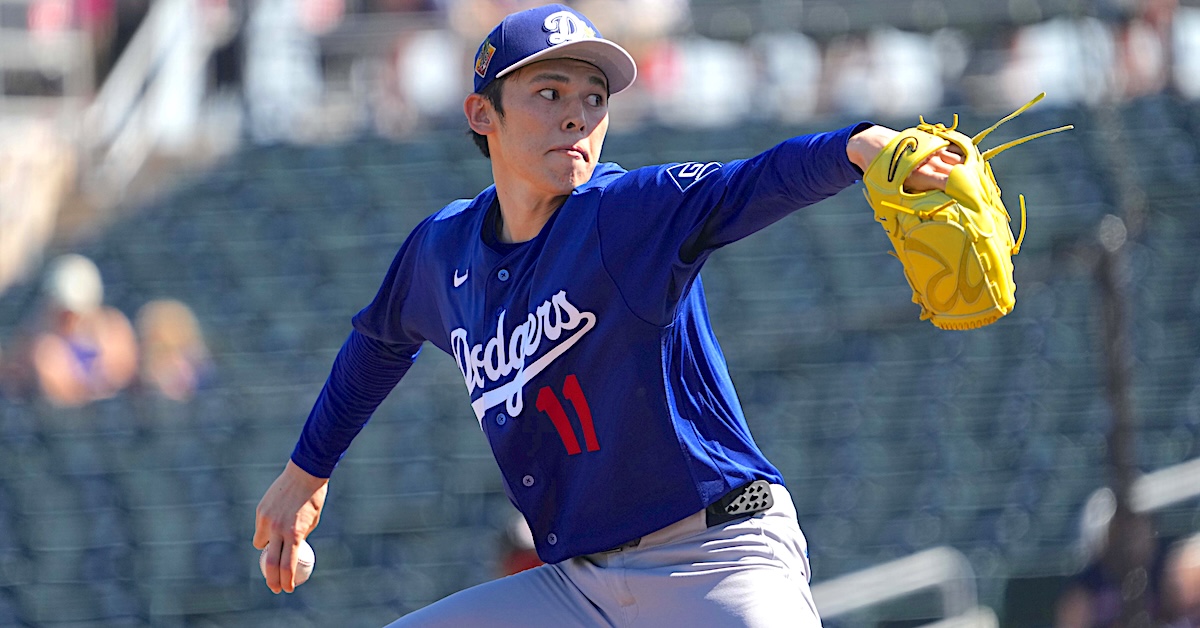
You should never worry about spring training results; it’s a small sample against uneven competition, in which the outcome of the game is irrelevant. But it’s not going great for Roki Sasaki. In two Cactus League starts, the Dodgers’ 24-year-old right-hander has allowed half of the 20 batters he’s faced to reach. His ERA is 18.90, and no matter the context, you never want to see a pitcher with a post-Civil War ERA.
For people doing the Chicken Little act about the Dodgers signing every big free agent, Sasaki — not Yoshinobu Yamamoto, Shohei Ohtani, or Kyle Tucker — is the guy who should’ve been scariest. The Dodgers signed a 23-year-old NPB ace even though, by dint of his youth, money was not an issue. If the Dodgers could land Sasaki, perhaps their dominance would become self-perpetuating.
That’s not really how it played out. Sasaki had a 4.72 ERA when he went on the IL with a shoulder impingement after eight big league starts, and didn’t look like himself. The Dodgers had him use that time on the shelf to rework his mechanics, and Sasaki returned in the last week of the regular season as a simpler form of himself: a one-inning reliever throwing almost exclusively fastball-splitter.
He came back not a moment too soon for the Dodgers, whose bullpen had been decimated by a combination of injuries and whatever psionic demons crackle behind Blake Treinen’s troubled eyes. Sasaki retired 16 of the first 17 batters he faced in the playoffs; about half of that output came in three perfect innings against the Phillies in the decisive Game 4 of the NLDS.
We probably use the word “unhittable” too much, which is a shame, because now there’s no remaining superlative for what Sasaki looked like in the first two rounds of the playoffs. Truly, I have no idea what a batter’s supposed to do when the options are 99 mph with 15 inches of rise at the top of the zone, or a high-80s splitter that looks like the fastball and then slams the yoke forward and dives toward the plate.
Even if you sit on one pitch or the other and just guess, making meaningful contact is much easier said than done. At about five minutes and 40 seconds into the video above, J.T. Realmuto — who’s seen a thing or two in his decade-plus in the majors — gets so lost he just swings through a center-cut fastball and trudges back to the dugout like Charlie Brown.
The expectation, having seen Sasaki perform at that level on that stage, was that he and the Dodgers could figure out how to transmute that bonkers relief performance into a competitive rotation piece. If not a skinny, Japanese Paul Skenes, then at least a highly entertaining no. 2 or no. 3 starter.
I think that’s still a fairly likely outcome. Sasaki seems like a veteran because he’s played four seasons in NPB, in addition to his one in the majors. He’s already gone through a major free agent saga, a World Baseball Classic, and a World Series. But he’s still only 24; he’s three and a half months younger than Nolan McLean.
But right now? Yeah, things are a bit messy.
Speaking of bad omens: Having a highlight titled “Kyle Manzardo’s grand slam” on your MLB Film Room results page. Particularly if you’re not Kyle Manzardo.
In contrast to those searing eye-level fastballs of October, this heater came in at a hair under 98 mph, caught plenty of the zone, and had only 12 inches of rise and seven inches of arm-side run. You’d expect a pitcher to have a little less zip in March than in October, especially considering that Sasaki was pitching out of the bullpen then and is pitching out of the rotation now.
Still, let’s take a look at what Sasaki has thrown in each of the three discrete phases of his career: His first eight-start run, his playoff stint out of the bullpen, and his first spring training outings of 2026.
| Spring 2026 | Pitch% | Velo | Spin | H-Mov | IVB | V-Release | H-Release | Extension |
|---|---|---|---|---|---|---|---|---|
| Fastball | 42.0 | 97.4 | 1,891 | 7.5 ARM | 14.6 | 6.3 | -2.2 | 6.9 |
| Cutter | 29.6 | 86.9 | 1,860 | 4.3 GLV | -1.4 | 6.4 | -2.2 | 6.8 |
| Splitter | 21.0 | 86.0 | 692 | 2.6 ARM | -2.7 | 6.3 | -2.1 | 7.0 |
| Sinker | 7.4 | 95.9 | 2,200 | 12.1 ARM | 12.6 | 6.3 | -2.2 | 6.9 |
| 2025 Playoffs | Pitch% | Velo | Spin | H-Mov | IVB | V-Release | H-Release | Extension |
| Fastball | 50.6 | 98.9 | 2,152 | 9.7 ARM | 14.9 | 6.1 | -2.1 | 7.1 |
| Splitter | 47.0 | 86.3 | 558 | 4.5 ARM | -4.5 | 6.1 | -2.0 | 7.1 |
| Sinker | 2.4 | 96.8 | 1,893 | 14.8 ARM | 9.9 | 6.1 | -2.0 | 7.3 |
| 2025 Pre-IL | Pitch% | Velo | Spin | H-Mov | IVB | V-Release | H-Release | Extension |
| Fastball | 48.1 | 96.0 | 2,080 | 10.6 ARM | 14.3 | 6.1 | -2.4 | 7.1 |
| Splitter | 31.6 | 84.8 | 483 | 0.8 ARM | -3.9 | 6.2 | -2.3 | 7.2 |
| Slider | 16.3 | 82.0 | 1,869 | 11.7 GLV | -2.3 | 6.1 | -2.4 | 7.0 |
The first thing is that Sasaki has changed his arsenal. He’s gone from a slider to a harder glove-side pitch that’s getting marked as a cutter. He’s also thrown a sinker a few times this spring.
Compared to the postseason, his fastball is down a tick, which I’ve said bothers me not in the slightest at this point in the calendar. Having two inches and change less of induced arm-side movement is a little worrying, though. Sasaki’s four-seamer shape has never been ideal; it plays up because of a combination of velocity and elite extension, and the fear of that diabolical splitter.
Speaking of: Sasaki’s splitter is spinning faster. For a breaking ball, more spin means more break. But for splitters and certain changeups, an extremely low spin rate leads to a tumbling, knuckleball effect. Spin stabilizes the path of a projectile — the term “rifle” comes from the spiral grooves they cut on the inside of gun barrels to make the bullet spin, and therefore fly straighter. Absent spin, a baseball wobbles to the plate like a wad of Silly Putty.
Before he went on the IL last year, Sasaki’s splitter averaged a spin rate of 483 rpm. That looks like a lot, because the denominator in “rpm” is minutes. In practice, that splitter only rotates about four times in the half-second it takes to get from hand to mitt.
This year, that splitter’s spin rate is almost 700 rpm, up about 17% from what it was during the playoffs, and 43% from what it was at the start of the 2025 regular season. Without the average velocity changing much at all from the postseason, Sasaki has lost almost two inches each of dip and run on his out pitch. Could be offseason rust, or the move back to the rotation, but it’s worth monitoring.
The one thing about Sasaki’s spring that really freaks me out is his release point.
Sasaki is built like a flamingo; he looks so long and whippy on the mound that I was shocked to find that he’s only listed at 6-foot-2. That’s usually a good thing for a pitcher, as long arms create angular momentum and release point extension. This last is a big deal for Sasaki, who got more than 7 feet of extension last year, one of the highest (or longest, or stretchiest, depending on your vantage point) marks in all of baseball.
The downside to that body type is mechanical inconsistency. We saw this at two points last year; first, when the Dodgers took him back to the lab during the regular season to un-kink his mechanics. And second, in October.
You probably found it odd that when I was talking about Sasaki’s postseason dominance, I left off after the NLDS. That’s on purpose, because the last two rounds of the playoffs were bumpy. Sasaki almost blew a save in Game 1 of the NLCS, and then allowed three baserunners in each of his two World Series appearances. Yes, he only got eight outs in a seven-game World Series that ended with Dave Roberts going full Augie Garrido on Yamamoto. That tells you the extent to which Sasaki had escaped the circle of trust.
And you could see it live; he was all over the place as the playoffs wore on. Given Sasaki’s extensive professional experience and exceptional performance in previous rounds, I doubt it was nerves. Maybe he was gassed. Maybe he struggled to adjust to pitching on back-to-back days, or he didn’t recover well from a couple multi-inning appearances. Either way, I expected those bugs to sort themselves out before the start of 2026.
But they haven’t. And now, Sasaki’s release point is drifting. Instead of getting the ball out at full extension, his arm is drifting out and up. That’s going to affect movement and command, but it’s also going to hurt the perceived velocity on his fastball: an even 100 mph during last year’s postseason, down to 98.5 mph now.
So once again, the Dodgers are left with one of the most talented young pitchers in the world, only with kinked up mechanics. It’s not a matter of life and death for the best-resourced team in baseball; the Dodgers always seem to find more pitchers. But now, entering Year 2 of the Sasaki experience, we’ve got four awesome postseason relief appearances and a whole lot of question marks. It was supposed to be easier than this.
Michael is a writer at FanGraphs. Previously, he was a staff writer at The Ringer and D1Baseball, and his work has appeared at Grantland, Baseball Prospectus, The Atlantic, ESPN.com, and various ill-remembered Phillies blogs. Follow him on Twitter, if you must, @MichaelBaumann.
I came to just comment that this article headline rage baited me. Well done.
I guess this is another cautionary tale (a la Jackson Jobe) that pitching grades don’t tell the whole story if the numbers under hood such as extension and repeatable delivery are messy. Got to wonder other non-injury instances when pitching grades and performance just don’t align in the past.
I would guess that is a very very very long list. Guys get drafted largely on how good their stuff is and most don’t pan out. Recent example, Asa Lacy was in the discussion for the top pitcher in the 2020 draft based on his stuff (60 grade fastball, 70 grade slider). he got taken 4th overall and then looked like he had never played baseball in his life when he got to the minors. Literally walking almost 30% of batters. career FIP over 8.00.
I guess I am including that both Sasaki and Jobe were also projecting average to plus command, as well. Lacy always had relief risk.
I haven’t given up on Jobe, personally. He has 62 career innings pitched at levels above AA and will likely still be only 23 when he comes back. TJ surgery is always scary but I wasn’t overly concerned before Jobe went down.
Sasaki I’m a bit more wary of because he simply has not remotely looked like his peak self since coming over the the US, and as more time passes, it seems increasingly unlikely to me that he can regain that form. His pitches and mechanics were different from his NPB time when coming over in 2025, and now they seem different yet again even from last year’s version (and not for the better).
In time series analysis, we talk about whether momentary deviations in performance are additive (short-term effect with no bearing on pattern) or innovative (affecting the long-term pattern) outliers. As time passes from Sasaki’s NPB time, this new version of Sasaki looks more like the new normal and not a brief fall in performance.
Even out of the bullpen in the playoffs, the sparkling ERA belies the fact that Sasaki was probably more serviceable than dominant in a relief role. The dominant stretch that Baumann references in the article in the first two rounds was 5.1 innings pitched, following by a very shaky 5.1 innings.