
Jac Caglianone Joins the 120 Club
Somewhere in my list of article ideas, I have a theoretical question tucked away. What’s the longest distance you could hit a baseball? Not what’s the longest distance a really strong player could hit a ball, but what’s the longest distance that it’s possible to hit a baseball? I haven’t gotten around to it because I’d need to interview a physicist or a materials scientist or both, but I’m excited about this question. Say you’re an infinitely strong batter with an infinitely fast swing. The distance you can hit the ball isn’t infinite. At some point, you’ll hit the ball hard enough that your bat will shatter, reducing the efficiency of the energy transfer. Or maybe the ball will be the weak link, and you’ll hit it so hard that it will deform into a less aerodynamic shape or explode into a thousand pieces. There’s a limit somewhere.
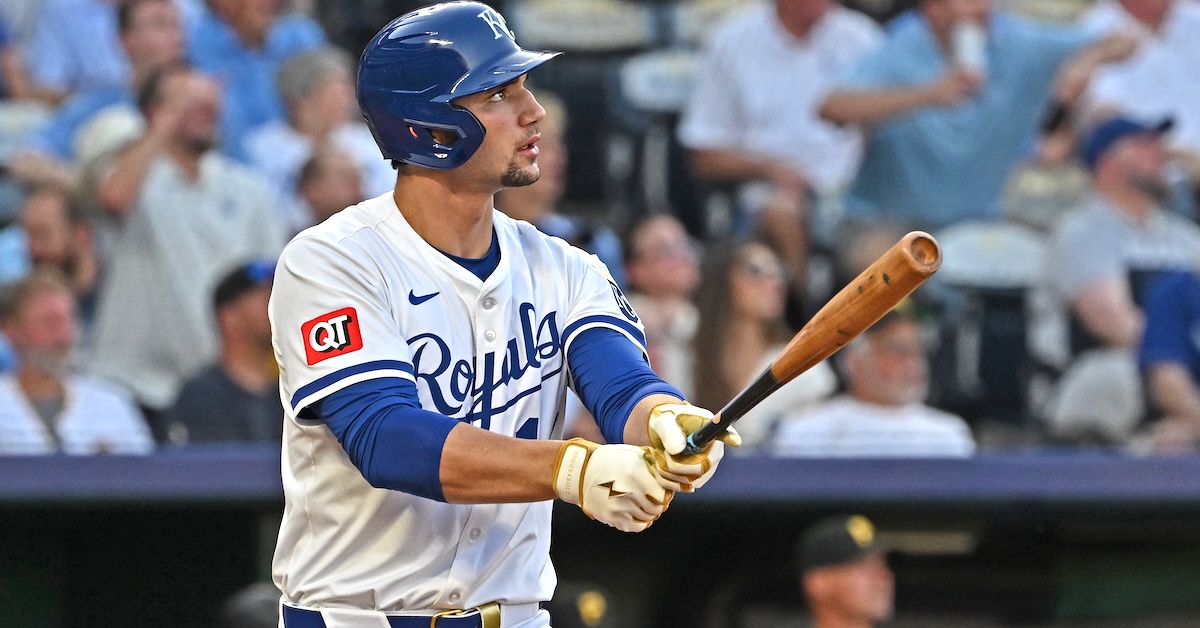
I will write this article one day (so please don’t steal it), and it will be fun to discover the answer through math and logic, but theory isn’t the only way to solve a problem. Last Thursday, Jac Caglianone tried to find the answer through pure experimentation, which is to say that in the top of the fifth inning against the Diamondbacks, the Royals right fielder turned on a Yilber Díaz fastball and ripped it into the right-center gap at 120.2 mph. The missile made Caglianone just the eighth player to gain entry into the 120 MPH Club in the 11-year history of Statcast.
It’s the hardest-hit ball of Caglianone’s career (officially, anyway; we’ll return to that later). It’s also the hardest-hit ball of spring training, and it’s far from the only fireworks display he’s put on in the past week. With a 116.5-mph double on Saturday and a 115.2-mph homer on Tuesday, Caglianone now owns three of the 10 hardest-hit balls of spring training. More importantly, it’s the 30th-hardest ball ever recorded by Statcast at any level. Thankfully, Statcast is now in every spring training ballpark, or we never would have grasped just how special Caglianone has been this spring.
Caglianone is not exactly a surprising addition to the 120 MPH Club. In his write-ups of Caglianone as a prospect, Eric Longenhagen awarded a 70/80 present/future grade for power, variously describing it as elite, top-of-the-scale, otherworldly, and nutty. He also noted, “His thighs are practically bursting out of his pants.” When asked how Caglianone looked during the Arizona Fall League during a chat, Eric replied with just one word:

It’s also not surprising because Caglianone has done this before, just not officially. Last April, Kenny Van Doren of MLB.com wrote that in Caglianone’s first Double-A at-bat, he lined a single the other way 120.9 mph, though the pitch was measured by the less-accurate Trackman system.
So news that Caglianone can hit a baseball really hard is not exactly going to stop the presses. All the same, Thursday’s blast pushed him into a different tier. It’s exciting stuff. The game wasn’t broadcast on television, so the footage of the play came from a lower-quality camera behind home plate, but just look how quickly this ball makes it to the wall.
The lack of a television cameras and special parabolic microphones pointed at home plate is also the reason that the ball doesn’t sound like a shotgun blast. What you’re hearing there is the radio feed. To get a sense of how loud it is, let’s put it side by side with Luken Baker’s three-run homer, which came just two innings later. I did not do anything to the audio here. Baker’s 109.5-mph home run sounds like a pop gun compared to Caglianone’s explosion.
We should be sure to give Yilber Díaz, whose name is just begging to be spoonerized, some credit here, too. His pitch came in at 96.8 mph, and while pitch models aren’t everything, this might be a good place to note that his four-seamer graded out as one of the worst in the majors last year according to Stuff+. You know how some people say that home runs aren’t hit, they’re thrown? This is what they’re talking about.
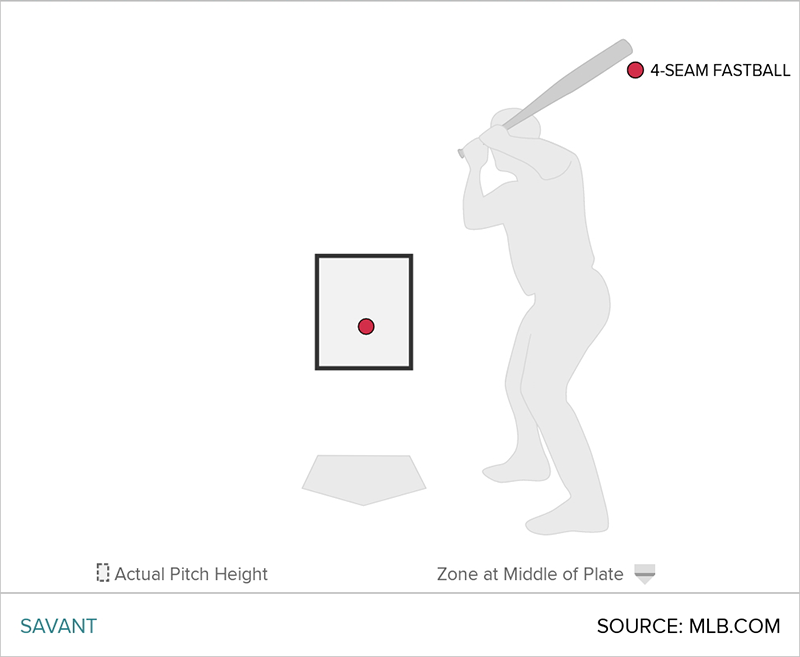
In a way, this almost qualifies as a success for Díaz, whose command has been his biggest issue as a prospect. His Location+ was also right at the bottom of the majors last year, but that right there is a perfect draw right to the button. It’s a four-seam fastball, mid-(gigantic)thigh, directly over the center of the plate. It’s the platonic ideal of a meatball. This is what it looks like when a baseball is begging to be put out of its misery. I’m surprised that little red dot isn’t holding a little sign that says “YIKES!” like Wile E. Coyote.
We’re in early March here, and we’re not supposed to read too much too much into one batted ball, or even the entire sample. Caglianone is 6-for-15 with five walks this spring. That’s a .400 batting average and a 25% walk rate. He also has a 15% strikeout rate, and his three massively hard-hit extra-base hits pushed his wRC+ to 229. Now let’s pour some cold water on that, shall we? He’s one of a whopping 62 qualified players with a wRC+ above 200, alongside renowned thumpers like Akil Baddoo and Brandon Lockridge. His 66.7% hard-hit rate is tremendous, but it’s not even tops on his own team, as Bobby Witt Jr. and Carter Jensen are both above 70%. The one thing we’ve always known about Caglianone is that he possesses absurd power. The questions were always about his contact rate, his ability to lift the ball, and his outfield defense, and it will take more than a week to answer them.
Still, it’s hard to imagine Caglianone doing much more to prove himself in a single week. He has now exceeded 115 mph three times in a week and gotten his fickle batting average to twice the Mendoza line. It could very well be nothing more than spring training noise, but we should be paying attention. And regardless, a 120.2-mph batted ball is worth stopping what you’re doing just so you can take some time to marvel. It only happens a couple times a year.
Davy Andrews is a Brooklyn-based musician and a writer at FanGraphs. He can be found on Bluesky @davyandrewsdavy.bsky.social.
As a Royals fan, I can’t help but hope this is meaningful.
As an (amateur) analyst and realist, I know it isn’t meaningless. But it’s closer than I’d like.
It’s certainly better than not doing that, but I don’t think there’s any way to “prove” anything in spring training.
Last spring training some of the big breakout names were Pete Crow-Armstrong, Jeremy Pena, Hunter Goodman and Curtis Mead. Three of those guys actually broke out in the regular season, and then there was Curtis Mead.
In 2024, the big breakout names were Nick Pratto, Mauricio Dubon, Dane Myers, and Hoy Park. Dubon and Myers did sort of break out, but Pratto and Park’s successes didn’t even carry over to AAA and they never got a shot in MLB.
In 2023 the big breakouts were Mike Brousseau, Jake Cave, and Hanser Alberto…all of whom had negative fWAR that year.
You’d rather see this than him scuffling but we have no idea if this is going to turn out like Daniel Palka or Matt Olson.
It is meaningful because he is crushing the ball while having elevated his launch angle. The latter was his problem last season, as he was mashing balls into the dirt instead of the sky. He had the 12th best EV90 in baseball for anyone with at least two hundred plate appearances. Going from a 4.1 LA in 2025 to 15.2 LA this spring while maintaining elite exit velocities is something meaningful to be very excited about.
Complete list of guys to clear 120MPH, both regular season and ST (with total # of 120+batted balls):
Stanton 17
O Cruz 6
G Sanchez 1
Acuna 1
Vladito 1
Judge 1
Jac 1
Shohei 1
that’s pretty good company . . .