
Kevin Gausman Faces a Difficult Decision
On Sunday afternoon, Kevin Gausman became one of six players to be offered a qualifying offer. With tons of uncertainty about the health of the free agent market heading into the offseason, Gausman’s offer was a bit of a surprise to see. To his credit, he put together a phenomenal year for the Giants, posting the lowest FIP of his career in 2020. But he’s also only a year removed from being designated for assignment by the Braves in August of 2019.
On Monday, Jay Jaffe reviewed all six of the QOs offered this year. He concluded that Gausman and Marcus Stroman were the two players who faced a particularly difficult decision about whether or not to accept the offer and return to their previous teams. Stroman’s decision is a little more complicated since he opted out of the 2020 season and last took the mound in 2019. Gausman made 10 starts and two relief appearances in 2020 and made a compelling case that he’s one of the top starting pitching options on the market this offseason. Craig Edwards ranked him the fifth-best starting pitching among this year’s free agent crop.
Gausman’s big year was a welcome development after struggling to put everything together in Baltimore for much of his career. The former first-round draft pick was a hair better than league average by park- and league-adjusted ERA and FIP during his time with the Orioles. But he never really lived up to his pedigree, and he was traded to the Braves at the 2018 trade deadline. He was excellent in Atlanta for the remainder of that season season but really struggled in early 2019, leading to his DFA in August. He was picked up by the Reds and moved to the bullpen, where his stuff played up in short outings.
The Giants signed him to a one-year, $9 million contract, and many of the adjustments he made in Atlanta and Cincinnati bore fruit in San Francisco. After being traded away from the Orioles, he changed his pitch mix to rely heavily on two pitches, his four-seam fastball and his nasty splitter.
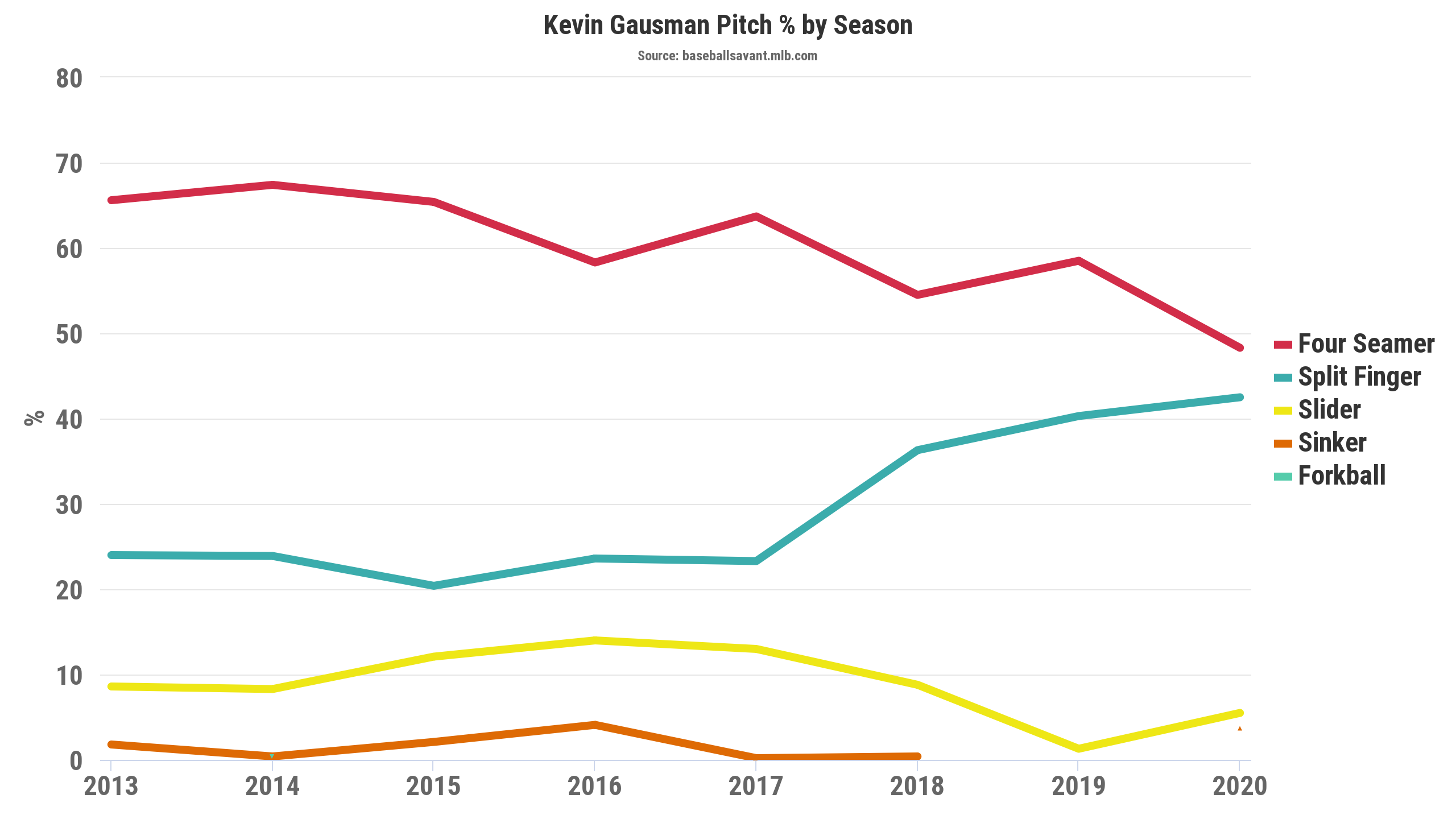
His splitter has always been a good pitch for him, but it’s notoriously difficult to throw and can lose its effectiveness if he loses his feel for it. But he’s generated a 42.8% whiff rate with the pitch during his career, so using it more often was bound to help him earn more strikeouts. He didn’t see much of an effect in late 2018, but in 2019 he posted the highest strikeout rate of his career, only to be topped again this season. Opposing batters whiffed on 45.7% of their swings against his splitter this year and collected just 10 hits off the pitch.
His fastball also saw some improvement that contributed to his success. After two years of diminished velocity, his heater once again averaged over 95 mph.
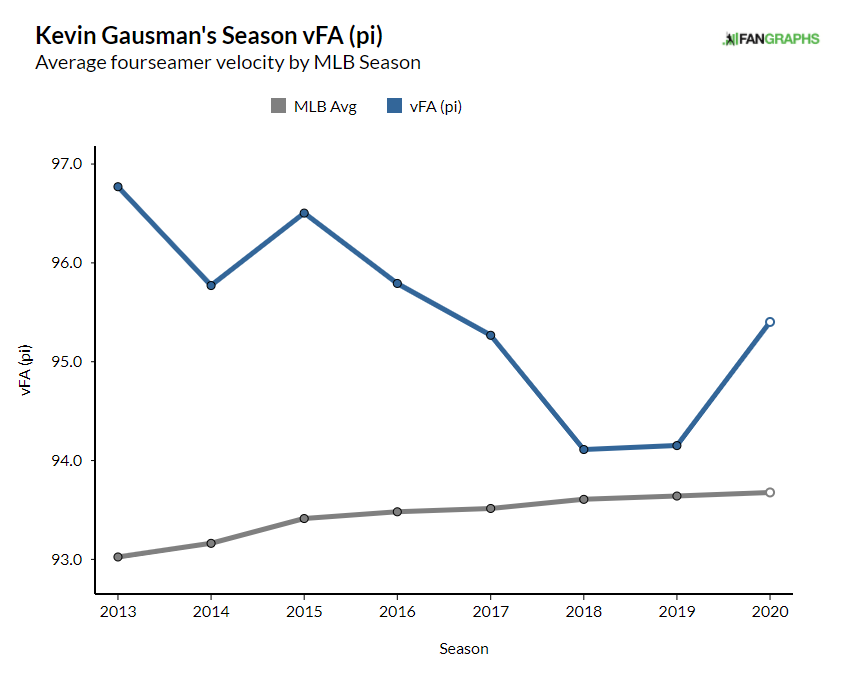
Along with the added velocity came a higher average spin rate. Considering spin and velocity are related, he likely didn’t make any physical changes to how he threw his fastball and instead simply regained the velocity he had earlier in his career and the higher spin rate followed. But the results were greatly improved, as his whiff rate on his fastball jumped up to 24.8%, easily the highest of his career.
Not only did he enjoy improved results on his individual pitches, the way he used them also took a turn for the better. All those additional whiffs via his splitter and fastball came with his highest rate of pitches thrown in the strike zone of his career. He was challenging batters more often and they were coming up empty. His chase rate fell from a career-high in 2019, but when batters did offer at his pitches thrown outside the zone, they had an incredibly difficult time making contact. His 47.6% O-Contact rate in 2020 was a 16-point drop from his career rate, easily a personal best, and the third-lowest O-Contact rate among all qualified starters.
Accepting the QO would be a one-year bet on himself that he could replicate his excellent performance again next season. But the QO doesn’t give Gausman much long-term security. The worst-case scenario could look something like what happened with Jake Odorizzi in 2020. Odorizzi accepted the Twins QO after a phenomenal 2019 season where he posted career-bests in strikeout rate, FIP, and WAR. Unfortunately, he spent nearly the entire 2020 campaign sidelined due to a number of injuries. As a result, he’s reentering the free agent market this offseason without a strong case for a long-term contract.
Perhaps Gausman’s decision shouldn’t be all that difficult. A one-year, $18.9 million contract probably represents a higher average annual value than what he might have commanded on the open market without a QO attached to him. Edwards estimated a $14.0 million AAV for Gausman while the crowd was a little more bearish, estimating a $12.4 million AAV. And with a suppressed market for free agents on the horizon, he might be better off accepting the QO and testing the open market again in 2021.
But there are indications that Gausman and the Giants have mutual interest in negotiating a long-term extension. Andrew Baggarly of The Athletic reported that initial discussions have already occurred and that the QO was a contingency in case they couldn’t come to an agreement. This was the same situation José Abreu found himself in last offseason. The White Sox offered him a QO, he accepted, and then they later signed a three-year contract extension that lowered his AAV but also included a signing bonus to compensate for the lower yearly salary. Abreu’s extension represents the best-case scenario should Gausman accept his offer.
But what if he wants to test the open market? Declining the QO wouldn’t necessarily preclude him from later signing a multi-year contract with the Giants, and it would give him the opportunity to see how other teams value him. Here’s a look at the contracts some of Gausman’s peers signed over the past few years.
| Player | Year | Age | Qualifying Offer? | ERA- | FIP- | WAR | Contract Years | Contract AAV |
|---|---|---|---|---|---|---|---|---|
| Yu Darvish | 2017 | 31 | No | 84 | 85 | 3.7 | 6 | $21.0M |
| Jake Arrieta | 2017 | 31 | Yes | 82 | 96 | 2.5 | 3 | $25.0M |
| Alex Cobb | 2017 | 31 | Yes | 87 | 98 | 2.2 | 4 | $14.3M |
| Patrick Corbin | 2018 | 29 | Yes | 78 | 61 | 5.9 | 6 | $23.3M |
| Dallas Keuchel | 2018 | 30 | Yes | 91 | 88 | 3.3 | 1 | $13.0M |
| Nathan Eovaldi | 2018 | 28 | No | 89 | 87 | 2.2 | 4 | $17.0M |
| Hyun Jin Ryu | 2018 | 31 | Yes (Accepted) | 51 | 75 | 1.9 | 1 | $17.9M |
| Hyun Jin Ryu | 2019 | 32 | No | 55 | 71 | 4.8 | 3 | $20.0M |
| Zack Wheeler | 2019 | 29 | Yes | 96 | 80 | 4.7 | 5 | $23.6M |
| Jake Odorizzi | 2019 | 29 | Yes (Accepted) | 75 | 73 | 4.3 | 1 | $17.8M |
| Madison Bumgarner | 2019 | 29 | Yes | 93 | 93 | 3.2 | 5 | $17.0M |
| Kevin Gausman | 2020 | 29 | Yes | 84 | 74 | 4.6* |
These starting pitchers were either offered a QO or they had a season roughly on par with what Gausman accomplished in 2020. The average annual value of these contracts was $19.0 million and the average length of the contract was 3.5 years. Both of those marks would give Gausman long-term security with a yearly salary on par with the value of the QO this year. The worst-case scenario would be a situation like Dallas Keuchel faced after the 2018 season. The draft compensation attached to the QO drove Keuchel’s market far below what he was willing to sign for and he ended up sitting out much of the first half of the season before signing with Atlanta in June 2019. But even a contract like the one Alex Cobb signed with Baltimore wouldn’t be all that bad for Gausman, particularly considering his rough history prior to this year. Cobb’s contract is in the range of what Baggarly estimated for Gausman if he was to hit the open market.
For non-elite free agents who have a QO attached to them, we know the draft compensation drives their potential earnings down. This is what happened with Keuchel and it’s likely to happen with Gausman if he declines. Teams are including that lost draft capital in their calculus when offering contracts to these mid-tier free agents with QOs. The Giants don’t have to worry about that draft compensation if they re-sign Gausman, putting them in prime position to woo him back with a full-value contract offer.
Accepting the QO wouldn’t come risk-free beyond the typical concerns a pitcher faces during the normal wear and tear of a season. There’s also no guarantee that Gausman and the Giants can come to an agreement on a multi-year extension. That would force Gausman back onto the open market in 2021 with the looming expiration of the Collective Bargaining Agreement introducing all sorts of uncertainty. Accepting the QO and continuing to negotiate an extension with San Francisco probably mitigates the most risk for Gausman and sets him up with a nice salary for 2021. The long-term security may or may not come, but with all the uncertainty facing baseball in these coming months and years, grabbing what he can now right now might be the best he can hope for.
Jake Mailhot is a contributor to FanGraphs. A long-suffering Mariners fan, he also writes about them for Lookout Landing. Follow him on BlueSky @jakemailhot.
It’s really hard to pin down what Gausman would get on the open-market because this was such a small sample size, it is different than his previous work, teams may not want to spend money, and on top of all that he has no clear comp from recent offseasons. Maybe Alex Cobb? If he’s getting Alex Cobb money then he shouldn’t sign the QO, but I somehow doubt it’s going to be that high. On the lower end we’ve got Lance Lynn, and if that’s what we got he should take the QO. I suppose that’s possible?
This breakout for Gausman started in 2019, though, right around the time of his trade. So the sample is somewhat larger. The velocity bump is evident as starting 2 starts before he was traded at the deadline, and the pitch mix change follows soon after.
So the sample is about double the size, and pitch velocity and mix data is reliable very quickly – there’s plenty here for teams to make their decision with (and hence why the Giants made the QO in the first place: it makes them the best price in an extension, as everyone else’s prices will be driven down by the draft pick compensation).
If Jake had done the Jeff Sullivan-style “rolling 15 game window’ graph instead of by season, it makes it much more evident where Gausman’s performance spike occurred, and the way that the pieces are related to each other (increased velo, more sliders, more whiffs, more Ks).
Except Cincinnati moved him to the bullpen after acquiring him. So not really an apples to apples comparison. (he also got roughed up those last two starts in ATL so not sure how much improvement there really was at that point).
I agree with this, at least mostly. Reading this reminds me a bit of Nathan Eovaldi, who had a really good walk year but it was only about 110 innings, and previously had been a little bit of a disappointment relative to expectations. Sure, he was good enough to start, but everyone expected he would be a star, and when he finally put it all together he looked fantastic.
Eovaldi didn’t have a QO, and wasn’t in this offseason where money is going to be tight, and he also wasn’t a missing piece of a world series winning team which really wanted to keep him to defend their title, so the conditions here are a bit different than Eovaldi. So I still don’t see him topping Cobb but it gives me a little more faith that he would get something higher than 3/$30M.
I don’t think it’s even that much of a decision. He should definitely take the QO. I don’t see him getting much more than $10m per for 3-4 years at most. Declining means he’ll cost draft pick compensation and no team wants to spend (other than maybe the Mets?).
If he accepts, he gets maybe half of what he’d get in a 4-year deal. And even if he is injured, guys like Matt Harvey continued getting small deals years after they were useful.
Accepting means he has enough money to at least survive for his entire life (even if it won’t be enough to be “comfortable” for 50 years).
Declining means he might get twice as much or he might have to settle for a one year deal for half as much.
I think defining his range and the uncertainties involved in them is a useful exercise, even if it’s not very conclusive. If we use Lance Lynn to Alex Cobb as his range, the guy gets somewhere between 35% and 63% of what he’ll get on the open market with the qualifying offer, just by itself.
If he muddles through on the QO as a 2-3 win pitcher–he reverts back to his norms rather than keeping up this awesome run or getting injured–he’s looking at one of those 2 year, $20M deals that were handed out last offseason, most likely. So now he’s getting somewhere between 68% and 130% of the salary with the QO and the 2 year deal.
In this little unscientific simulation, used more for demonstration purposes than anything else, would suggest his breakeven point is $39M. If he thinks he is getting a 3 year, $39M offer then it’s pretty close to what we might expect if he just takes the QO. But of course, the uncertainty is unevenly spread. Taking the QO means he doesn’t have to worry about the market collapsing entirely; he’s banked $19M. But it preserves a wider range of outcomes down the line, so it shifts some of the uncertainty forward. But if he somehow manages to get past that uncertainty and bank $39M he’s protecting against getting seriously injured or the yips.
I think I would be pushing for Alex Cobb money and be willing to sign for a bit below that–but if no one is willing to give me $50M I just take the QO.
I mean you can certainly spend 18.9 million. Lets just call it 10m. But to say it isn’t enough to be “comfortable” for 10 years? I guess it depends on your version of comfortable. Even with no other money that is 200k a year. Obviously 200k won’t be the same in 50 years, but still think he could be comfortable.
*50 years
You could reasonably depend on $300k per year inflation adjusted without spending down the principle, based on a 5% return and 2% inflation.
Basically repeating what dl80 said, but I don’t think it is a particularly difficult decision for Gausman. Going into the FA market this winter with QO attached is the much riskier move for Gausman. If I were his agent, I would recommend him to accept and then negotiate an extension with the Giants. If the Giants like him enough to submit a QO, then they would surely be open to extension talks.
I find Stroman’s decision to be much more interesting and debatable.
One thing to note is that Stroman rejecting the QO makes a lot more sense if Gausman accepts, and vice-versa.
Also, I just realized today they have the same agent. Not that there would be explicit coordination but it does mean if one of them is definitely taking the QO that knowledge might change the decision for the other.
Totally agree. Take the QO and negotiate your best long term deal in a place where you’re comfortable and began to realize your potential.
I’d take the offer and then see if I could negotiate an extension. I don’t see him with a huge multi-year deal with such a thin body of work. Do well this year, be free of the QO, and you get paid well for your years 31-35. Owners are going to be tight this year–even more so with a loss of draft-pick situation. Gausman isn’t elite, at least, not right now.
I don’t see anyone giving him more than a 2 year deal worth 20 mil. He might as well make almost that in one year.
If the Giants believed that, they wouldn’t have offered him a QO, and instead tried to get him for half the cost.
Guys have Farhan Zaidi have made it clear they absolutely don’t want to overpay for players, and are extremely value-conscious.
They aren’t going to risk Gausman accepting the QO if they think it’s a bad deal for them.
That split finger changeup Gausman throws makes him an entirely different pitcher. He’s jumped to a new level.
Nothing I’m seeing in any of the data makes me think that Gausman has really changed from the pitcher that the Braves DFA’d in 2019. The two things he’s doing are he’s throwing fewer 4 seam fastballs and he’s using his slider/curveball again. Those were things I thought he needed to do to be more effective, because hitters would either sit fastball or vulcan changeup, and by the second time through the order, he’d be getting hammered.
IIRC, the Braves DFA’d him in part because he thought all he needed was his fastball and forkball. Multiple starts showed otherwise, and Gausman wasn’t willing to listen to pitching coaches or catchers telling him to use his breaking ball. I think he should take that QO, and see if he can work out an extension. That may be a better offer than he’ll otherwise get.