
Let’s Hear From Shane Drohan, a Southpaw Who Is Now a Brewer
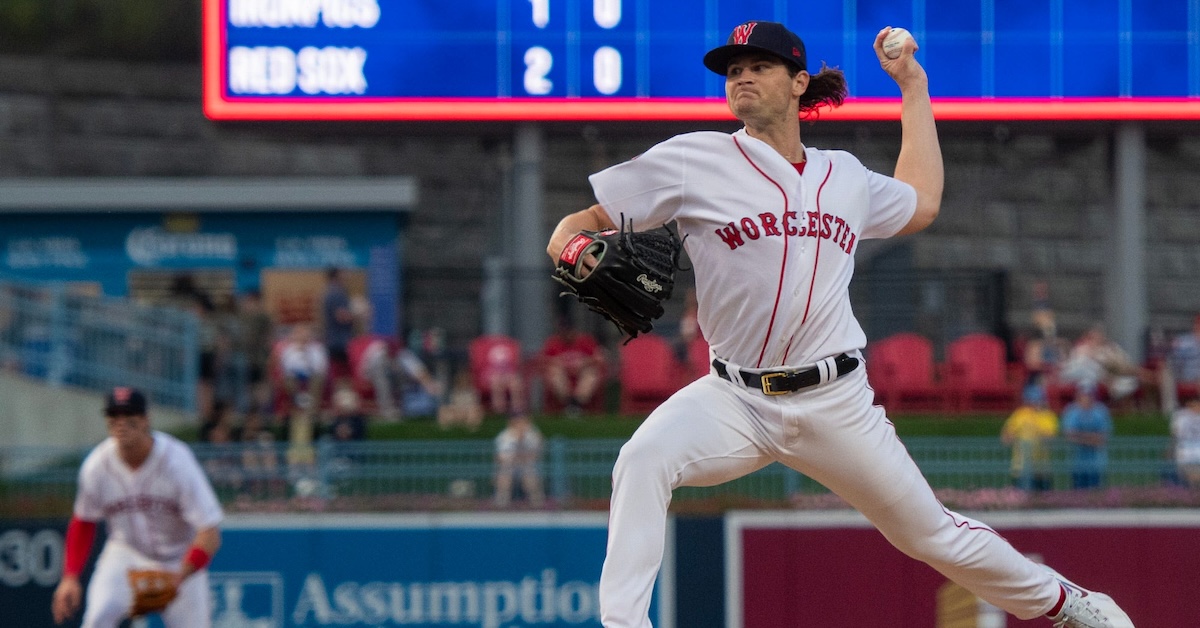
Shane Drohan might be the least well-known of the three players the Milwaukee Brewers acquired in Monday’s six-player swap with the Boston Red Sox, but that doesn’t mean he isn’t talented, nor is it an indication that he lacks a big league future. Fully healthy and with a more diverse arsenal than he possessed prior to undergoing shoulder surgery 24 months ago, Drohan arguably profiles less as a long shot and more as a diamond in the rough. As my colleague Davy Andrews put it when assessing the deal, “The Brewers get the chance to work their magic on two young pitchers,” with the other being Kyle Harrison.
A 27-year-old southpaw whom the Red Sox took in the fifth round of the 2020 draft out of Florida State University, Drohan is coming off a 2025 season that saw him log a 3.00 ERA, 3.11 FIP, and 34.5% strikeout rate over 54 innings, the bulk of which came at Triple-A Worcester. Health was once again an issue, though this time it wasn’t his shoulder: The Fort Lauderdale native was out of action from early May until mid-August due to forearm inflammation.
Drohan discussed his arsenal, including how it was impacted by having gone under the knife two years ago, when the Red Sox held their annual rookie development camp at Fenway Park in mid-January.
———
David Laurila: I’ve seen your scouting profile, but how do you view yourself as a pitcher? What makes you effective?
Shane Drohan: “I think the biggest reason I’m effective is that I mix a lot. I have a large arsenal, five pitches, that I’m essentially comfortable throwing in any count. I’ll even throw curveballs, changeups, and sliders on 3-0. That puts a lot of pressure on the hitters, knowing that they can’t cancel out any pitch. I also attack both lefties and righties with my entire arsenal. I don’t limit myself against one side or the other.”
Laurila: What are your five pitches, and what did you throw when you came into pro ball?
Drohan: “I’m four-seam, cutter, slider, curveball, changeup. When I signed, I was predominantly fastball-curveball. I would mix in some changeups here and there, but I wasn’t comfortable with that pitch. It’s been a long process. In Low-A, and again in High-A, they were pressing me to throw the changeup and continue to develop it. Once we were able to check that box and I went up to Double-A, we implemented the cutter. This past year, the cutter shape changed a little bit after my shoulder surgery. It had a little bit more vert to it — it was holding its plane a little bit better — creating a big gap between the cutter and the curveball. We also added the slider this past year. That’s how pitching is. You’re constantly looking to add and refine, making it harder on the hitters.”
Laurila: Can you elaborate on your cutter changing shape?
Drohan: “Basically, the injury I had been dealing with… it was a strange injury. It wasn’t a singular event where it was like, ‘Oh, this happened and now I’m hurt.’ It was a long process that played out over a couple of years. I had a compressed nerve in my shoulder, so that two of the rotator cuff muscles weren’t being told to contract. By the time we got to the point where we realized I needed the surgery, my infraspinatus and subscapularis were pretty much completely atrophied. There was a lot of weakness, specifically in the back of the shoulder, and that is a really important factor in transferring force to the ball. Getting to back to normal — my shoulder being stronger, the nerve properly working, the muscles contracting — allowed my arm to sit back a little bit longer, which created more backspin. I actually saw a lot of my shapes change. For one, I got more vert on the four-seam.”
Laurila: What is the movement profile of your four-seamer?
Drohan: “I get ride-run. Sometimes I’ll throw bad ones where it gets a little wonky, but for the most part, it is ride and run. My average fastball will be around 94-95 [mph], with 16 or 17 inches of vert and nine to 12 inches of run. It’s usually in that ballpark.”
Laurila: Is the ride-run something you’re satisfied with, or would you ideally have more vert?
Drohan: “I’m fine with it. A lot of times, the fastball you have is what you have, unless you want to make drastic changes, which I don’t want to do. If you change the fastball, everything else can change as well. I feel like my other pitches are in a good spot.”
Laurila: I’ve read that you threw a lot of cutters and sliders last season.
Drohan: “Yes. When I first started throwing the cutter, it was actually like a not-too-great gyro slider. Once I really bounced back from the surgery, it turned into more of a true cutter, to where it would hold its plane and just cut across. My shoulder being stronger also made throwing my slider a lot easier.
“Metrically, my slider is now mid-to-high 80s, with zero to maybe a little bit of depth, and then anywhere from four to seven inches of sweep. It was probably my best pitch this past season, to be honest.”
Laurila: What about your changeup? Are you throwing a kick-change like so many other pitchers have begun doing?
Drohan: “I have tried the kick-change, but it wasn’t for me. I was basically just spiking it into the ground. I mean, I’m constantly tinkering with grips. The changeup was a point of emphasis this offseason, mainly because adding the slider last year — and also using it as a weapon — resulted in the changeup kind of taking a back seat. Toward the end of the year we decided that we wanted to throw more changeups and kind of pick and choose when to throw the slider. We figured the slider would be more effective if we weren’t throwing it quite as much.
“Because the changeup had been on the back burner, I ended up adding a little positive vert to it, which you don’t want; you want negative vert. This offseason, we’ve worked on the grip, with the goal of killing the vert to where it’s closer to what a kick-change would look like depth-wise. We’ve made good progress. Like I said earlier, I feel that my pitches are all in a pretty good spot.”
David Laurila grew up in Michigan's Upper Peninsula and now writes about baseball from his home in Cambridge, Mass. He authored the Prospectus Q&A series at Baseball Prospectus from December 2006-May 2011 before being claimed off waivers by FanGraphs. He can be followed on Twitter @DavidLaurilaQA.
I often wonder when we talk about dudes in the past who went from good players to…not, seemingly overnight, how often it may have been a subtle injury or health condition like Drohan talks about here with his shoulder. A big one for hitters, in my opinion, is vision — it wouldn’t shock me if some players who had a quick fall-off in plate discipline or contact rate were dealing with some minor (or worse) degradation of their vision.
It’s fascinating in some sense because most baseball players are highly tuned athletes on the very right tail of the right tail of human performance, and even scarcely detectable variations can take you out of that population.