
Let’s Make Hasty Judgments About Mark DeRosa’s Lineup
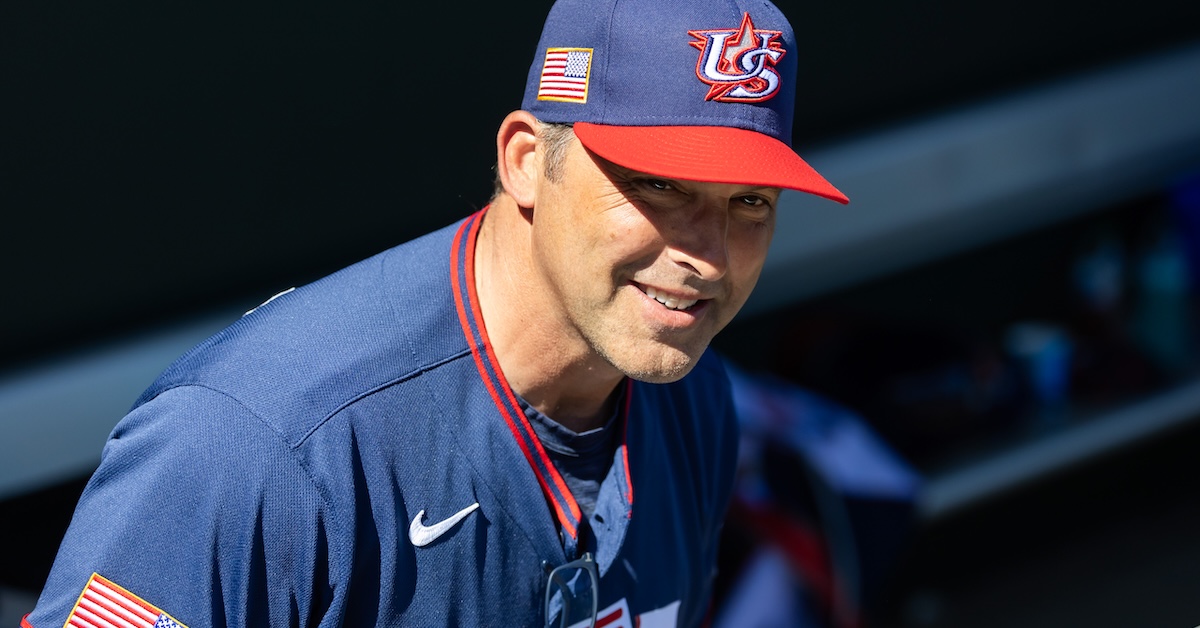
On Tuesday, Team USA played its first tuneup game before the World Baseball Classic, thrashing the Giants 15-1 in a scheduled 10-inning exhibition. This came on the heels of Monday’s announcement lining up the American rotation for pool play in the WBC.
The WBC is a bit unusual for an international best-on-best sporting tournament in that it takes place during the preseason, rather than during a dedicated break (as in Olympic ice hockey or the 2022 FIFA World Cup) or the offseason. Therefore, the best active managers and coaches for each country are unavailable to coach in the tournament, as they would be in hockey and soccer.
For the first four tournaments, USA Baseball got around this by hiring either unemployed or recently retired managers — Buck Martinez, Davey Johnson, Joe Torre, and Jim Leyland. Highly successful and well-respected managers, in the latter three cases. For 2023, they went with Mark DeRosa.
DeRosa played 16 years in the major leagues, but had never drawn a paycheck as a coach or manager anywhere until he was tapped to manage Team USA in 2023. But he’s on TV, and people seem to like him, and think he’s smart because he’s got a degree from Penn’s Wharton Business School. (An institution whose reputation has somehow survived the exploits of its alumni.)
It’s hard to argue with the results DeRosa got out of his team in 2023; Team USA came within one cinematic Shohei Ohtani relief appearance of winning the whole thing. They got to the ninth inning of the championship game with Mookie Betts up, Mike Trout on deck, the tying run on base, and nobody out. That’s about as good a position as you can ask for.
I’m also sympathetic to the unique position DeRosa was in as WBC manager; he’s constrained by pitch count rules and team-imposed usage limits, and he has to find playing time for star position players who are used to starting every day.
You can say that a team led by Betts, Trout, Paul Goldschmidt, and Adam Wainwright basically manages itself; nevertheless, this is a harder gig than the raw talent on the roster would lead you to believe. DeRosa occasionally looked like a novice; much as I’d love to be able to forget Daniel Bard getting the yips against Venezuela and staying out there long enough to break Jose Altuve’s thumb, sometimes it’s hard to shake such stressful events. That’s the kind of situation where it’d be nice to have an experienced manager.
Well, DeRosa is back for 2026, and he’s not a rookie anymore. He commands a roster that, despite quite a bit of turnover, is even more powerful than the Team USA of three years ago. Kyle Schwarber is the only player to start both the 2023 championship game and the exhibition against the Giants, but the reinforcements are impressive: Bobby Witt Jr. has earned a promotion from pinch-runner to leadoff hitter. Adding Aaron Judge, Bryce Harper, Cal Raleigh, Byron Buxton, Roman Anthony, and Gunnar Henderson to the roster doesn’t hurt either.
And while Team USA has regularly ridden exceptional bullpens to the latter rounds of the tournament, for the first time the starting rotation reflects the best this country has to offer. In 2023, Team USA’s rotation was Merrill Kelly, Lance Lynn, and Pray We’re Playing Great Britain Next. This year, the top three U.S. starters are Paul Skenes, Tarik Skubal, and Logan Webb — three of the top four American-born pitchers in WAR last year. The no. 4 starter is Nolan McLean, the top pitching prospect in all of baseball.
It’s hard to overstate how big an advantage that’s going to be. I count two starting pitchers in the entire tournament — Cristopher Sánchez of the Dominican Republic and Yoshinobu Yamamoto of Japan — whom I’d take over Team USA’s no. 5 starter, Matthew Boyd, let alone Skenes or Skubal.
DeRosa’s performance probably isn’t going to be the difference in whether Team USA wins, fails to medal, or finishes somewhere in between. But it’s never too early to nitpick.
Let’s start with how the rotation is set up: Webb for the opener against Brazil, Skubal against Great Britain, Skenes against Mexico, and McLean in the final pool game against Italy.
The four U.S. pool games are on Friday, Saturday, Monday, and Tuesday. Assuming Team USA advances (which we should), the quarterfinal game will be the following Friday, March 13. That’s the first of three knockout round games in five days, including the final.
The pitcher usage limits for the WBC require four days of rest between outings of 50 pitches or more. With an off day between the second and third pool games and two off days between the final pool game and the quarterfinal, DeRosa has some wiggle room if he wants to shift his rotation for the knockout round. In fact, that’s what he did in 2023. In pool play, Team USA started Wainwright, Nick Martinez, Lynn, and Kelly, in that order. Then, Lynn swapped to face Venezuela in the quarterfinal, leaving Wainwright to pick up an easier matchup against Cuba in the semis, with Kelly on the bump for the final against Japan.
Last time out, the group stage was a little chaotic; Mexico beat Team USA to win its group, while the Netherlands, South Korea, and the Dominican Republic all failed to advance out of pool play. But if the favorites — Puerto Rico and the U.S. — win Pools A and B, respectively, Team USA will be in for a fairly easy quarterfinal matchup against Canada, Cuba, or Colombia, followed by a brutal semifinal against either the Dominican Republic or Venezuela.
The first two group games, against Brazil and Great Britain, are gimmes. If Team USA loses either one of those, there should be congressional hearings. The Mexico game will all but certainly decide the group — it did in 2023 — and Italy, with its army of heritage speakers and New Jerseyans, will be an underdog, but a dangerous one.
That works out fine for the U.S., because starting its two best pitchers — Skenes and Skubal, in some order — in the two toughest group games would set them up for the semifinal and final, should Team USA make it that far. In a perfect world, I’d start Webb against Brazil, just to have a veteran on the mound for the opener, followed by McLean against Great Britain, Skubal against Mexico, and Skenes against Italy. Then I’d bring back Webb for the first knockout game, followed by Skubal and Skenes again.
We do not, however live in a perfect world. Skubal is going back to Tigers camp after one start, and McLean has been battling vertigo symptoms. That’s weird enough to be troubling, but he’s expected to be able to join the team, though he’s going to start later in the group stage.
Thus we arrive at the DeRosa’s actual rotation: Webb, Skubal, Skenes, McLean. Given the circumstances — McLean can’t start one of the first two group games, and you’re not lining Skubal up for a knockout round start — that’s fine. The question of whether you’d want Skenes or Skubal starting against Mexico is close enough to come down to taste; either two-time defending Cy Young winner will do.
That still lines Skenes up to start against two of the three toughest opponents Team USA is going to face. If McLean looks good against Italy, I’d be fine lining him up for the championship game; if not, Boyd or Clay Holmes can start the quarterfinal, and Webb and Skenes can each move back a game. It’s a little fly-by-night, given the talent in this rotation, but I think DeRosa is playing the cards he’s got about as well as he can.
I don’t want to dig too much into the first warmup game, but this does look like Team USA’s prime lineup. Still, as much as I’m fine with DeRosa’s rotation order, I do have some notes about his lineup construction. Ordinarily I’d save my revamped lineup for later in the piece, but I’m including it here for reasons of table hygiene:
| DeRosa’s Lineup | My Lineup | ||
|---|---|---|---|
| Player | Position | Player | Position |
| Bobby Witt Jr. | SS | Aaron Judge | RF |
| Bryce Harper | 1B | Bryce Harper | 1B |
| Aaron Judge | RF | Cal Raleigh | C |
| Kyle Schwarber | DH | Bobby Witt Jr. | SS |
| Alex Bregman | 3B | Kyle Schwarber | DH |
| Cal Raleigh | C | Byron Buxton | CF |
| Roman Anthony | LF | Roman Anthony | LF |
| Byron Buxton | CF | Alex Bregman | 3B |
| Brice Turang | 2B | Brice Turang | 2B |
Left-handed hitters in red
Switch hitters in purple
Right off the top: I think DeRosa got the right nine guys into the starting lineup. There are two positions at which I think there’s a legitimate argument over who the best player is: shortstop (Witt vs. Henderson) and the three-into-two of Anthony, Buxton, and Pete Crow-Armstrong for center and left field. Maybe three positions if you want to use Henderson at third instead of Bregman. Nevertheless, I would’ve made the same decisions here.
The lowest wRC+ any of the nine U.S. starters posted in 2025 was Turang’s 124. Last year, 11 big league teams didn’t have a single qualified hitter with a wRC+ of 124 or better. If you put these nine guys in the lineup in any order, they’re going to score runs by the truckload.
But DeRosa’s putting this lineup together like he’s Leo Durocher or something. He alternates left-handed and right-handed hitters, and having the switch-hitting Raleigh in the lineup allows him to keep that alternation going even when the lineup turns over. That’s good; all things being equal, I’d do the same thing.
Other than that, it’s a lineup by stereotype. The fastest hitter leads off. The no. 2 hitter is a lefty who gets on base and can grind at-bats. The best hitter hits third, and the hitter with the most power (if not the no. 3 hitter) bats cleanup. The third baseman hits in the middle of the order and the middle infielder who doesn’t hit at the top of the lineup hits ninth.
I think we can do better. If I were running Team USA, my no. 1 objective would be to get Judge as many at-bats as possible. Not only is he the best hitter, he’s the best on-base guy, and the lineup construction limitations that apply to a normal team are not a consideration here. Everyone in the lineup can get on base to be driven in by Judge, even no. 9 hitter Turang, who posted a .359 OBP in 2025. Similarly, everyone in the lineup can drive Judge in. Just like the Dodgers maximize Ohtani by leading him off, I’d feed opponents as much Judge as the rules allow.
I’d also move Raleigh up in the order from sixth to third. The third guy in the order is going to come up with nobody on and two out a fair amount (well, maybe not with Judge leading off), so you want a guy who has the power to score himself with a home run if he appears with the bases empty. And if there are two outs, you’re not sweating a lower OBP; a two-out walk doesn’t do much for you.
The other change I’d make is moving Bregman from fifth to eighth. This is praising with faint damnation, but Bregman is genuinely one of the weaker hitters in Team USA’s lineup, and seeing him higher in the order than Raleigh and Anthony left a sour taste in my mouth. Sure enough, after the first four U.S. hitters reached off Adrian Houser, Bregman killed the rally by grounding into a double play. Then he homered the next time up, illustrating the futility of lineup discourse.
Ultimately, we’re looking at a seven-game sample, at most. Over that small a sample, Boyd could out-pitch Skenes and Bregman could out-hit Judge. (Heck, Joey Meneses could out-hit Judge over the right seven games.) All of this is academic.
But part of the fun of an international tournament is overanalyzing the manager’s tactics and griping about how you would’ve done things differently. And I am ready to nitpick, baby. My country’s fate depends on it.
Michael is a writer at FanGraphs. Previously, he was a staff writer at The Ringer and D1Baseball, and his work has appeared at Grantland, Baseball Prospectus, The Atlantic, ESPN.com, and various ill-remembered Phillies blogs. Follow him on Twitter, if you must, @MichaelBaumann.
There literally cannot be too much WBC content. Playoff baseball in March? Inject it straight into my veins.
That said, there’s a reason Mark’s not really making the rounds as a managerial candidate. Looking “smart” on TV is just projecting confidence, which only a lineup like this could let you back up on the field.
Thinking more about this, I sometimes get the impression that he wishes he was the JJ Redick of baseball. He’s… not.
Well known that Aaron Boone is the JJ Redick of baseball!
Although, in fairness…JJ was a good NBA player.
And he did win a couple rings in college…
I’ve been a WBC die-hard since I watched the ’06 tourney in High School. So excited to see it finally starting to get the attention and respect it deserves.
I just wish they could have convinced Skubal to make his one start in the knockout round. I’m not sure having him against Great Britain really moves the needle on the US chances of winning the tournament at all. If they can’t win that game with say Bryce Harper pitching, they’re probably not going to win the WBC.
A very effective way to summarize the dream team aspect of this lineup.
What alumni are you referring to, I wonder?
Clearly that obnoxiously undignified teetotaler Warren Buffett
he said “alumni,” so it’s beyond the digit 1.
Jho Low has evaded the law for 10 years, and they still hate him in Malaysia.
Because I too love overanalyzing things that are likely irrelevant, I have some thoughts on the lineup. But first, a large caveat: DeRosa is likely going to defer to some of the players on lineup order preference. After all, Judge has frequently stated a preference to bat 3rd, which is (part of the reason) why the Yankees didn’t run what my personal preference of a Soto/Judge top of the order would have been in ’24.
I think trying so hard to go L/R all the way through with this freakin’ lineup is being too cute.
That having been said, I’m running out:
Schwarber
Judge
Harper
Raleigh
Witt
Anthony
Buxton
Bregman
Turang
as my lineup if those are the starters. Schwarber/_/Harper is the SOP Phillies lineup over the last couple of years, so I’m willing to roll with that. I think my optimized lineup would probably slide Anthony up to 4th, but I can see why that could be a problem from a “I’m not trying to piss anyone off” perspective — putting the second year guy in a “prestige” lineup position would raise some eyebrows.
I could also see flipping Buxton and Bregman in my above lineup to give Buxton more of a chance to hit with traffic on.
Nitpick: Only one two-time defending Cy Young winner in the USA rotation.
Can’t wait to hear DeRosa talk about how the Dow is up
Witt is the clear choice for SS, and I get having Bregman at 3B. It’s pretty crazy that Gunnar might not see much time.
It’s a bummer Skubal won’t be available for the knockout rounds and it’s a bummer Carroll got hurt. Otherwise, there’s really not much nit-picking to be done with this roster (personally would have taken Hoerner over Turang and found room for Mookie).
DeRo’s job should be fairly simple and straightforward, especially with two gimme games to start off pool play. But it would be nice to have someone with actual managerial experience making the decisions on pitching changes in the later rounds.
I certainly agree the that Sanchez and Yamamoto are the only other starters in the tournament that I would consider taking over Webb. But I would take Ranger Suarez and possibly Nola or Alcantara over Boyd.
Thanks for this Michael. I agree with getting as much Judge as possible. But, is that your feeling in this instance, when there are good hitters at the bottom of the lineup that can get on base for Judge? Or do you think the Yankees should employ this strategy when they project to have low OBP guys at the bottom of their lineup? Wouldn’t maximizing Judge PAs also minimize Judge RBI opportunities in NY?
I feel like the trade off bears out that getting the best hitter in the game an extra PA every couple games gives you better chances to win than trying to compound incredibly unlikely outcomes by batting him 3rd. In the latter situation, you’re betting not only a 1 in 3 chance he’ll get a hit, but also an even smaller chance that it’ll be a hit for power and also an even smaller chance someone will be in scoring position ahead of him. In the former situation, you’re only betting on him getting on base with an extra chance.
That said, I think the strategy of batting him 2nd for the Yankees is a decent compromise. It gives him more chances for PAs while also likely surrounding him with good hitters on both sides, and keeping him out of the regular bad situations inherent to the third spot (2 outs no one on, 1 out runner on first)
The other situation you see more often in the third spot than anywhere else is 1 out, runner on first. In that situation you don’t want your best player with both contact and power, you want a three true outcomes guy with crazy ISO and a high fly ball rate so you don’t end up grounding into a double play to end the inning.
If USA gets a big, early lead against Mexico, I would pull Skenes before he gets to 50 pitches so you have the flexibility to pitch him in whichever knockout game you need him. USA has a very strong bullpen.
Of a mixed mind about Bellinger declining. Initial reaction is how can he say “no”? But sitting on the bench for two weeks is not going to get him ready for the season. Now that we have the best players going it could be harder to get players to fill bench roles. The idea of Gunnar Henderson and PCA riding the pine for two weeks in March can’t make their MLB teams happy. I assume Will Smith will play some (Raleigh caught all ten innings yesterday). The only other WBC squad with all-star quality MLB players in a bench role is the Dominican Republic — Perdomo/Jeremy Peña at SS; Caminero/Machado at 3B; Juan Soto/Tatis/JRod/Oneil Cruz in OF (probably better in OF and 3B than U.S. roster) — and those guys likely can’t go home if they decline to play.
Devil’s advocate!
What’s the argument for Bregman over Gunnar, if the former doesn’t know what pitch is coming?
Will several fields have 300’ LF walls?
Agreed. Then on queue he blasts one. Maybe it’s just be (and the weather) but I’ve seen a lot of loonnng home runs this spring. McGonigle 471 or something. Guys who you didn’t think could hit it quite that far. Makes me wonder if the balls changed again
Well, even not knowing what pitch was coming, Bregman’s wRC+ last year was 125 and Gunnar’s 120. so there’s that.
I’m not sure I love Webb against Brazil. Sure they hit a home run off deGrom today, but they are easily the worst team in the tournament. Most the guys weren’t ever even MILB caliber. I would bullpen it, or use Holmes or something. I realize college teams have beat mlb teams before, and minors teams due every year in st… but the team is going to give you 8-10 runs min I’d guess. No reason to waste Webb
Much as I love Paul Skenes, he’s not yet a two-time defending Cy Young Winner. Should be? Yes. Will be? At some point, I think so, perhaps as soon as this fall.