Mariners Finally ‘Seize the Moment’ and Advance Past Tigers to ALCS
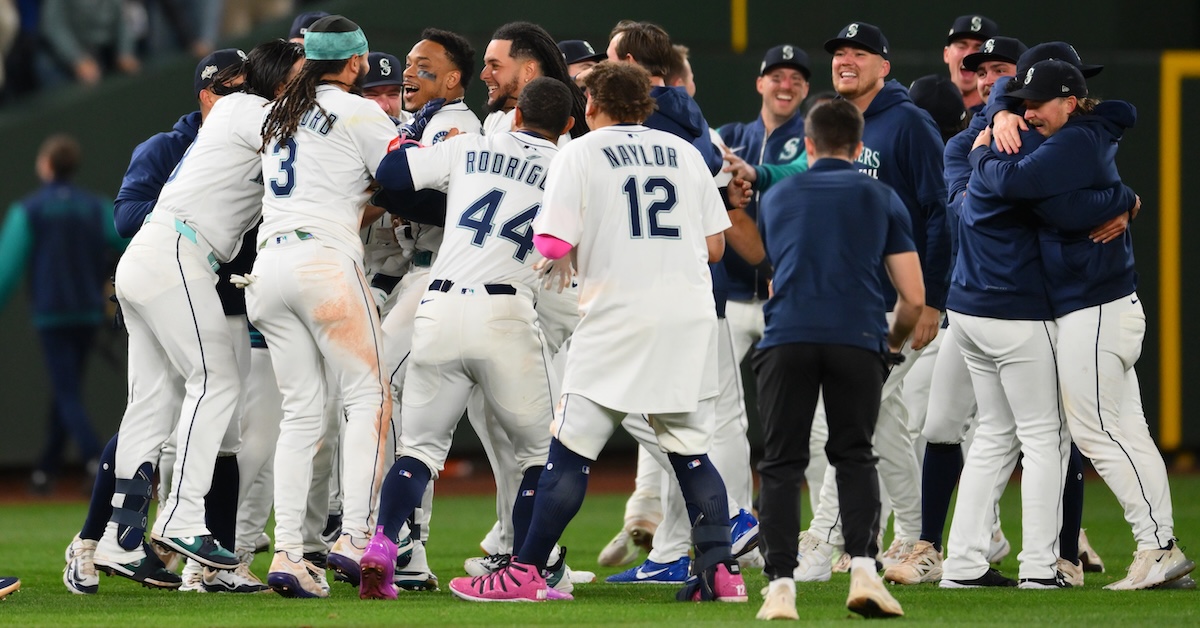
SEATTLE — On a per-game basis during the regular season, the Mariners and Tigers both scored and allowed roughly the same number of runs — 4.70 and 4.28, respectively. Through the first four games of the best-of-five ALDS, each team eked out a one-run win and each team triumphed in something of a laugher. Both teams won one game at home and one game on the road, and both teams relied extensively on their bullpens. Heading into Game 5 on Friday night in Seattle, it was clear one team was going to need to do something to distinguish itself. These teams entered the night locked in a dead heat, having played matching hands for much of the series and needing a new strategy, something different to get an edge and break the stalemate, and even then, it required 15 innings and four hours and 58 minutes to do that. When it was all over, the Mariners had outlasted the Tigers, 3-2, on a walk-off single by Jorge Polanco to advance to the American League Championship Series for the first time in 24 years.
“I don’t even know where to begin to try to recap all the heroic efforts that went into today,” manager Dan Wilson said. “And 15 innings? I’ve got to say, I don’t know how the fans kept their energy going. It was unbelievably loud, even in the 15th inning. And this is a special place. T-Mobile Park is a special place, and they showed us that tonight. And just an incredible ballgame from top to bottom.”
Both starting pitchers were taking the mound for a second time in the series, and both brought a slightly different approach to Game 5 than what they put on tape in their prior starts. In Game 1, Seattle starter George Kirby threw his slider 31% of the time; it was the first pitch he threw to eight of the 22 batters he faced. In Game 5, Kirby went to his slider 50% of the time and threw it as the first pitch to 10 of the 18 batters he faced. After the game, he confirmed this was a conscious shift in strategy to show Detroit’s lineup something different from what it’d seen from him six days prior. “All those guys from top to bottom are probably looking for a heater to start,” Kirby said, “and just starting off with a slider, curveball, whatever it may be, just — if I kept them off balance a little bit, I was able to attack the zone a little bit more with my fastball.” By mixing in more sliders early in the count, he was able to maintain the effectiveness of his four-seamer despite the recent exposure. Though the slider-heavy approach meant Kirby racked up fewer strikeouts than usual, he finished his outing allowing just three hits and one earned run over five innings with six punchouts.
After going to his changeup just 22% of the time in Game 2, the Game 5 version of Detroit starter Tarik Skubal went back to throwing his changeup over 30% of the time (in line with his average usage on the season) and scaled back his slider and sinker usage dramatically.
| Pitch | Game 2 | Game 5 | Season Average |
|---|---|---|---|
| Changeup | 22% | 33% | 31% |
| Four-Seamer | 38% | 44% | 30% |
| Sinker | 23% | 14% | 24% |
| Slider | 18% | 7% | 12% |
As Jake Mailhot noted prior to Game 5, the Mariners offense was happy to feast on the buffet of sinkers and sliders he laid out on chafing dishes during his first three encounters with Seattle this season. At least to the extent that anyone really gets to eat against Skubal. With that surely in mind, Skubal chose to rely more heavily on his changeup, which is his best pitch by Stuff+ and run value. And though his Game 2 start was only marred by the two home runs hit by Polanco, the recalibrated pitch mix Skubal threw in Game 5 was even more effective, serving up a final line of six innings pitched, two hits, no walks, 13 strikeouts, and one earned run. Skubal’s best got even better and he distinguished himself even further by setting a postseason record for consecutive strikeouts at seven.
But while certain aspects of each team’s game plan needed to evolve to stay competitive and perhaps manufacture an advantage, others provide a steadfast edge that should never be modified. Like Josh Naylor’s baserunning. Despite moving at a glacial pace, Naylor reads pitchers and situations like a book. His ability to get the right read led to 30 stolen bases during the regular season and multiple instances during Game 4 where he overtly relayed signals to the batter while standing at second base. So when Naylor doubled in the second, it should have come as no surprise when he made a move to steal third. But Skubal seemed suddenly struck by a bout of ephemeral amnesia, causing him to forget to check the runner. Naylor was able to read Skubal and made it over halfway to third by the time the ace started his delivery. It’s clear Naylor couldn’t believe his good luck because he briefly broke back toward second. The crowd realized what was happening before Skubal did, and as the roar spread through the stadium, perhaps Naylor was worried the overexcited fans were going to blow his cover. But Skubal’s focus stayed trained on Mitch Garver at the plate, and Naylor swiped third on Skubal’s memory lapse. From there, Naylor scored easily when Garver drove a ball deep to right-center field. And with that, Seattle jumped out to a 1-0 lead.
.
Eventually, the starters came out of the game, and it was on managers Wilson and Detroit’s A.J. Hinch to find a new way to gain an advantage. Initially, Wilson played the hits, which led him to bring in Gabe Speier to face Kerry Carpenter for the fourth time in the series. After Wilson let Kirby face Carpenter for a third time in Game 1, and Carpenter hit a go-ahead two-run homer, Speier became Wilson’s go-to guy for retiring Carpenter, one of the most platoon-heavy players in the game. Carpenter owns a career 138 wRC+ against right-handed pitching, compared to a mark of 69 vs. lefties, with 63 of his 70 career home runs in the regular season coming with the platoon advantage. He’s also 7-for-13 with five home runs in his career against Kirby, including the playoffs, with two of those hits (both singles) coming in his two previous times up in Game 5. The move made sense.
And yet, when Carpenter stepped in against Speier with a runner on second and nobody out, he drove a middle-middle fastball 411 feet to give the Tigers a 2-1 lead in the sixth. Carpenter did the very thing Wilson’s tried-and-true Speier-strategy aimed to prevent.
Then, in the seventh inning with runners on first and second and Skubal out of the game, Wilson attempted to send the lefty-hitting Dominic Canzone and his 150 wRC+ against righties to the plate to face right-handed reliever Kyle Finnegan in place of Garver and his 63 wRC+ against righties. But once Canzone was announced, Hinch lifted Finnegan from the game and brought in lefty Tyler Holton. From there, Wilson pivoted to birthday boy and switch-hitter, Leo Rivas, who brings neutral platoon splits to the function. As such, when Holton left a changeup over the plate, Rivas looped it into left field for a game-tying single. Bringing in Rivas was a departure in strategy for Seattle. Initially, when Rivas heard his number called, he thought he was most likely coming in to run for Polanco who stood at second. Instead, he took his first-ever postseason plate appearance and knotted the score at two.
“To be honest, I was ready to run for Polo on second,” said Rivas, who turned 28 on Friday. “Then [bench coach] Manny [Acta] came to the case, ‘Hey, Papa, come here. Go get this guy.’ I’m like, ‘All right, I’ve got him.’”
The Mariners next move to shake things up and create separation from the Tigers was to bring in starters Logan Gilbert and Luis Castillo out of the bullpen. The two pitchers have headlined Seattle’s rotation over the last few years and neither has pitched a single inning in relief at the major league level. Gilbert last pitched out of the pen during his sophomore year at Stetson University in 2017, while Castillo last appeared as a reliever for the Marlins High-A affiliate in 2016. Gilbert and Castillo combined for 3 1/3 scoreless innings, preventing Wilson from needing to call upon the members of the bullpen that Detroit had already knocked around earlier in the series.
As the innings wore on, Hinch cycled through Finnegan, Holton, and Will Vest — his mainstay relievers. He also called upon Troy Melton and Keider Montero, his all-purpose pitchers, who have spent the season cycling between starting and relieving. Then, like Wilson, Hinch asked a starter to power through a couple of innings. Game 3 starter Jack Flaherty worked the 13th and 14th after not having appeared in relief since pitching one inning out of the bullpen for the Cardinals in 2022.
But before we get to what happened in the 15th inning, we must pause for a brief interlude to explain some T-Mobile Park lore to those not already in the know. As part of the between-inning entertainment at every home game, the Mariners host a Salmon Run in which four salmon — King, Sockeye, Silver, and Humpy — race along the warning track. Stats are kept documenting each salmon’s record, and famously, Humpy had never won. As of this writing, the fun fact in Humpy’s bio on the Mariner’s website reads, “Has never won the race!” Just over a week ago, outfielder Victor Robles joined the Salmon Run to ensure Humpy stayed winless. But as the two teams continued to tack on extra innings, someone behind the scenes made the call to stage a second Salmon Run. And y’all are never gonna believe what happened: Humpy notched its first career win. The players and coaches were not the only ones in the stadium pushing the envelope in the hope of securing a victory.
Then, in the bottom of the 15th Tommy Kahnle took the rubber for the Tigers. Kahnle famously throws changeups 86% of the time. But perhaps knowing a shift in strategy would be necessary to finally overcome the deadlock in both the game and the series, Kahnle threw just 62% changeups, opting to mix in six fastballs. Or maybe the uptick in fastball usage was simply a byproduct of Kahnle’s inability to locate his changeup. Normally, he is able to throw the pitch to all quadrants of the zone, but on Friday, Kahnle struggled to even kiss the shadow region of the zone. His only way to tempt hitters to swing was to use his fastball to prove he could still hit the zone with something. But it wasn’t enough.
After J.P. Crawford singled to start the inning, Kahnle hit Randy Arozarena to put two runners on with no outs. The next batter was Cal Raleigh, who hit a fly ball to center that seemed ill-placed to advance the runners, but Crawford tagged up and pushed for third anyway, and a throwing error Parker Meadows not only allowed Crawford to reach third, but it also let Arozarena move up to second. Detroit intentionally walked Julio Rodríguez to load the bases for Polanco, hoping he would roll over a Kahnle changeup and ground into an inning-ending double play. Instead, Polanco worked the count full and then got just enough of the barrel on a low-and-away changeup to rip it through the four-hole into right field, scoring Crawford and sending Seattle into a state of joyous delirium.
“I know we played a long game, but this team never gave up,” Polanco said. “I know there is a lot of emotion, but we are always trying to keep it simple. I’m just trying to go out there and play and trying to get the win.”
With the win, the Mariners advance to the ALCS to face the Blue Jays. It will be Seattle’s first appearance in the Championship Series since 2001 and fourth time overall. Though the team has found success at various points over the last 30 years, but it has never reached the World Series.
While waiting for Wilson to join the media in the interview room for his postgame press conference, a Mariners PR person brought in a gray plastic chair and placed it behind the mic at the center of the table, between several padded leather chairs. When Wilson entered the room, the reason for the change became clear. Visibly dripping with a soup of beer and champagne, Wilson took his seat — the gray plastic one — so as not to ruin the upholstery of the chairs on either side. The rearranging of the furniture represented one final strategic shift to get Seattle over the ALDS hump and on to Toronto, where the series begins this Sunday.
Kiri lives in the PNW while contributing part-time to FanGraphs and working full-time as a data scientist. She spent 5 years working as an analyst for multiple MLB organizations. You can find her on Bluesky @kirio.bsky.social.
Instant classic. Leo Rivas put his name in the history books last night.
Regardless of outcome, though, we gotta fire all the managers in these playoffs so they stop IBBing the bases loaded.
You mean stop Bobby Coxing the bases loaded…
They should walk every lead off hitter to set up the double play
They need to bring back the IBB of yore. I don’t care if it adds, like, 30 seconds to the game time. Managers only having to hold up four fingers is b o r i n g.
I agree. Make them do it and let the boos rain down (if you’re on the road).
I also once watched Albert Pujols hit a homer on a pitch that bounced, while the Mets tried to not-intentionally intentionally walk him. I love those weird plays!
Three out of five games decided by one run with two of those going to extras. 15 innings for a winner take all game! It is hard for any 5 game series to be “the closest of all time” but maybe this is the closest among 5-games series?
And as always with one-run games, certain kinds of team are likelier to end up there than others. The “instant classic” vs. interminable slog question is obviously in the eye of the beholder here, but it certainly seems like you could only get this kind of series and this kind of decisive game when both sides are fairly short on hitting (and the game is played in an extreme pitchers’ park). For the last 7 or so innings of this one it felt like a Sisyphean task for either side to get a guy across home plate. “Good pitching beats good hitting” maybe covers the first 6 innings but by the end it was apparent that the whole run-scoring environment was tilted toward the extreme low end, both by talent and by circumstances, for a playoff game.
I mean, the Dodgers and Phillies both have plenty of hitting and slugging but still managed to play a low scoring, extra inning, game 4.
I’m not totally sure how to interpret this take. Were you saying that the teams were getting tired? If so, okay I can buy that. But if you’re suggesting the hitting (on paper) was bad, it kind of fails to recognize how good of an offence the Ms (for one) had this season (both on paper and statistically), especially after the trade deadline. Indeed, the park factor might be at play here, but I truly don’t know what you are getting at here. Generally, memorable games like this inevitably require a certain amount of luck and ineptitude for them to earn that memorable element. In the end, it was a dramatic game that kept anyone who cared on the edge of their seat. Why try to say otherwise?
This take feels not true at all. The Mariners are one of the best offenses in the league. And Detroit isn’t terrible either. And there were tons of base runners in the last 5 innings. Pitchers on both teams made big pitches, managers kept going to a fresh arm whenever anyone struggled, and hitters got unlucky with hitting hard balls right to fielders. This was a story of a hard fought battle much more so than meager offenses.
These series’s are incontrovertible evidence that DS should be 7 games. I could have totally watched more Dodgers-Phillies.
This sounds good now, but after a couple more rounds of 7-game series I would get tired. Seems like the right amount for me.
Easy solution, just dump the wild card round.
Yeah there is no way that is going to happen!
After one team gets to 3 wins, hold a national snap poll. If fans vote for more baseball, boom, best of seven. If they don’t? Series over.
The drama of having to make your pitch, as the team down in the series? Excellent.
I guess you could also set it such that if the teams go to 2-2, it becomes a 7 gamer automatically.
None of this will happen though
Excellent, Kiri.
One performance Kiri does not note in this insightful write up is that of Seattle reliever Eduard Bazardo.
He entered the game with two on and none out in the 12th and, after a successful sacrifice put runners on 2nd and 3rd, got the Mariners out of the inning unscathed. He then struck out the side – Greene, Torkelson, Keith – in the 13th. He got two more outs in the 14th, including another K, before leaving for Castillo.
Line: 2.2 innings, 1 H, 4 Ks, 1 IBB, 0 R, 2 inherited runners/0 scored , 39 pitches/28 strikes. He also made a good fielding play on the sac bunt.
This is the first season in which the 30-year old Bazardo has not pitched a large chunk of his innings in the minors.
Rivas will deservedly get attention for his game-tying pinch hit, but some is also due Bazardo, who probably delivered the single best relief appearance in a game that featured 13 of them.
I never thought much about him until yesterday but he was as important as anyone in that game to the outcome
WPA
Carpenter .483
Bazardo .471
I was surprised, to the point of disappointment, to not see Bazardo get his due in the article. He was excellent in the highest leverage situation that there could possibly be. I have followed him since his time in the Red Sox organization and was surprised they cast him aside. He was on a steady climb until the pandemic then had a misstep or two but was okay in his only short stint with the Sox. Just another Bloom blunder.
Seemed like every single extra inning had multiple threats…and they just kept getting extinguished. Double plays, bad bunt attempts, pop-ups…and soooo many strikeouts.
Great game…go M’s!
Nice writeup. The insights on the salmon run and wilson’s chair switch are appreciated
I’ve been rooting for Leo Rivas all season. Rivas was running a 128 WRC+ and was on pace for a >4 WAR season when the Mariners sent him down in favor of ranked prospect Cole Young. But it was more than good numbers. He was “controlling the zone,” cranking out one good at-bat after another, wearing pitchers down and being very pesky on the basepaths.
I texted my baseball buddies at the time that if everything worked out exactly to plan with Young…he might be as good as Rivas was. It didn’t work out. Young got 257 PAs to Rivas’ 111, producing -0.3 WAR to Rivas’ +0.8 in less than half the appearances.
Even now, I’m not sure they are using him enough. Don’t be fooled by his mediocre defensive metrics, he is an excellent defender at second base. The best Mariners team might have the switch-hitting Rivas starting at second with the switch-hitting Polanco at DH regardless of pitcher handedness, while Mitch Garver and his 86 WRC+ rides the pines.
I wasn’t super familiar with him but that at-bat was incredible. To come off the bench, not even knowing you were getting into the game, and still having a specific plan and executing it perfectly is big league stuff.
I recall him making an incredible defensive play and being touted as a great defender and solid regular if he could even hit a wee bit.
Canzone has been so good against righties though. I’d play Rivas’ bat over Garver against lefties, but not over Canzone against righties.
In a post-season in which the managers have been making ghastly mistakes in this instance both managers made the proper moves.
Yes, Rivas has been very good when given the opportunity. They should play him at 2B vs LHP with Polanco at DH, but Canzone deserves his spot vs RHP.
Garver was great for Texas when they won the World Series but has looked like a shadow of himself at the plate ever since he joined Seattle.
As far as “sicko games” go, this might have been the sickest game to be played in quite some time, maybe since 2018 WS G3. Felt like both teams were sending their whole lineup to the plate in every extra inning but were completely incapable of scratching a run across.
I was only 76 at the time and I remember looking at the clock when Muncy ended that game and, here on the east coast, it showed 3:36. I got off easy last night when Polanco delivered it was only 1:08. I still slept until after 10.
The never ending parade of poor ball and strike calls almost struck again last night. In the bottom of the 12th the Mariners had men on 1st and 2nd with no outs. J.P. Crawford had a 3-0 count with Montero on the mound and the 4th pitch of the AB was well outside the zone but was called a strike by Alan Porter. The correct call would have loaded the bases with no out. Instead Crawford popped to left and the rally fizzled when Arozarena hit into a DP. This is at least the third very poor call that has come at a crucial moment in the game. I fear the ABS won’t help as much as it could if the teams were given at least three challenges.
Totally agreed on that call against JP being both bad and impactful. That said, the ump scorecard was actually great this game, which is so impressive to me given how long the game went and how many pitches he had to call.
To your other point – maybe it’ll work similarly to mound visits in extra innings. Like you get an extra challenge for every 1-2 extra innings. Or even just one extra one at the start of extra innings.
Call it a makeup call for that absolutely abysmal “hit by pitch.”
I was at the game so I didn’t see all the angles on the hit by pitch. Was there an actual definitive/conclusive angle? The main one I kept seeing is from the pitchers view, but the ball covers the top part of his hand in that view. So while it looks like it hit the bat first, from that angle I can’t definitively say it didn’t graze the top part of his hand first/almost simultaneously with hitting the bat.
I’d be interested in a link if there’s another angle!
I think if you pause that straight-on view right before the ball redirects sharply down and to the left (from the CF perspective) into his hand, it is very nearly conclusive that it hit the bat first. I would say it’s also not conclusive that he actually pulled back the attempt, but that part isn’t reviewable.
Whatever was called on the field was going to stand, in all likelihood. But I think the replay makes it more like 90/10 that the call on the field is wrong. So maybe they can’t overturn it, but Porter might be thinking, “Man, the Tigers kind of got screwed there.” Or he just completely whiffed on the Crawford call.
Not that it matters, but the Reddit consensus from fans of neither team is certainly that this was not a HBP: https://www.reddit.com/r/baseball/s/HnJrroSYG8
Best view I’ve seen: https://x.com/PitchingNinja/status/1976862494389158309
Can we petition for AJ Pierzynski to never be in the booth again? I found lots of his commentary so dumb and annoying, and he had absolutely no feel for the pace or energy of the game.
He sounded like someone who put a bunch of prop bets on specific pitches, and that he didn’t care about the outcome of the game so long as Kahnle threw a changeup.
Or is it just me?
They were the weakest booth of the four. Wainwright wasn’t any better.
Time for a screed from an old guy.
It is almost impossible to fathom, from the vantagepoint of the end of the first quarter of the 21st century, just how big baseball was in the sports world relatively late in the 20th. You just have no idea how big the 1979 “We Are Family” Pirates were. The 1984 Tigers, with their 35-5 start, dominated sports in the summer of 1984, notwithstanding that it was an Olympic year with the Olympics in Los Angeles. The 72-74 As and the 88-90 A’s, three straight pennants, four World’s Championships, were everywhere. Then the 1994 strike but even then the great home run chases by McGwire and Sosa, pre-revelations, brought some of the audience back.
Meanwhile, our friends at Fox and ESPN were starting to look at programming baseball from a different perspective than it had been done previously. I think you know where this is going: Yankees, Red Sox, Dodgers, Cardinals, Cubs, Mets. Baseball became, as the parlance goes, a regional sport. You watched “your” team, you rooted for “your” and you didn’t care at all about the other 29 except when they were playing them.
Of course, there are great announcers in many markets, familiar with their teams from spring training to banquets in the winter. But those voices aren’t familiar to anyone else, and with minor exceptions (a Tarik Skubal or a Paul Skenes or a Cal Raleigh can enter the consciousness if only for a bit) neither are the teams or the players.
Baseball attendance is good, but baseball national TV ratings not so much. Baseball “clicks” are not as good as NFL, NBA or I suspect EPL ones. And baseball is about to go through a serious revolution because of the end of regional sports networks.
What’s relevant to that and the comment above is that there aren’t a great number of good announcers to go around among TBS, ESPN and Fox to staff the entire playoffs. And the ones who get assigned to teams that aren’t in Los Angeles, Chicago or New York are likely to be very unfamiliar with the teams in Detroit, Toronto, Seattle or Milwaukee. And they assume their audience is, too. So they go through their “storylines” and they don’t really have the familiarity with the actual way the teams operate to handle a fifteen-inning all or nothing game between the Tigers and Mariners when the choices available to the managers aren’t in their very hastily scribbled notes.
That Dan Dickinson, Jason Benetti, Rick Rizzs and Aaron Goldsmith, each of whom could tell you without needing to look at a note who is likely to come into the game from either side, because they saw every one of their own team’s games, and every game between them, and would have been quite available to the networks to come into the booth, is of course something we can all contemplate.
I said I’m old. In 1968, Harry Caray and Ernie Harwell were in the network booths for the World Series. You may recall Mr. Caray, then broadcasting for the Cardinals, was a bit of a homer. Let’s just say he didn’t make any friends in the Detroit area that Series.
I’ve always thought the best way to do national broadcasts would be to take one of (or both of) the local guys for the two teams playing and have them broadcast the game. They know the teams better, and it’s so much more fun to hear people who are invested in the game. I actually prefer the local announcers of the opposing team (those actively rooting against my team) to most, if not all, of the national announcers.
It’d be fascinating to have a mixed booth: one broadcaster from each team’s broadcast team. Has anyone ever tried that sort of thing?
This is how the Sunday morning Roku games are. It’s a little strange but not bad!
Love it.
First question is who becomes the lead play-by-play guy.
But that’s easy: the Home Team.
And the rest all become color commentators.
It might be rough at times.
Maybe even literally. But that would just make it more entertaining.
Would be amazing if they get in regular trash talk.
Who would you guys think is the closest to Hawk Harrelson? (as such a homer-broadcaster that he’d be likely to get in fights with the opposition)
Dang, I wish they’d given Humpy a chair.
I can not talk about it without crying!