
Mariners Swap a Ford for a Ferrer(i)
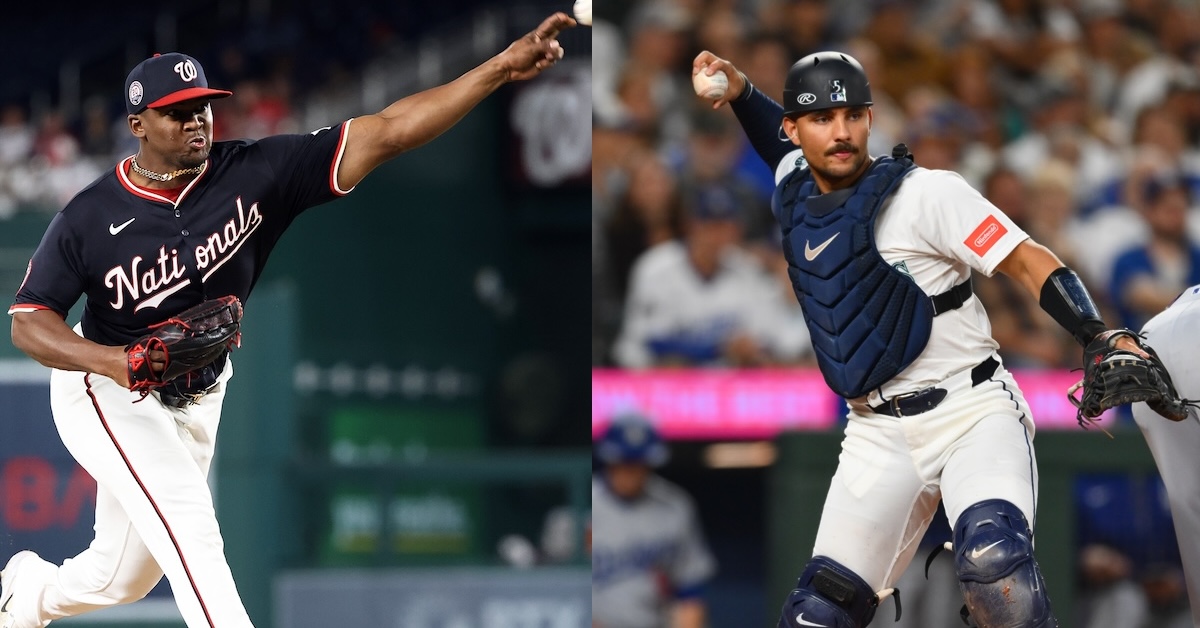
On Saturday afternoon, the Mariners traded catching prospect Harry Ford to the Nationals in exchange for Jose A. Ferrer; the Mariners also sent right-handed pitcher Isaac Lyon, their 10th-round pick from this year’s draft, to Washington. Robert Murray of FanSided had the news first.
This is a trade that raises a few eyebrows. While Ford moved through the minor leagues slowly by modern standards, he’s been a consensus Top 100 prospect for nearly three years now. It’s a little jarring to see someone of that caliber dealt for a reliever, particularly one with pedestrian surface-level numbers and good but not sterling peripherals. My initial reaction was that Seattle sold low on Ford, though further review has changed my thinking a little. Let’s dive in.
The Mariners’ side of this takes a little more nuance to work through, so we’ll start with their situation. Ford is a good, if not great prospect. He’s been on our Top 100 list for a couple seasons now on the strength of a well-rounded game, finishing the 2025 season ranked 43rd overall as a 50 FV. He can hit a little bit, there’s average power that he’s learning to tap into, and he’s growing into a reliable, if unspectacular defender behind the plate. There isn’t much star potential here, and I’ll say more on why that is in a bit, but he does project as a regular.
But Ford was also as blocked as any prospect in the minors, stuck behind MVP runner up Cal Raleigh. Raleigh is durable, excellent, and thoroughly entrenched after inking a six-year extension this past March. The Mariners had experimented with Ford in the outfield to see if they could find something else for him to do, as it’s been clear for a while now that his future would not be behind the plate in Seattle. He’s been an obvious trade candidate for at least a year, and the only surprise is that it took so long for the M’s to move him. They’ve reportedly been shopping him for impact relievers elsewhere; frankly, this is a swap that would have made a ton of sense four months ago, when Ford was just as blocked and the Mariners could have used more relief depth in front of Andrés Muñoz and Matt Brash for their playoff push. Oh well, not like it bit them in the butt during October.
So, trading Ford makes sense. But for Ferrer? A guy with a 4.36 career ERA? Don’t they have holes around the infield, ones they may need to fill via trade since it seems like their off-season budget is pretty modest? What gives?
As readers likely know, Ferrer’s numbers under the hood are much better than his ERA. His FIP over the last two years is under 3.00, thanks to tiny walk and home run rates. He’s also one of the league’s foremost groundball generators. His groundball rate is just over 60% for his career, and of the pitchers who threw at least 50 innings in 2025, only José Soriano, Jhoan Duran, and Tim Hill topped Ferrer’s 62.6% mark. As you’d expect, it’s really hard to drive the ball against him, and he only allowed five long balls in 76.1 innings of work in 2025. He takes full advantage of his ability to dampen damage on contact, pounding the zone to the tune of a 2.21 career BB/9 rate and an in-zone pitch rate of nearly 60% (roughly the 90th percentile for the league).
And of course, the Mariners aren’t just acquiring those numbers. They’re trading for the chance to unlock more, and you can see compelling paths forward here.
This season, Ferrer mostly just pounded the zone with his sinker while mixing in a changeup about 20% of the time and a slider once or twice an outing. His sinker is quite good, as it sits in the upper 90s, touches 100, and features plus tail. It’s a quick and reliable way for him to generate outs, and you can see why he leans on it. But like most pitchers who spam the fastball, there’s an argument for a usage adjustment here. The changeup performed very well in 2025, generating big whiff and chase rates, and hitters didn’t do much with it even on contact. He could probably stand to use it more.
The real path forward may be the slider, though. Ferrer’s sits in the low 90s and has tight, two-plane movement, not quite cutterish but in the neighborhood. His command of it isn’t great, generally in the dirt to the glove side, but whether it’s because guys don’t expect the Spanish Inquisition or they’re just not seeing his spin very well, opponents did absolutely nothing with it and whiffed more than half the times they swung. The Mariners have had a lot of success getting fastball-heavy arms to diversify their arsenal — Logan Gilbert and Bryce Miller are two obvious examples — and it would come as no surprise if they have Ferrer lean on the bender a lot more going forward.
Put everything together, and you can imagine why Seattle sees Ferrer as an impact reliever, the kind worth parting with a top prospect for. Sources from around the game like Ferrer as an upside play. He throws hard, he pounds the zone, he has three pitches that flash plus, and there’s a relatively straightforward adjustment that could unlock more. With four years of team control left, he’s not even expensive. He lengthens the bullpen and gives the Mariners a left-handed weapon of a magnitude they didn’t have last season. There’s always risk in acquiring relief pitching, but this looks like a safe way to add 1-1.5 WAR to the bullpen, and with his skills, a nutty, sub-2.00 ERA season is not outside the realm of possibility.
On Washington’s side, this also makes plenty of sense. Ferrer’s a tough guy to lose, but good relievers are a luxury on a rebuilding club and swapping bullpen arms for bats with everyday upside is a sound idea. That’s especially true behind the plate. Nationals catchers produced -1.4 WAR in 2025, last in the majors, and were awful on both sides of the ball. Led mostly by Riley Adams and Keibert Ruiz, the club’s backstops hit .225/.270/.322, good for a 65 wRC+ that was 29th in baseball. Thanks in part to Ruiz’s horrible framing numbers (his mark of -5.3 runs prevented was third from the bottom among all catchers, in 65 games no less), Washington’s catchers were also the league’s worst collective on defense as well. Ruiz was once a top prospect, but he’s now 27, has no approach, and is not exactly an asset defensively. It’s time to move on.
Enter Ford. A first round pick in 2021, Ford progressed slowly and steadily toward the big leagues before making his debut in September. His approach has been awesome: He has a very good eye, he recognizes soft stuff out of the hand, and while he doesn’t swing a ton, he reliably turns it loose on pitches he can drive. If you put a ton of stock in swing decisions, this is your guy.
Statistically, all is well. His production has been strikingly consistent, with Ford notching a wRC+ between 125 and 135 at each full-season level. He’s also posted very small deviations in his walk, strikeout, and — aside from 2024, which he spent in a huge, homer-suppressing yard — ISO numbers, all of which were encouraging. If you value consistent minor league production, this is your guy.
Scouts and evaluators are not universally sold on Ford’s ability to translate that production to the big leagues, though. His bat speed is average and he’s periodically struggled getting his bat to fastballs up in the zone. In his most recent prospect write-up, Eric covered an adjustment Ford made with his feet and timing that seems to have helped this season, but obviously the big leagues will provide a different stress test. I see an average bat with a chance to grow into average game power, but there are scouts who would take the under on both.
Ford’s defensive growth has mirrored his ascent through the minors. His framing has improved but is still fringy, and he may benefit from an ABS assist (though he was actually pretty bad at challenging pitches this season). He shines more in spots where his athleticism takes center stage. He’s quick on plays where the ball is tapped out in front of the plate, and he’s going to catch his share of baserunners. He has an above-average arm, his throwing accuracy has improved, and he caught nearly 25% of would-be-thieves in 2025. Early-career reports questioned whether he had too much trouble simply catching the ball, but his passed-ball figures have plummeted since 2023. I’m projecting an average defender, though again, there are evaluators who will take the under.
It all adds up to a 50 FV report, albeit one where there isn’t a lot of wiggle room if one of the tools doesn’t reach its projection or Ford’s approach buckles against better stuff. In truth, part of that projection is a reflection of the state of catching throughout the league; the bar for being an average regular isn’t very high right now. Still, if he’s average on both sides of the ball, that’s a good player, and he’s the kind of risk Washington should be taking at this stage. Ford could be part of the next good Nationals team, and even if he falls a little short of where we have him here, he’s likely steady enough to be a real upgrade over what they’ve trotted out in recent seasons.
Let’s quickly touch on the other player in the deal. Lyon, the son of former big leaguer Brandon Lyon, signed for nearly $200,000 this summer. He’s a good strike thrower with a bad fastball, a slider and change that flash average, and a delivery with some deception in it. He sat in the low 90s in short starts with Low-A Modesto, and could have another gear as he fills out. He projects as an up-down type and has a low-leverage relief ceiling if he can find a way to throw harder in shorter stints.
One other thing to note: With Ford now in Washington, Seattle will be in the market for a backup catcher. The club is reportedly open to a reunion with Mitch Garver, who hit 24 homers amidst otherwise disappointing production over the past two years as the club’s primary backup catcher; he also started at DH 22 times this season. While Raleigh plays nearly every day, he does DH fairly often, so whoever Seattle signs will probably start about 25% of the time behind the plate.
Ultimately, the deal helps both parties, and one exec I spoke with called it a “win win” move. The more I look at Ferrer, the more he seems like a reliever with another gear, a guy with closer stuff who is a plenty good fit for Seattle’s bullpen as is. Still, I think Washington did well here, getting a high-floor position player at an area of desperate need. The Paul Toboni era is here now, and Nationals fans should be enthused about his first big trade as president of baseball operations with the club.
Brendan covers prospects and the minor leagues for FanGraphs. Previously he worked as a Pro Scout for the Pittsburgh Pirates.
This Nats fan gives this trade two thumbs up. A major league ready quality catching prospect for the cost of a bullpen arm? Heck yeah!
Ferrer is an excellent reliever who did not benefit from atrocious catching and fielding behind him last year. On a team with excellent catching and infield defense he will be an All Star.
Also I am so tired of my Nats having terrible bullpens. Ford is not much of an improvement over Millas. Millas is the better defender. Ford should hit better, but Millas has really improved his bat.
ABTR (Always Be Trading Relievers)
Seriously, I like Ferrer and Millas too.
But Ferrer had an xERA of 3.60 last year and Millas slashed .247 / .306 / .374 in AAA.
Ferrer has another gear but he hasn’t found it yet, and there’s no guarantee Millas will hold up for more than a couple hundred PAs.
I don’t think that the Nationals are in a position where they can afford holding on to a reliever project when the alternative is a guy who could be an everyday catcher. Those don’t grow on trees.
And it’s not like the Nationals are overflowing with talent. The only positions where they could acquire a prospect and they’d be obviously blocked is the outfield corners.
There is plenty of room for Ford and Millas to split catching duties. Even if both are healthy (which is not by any means a guarantee), Millas basically cannot hit left-handed pitching at all so he’d have to sit against them anyway.
Mr sadtrombone, i’m very curious – what was your fangraphs usage rank in the year end year end wrap feature? If you’re not #1 it must be a fangraphs staffer lol. thanks for all your commentary
i often come to an article like this to see brother trombones take. an institution. FG should pay him. the soto comment is legendary
although arguably cares too much about defense thats your achilles heel to evaluation brother trombone
The Soto comment…?
I guess I did talk about Soto a lot early. “Juan Soto is the truth.” I remember writing variations on that a lot.
I do sometimes wonder about all the posts I have made. I would love to figure out what the heck I said about something four years ago. Google only takes you so far.
Thanks for prompting me to check, I hadn’t done it yet.
Apparently I am #6. I also currently hold the Cal Ripken Jr badge, apparently checking every day this year. I am not surprised.
My “sleepers” are all left handed TTO mashers and fireballing starters who started strong and never lived up to their promise (usually due to injury). I apparently also spend a lot of time looking at minor leaguers.
Seems like higher
#6…on a Mariners article??!
#528, Diamond (but, not Platinum) level.
No Cal Ripken. Not sure when I missed, but, I went to Cabo for a week, so I am sure it was during that time that I didn’t jump on the site.
My highlight- I have 1 player that I search the most of anyone- Pat Rockett, in my ongoing quest to have him be judged the worst player in MLB history. I searched him 3x. My most searched player was Ohtani.
474, baby!
306 and Platinum.
If there is a award for “most total upvotes of comments in the calendar year”, I assume/hope it is called the sadtrombone award.
There is a Fangraphs usage rank? Forgive my ignorance, but where?
Doubleclick the button on the right side of your phone
What does the right button say? Is it available on web browser as well?
Found it:
https://www.fangraphs.com/walk-off
he’s the best part of the site tbh. oh and davy andrew’s! and all the other great stuff!
Yep – even the Ms turn him into Clay Holmes, Ford helps the Nats more.
Yeah. As an M’s fan, it just doesn’t pass the sniff test on our end.
An upside-first SRP for a Top-50 ‘spect + filler? It doesn’t have the right feel to it. Maybe I just need to catch up on the kind of value an Opening Day-ready, 50FV prospect can net, but it feels like if both hit their 50th percentile projections 2026-30, Ford would probably have netted more value for the M’s than Ferrer.
And this was a trade by Jerry “Relievers are fickle” Dipoto’s Mariners. In my understand (“understanding”), they don’t trade value for RP like Ferrer. They pick them out of the rough.
Though I admit I’m not even going to get into who would win the net value on any trade of a C to the Gnats. I don’t think they have a single player who would cause them to lose any such trade.
To be clear – if the Ms do instantly turn Ferrer into a Top 15-ish reliever, I like this deal a lot for them.
Unlike fWAR, I think it’s valuable when a reliever enters with one out and the bases loaded and gets a double play.
But the Nats need an acceptable catcher in the worst way, haha.
Should clarify – fWAR thinks that’s an entirely average result, while giving up a double than getting 2 Ks would be exceptional performance by the reliever.
I disagree.
I don’t think the league valued Ford as a top-50 prospect, and I think this trade’s pretty clear evidence of that.
He’s an interesting case in that he’s done enough each year to keep himself on the prospect map for an astonishing four years running without ever really doing anything to improve his stock. He’s never been overmatched by a level but he’s never dominated one either. I think there’s a pretty strong consensus around the league on him that any sort of star-level upside is a pretty remote possibility at this point. He can catch, but he’ll probably be below average at it. He can get on base a bit, but he’ll probably never be an above-average hitter. Not a bad trade asset, but not one that anyone was willing to offer the Ms any sort of established impact talent for.
Perhaps ABTAR (unless ABTR is an established fancronym and I’m outside-looking-in) — Always Be Trading Away Relievers?
First saw it in a Jeff Sullivan article. He might have come up with it. The idea is that reliever performance is volatile enough that years of control aren’t nearly as relevant, especially for rebuilding teams.
I think he actually coined it for the A’s trading Sean Doolittle to Nationals.
Caught in moderation, I’ll try again.
I don’t think it’s likely at all that he hits like either one, but there’s a little bit of Shea Langeliers / JT Realmuto here in terms of the raw athleticism / tools and that his framing might be iffy.
I suppose you could say the same thing about Connor Wong. But Steamer is projecting him for a 97 wRC+ next year and that’s very good for a catcher who projects to be average defensively with some upside for more.
That’s a really good get for a reliever who isn’t by any means bad, but whose best quality is “the stuff is good so he could be better.”
I don’t think this would have been the best deal on offer if the league saw him as a ~league average bat and an average defensive catcher with the potential to be better than average.
I’m not confident about a ton but I’m pretty confident the Ms shopped Ford around to more than just the Nats before they pulled the trigger on this deal. I think the most likely takeaway here is that there’s just not a lot of belief around the league that Ford’s likely to be more than a 2nd-division regular.
League consensus could be wrong of course, but I don’t think this deal happens if even 2-3 of the Ms’ 29 potential trade partners were as high on Ford as you are in that middle paragraph. The Ms think pretty highly of their ability to turn ok relievers into good ones, but they haven’t historically been prone to making huge outlays of money or talent for the guys they think they can level up.
“pretty confident the Ms shopped Ford around to more than just the Nats before they pulled the trigger ….”
This.
I confess the perma rebuild has made a lemon out of lemonade from yours truly.
That said, I can’t argue with turning a reliever into a solid C asset before said reliever breaks or pumpkins.
Morbid curiosity has the best of me now so might as well see what this teardown iteration of the rebuild nets.
Outside Wood & Lile & the newly added Harrison Ford and Cavalli sprinkled with an extra dose of something approaching religious faith for good measure I’d say the roster is completely fair game for turnover.
And just today Toboni’s message to the fans appears as much an admission as can be of the impending firesale.
“Somewhere out there, the players who will comprise the next great Washington Nationals teams are taking shape”
Very much needed, and certainly better to be done by one with a clean slate. Hopefully the post world series hangover of 2020-2025 becomes a small footnote against what comes next.
https://www.mlb.com/news/paul-toboni-letter-to-nationals-fans?partnerID=web_article-share
CJ and Crews aren’t going anywhere soon.
Agreed that Crews will stay put although I would favor his being traded to shore up pitching talent given the Nationals relative OF depth.
CJ I suspect is on his way out the door in short order.
While M’s fans are not happy with the prospect price they paid for a RP, if this was the most they could get from Ford, I think it’s a move that makes sense. Especially if they weren’t comfortable going into 2026 with Ford as the #2 catcher.
btw, K.Ruiz, was more highly regarded as a prospect than Ford and he’s sitting at 0.2 career WAR. The over under on Ford’s career MLB ABs might be around ~1000.
Ferrer could be a very useful piece, has upside, and fills a need.
My initial reaction was overpay, but Ford’s name has been out there for awhile. This was the market reality.
Good get for WAS though.
Sure seems like an overpay to me, but I have to wonder if:
1) They passed up offers involving him at the deadline when they could have really used some more help, or
2) Teams like the Pirates and Twins were out on Ford for one reason or another (another reason to want to fire their front offices)
Like Brendan I think this deal could have happened in July and it would have made so much more sense. Rather than now when there’s a glut of interesting relievers with good stuff who could be fixed up and who would not cost a huge amount of money. Pete Fairbanks, Seranthony Dominguez, and Gregory Soto are all pretty similar to Ferrer that way.
The M’s were very close to getting the Duran at the deadline, so it seems the Twins preferred Tait to Ford. I think the Mariners ran into that situation a few times trying to move Ford. I can see how scouts would be lower on Ford than analytics departments. Having watched him at Spring Training since he was drafted, the traits don’t jump off the field. I wonder if he has enough skill to unlock the athleticism that has been his value since drafted. Hope he succeeds, but this M’s fan won’t lose sleep over him either way.
He is a weird prospect and traditional scouting doesn’t really know what to make of weird prospects. He’s a plus-running catcher who’s framing is a work in progress and he’s going to try and make it as a TTO hitter with only average raw power. There’s not a ton of precedent for this type of player and there’s nothing here that looks double-plus, so scouts might focus in on what he can’t do instead of what he can.
But he’s also a catcher. If he can hit anywhere close to being league average while he plays catcher at an average level he’s a primary catcher. Maybe the skillset doesn’t age well but he’s also only going to be 23 this year.
To follow up on this: Scouts are looking at him and they see a guy like Alex Call or Austin Kearns. In a corner outfielder that’s not exciting. But that kind of hitter at catcher would be *great*.
Teams know that though. An average catcher with a 95-105 wRC+ is really valuable. Nobody in baseball disagrees with that.
Which is a really good sign that most people around the league don’t think he’s an average catcher.
Hot take. Because of how many games a primary catcher misses, an average catcher has about the same value as a very good reliever.
Not sure I believe that take, but I think some in front offices may be close to that stance.
Looks like we had the same thought at the same time…
The big difference is that a primary catcher’s valuable to everyone, while good relievers are only valuable to teams who think they’re going to have a lot of important leads to protect.
30/30 teams have a use for someone who can be a good primary catcher with 6 years of club control left. Only like 18/30 teams are realistically in the market for quality bullpen depth at any given time.
I actually think we’re in a moment where a lot of teams are *devaluing* the catcher position because of injuries there and how much rest they require. Things were a little different in 2024 and 2025, but from 2017-2019 and 2021-2022 there were only about 5 catchers a year who would have qualified for the batting title. And even now if you do a positional split for catchers on the FanGraphs leaderboards in 2025 you will see that only three players got more than 500 PAs as a catcher and only 15 got more than 400.
I think what this means is that teams are more interested in avoiding having a below replacement player at catcher than they are looking for offense there. Because unless you have a catcher who hits at a 110 wRC+ or better (preferably better) they are probably not a candidate for DH.
So how much do you want to shell out for a guy who will probably only catch 60% of a season for you? Ford doesn’t project hit well enough to DH. I think teams just don’t care about catchers now unless they *really* have an area where they stand out. But I just don’t agree with that. If your options are to play half your games with Riley Adams as your catcher or half your games with a guy who is anything close to average back there, I am taking door #2. And I don’t care that my “primary” catcher is only giving me 450 PAs at the position, the dropoff is huge.
What are your examples of teams devaluing average catchers? Last year Danny Jansen got $8.5m coming off a 0.5-WAR season. Alejandro Kirk was pretty much the definition of avg bat, slightly plus glove when he signed an extension guaranteeing him $58 million. Even the Nats gave Keibert Ruiz $50m guaranteed coming off his one semi-decent season (1.5 WAR in 433 PA/112G).
I think teams are appropriately paying part-time prices for part-time players, but I don’t think that’s a devaluing as much as it is an appropriate assessment of risk. Good catchers are still commanding a fair amount: $140m guaranteed for Smith, $105m for Raleigh, nearly $90m for Contreras, etc.
If people thought Ford still had a good shot to end up in that category I think he’d have had a more robust market that returned more than a solid cost-controlled reliever with 8th-inning upside.
But that’s kind of the point I’m making. They’re mostly part-time players and they are basically all part-time catchers. Here is the total list of players who had more than 500 PAs as a catcher in a single year from 2022 to 2025: JT Realmuto (4x), Cal Raleigh (2x), William Contreras (2x), Will Smith(1x), and Shea Langeliers (1x). That’s it.
Here’s another way to look at it: In 2025, the realistic maximum number of innings a player can play in a year is about 1,440, and that’s what Matt Olson has done. Let’s define “full time” at a specific position as someone who plays 1000 of those innings. There are exactly 100 players who did that in 2025. Five of them were catchers. The first one on the list is JT Realmuto at #49.
Now let’s come up with a definition of “part time” at a position. If you play 50% of Matt Olson, you’re around 700 innings, so let’s do plus or minus 200 innings. There are 123 players who played between 500 and 900 innings in 2025. Twenty-eight of them are catchers. Catchers make up 5% of the full time players at a single position and 23% of part-time players at a single position.
And because almost every catcher is locked in at DH, 1B, or C I just don’t think there’s any appetite out there for any catcher who can’t hit well enough to play first base or DH. Someone who hits like Cal Raleigh, Will Smith, Drake Baldwin, or the Contreras brothers are valuable because you can give them another 200 PAs at DH and your team is better off for it. But while Austin Wells or Carson Kelly or Tyler Stephenson provides an exceptional amount of value he would only DH for your team if something went really wrong and / or you constructed your team badly (yes, I’m talking to you Cincinnati).
And projecting any catcher to hit noticeably over 100 wRC+ is basically not something you can do. There are only five catchers who are graded as having at least 50 game power and at least 50 hit. If you broaden your search to players who have at least 40 hit / 60 game power you get another 5. Broaden it further to 60 hit / 40 game and you get Caden Bodine. There are a lot of catchers in the minors right now (including Ford) who are projected to give you more than 2 wins a year (some much more than that) in about 300-400 PAs because almost no one who can play catcher can hit at all. And this is why the Twins probably preferred someone like Eduardo Tait to someone like Harry Ford, and why it’s way too early to give up on someone like Thayron Liranzo, but I bet if you started shopping Joe Mack, Jimmy Crooks, Walker Janek, etc around the league you would get the same reception as the Mariners did with Ford even though they’re objectively valuable players.
I agree that teams price the fact that catchers usually don’t exceed 500 PA into their price. Much like they price pitcher injury in.
I don’t think it follows that a 400PA catcher is valued on par with a good reliever and I don’t think you’re really offering more than supposition based mostly on the Ford trade itself, which is kind of the definition of circular logic.
Keibert Ruiz was more highly thought of as a prospects and was a major centerpiece of a deal for Scherzer and Turner just a few years ago. The Ms got Andres Munoz AND Ty France a few years back for a guy with less than 110 games worth of evidence that he could be a decent part-time big-league catcher a few years back.
I stand by my statement that if league consensus on Ford was that he has a league-average bat and average or better C defense, teams would’ve offered the Ms more for him than a cost-controlled reliever with late-inning upside.
It helps that it’s really hard to find a public scouting report outside of this website that thinks he’s a present average receiver. Eric has written positive things about his glove, but the kindest thing Pipeline says about his glove is that he has good leadership skills. BA’s report from last year is pretty brutal and says pitchers don’t trust throwing to him. Everyone agrees he’s a plus athlete and that means he could improve, but he’s had a long time to do it and we’re still talking about his athletic potential at 23 rather than what he can actually do behind the plate. At some point, teams stop buying the “bet on the athleticism” story and I think this trade pretty conclusively shows we’re there.
Given what we know now (there were Mariners-Duran rumors at the deadline, Duran was traded for another catcher, Ford now has been traded for another reliever) – it’s possible the Twins preferred Tait to Ford, but maybe also possible that Abel as a second piece tipped the scales toward a Philly deal. Ford would seem to fit their needs and timeline really well, if it were just a 1:1 comparison of the two catchers.
Certainly possible. And the Mariners had to attach another player to get this deal done, albeit less accomplished than Abel. I’m mostly responding to folks in the PNW who read about the game more than they watch it. You would think we traded JT Realmuto Jr and Ford just ain’t that. I suspect that elite walk rate will plummet when pitchers realize he’s not going to hurt them in the zone.
isn’t there data out there suggesting high walk/low power profiles do not retain as much of that walk rate at the MLB level as projections expect? If everything clicks he could be a steal as a starting C, but there are a lot of potential avenues for Ford to be a below replacement/unrosterable.
I think this may be a case of the Mariners selling late, but not toooo late. Still a good gamble for WAS at the price.
I remember that was one of the big takeaways from KATOH. IIRC the big takeaways from that were:
1) Avoiding strikeouts is good
2) Hitting homers is good
3) Walks don’t translate as much (I think this because so many pitchers are ironing out command issues)
4) BABIP doesn’t translate much (I think this is because teams are doing weird things like trying to get their eventual left fielder to stay at shortstop)
This is why it’s time to get excited about Kevin McGonigle and Josue Briceno.
I think passivity can get rewarded in the minors, and it gets absolutely exposed in the majors. Edouard Julien is fresh on my mind as the possible archetype.
The Pirates do have Joey Bart at home, to be fair.
If Rafael Flores outperforms Harry Ford then Pirates fans can stop calling for Cherington to be fired.
Cherington very much prefers to get back a bunch of less-regarded prospects instead of a headliner. But I find it hard to believe that the Mariners wouldn’t also throw in a couple low level prospects to get Bednar.
Eric does have Edgleen Perez as a 40+ who should have spent 2025 in one of the leagues that don’t exist anymore, because his eye’s too good for rookie ball, but he hasn’t filled out enough for Low-A.
Sure, but they traded their big relief asset for Rafael Flores. Probably I’m not the only one who’d rather have Ford.
With the caveat that Cherington made an awful trade and should have gotten more for Bednar…Edgleen Perez isn’t chopped liver.
He’s one of the poster boys for Law’s point about how they’ve gotten rid of the leagues appropriate for skinny teenagers who know the zone.
The Mariners needed a lefty in particular, they only have one Gabe Speier and all their starters are right handed. “Throw your best pitch more” is also a much easier correction than “don’t get injured every season” or “get better slider command”. It’s confusing timing but I get why they like Ferrer more than anyone in free agency.
I think part of it is there are two top 10 catcher prospects who debuted last year on teams that already have established catchers. Dalton Rushing is a better prospect who’s just as blocked. The O’s seem committed to Basallo but that means they could trade Rutschman for rotation help. The Braves are also probably shopping Sean Murphy, contenders that need catchers have options. There just aren’t that many teams who had ABs for a rookie catcher and were willing to give up something the Mariners needed.
As a Mariners fan, I think they ideally would have traded Ford for Yandy Diaz at the 2024 deadline while they were getting Arozarena but this was the move to make in the current situation even if it’s confusing on the surface.
There are some decent left handed relievers in free agency, but no one I’d feel good about watching take on Yordan Alvarez or Nick Kurtz in a high leverage situation. Ferrer could get there. Both games the Mariners lost in the ALDS hinged on lefties with big platoon splits crushing homers in the middle innings. All their starters including the depth guys are right handed, they need a good lefty reliever for this current team, they only have one Gabe Speier and he was gassed in the playoffs.
It’s an overpay but it’s also better than letting a prospect wither on the vine after being 8 outs away from a World Series.
100% agree
It’s not the return we were hoping from Ford, but it’s the kind of difficult move I’m glad they were willing to make. Maybe should have made sooner, but still the right move to make now.
Another Nats fan here giving this trade a thumbs up. With the recurring concussion symptoms Ruiz had this past season, it was likely that his days behind the plate were over, so this makes me hopeful that combined with Drew Millas, the Nationals will climb out of their negative catcher WAR.
I was somewhat surprised at the tone of the article. Eric’s analysis, written in June, paints a much rosier picture of Ford than what is written here. 16 HR’s in 97 games, even in the PCL, along with good numbers across the board and a excellent BB/K rate, hints at something far better than the bulk of present day catchers. Eric also put a 70 on his arm, much better than “above-average”. He also brings a level of speed that is rare for the position. With the Nats catching in the abominable straits that it is presently in this looks like an exceptional acquisition. I also see Ferrer from a different perspective. Until proven otherwise I like to see performance before jumping on a player’s bandwagon. Ferrer has been in the majors for three full seasons and has performed like an average reliever, a very average reliever. I like to look at two specific stats, hits and K’s per innings pitched, and he comes up short in both categories. There may still be more than he has shown but, overall, I am surprised that the Mariners couldn’t get more for the 43rd ranked prospect on Fangraphs. That is even more surprising when Ford plays the position that is so difficult to fill. At first glance this appears to be a steal for Washington.
totally agree. Ford could end up being a solid back up and it would still be more valuable than keeping ferrer on a last place team. no way the nats were gonna do better than ford for ferrer.
For the Ms, this does have to he a “We have identified a single, easy to implement fix that will make him a much better pitcher.”
It could also be “we like this guy and after shopping him for a year it’s crystal clear the league doesn’t value Ford anywhere near as highly as our fans do.”
Good point.
“Our fans don’t know he’s Tyler Black, but all 30 teams do.”
I’m sorry, just gotta say: your go-to stats for evaluating pitcher performance are hits and Ks per inning!? My dude! Let me guess, your go-to stat for evaluating batter performance is batting average?
Imagine two pitchers: one of them has a WHIP of 1.00 and strikes out one out of every four batters he faces. Real good pitcher. The other has a WHIP of 2.00 and strikes out one out of every five hitters he faces. Terrible pitcher. Guess which one has the better Ks per inning ratio?
[edited for typo]
The other day on the zips projections for the nats i said i think theres some reason for hope, and I think a move like this shows that a competent team can be made here. This immediately upgrades the worst position on the team by a mile. if ford is average, the nats just added like 4 wins to their team, just by NOT being Ruiz / Adams. Ferrer is such a replaceable bullpen guy. this is a 11th overall pick who has not disappointed in any way. Thats crazy. This actually kinda feels like one of those rizzo heists, which is exciting. That was the best part about rizzo, and now tobooni is picking up the torch. I’m excited, and this moderate approach from brendan is not killing my buzz
Ferrer getting away from CJ Abrams will be a big help for him as he’s put up massive ground ball rates. I really like the Nats return as I think Ford will be a top ten catcher and the Nats and their fans will not be stuck having Ruiz behind the plate for much longer. . You gotta figure he’ll be dfa’d pretty soon.
Abrams (ss) AND Garcia Jr. (2b) AND Lowe (1b) were all turrible defensively last season. They also played a lot of games with either Jose Tena (bad) or Ahmed Rosario (worse) at 3b Ferrer might have PTSD from being a ground ball pitcher in front of that infield.
J.P. Crawford’s not exactly a gold glover out there either.
Well okay, he does have one, but that was years ago and he’s much closer to CJ Abrams defensively than he is to being a good defender.
My Twins’ “catcher of the future” is a teenager in A ball and Ryan Jeffers has 1 year of team control left.
The Twins missed an opportunity here imo.
Hard to believe Ford cannot be a decent part time catcher this year with an opportunity to earn more playing time next year once Jeffers leaves in FA.
Ya, this is hugely disappointing to this Twins’ fan also. We couldn’t get him for Jax or Duran? Unreal.
I understand why Mariners fans would expect a name they’ve heard of in exchange for a prospect with Ford’s pedigree, but Ferrer is really interesting. That sinker gives him a high floor for any team with competent infielders, and if Seattle can unlock that slider then he has the potential to be one of the best left-handed relievers in baseball. Four years of that is pretty valuable.
Ferrer is awesome. Good deal for all parties.
As a neutral observer (except for the aforementioned “gosh I wish the catcher my team had got for their closer was Harry Ford instead of Rafael Flores”), I don’t like this for the Mariners at all. The killer line for me is that the Mariners are “reportedly open to a reunion for Mitch Garver.” Why not stick with the guy who might be able to catch and hit?
Also we don’t make enough of the fact that “Harry” is short for “Harrison.” Harrison Ford has played at least three different fictional presidents or future presidents (Jack Ryan, James Marshall from Air Force One, Thaddeus Ross) so that’s a fit for DC.
The backup catcher for the Mariners is a luxury because if Raleigh is hurt for any length of time they’re doomed no matter who subs in for him.
There’s also no shortage of backup catchers out there. Jonah Heim, Danny Jansen, and Chirstian Vazquez are all unsigned and are unlikely to get starting jobs. Plus Garver and Caratini who are more offense-oriented.
Everyone thought the same thing about the 2021 Braves and Acuña.
It’s an “overpay” in that you’d want to be on the Nate’s’ side of this trade 20 times out of ten. (And the M’s threw in the extra piece to balance it out?!?)
It’s market value in that every team knew Ford was available—and Jerry talked to all of them.
I’m surprised Ford didn’t fetch more. I suspect Jerry of overpaying slightly, because he often does to make trades. Congrats to the Nats.
Back when Kevin Goldstein wrote for the site he had a pretty amazing article that detailed how front offices were viewed by others in trade negotiations. I think it’s gone now, which is too bad, but I seem to recall that teams enjoyed working on deals with the Oakland, Milwaukee, and Seattle front offices and disliked having to call Cleveland. This makes me wonder if there are any front offices who are so annoying to talk to that other teams just don’t bother.
That was interesting, heard the Cleveland thing from a Rays employee also. Cleveland just seems to overvalue their guys or undervalue yours and won’t budge. Then again they got Caminero for myers so sure someone got fired so maybe some PTSD.
That is exactly what the article said. They basically already have their mind made up. I get the sense that they think they have no margin for any missteps—they don’t seem to sign players to extensions unless they are clearly below market (and sometimes you wind up with a Myles Straw situation anyway).
That’s normal. When you buy a car, you don’t shop around dealerships and pick which one gives the biggest discount from the sticker price. You choose the one that you feel is the best fit for your needs and which one you’re the most excited about, even if a different car was a better “deal” on paper.
The Mariners didn’t have to trade Ford. They made this deal because Dipoto really likes Ferrer and believes in his potential to help the team. Time will tell if that was a wise decision.
When Jerry was in his big trading mode, early in his tenure, it felt like every trade he made was a 10% overpay (except with San Diego). Jerry was in a hurry to reshape the roster, and he wouldn’t let pedestrian concerns of “getting equal value back” stand in his way. That is admirable in many ways, but when you’re making a flurry of exchanges, you end up potentially turning your new car into the proverbial paperclip. This is definitely more true of Jerry than some, which is why he has been able to make so many trades.
It can work well, but carries some risks.
I don’t think the fact that a prospect’s blocked or that a team is motivated to move him affects his value.
Good luck going into a car dealership and saying “this car has no value to you. You’re literally just waiting for someone to take it off your hands, so you should give it to me for 40 cents on the dollar.
If teams thought more highly of Ford they would have offered more for him.
The metaphor doesn’t work for me because there’d be a lot more risk of a car sitting on a lot longer enough to lose value if there were only 3 or 4 potential buyers and not 10,000. The Mariners didn’t have leverage to not trade him and didn’t make the same mistake the Orioles did of refusing to lose a trade everyone knew they had to make.
The mariners absolutely had the leverage of not trading him. Every team needs 2 catchers and Raleigh already DH’s about 25% of the time.
If he were highly thought of around the league there would be multiple buyers willing to give up real value for him. The fact that this was the deal the Ms took tells you that wasn’t the case. The Ms didn’t need to trade him. They wanted to. And they found themselves in a position where this was the deal they took. Unless there’s literally only 1 potential buyer leverage is found in his value to the buyer, not his lack of value to the seller.
Yep – bit of a “Wow, *no one* thinks he’s a catcher” deal.
He’s not a slam dunk prospect, I agree with you about his value being lower than Mariners fans expected even under ideal circumstances.
It would be a mistake to have him on the 2026 roster. Having him be a backup catcher means he’s only playing a couple days a week, which hurts his growth. That means putting him in AAA where he has nothing left to prove and still being in the same position they are now or having his value decline as a part time player who only has a small sample in the pros. Finding a new backup catcher at the deadline isn’t necessarily easy if he’s the primary backup all year. It’s hard to have three catchers on a roster with Luke Raley and Dom Canzone.
He had no place on the 2026 roster and his value was only getting worse. That’s not the same thing as “needing to trade him” I have no idea what trade negotiations look like but I can’t imagine that helped the Mariners.
Yeah, I’m pretty skeptical of that argument. There would’ve been huge value to the Ms in having a good backup who could catch 40% of games (with Raleigh moving to DH) without the team losing a ton defensively or offensively. To be clear, I’m not saying someone who could hit as well as Raleigh (few in the league can), just someone who’s not *much* worse whoever would get benched when Raleigh DHs (probably Young given current personnel and the Ms’ offseason approach, which isn’t that high a bar).
I don’t think the Ms make this deal if they thought Ford was that guy. Maybe they think he could be but he’s more likely to get there somewhere else than playing part-time as Raleigh’s backup, but even then I think they hold out for more if they think that’s a reasonable take on his value that other teams are likely to agree with. There’s just not huge precedent for teams accepting lowball trade offers just because a guy’s blocked.
The most blocked prospect this century was Ryan Howard, who was defensively limited to a single position where his team had a literal hall of famer playing at near-peak levels. Everyone and their mother was coming up with hypothetical trades the Phills would be forced to take because there was no value to them in watching him put up another 1.000+ OPS in AAA at 25. Instead of taking those lowball offers, the Phills waited it out, Thome got hurt, and Howard hit his way onto the roster and then led the league in homers 2 of his first 3 full seasons.
The market’s obviously changed a lot since 2004 but I struggle to come up with any good example since then of teams trading a bluechip prospect at what looked like a deep discount relative to other prospect deals just because he was blocked.
As a Cardinals fan (amongst other teams) this is moderating my expectations of what they might get if we say, traded Jimmy Cooks, since the cardinals seem to have a lot of catching prospects…
I’m baffled. I thought the Red Sox got ripped off when they traded The Password for Oviedo. This move is objectively worse. I don’t know why teams are trading top prospects for middling relievers. Ironically, after The Password trade, I posted the list below of players that have had 300+ ABs at AAA, with a wRC+ of 115 or higher and are 22 or younger. I wasn’t expecting another player on that list to get traded for another reliever so quickly. Tre Morgan is a virtual lock to get traded for Jordan Leasure any day now.
Oscar Taveras
Nick Castellanos
Kyle Tucker
Austin Riley
Keibert Ruiz
Owen Caissie
Colt Keith
Adael Amador
Jhostynxon Garcia
Samuel Basallo
Harry Ford
Jordan Lawlar
Nacho Alvarez Jr.
Jackson Holliday
Roman Anthony
Anthony Rizzo
Justin Crawford
Tre’ Morgan
What I really don’t get about this trade is, straight up, contracts and team control being equal, I would take Harry Ford…by quite a bit. But Ford has 2 extra years of team control…and they threw in another lottery ticket. If he can be an average hitter and average defender at the catcher position, which is what he’s projected to be right now, that’s a 2+ win player right there. Perhaps he doesn’t have the highest ceiling in the world but his floor is also pretty high. Plate discipline tends to translate. He’s also been young for his level at every stop and there very well could be additional development ahead of him.
I guess Black only had 173 PA in AAA in 2023.
But yeah, this is a pretty solid indicator the league doesn’t think he’s a catcher.
His floor is replacement level or below. “High floor” prospects don’t really exist, and if they did, they wouldn’t be 23-year-old catchers with questions about whether they’ll be more than barely adequate defensively or whether they’ve got enough power to make their batting eye translate in the majors.
Keibert Ruiz is a great example. As a prospect he had similar defensive evaluations and a better offensive track record. He was one of the worst regulars in baseball last year.
Jose Ferrer was nominated for 3 Oscars and won one – the first Latino to win Best Actor. He also fathered underrated character actor Miguel Ferrer (RIP) and is George Clooney’s uncle.
Harrison Ford (that’s his name) only has 1 Oscar nom and no famous progeny, but did create 2 iconic cinematic heroes and is generally considered badass at 83. So pop culturally this is also kind of a wash.
I came to the comments section looking for this
I love this trade for the Nationals. I see Ford as maybe developing into a Russell Martin type of player.
Transaction review 12-7-2025 – by Sean
I’ll keep saying it: we’ve been building the conditions for years – mainstreaming prospectlandia, service time games, caps at every level, etc etc – and in the post-pandemic era no one is Actually good
I have a proposal: starters *are* stars. Playing time has never been harder to get in *any* major league bc teams have an endless supply of players and the only agenda is payroll (sorry, we ‘Mericans like euphemisms pls hide the truth its scawy, I’m too bwave and fwee to know: “roster”) mgmnt. If Ford really does become a full time catcher, seems many are more optimistic these days, thats a pretty big deal.
I full expect Ferrer to be excellent for the Mariners. Hard to say nowadays when f’n everyone is underrated and teams can just select from a robust menu with different 🤮 price points, but a TJ free, productive pitcher seems a good candidate for most underrated demo in The League*.
*Boy howdeee does the MLB want to be the NFL. I genuinely don’t believe either league lasts much beyond Boomers, no one else can afford this stuff, no one else has decades of freetime to consume mindlessly in the ‘burbs talking to no one else all day, and eventually even ‘Mericans will notice at least one of these leagues is essentially entirely publicly funded (along with all the holocausts we pay for including the live streamed one in Palestine…IIRC the mayor of wherever the Rangers play stated specifically they got $600-700 million for a new stadium that the people need entertainment, a distraction, noise – an open clowning of the population)