
MLB Payroll Probably Isn’t Going Back Up in 2019
In 2018, for the first time in more than a decade, player salaries went down from the previous year. At one point, there was some thought that this offseason’s free agent class might reverse the course charted last offseason. For years, we’ve been hearing about the monster class of free agents that would sign this winter. Here’s Jeff Passan back near the beginning of the 2017 season:
For those who have yet to hear about the free-agent class of 2018-19, here’s a sampling: Bryce Harper, Manny Machado, Clayton Kershaw, Josh Donaldson, Daniel Murphy, Dallas Keuchel, Charlie Blackmon, Andrew Miller, Zach Britton, Craig Kimbrel. There are dozens more. Teams will guarantee $3 billion to players that winter. The number could exceed $4 billion.
Two years later, that free agent class isn’t quite as good as we expected. When we put up our Top-50 free agents, along with crowdsourced contract expectations, the expected outlay to 66 potential free agents didn’t come close the $3 billion assumed; the crowd predicted a number that was just about half of $4 billion that was thought possible about 20 months ago. Our readers provided estimates for 66 players, including Joe Mauer and Adrian Beltre, who have since retired. Of the remaining 64 players, 36 have signed contracts so far. Here’s how the contract totals compare to the crowdsourced average.
| Name | Signing Team | Proj WAR | Crowd Average | Contract Total | Difference |
|---|---|---|---|---|---|
| Patrick Corbin | WSN | 3.5 | 102.3 M | 140 M | 37.7 M |
| Nathan Eovaldi | BOS | 2.7 | 44.5 M | 68 M | 23.5 M |
| Andrew McCutchen | PHI | 2.9 | 43.1 M | 50 M | 6.9 M |
| Zach Britton | NYY | 1.1 | 31.8 M | 39 M | 7.2 M |
| J.A. Happ | NYY | 2.8 | 32.6 M | 34 M | 1.4 M |
| Michael Brantley | HOU | 2.4 | 42.2 M | 32 M | -10.2 M |
| Charlie Morton | TBR | 2.8 | 32 M | 30 M | -2 M |
| Jeurys Familia | NYM | 1.0 | 33 M | 30 M | -3 M |
| Lance Lynn | TEX | 1.6 | 27.3 M | 30 M | 2.7 M |
| Andrew Miller | STL | 1.3 | 26 M | 25 M | -1 M |
| Joe Kelly | LAD | 1.0 | 16.1 M | 25 M | 8.9 M |
| DJ LeMahieu | NYY | 2.0 | 41 M | 24 M | -17 M |
| Daniel Murphy | COL | 1.9 | 29.6 M | 24 M | -5.6 M |
| Josh Donaldson | ATL | 4.2 | 57.8 M | 23 M | -34.8 M |
| David Robertson | PHI | 1.4 | 26.3 M | 23 M | -3.3 M |
| Jed Lowrie | NYM | 2.1 | 26.8 M | 20 M | -6.8 M |
| Wilson Ramos | NYM | 2.2 | 35.6 M | 19 M | -16.6 M |
| Anibal Sanchez | WSN | 1.7 | 11.8 M | 19 M | 7.2 M |
| Yasmani Grandal | MIL | 3.2 | 51.6 M | 18.3 M | -33.3 M |
| Kelvin Herrera | CHW | 0.4 | 24.8 M | 18 M | -6.8 M |
| Hyun-Jin Ryu | LAD | 2.0 | 35.6 M | 17.9 M | -17.7 M |
| Garrett Richards | SDP | 0.0 | 17.4 M | 15 M | -2.4 M |
| Joakim Soria | OAK | 0.9 | 14.8 M | 15 M | 0.2 M |
| Nelson Cruz | MIN | 3.2 | 28.2 M | 14.3 M | -13.9 M |
| Matt Harvey | LAA | 1.0 | 14.7 M | 11 M | -3.7 M |
| Kurt Suzuki | WSN | 1.3 | 10.1 M | 10 M | -0.1 M |
| Brian Dozier | WSN | 2.2 | 31.9 M | 9 M | -22.9 M |
| Trevor Cahill | LAA | 1.3 | 14.5 M | 9 M | -5.5 M |
| CC Sabathia | NYY | 1.2 | 10.7 M | 8 M | -2.7 M |
| Ian Kinsler | SDP | 1.7 | 11.8 M | 8 M | -3.8 M |
| Jesse Chavez | TEX | 0.6 | 7.5 M | 8 M | 0.5 M |
| Trevor Rosenthal | WSN | 1.2 | 9.9 M | 7 M | -2.9 M |
| Steve Pearce | BOS | 1.2 | 10.5 M | 6.3 M | -4.2 M |
| Jonathan Lucroy | LAA | 1.9 | 10.4 M | 3.4 M | -7 M |
| Lonnie Chisenhall | PIT | 0.9 | 10.4 M | 2.8 M | -7.6 M |
| Brian McCann | ATL | 1.0 | 10.1 M | 2 M | -8.1 M |
| TOTAL | $984.7 M | $838 M | -$146.7 M |
So far, free agents have signed for roughly 15% less combined than predicted. It’s interesting to note that the discount is being taken almost entirely in the length of the contracts, as both the predicted and actual AAV are around $12 million. Now that many players have reached agreements to avoided arbitration and a good number of players have signed free agent deals, we can take a look at where teams’ Opening Day payrolls stand at this point in the offseason. There are obviously a few huge contracts to go, with five of the top six contract projections still unsigned, so these numbers are nowhere near final. As of this writing, here’s what Opening Day payrolls look like for every team.
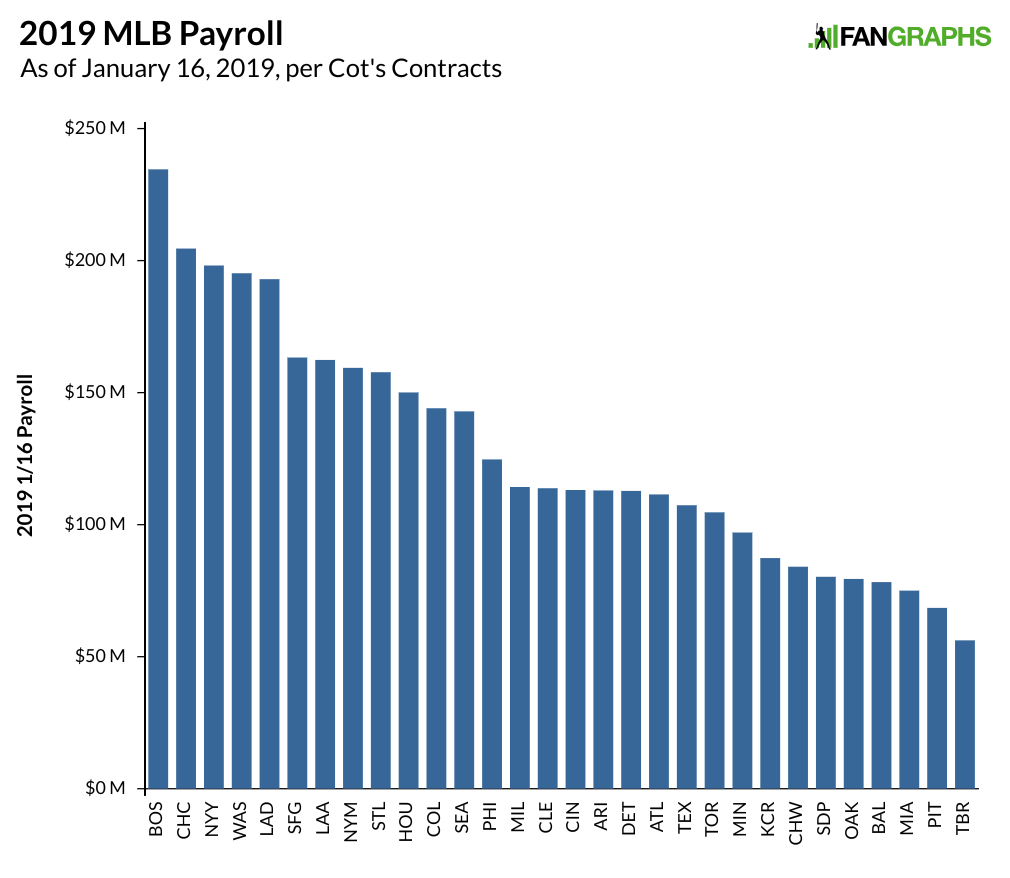
The Red Sox are well out in front of everybody, just like they were last season. The Cubs payroll is up compared to where it was. It might be somewhat difficult, if not impossible, to tell how every team’s payroll has moved based on the graph above. For reference, here’s a graph showing each team’s change in payroll from Opening Day last season.
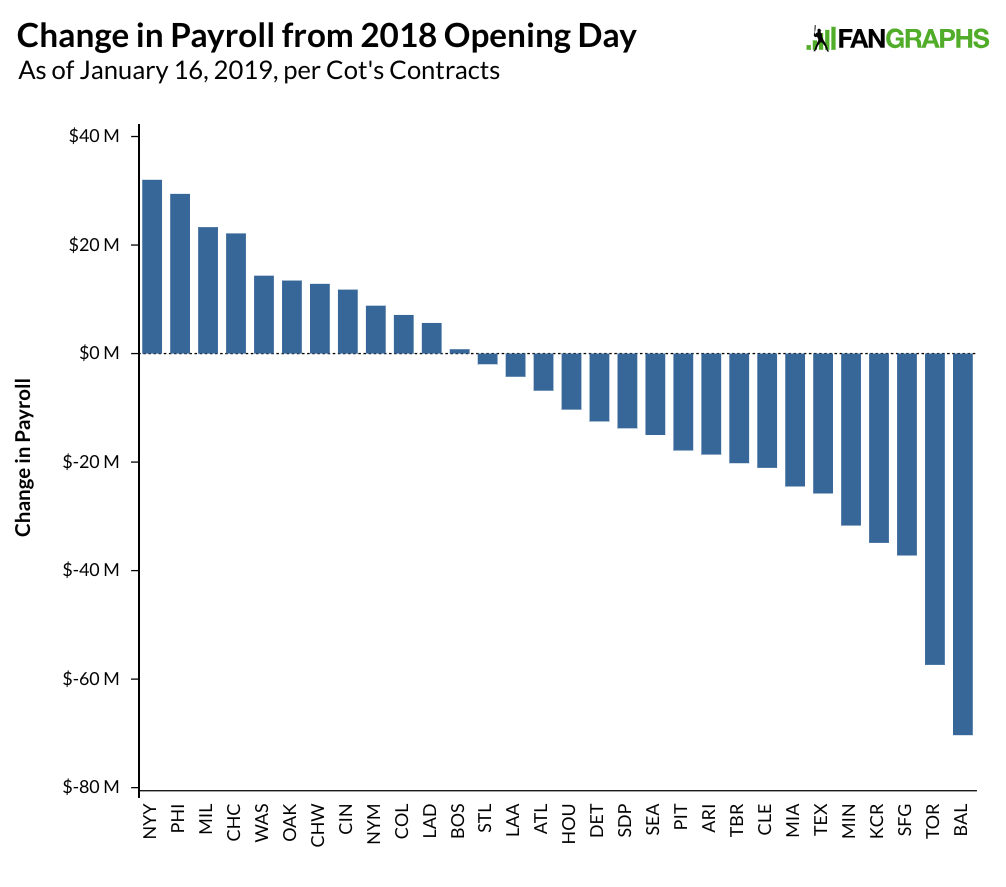
Some of this will change in the coming months, though a lot of those teams at the bottom aren’t really expected to move the needle much. Last year’s Opening Day payroll average came in at around $136 million. Keep in mind, these numbers don’t include benefits or players on the 40-man roster. Last year, the end-of-season payroll average including those numbers went up to around $152 million. Right now, the average 2019 Opening Day payroll comes in at close to $128 million. In total, the difference between last year’s combined Opening Day payrolls and payrolls right now is $243 million. If we take a look at how much spending is left to be done, we might be able to approximate payroll for next season.
Here are the remaining crowdsourced free agents, their projected total salaries and the average annual value of each deal.
| Name | Proj WAR | Crowd Avg Years | Crowd Avg Total ($M) | Crowd AAV ($M) |
|---|---|---|---|---|
| Bryce Harper | 4.9 | 9.1 | $300.0 | $33.0 |
| Manny Machado | 5 | 8.6 | $272.9 | $31.7 |
| Dallas Keuchel | 3.3 | 4.2 | $81.0 | $19.4 |
| Craig Kimbrel | 2.1 | 3.9 | $62.2 | $16.1 |
| A.J. Pollock | 3.1 | 3.7 | $58.8 | $16.0 |
| Mike Moustakas | 2.8 | 2.8 | $34.3 | $12.2 |
| Adam Ottavino | 0.8 | 2.6 | $27.0 | $10.3 |
| Marwin Gonzalez | 1.8 | 2.9 | $29.5 | $10.1 |
| Jose Iglesias | 1.7 | 2.8 | $25.6 | $9.1 |
| Gio Gonzalez | 0.8 | 2.3 | $26.4 | $11.6 |
| Nick Markakis | 1.1 | 1.9 | $19.9 | $10.8 |
| Adam Jones | 1.2 | 1.9 | $18.7 | $9.9 |
| Asdrubal Cabrera | 2 | 2.1 | $20.4 | $9.6 |
| Cody Allen | 0.5 | 2.3 | $20.5 | $9.0 |
| Wade Miley | 1.1 | 1.9 | $15.9 | $8.5 |
| Josh Harrison | 1.2 | 1.9 | $14.5 | $7.5 |
| Freddy Galvis | 0.3 | 2.1 | $15.1 | $7.2 |
| Brad Brach | 0.1 | 2.0 | $15.0 | $7.5 |
| Justin Wilson | 0.1 | 2.1 | $12.2 | $6.0 |
| Martin Maldonado | 1 | 1.8 | $10.7 | $5.9 |
| Carlos Gonzalez | 1.3 | 1.5 | $10.9 | $7.3 |
| Ryan Madson | 0.1 | 1.2 | $6.9 | $5.8 |
| Clay Buchholz | 1 | 1.4 | $9.3 | $6.6 |
| Jeremy Hellickson | 0.4 | 1.5 | $9.2 | $6.2 |
| Greg Holland | 0 | 1.3 | $7.4 | $5.8 |
| Tony Sipp | 0 | 1.2 | $5.9 | $4.8 |
| Shawn Kelley | 0 | 1.2 | $5.4 | $4.5 |
| Zach Duke | 0 | 1.2 | $4.7 | $3.9 |
| TOTAL | 73.3 | $1140.3 M | $296.1 M |
If the crowd is correct and $296 million in salaries are added to the 2019 season, we’ll be looking at around a $50 million increase over last season. That probably won’t happen, though. Last season when I did this same exercise, I was overly generous in my estimates, giving the players the crowdsourced money, and adding in another $60 million for all the other players for whom we did collect estimates. By the time Opening Day rolled around, I was more than $100 million off, and instead of a potential 1% increase in payroll, teams moved down 1% from the previous year.
If the rest of this offseason is anything like the remainder of last offseason, we are going to be looking at flat Opening Day payrolls. Even more troublesome for the players is that while Opening Day payroll was down about one percent from 2017 to 2018, when the end of season numbers were calculated, that figure was closer to 2.5%. While not definitive yet, there seems to be a pretty good possibility that major league payrolls will go down for the second consecutive season.
Craig Edwards can be found on twitter @craigjedwards.
this doesn’t account for inflation either
which is ummm higher? than reported
Firstly, baseball revenues probably operate in jumps that are not directly related to overall measures of inflation. Labor expenditures will be influenced mostly by those shifts in revenue. But if you are thinking about it from the point of view of the players, do you think the CPI is the best measure of inflation for people making at least $550,000 per year? And secondly, why is it higher than reported?
We now used chained CPI, which assumes that consumers will jump to comparable goods when prices of favored goods rise, and furthermore that there’s essentially zero loss of utility in having to switch away from favored goods. I imagine at major league player salaries, substitution won’t happen much, meaning that the players (and all wealthier folks) experience higher inflation than official CPI figures.
Most importantly, team revenues have risen substantially each of the past two years, while player salaries are falling. And this is on top of a several year trend of corrosion of the percentage of league revenues going to the players.
We are on a crash course for a major strike before the next CBA is signed.
Too many teams tanking and using that as an excuse to line the owners’ pockets at the bottom. Next CBA needs a salary floor as well as luxury tax levels that are tied to revenue.
I think 2018 is a good example of why we shouldn’t assume teams are tanking. The Rays, A’s, Braves and Pirates were all teams purported to be “tanking” who finished above .500.
I don’t think there are any teams that are “tanking” right now, and I’m really not sure that we’ve ever seen a team truly tank recently except the Astros. Even the Royals are trying to win some games now, and the Marlins were insisting on a MLB-ready piece back for Realmuto, both of which seem kind of ridiculous. Maybe we’ll see the Orioles tank, now that Elias is in charge there.
But there are a lot of teams that are definitely cost-cutting and not willing to spend to win. All four of those teams fell under that category, and it seems like the Rays and Pirates are in that boat again this year. I’m not sure that’s a bad thing, as long as they spend more when they’re planning to go for it. Whether they will is the real question.
The good people of South Beach would like to have a word with you
I think that the new ownership group in Miami is being portrayed unfairly. I know that the franchise has a rather incriminating history of tanking, but that was the previous ownership group. As far as the behavior of the current ownership group, their “fire sale” was a requirement in their purchasing of the team which was made very transparent during negotiations. In order to make the team financially viable, they needed to shed significant payroll. I don’t know that I’d call it blatant tanking in spite of the fact that they actively did not put their best foot forward to win now.
It wasn’t about making the team profitable, it was about paying for the debt they built into the purchase because they didn’t have enough.
I think that Miami has a totally dysfunctional ownership/front office situation, but I don’t think their goal is to “tank” per se. Tanking is about getting better draft position. The Marlins don’t really care about getting better draft position, mostly because they’re agnostic towards the whole enterprise of “winning.”
We have a one year sample on the Miami ownership group. I think the jury is still out on their effectiveness, although the Yelich trade looks particularly rough right now.
Perhaps that’s why they’re drawing out the Realmuto negotiations? Progress!
I don’t know how much of it is ineffectiveness and how much of it is that they just don’t care about winning. They definitely want to win in the abstract, in the sense that winning is better than losing, but the defining moves so far of their tenure have been (a) dumping salaries and (b) holding onto the one star they have who was cheap. The only deal that doesn’t fit those moves is Yelich. What they’ve done mostly is subtract talent in order to subtract payroll.
They made a bunch of moves to acquire international slot money to sign the top international prospect.
The Royals (if you believe them, which I happen to) actually tried to resign Eric Hosmer last year. Even the most optimistic outlook of his performance wouldn’t have put them into contention, and yet they were willing to drop $100mil-$150mil to bring him back. So, yeah, I don’t buy that they’re tanking either.
Retaining a player and contending aren’t the same thing. We don’t approximate the value of a face of a franchise/15-20 years on one team thing because there isn’t really an objective way to do that, not to mention it doesn’t happen that way very often. I don’t think attempting to retain Hosmer is an automatic indication that KC felt it was in a position to contend.
Right, but it would have made them objectively better, and they made a more than earnest attempt to retain him at a significant cost, which should be strong evidence against their “tanking”.
So if you are not contending then you are tanking?
huh? Everyone is tanking and have publicly admitted to it,……oh wait they are “rebuilding” ha. Tigers are tanking. Marlins, Orioles, Rangers….more than half the MLB is. Just look at the teams who reduced their payroll this year.
Owners think why spend money and win 75 -80 games and not make playoffs when you can pocket the money and win 60. Hurts the fans.
The fact that half of the MLB cities are rebuilding is not good for those communities and fans. Do you think the entire city of DFW is enthused and cares about MLB when their team is going to win 60ish games? Does not grow the sport. All teams and communities should be competing for championships. That is not happening currently.
While I agree that the prospects of those teams competing looks bleak, I’ll again point you to the examples of teams from last year who were purported to be tanking who were actually quite competitive.
The Rangers, for one, have committed $40mil this year to Lance Lynn and Jesse Chavez, so perhaps not the best example of a “tanking” team if your point is to illustrate a lack of spending in the league.
The O’s, for another, ineptly decided not to trade their best asset in Manny Machado last offseason, potentially limiting their return for him. But I guess they only just decided to start tanking last July/Aug.
The Tigers have been crushed across the industry for not cutting bait and beginning their “rebuild” SOONER.
You’ve noted four teams for whom it’s at best debatable whether or not they’re actively “tanking”. Only 12 more and you’ll be past the minimum threshold of “more than half the league”.
the tigers have cut bait and are admittedly tanking. verlander trade, kinsler, jd martinez, iglesias, price, mccann…..all of them are gone and soon to be castellanos too.
O’s are definitely tanking and just hired elias to be gm to bring the astros blueprint. Currently forecasted to be dead last in mlb.
The rangers have cut payroll by 30$MM, and they are forecasted to win 60ish games…they are definitely not interested in competing or they would be signing better FAs.
Add in the Royals…hell everyone. This is not good for MLB for more than half the teams to be rebuilding i don’t know how anyone can argue otherwise that this is good for the sport. Its only good for the owners.
So maybe one question to ask is why so many team are in “rebuilding” mode… could the financial disparity play a role… I think so… so small market team must be smart… wait for you window and then spend… otherwise, they probably make a deficit every year. Cleveland is a good example… winning team, fun team to watch, payroll’s going up… but not the attendance… they are probably in major deficit waters right now…so money made in years with lower payroll may help offset some of the deficit
That’s not really tanking. Tanking is a type of rebuilding strategy that involves deliberately not trying to win games to get high draft picks. It is quite rare that a team is humiliatingly, depressingly bad and just doesn’t care. When the Tigers sign Jordy Mercer or the Rangers sign Lance Lynn, they’re showing they don’t want to tank. It might be cheap, but it does show that their ability to feel shame is greater than their desire for draft position.
I put another post up on this but I don’t think that’s how tanking is commonly discussed in baseball. First of all, the team itself (as opposed to the FO) never deliberately tries not to win. Recall how much trouble Cuban got in for suggesting that the Mavs weren’t in win-now mode when his language gave even the slightest hint that that players themselves wouldn’t try to win.
Second, baseball just doesn’t work that way. The draft isn’t a source of immediate help, draft picks can’t be traded and thus can’t be stockpiled, and one player doesn’t reverse a struggling team’s fortunes on his own the way a generational basketball talent or a franchise QB can. Case in point: baseball’s greatest active player has missed the playoffs each of the last 4 years.
Tanking in baseball is about making the big-league team worse now to stockpile youth for the future. You can probably show me some instances where people have spoken of it the way you do, but you just don’t see articles about the “Race for Adley Rutchman” the way you see those things spoken of in other sports. They’ve happened (I remember in particular some hype around which team would lose enough to get Harper and Strasburg during their draft years and some low-key buzz about the Justin Upton sweepstakes long ago but that was mostly among Mariners bloggers covering a bad team that wasn’t bad on purpose), but they’re not common. Instead, you see articles contrasting the state of the major league team with the strength of the farm for teams that have prioritized youth.
I agree with you on all the big points wholeheartedly, but…I just don’t think that’s really “tanking.” It’s qualitatively different. The reason why tanking gets such a bad reputation is because it breaks the implicit contract between fan and team. You don’t really have teams that have “rebuilds” in those other sports for similar reasons. In baseball, almost no one is ever trying to be bad, and that’s a really important difference.
I would argue the distinction isn’t between tanking and competing (which never happens) or between rebuilding and competing (which aren’t necessarily mutually exclusive) but between teams that are willing to spend to win and those that aren’t. And whether a team isn’t competitive–or even spending!–over short periods of time isn’t the best way to assess that. It’s totally reasonable for teams to spend more when they’re in the right place on the win curve, and less when they’re not. The Rangers aren’t spending a lot of money this offseason, and they’re 20th in the league in projected payroll commitments according to Cot’s. So what? In 2012 they were 6th in the league. Does anyone think that they won’t spend more when/if they need to? The projected payroll for the Orioles is under $100M, good for 26th in the league. In 2017 they were 8th.
To answer whether a team is willing to spend to win, you have to look at several years of data and their expected revenues, which a lot of this conversation misses. Which teams do you think aren’t willing to spend to win? I can only think of one for sure: The Marlins. Potentially the A’s, Pirates, and Rays. Maybe, if you’re not being charitable, you could include Cleveland. You can ding teams for not wanting to go over the luxury tax on this metric too–the Dodgers and Yankees. I don’t think any of these teams, except the Marlins, can be credibly accused of “tanking” or even really “rebuilding.” But you can criticize them on other grounds.
The problem we have here is that tanking is basically whatever its critics complain of when they complain about it. It’s not something with a definitive definition.
In baseball, it’s generally used to refer to teams who make the conscious decision to make the MLB team worse now for the hope of getting better later.
Getting better later in MLB is a lot more about stockpiling lots of good prospects than winning the sweepstakes for the best one. I think that a team that willingly moves down into that 70-75 win space by trading multiple veterans for minor leaguers is absolutely tanking, the way the critics of that practice – specifically as applied to baseball – use the word.
Sadtrombone, I think you are probably one of if not the best posters on this site. Alot of insight. But i have to disagree with you,. Signing Jordy Mercer and Lance Lynn shows that in fact those teams are tanking. Iglesias is better than Mercer. Put up better war etc, tigers didn’t offer him and offered a worse SS for less money.
GURU, I think there can be other things at play when rebuilding teams sign veterans. 1/2 a WAR here and 1/2 a WAR there and how efficiently the teams spends for those wins when you are a 70 win team doesn’t move the needle much. I don’t know specifically about Lynn or Mercer, but if you are rebuilding, there is value in having veterans around the locker room to show the young guys what being professional is about. Hard to quantify, but there is intangible value there, and I suspect that might be part of what’s going on there.
The current projected standings have 17 teams winning 80 games or more, and 23 winning 75 or more. And the Brewers are only projected for 79 wins, so… yeah, half of the league is clearly bad at tanking or not tanking.
https://www.fangraphs.com/depthcharts.aspx?position=Standings
huh? Of course their are 17 teams winning 80 games. Someone has to win. Product is getting worse on the field…but to lose the most games you have to be tanking more so than your opponents.
Its a race to the bottom. There will always be 14-18 teams projected of winning 80 games regardless in how much one teams spends or tanks. Its all relative. If everyones tanking/rebuilding then its all level playing field. Its about the owners pocketing the money.
If half the league were in a race to the bottom, you would see more teams projecting like the Orioles or Royals. That’s simply not the case.
no you wouldn’t its all relative. Not everyone can win 50 games. There are 4800 wins every year regardless of how many teams are tanking. Will always be that amount every year.
If anything, I’d say there’s a race to the middle right now with teams figuring they can hang around for a possible second wildcard run without spending heavily if things break their way, and if things don’t they can sell at the deadline. See the Reds, Pirates, Rockies, Diamondbacks, as examples. All of them positioning to be like the A’s last year (you can add the A’s to that list, actually).
Tanking in basketball and football has a much more prominent component of competing for one of the 2-3 worst records in the league to secure a premium draft spot. In baseball it’s a bit vaguer because the draft doesn’t offer the prospect of immediate help and baseball prospects are a bit more uncertain than basketball and football prospects, so it’s more about making moves for the future at the expense of the present.
I think it’s fair or at least not unreasonable to characterize as “tanking” any team that’s sent a clear signal that it’s prioritizing years n+2 and beyond over n (where n is the current season). I don’t think a GM has to be actively making moves eying the #1 draft pick to warrant use of the word.
Given the above, I think it’d be fair to consider Baltimore and Seattle as tanking, and perhaps to characterize Detroit and the White Sox as beginning to emerge from recent tanking efforts.
Whether teams are tanking or not, criticizing teams for tanking is silly. If you don’t like it, criticize the league and its salary and drafting structure that reward losing and stockpiling youth, not individual teams making entirely the entirely rational decision to trade present-day mediocrity for potential future excellence.
And the O’s tried to compete only to end up being the biggest tank job of them all!
YES! people forget that the orioles actually planned to contend last season!
Being bad by poor decisions is not the same as tanking. Tanking is being bad as part of a plan to improve in the future. But sucking really bad as part of stupid decisions is just plain old “losing.”
While the term tanking here may be wrong, the way these teams operate in a way to save money is still applicable. The Rays and the Dodgers are the perfect example of using similar strategies but what happens when you include more spending. The fact that the Rays were successful doesn’t change the fact that if they weren’t so cheap, they’d be even more successful across seasons.
That said, as long as baseball is a regional sport that can’t just easily pool its money the way NBA/NFL can, these discrepancies will unfortunately always exist and I can’t think of ways to truly solve the problem. Salary floor doesn’t help that much IMO, since teams will just take on albatross salaries from other teams to get prospects rather than adding veterans that help winning.
Being cheap =/= tanking
Is that really true? If a team can win 95 games and make the playoffs but the owner decides it’s better to spend less and win 85 games, is that not tanking? In fact, is that better than a 70 win team “tanking” to win 60 instead?
Which do fans prefer for their team to do? The former or the latter?
the “tanking” argument is so lazy in my opinion. there’s always been rebuilding teams, and i just hate the word “tanking” which has been thrown around only because it seems to be popular in other sports, but there is a clear difference between tanking and rebuilding . not all bad teams are tanking but people just throw that word around without actually knowing what it means
Avg. salaries going down to less than 500x the average viewer’s income? My heart bleeds for them.
I too think instead of the revenue being spread across the 25-40 players that actually create my interest in the game, I’d rather it be directed to 1 owner. I mean if the owners are making more money I’m sure they’ll pass along savings to us fans. Ticket prices are sure to go down.
Actually I think ticket prices did really skyrocket when free agency started. But actually getting the prices to go back down if labor costs are more controlled would probably not happen. However, they would likely go up more slowly in the future. When you have to spend significant money to compete then there is a competitive pressure to search for ways to increase revenue.
In any case, I think any oppressor/oppressed or class analysis of the situation is laughable. The days when professional baseball players in the US were being in any way monetarily exploited is long over. It’s also funny that fans want to voice where they think the money should go. Why should the money go where you’d rather see it go? And if you want a more worthy group of transient workers whose cause you can champion then look at graduate students in universities. They aren’t making over $550,000 a year, at least.
Minor league players are almost certainly “oppressed,” as most of them will never make more than a few hundred dollars a week playing baseball, and many of them don’t have very good opportunities outside of baseball because they (and their parents) chose to specialize in baseball rather than academics or other marketable skills. The small fraction of pro baseball players who sign multi-million dollar free agent deals have certainly overcome the unfair system, but that doesn’t mean the system isn’t oppressive.
A few hundred dollars a week would constitute a raise for most minor league players (c/o sportslawblogger.com):
“Until a minor league player is placed on a 40-man roster, monthly salaries are $1150 for the short season teams, $1300 for low A and $1500 for high A. For players repeating a year at the same level, the salary goes up $50 each year. For AA, the monthly salary is $1700 and it goes up $100 per month for subsequent years. For AAA, the monthly salary is $2150 per month and it goes up to $2400 the second year and $2700 the third year.”
If the seasons were year round jobs (somehow), short season players would barely clear the federal poverty line for individuals. Assuming they’d still receive no overtime pay, of course.
While minor league salaries are very low, bonuses are rather large.
Most minor leaguers got a very small draft bonus or none at all.
According to the MLB site, the lowest selection in last year’s 10th round had a $136,800 slot. According to the Yankees website, in 2017 their lowest bonus to a draftee was $40K.
…the draft has fifty rounds, not one. Anyone who signs, signs to work in that environment.
“many of them don’t have very good opportunities outside of baseball because they (and their parents) chose to specialize in baseball rather than academics or other marketable skills”
That’s not a very good argument for them being oppressed at all. But it is an excellent argument for personal responsibility and owning one’s own decisions.
They aren’t oppressed because they aren’t bringing in value. Minor league teams don’t bring in a lot of revenue. The reason they are slogging away bringing very little value is because they choose to chase a dream. That’s not being oppressed any more than the wannabe actor or wannabe rock musician sleeping in their friends’ apartment because they can’t afford a place of their own is being oppressed.
Minor league teams bring in a lot of value when you figure in that you can’t develop major leaguers without giving them guys to play against.
MLB teams aren’t paying minor leaguers for the value of minor league ticket sales. MLB teams don’t even own the minor league teams (in all but a couple cases). Ticket sale revenue goes to minor league team owners.
MLB pays minor leaguers because in the system MLB has developed it’s the only way to get major leaguers. Without the minor leagues you’d see 60+ person roster sizes + “practice squads” of similar size. The on-field product would suck compared to what we have, because baseball’s really hard and finding the very best players alive without having them compete repeatedly against a large pool of almost-the-very-best-players-alive to see who stands out is pretty much impossible.
The future stars need someone good to play to develop. Thats their value
Ticket/parking/concession stand pricing, etc. is correlated with cost of labor. The reason is that the owners have a desired/required return on invested capital. As the capital invested increases, so too do revenue extracted from fans.
While avg. ticket prices certainly wont decline this offseason I would point out that in years past, ticket process have declined in Tampa, Queens, Detroit when salary expenditures had declined, and fan viewing with it.
As far as salaries of multimillionaires playing ball, I just don’t care if it declines a bit (and 1% is what I would call a bit). Same way I didn’t care when average salaries increased by 40% per year for the prior 3 decades.
I like baseball, and watching baseball, regardless of whether the players are paid a lot, a little, or something in between. Suspect fans who go to high school, college, minor league and independent ball agree with me.
I like forests. It doesn’t matter to me whether forest rangers are paid a lot or a little, because a forest is a forest, and there may be lower admission fees (or none at all!) at the forests that aren’t Yosemite.
Forest rangers receive a base salary and benefits, and if they work overtime, they are paid overtime. They also do not have to be public figures, so their family relationships and medical history and personal demons don’t become a part of the public domain.
I’d actually like to see what has happened to MLB ticket prices versus spend on players. I only know my team. When I saw their decline in payroll I was ready to holler but then looked up average ticket prices (Statista) the last eight years and saw they were flat. Many of us assume there is no relationship between salary and tickets prices (I understand there are a lot of other lines on Income Statements) but maybe there is under certain conditions.
And here we have a classic example of how class warfare works in real life.
god forbid someone in any industry with elite skills of .00001 % of the population get paid their worth.
Perhaps they are getting paid their worth right now? Can you say the true worth of one of these players? No.
This is the state of things for highly specialized employees protected by a powerful union. Makes you wonder what the average viewer’s workplace is like. Labor law is essentially optional in many workplaces. People who are in economically perilous situations or, say, here on a work visa, are vulnerable and often do not have legal resources to protect their rights. Employers know this and act accordingly.
Other than for unskilled labor there are real costs in hiring, training, and investing firm-specific capital in employees only to treat them so poorly that a competitor plucks them away after they have developed valuable skills. Firms attempt to maximize profits, but highly skilled employees are a valuable asset that most firms try not to destroy.
Right. Nearly 80% of the US economy is the service industry. A lot of it isn’t unionized. If labor issues and fair employment practice doesn’t matter for the visible economies that people actually care about (e.g. baseball), then e.g. housekeepers have no prayer.
I cannot rec this comment enough.
Dump the CBT. If you are really so worried about the mega-market teams spending colossal sums and outbidding small-market teams for even the smallest incremental upgrade at a position, then you haven’t been paying attention to what’s going on out there. All these teams look at the same WAR/dollar calculations, and all want value. But if you want to put a drag on that particular type of competition, try limiting the number of $45M+ (or more than three years, AAV’s of above $15M) contracts any team can spend on free agents in any offseason to a maximum of one plus re-signing their own players or free agents.
I deleted a snarky reply because this does read like a sincere suggestion, but limiting even moderately large contracts to superstars is tantamount to bringing back the reserve clause and would hurt players significantly more than the current broken system. Big contracts aren’t a fundamental problem–underpaying young players with the “promise” of a payday at free agency is the problem.
Oh, I misread the suggestion, it looks like. 1 big contract per offseason. I’m not sure that would actually matter. The Phillies (Cutch + TBD) and maybe Nats (Corbin + maybe Harper?) are the only teams that look even kind of likely to shell out two contracts worth more than 3/45 this year.
Yes, that was the point. I’m not looking to limit the free movement of players–and I would dump the QO as well. But the CBT is discouraging teams from spending and having them do some really weird things like shipping salary to smaller market teams along with younger talent. I’d rather them not have to worry about the CBT. If someone wants to spend $400M on one player, who cares, he’s one player. Players should be able to earn whatever the market will bear out there, but to protect smaller-market teams from one big market team charging in to reboot, that’s why I suggested the player cap. The CBT is about reducing salaries.
The CBT discourages something like 25% of the league from spending. Which … sure, when the big money teams aren’t spending that puts a dent in big FA contracts. But the CBT isn’t the reason why OAK or TB have lower payrolls than the Alabama Crimson Tide. And the CBT isn’t why MIA lives in seemingly perpetual firesale mode.
Of course what is the CBT but an effort at affecting Competitive Balance? If those same big money teams were to start spending “stupid money”, most of all the same folks complaining about reducing salaries would be complaining about how unfair life is for the Pittsburgh Pirates.
And a player cap absolutely WOULD limit the movement of players. Any offseason where you have X+1 superstar FAs and only X reasonable destinations, someone’s going to get stuck signing a below market deal with their original franchise for no better reason than an artificially induced game of musical chairs.
When you cap out the top 25% of spenders, you also have a downward drag on overall spending, including down the line. The market gets repriced based on overall demand. A big market team near the cap just won’t complete for the good, useful player. Maybe he says, for a top-tier star “I gotta have the player” but for a 2 WAR player, you don’t break the cap.
Absolutely. There are all sorts of problems with caps, even the soft kind. They do create a drag on player salaries. That’s pretty much the point.
Of course this cap has no corresponding floor, so there’s a drag at the top end without a push at the bottom end
“When you cap out the top 25% of spenders, you also have a downward drag on overall spending, including down the line. The market gets repriced based on overall demand. A big market team near the cap just won’t complete for the good, useful player. Maybe he says, for a top-tier star “I gotta have the player” but for a 2 WAR player, you don’t break the cap.”
This is an assumption about how big market teams will act under a soft cap, and based upon what has actually been happening with big market teams this very offseason (the Yankees, in particular), your assumption appears to be the very opposite of correct.
I agree, I don’t want to limit people’s ability to earn. I was looking for a swap–get rid of the CBT that gets big market teams suddenly refusing to bid on players they are interested in that make sense for them in return for a limit on the number of really expensive FA can be signed by any one team in one year.
If the reduced amount of guaranteed money is coming almost entirely from length of contract instead of AAV, then it’s probably not that big of a stretch to think that among the top-tier free agents that we’ll be seeing similar numbers for AAV. The declines are likely to come with the less attractive free agents–the guys from Jose Iglesias on down, since those guys are less attractive to teams. The top 8 free agents left (from Harper down to Marwin Gonzalez) accounts for roughly half of the AAV projection, with the other half for the rest (about $148M for each). So if, on average, the guys from Iglesias on down get 2/3rds their projected salary then you’re looking at flat payrolls.
Looking at the list, I think that might be about right. You can see how guys like Cabrera and Miley will hit their AAV projections, but Madson and Galvis look like bargain-bin signings at best. And it’s hard to see who, of those guys, are going to top those AAVs at this point in the offseason.
And I’m not so sure that’s all that different than what we expected. What seemed to be happening last season was that guys were still getting paid for late 20s/early 30s years, but teams simply do not want to pay guys money after age 32 or so, at least on a longer term deal. That lines up pretty well with the length of contracts issue Craig brought up (although not Anibal Sanchez, which is a huge outlier), and how we saw some of the better free agents land really good deals.
There is one other issue that deserves a mention–the market for catchers seems to have completely collapsed. I don’t really have a good explanation for why this happened, but I think some of it has to do with Cleveland deciding to trade Yan Gomes and not really replacing him and McCann taking a below-market deal to go back to Atlanta, taking a couple of suitors off the board. I wonder if teams have just decided that since they have to carry two catchers anyway and they need time off, they just don’t want to invest money in them anymore.
“I have known Bob Nightengale and Buster Olney for many years and have always had a good professional relationship with both. But their recent reporting, like many other rumors in the past several months, have been inaccurate and reckless when it comes to Manny Machado,” Dan Lozano, Machado’s agent at MVP Sports Group, wrote. “I don’t know if their sources are blatantly violating the Collective Bargaining Agreement by intentionally misleading them to try and affect negotiations through the public or are just flat out lying to them for other reasons. But the truth is that their reports on the details of the White Sox level of interest in Manny are completely wrong.”
The 2022 strike is going to be a real bummer. What’s the next McGwire/Sosa plan to rescue the sport from a labor stoppage?
I personally look forward to a PED-enhanced, 33-year old Giancarlo Stanton hitting 107 home runs during the 2023 season. Baseball’s back, baby!
In the immortal words of the Tommy Lee Jones, I don’t care.
That’s a damn fine movie and memorable line, but one of the main points of that line is to set up the moment later on when he shows he actually does care.
Haha, touche. But, to be fair, while he ultimately “solves the puzzle”, even though his directive is to simply catch the fugitive, he never explicitly admits to caring, and I never will either!
This whole thing really seems to come down to young players being both cheaper and better. The problem with lower payrolls is happening in the first 1-4 years of a player’s career, when a lot of player’s peak and then decline before they get to the free agency chance. Here’s a different solution to the problem, aside from higher minimum salaries and a higher tax level – more teams! MLB has a glut of players qualified to fill out the back end of rosters, both young (cheap!) and older (more expensive!). This had lead to a lack of bidding wars for average-ish players, because there aren’t enough roster spots for them.
Talk of adding two teams likely isn’t enough to make a huge difference, I’d say they should add 6 (to balance the leagues, 18 each). Let’s say you’re the mega-billionaire owner of a new team in Boston (that’s right, I’m adding another Boston team). You want to be good, right away. Use the expansion draft to build your minor league system and a few main roster guys, put in extravagant bids on top free agents, and fill the rest of the roster with the average-ish guys left over. You could make the playoffs this year with a roster of just the top free agents left and roster filler, right?
It won’t happen but the game would be so much better if we got rid of 6 teams. Some cities will barely support a title contending team. Those cities don’t need a baseball team. Those owners have little reason to spend unless they can really win a title because nobody shows up at the games otherwise.
The Yankees and Dodgers sitting out on the superstars really has an impact. The biggest money guys always had a limited market, only so many teams could afford them, but then take out two of the typical biggest spenders and the potential market gets really tiny.
Red Sox too.
And the Red Sox, and the Cubs, and the Giants. I think that the ones that really changed the game are when the Cubs and Yankees decided to sit this one out; pretty much everyone though that the Yankees would be in on Machado and that the Cubs would be in on one or the other.
I was giving the Cubs & Red Sox a pass since they’re already taxpayers, but you’re right. The Yankees are really the one that strikes me. The CBT exists for lots of reasons but the Yankees historical Evil Empire reputation is based on their spending habits and the CBT was sold in part on leveling the playing field. Every star player was a “future Yankee” because of course the Yankees would spend anything to win, but at least the CBT would help a little. But now, even with the incentive to catch the World Champions in their own division, their first priority is still in limiting payroll below the tax threshold. I did not see that coming at all.
I don’t know that that is their first priority at this point, although it admittedly had a large role prior to this off-season so that they could “reset the thermostat”, so to speak. But, if they hadn’t been competitive with their current young players, maybe that wouldn’t have been the case. Their has also been a clear shift in their aggressive mindset since the passing of George.
To me, their behavior this offseason is pretty simple. They don’t have a spot for Machado. Or Harper. If there were better SPs on the market, you very well may have seen them overpay for one of them (I, for one, did not want them to touch Corbin, but they were clearly in on him). Their also evidently willing to spend, and, in some cases, overpay, in the relief market.
What will be really interesting for me to watch would be what they do with Didi, Hicks and Judge in the short-term, and potentially Severino and Sanchez in the longer-term. My guess is that you may seem them significantly over the threshold for a sustained period of time depending on their confidence level in all of the above.
But they did have a spot for Machado. They signed Tulowitzki and DJ LeMahieu instead.
Signing Tulo at the veteran minimum for one year to be a stopgap at SS and LeMahieu for two years to be a utility infielder is not the same as signing Machado long-term.
LeMahieu will give them the ability to shift Gleyber to SS if Tulo is ineffective or hurt, and DH Andujar on days where Stanton or Sanchez aren’t occupying that spot. While LeMahieu should be expected to play every day for now, he won’t have to once Didi is back where obviously Machado would.
Ostensibly:
They have a 2B of the future – Gleyber
They have a SS of the future – Didi
They have a 3B of the future – Andujar
I understand that there is some lack of clarity here.
What’s Gleyber’s position long-term? Will they resign Didi? Can Andujar actually play 3B?
I think we all expect Gleyber to be there long-term, whether at 2B or SS, so we can move on from him.
Addressing Didi next since he’s an FA next year, every indication is that they want to retain him long-term. It’s possible something changes. Maybe his performance drops significantly, or Torres proves to be a capable defensive SS, or Didi’s price skyrockets in FA. But, for now, my impression is that they’re planning to bring him back on a long-term deal.
The biggest question mark is clearly Andujar. However, in my opinion, he deserves to play every day in spite of his defense. He should have been the RoY. They cannot use him as a full-time DH. Their OF is too crowded and they’d also like to use that spot for Sanchez when possible. They can’t shift him to the OF (again, it’s too crowded). And I am not a proponent of moving him to 1B. I don’t see that better disguising his defense or mitigating its impact, and the team has in no way alluded to making that switch anyway.
The only way that I would advocate signing Machado is if they trade Andujar. I could see trading Andujar in a package for Kluber, but my sense is that the Indians are extremely hesitant to trade Kluber to an AL contender. I might be able to get on board moving him to SF for Bumgarner, but it would need to happen in the offseason in order to open up the spot for Machado, and SF seems intent on allowing that situation to play out into the season.
I’m not anti-Machado to NYY, but, because of their alternatives, those players’ circumstances and the investment that Machado would require, I just see him as an expensive way of muddying up their depth chart and reducing their operational efficiency.
There are 30 teams that can afford Harper
You don’t know that.
I’d never thought this before. But is this just a result of the new luxury tax hitting teams at the same time for the first time.
Over time, big spenders would end up staggering their luxury tax re-sets and big spenders would still be around most of the time. It’s just that everyone is hitting it right now.
How was Jose Iglesias’ mean projection 2/$26M? The Tigers couldn’t trade him last year when he was making $6M before he suffered a season-ending injury.
Good point, that projection is extremely optimistic.
unbelievable tigers couldnt move Jose Iglesias due to this market. Iglesias put up the best MLB defensive year ever for a SS. Think about that. He cant get a job. Its crazy.
“Fix” payrolls? Why is it broken? It seems intuitive that continuing to ramp up luxury tax penalties will put a damper on payrolls. I’m also not sure why players “should” make a certain amount, or always increase in payroll, or whatever other normative statements one can make.
A lot of this stuff happened because of the competitive balance push by people who didn’t like the teams with more revenue to be free to spend that revenue as they saw fit. What do you think “should” happen? All revenue equally shared with all teams and a certain percentage goes to the players? I’d stop watching MLB and hopefully join a push for someone to open up a relegation league.
This, exactly. The “fix” comment is needlessly sensational.
As noted, the AAVs are right in line with expectations. There’s been a move away from long-term guaranteed contracts. There has *also* been a move towards player options, which mitigate some of that change.
More importantly, and unaddressed here, is the idea that the player share has someone become disproportionately unfair. Other parties that seem to have done actual research purport that the player share of revenue has remained fairly steady around 50%, plus or minus.
There’s an open argument about whether that’s even the right point on which to anchor – but that’s a longer and more abstract case.
My point is that unless you believe that (in a world of declining attendance and dramatically declining TV ratings) that team revenues have grown dramatically faster than 4-5% in recent years, then players seem to be doing just fine.
I get that it’s a slow offseason and (I suppose), one has to generate clicks/pageviews to stay in business – am not sure why some FG writers have chosen this hill to die on.
As mentioned elsewhere, the hand-wringing of a year ago was proven to be almost entirely wrong: my the time spring training really got underway, there were very few players that fell through the cracks (Moustakas made a negotiating error/took a risk that didn’t work out) and very, very few deals that look like ‘steals’ for the club in hindsight (the Brewers are surely happy with Cain – but even purported ‘bargains’ like Carlos Santana are almost immediately underwater.
This data often gets mis-formatted in the posting process, but this is the best I can find for MLB-level payrolls dating back two decades.
I can’t remember panicking about how to “fix” baseball when payrolls skyrocketed 40% (!) between 2012 and 2015.
Do people really think that team revenues were rising at that rate?!
It feels to me some authors are happy to play along with an agent-driven narrative that isn’t supported by facts/analysis/objectivity.
Payroll YoY Change
1999 $1,463.8
2000 $1,661.3 13.5%
2001 $1,995.9 20.1%
2002 $2,040.4 2.2%
2003 $2,400.4 17.6%
2004 $2,195.6 -8.5%
2005 $2,123.9 -3.3%
2006 $2,496.7 17.6%
2007 $2,711.3 8.6%
2008 $2,897.4 6.9%
2009 $2,913.9 0.6%
2010 $2,911.6 -0.1%
2011 $2,999.6 3.0%
2012 $3,148.5 5.0%
2013 $3,767.4 19.7%
2014 $4,066.5 7.9%
2015 $4,404.8 8.3%
2016 $4,513.9 2.5%
2017 $4,663.3 3.3%
2018 $4,547.9 -2.5%
CAGR (yrs)
5 3.8%
10 4.6%
15 4.4%
Yes…the description under the article title on the main site does say “fix”. Now…the title of the article doesn’t say “fix” and the word “fix” does not appear at all in the article.
The word “fix” was clearly chosen to be sensational. Whether Craig writes what appears under the title on the homepage or whether it is the Meg, I don’t know. I’d guess the latter, based on comments I’ve read in other places about how this is handled.
At any rate, it does a disservice to an interesting article Craig has written. In fact, I will say that Craig (either consciously or not) steered clear of a side in this article. One of the last sentences he writes is as follows:
“Even more troublesome for the players is that while Opening Day payroll was down about one percent from 2017 to 2018, when the end of season numbers were calculated, that figure was closer to 2.5%.”
The qualifier “for the players” is very important here.
So…Meg or Craig…anyone want to comment here?
I get why the word ‘fix’ could feel clickbait-y, but I think the purpose was just to illustrate that *any* contract Machado and Harper end up signing probably won’t prevent overall MLB payroll from decreasing. That’s one thing the article says, after all.
FWIW, lots of professional sports leagues have widespread revenue sharing and link player salaries (in aggregate) to league revenue.
And the same people will be enraged when super-teams take up all the talent while spending all the money- Face it, people like to complain… I think the system is fine for free agents, arbitration is all screwed up but that’s a different animal- Thanks for the post., it seems a lot of people here lately have been a little too conspiracy theory for me throwing out “collusion” when in fact its just owners wising up on players like Harper/ Machado who arent slam dunks like Trout or Betts
Yep! You can change the rules – limit team control, raise the luxury tax threshold, etc – but get ready for the Yankees to come by and eat up your talent because they can afford to.
Somehow the rhetoric has shifted so much toward “owners versus players” and people have forgotten that owners actually compete against each other, as well.
MLB had record revenue yet again…..yet the MLB players salaries are going down. The owners getting greedy again will almost force the players union to strike during next cba talks. Sad for the fans. Players salaries as a percent of revenue has been trending down for over a decade as previous articles here at FG have shown.
I do worry about the players’ share of revenue declining, but I’m curious where your numbers come from? I think they might overstate the case. Here’s a recent piece from Forbes about the percentage of revenue going to MLB and minor league player compensation:
https://www.forbes.com/sites/maurybrown/2019/01/11/economic-data-shows-mlb-spent-less-on-player-salaries-compared-to-revenues-in-2018/#6c8e054a39d7
It shows three straight years of decline, from 2015 to 2018: 57.3%, 56.6%, 56.3%, 54.2%. But before that the numbers jump around, as we might expect, and all the numbers are above 50%, so seemingly at healthy levels. Certainly it doesn’t show a decade of decline. The percentage can also be calculated a number of different ways, which is why Scott Boras for example can cite a figure nearly 10% lower with some credibility.
The blog below does a good job, to my eyes, of breaking down some of the different ways the calculations can be done. It still doesn’t show anything as alarming as a decade-long decline:
http://www.captainsblog.info/2019/01/11/breaking-down-mlb-payroll-and-revenue-data-in-tweet-form/24893/
There have been some excellent comments on Fangraphs, both last offseason and now, arguing that it is at best premature, and at worst misleading, to conclude players are getting excessively squeezed. I’m not sure yet how to square those compelling arguments with the macro level data (players’ share declining, average MLB salary dropping for the first time since 2004, another very slow offseason in a year many expected big money to be thrown around). It’s going to take someone much more knowledgeable to read those tea leaves, which remain a mystery to me. Alternatively, we can just wait to see what Machado and Harper get, which will give us a lot more information.
Re: that long-term data, I would be interested to hear the thoughts of people who think all the hand-wringing is premature.
If you want greedy, look no further than the players. In the last CBA did they push for more money for minor leaguers? How about trying to get a raise for arbitration type players?
It isn’t really the owners fault that veteran players don’t perform when they get these huge deals. You can’t blame them for not paying for subpar performance.
However, you can lay blame on the MLBPA for not even trying to get more money for younger guys.
The minor league players aren’t represented by the MLBPA: only players on 40-man rosters are represented. I’m not sure it’s fair to blame this on players’ greed; short of absorbing all minor league baseball players into the MLBPA union (which may have unintended consequences for the union itself and its negotiations), it’s difficult to see how their interests will ever be a driving force in CBA negotiations.
That’s exactly his point! The have’s disregard the have not’s in their own self-interest.
I agree that it far from simple for the current MLBPA to absorb minor leaguers, but their lack of motivation to do so is completely selfish.
Seems like nobody really knows, but can the Dodgers afford Bryce Harper? If so, he should be signed.
I’m thinking the real story isn’t how much teams are spending but how they’re spending it.
The new normal seem to be shorter deals, less bidding on middle-class veterans, more convoluted options.
Ten year guarantees are becoming seven, five years becoming three, three becoming two or even one.
Teams are also gambling more on the lower end talents and younger players, probably because the risk is low and the reward can be high. Call it the Max Muncy rule if you will. (He wasn’t tbe first nor the only “out of nowhere” contributor but he just might be one of the reasons the Dodgers aren’t in on Machado.)
One certainty is teams aren’t jumping on the first shiny thing they see. They’re taking their time waiting out the market, trying different options, looking at things other than name and past performance. And looking at longer term scenarios. Along those lines: while the Yankees might still sign Machado it is quite likely they want to see what Andujar, Bird, and Voit do. Because, even if they pass on Machado and Andujar isn’t a long term 3B, there’s still Arenado coming next year. And after that Lindor will be available. And they still have a solid farm. Trades are always an option.
Free Agents are no longer the first answer to a team’s problems.
That is something the contract estimators are going to have to factor in.
How much dead money for bad contracts and deferred payments for former players is there?
You’re overthinking it. It has nothing to do with baseball or CBA. The nationwide economy/market are in a weird stand still moment until there’s more information if we are headed into a recession or not.
No one expected the US was heading into a recession during the previous offseason.
I’m ready for all talk about salaries to end. It doesn’t matter.
I continually find it amazing to see people telling businesses how they should spend their own money. The teams and the players determine the salaries. We can agree or disagree on their value relative to each other, but it makes no logican sense to tell someone else what they should be willing to pay for something, in any facet of life. If teams are being cheap, they’ll get less talent. If players are being too demanding, they’ll spend the season at home. This is how the world works.
Now, if collusion was happening, that’s different, because that’s a form of fraud. But so far, no one seems to have any evidence of any kind in that regard.
“But it makes no logical sense to tell someone else what they should be willing to pay for something, in any facet of life”
This is an argument against the minimum wage, in any facet of life, for what it’s worth.
You could take this a step further and add that your opening statement could be read as an argument against regulating any business, for any reason: “I continually find it amazing to see people telling businesses how they should spend their own money.”
I don’t know, we still end up with little children drinking water with lead in it and large swaths of people barely living above abject poverty in the status quo. A world where business ought to be free to act however it wishes to, for any reason, isn’t very logican to me. It’s terrifying, because if they legally constitute people, they can be rather psychopathic people when left to their own devices.
Deception (fraud) and physical endangerment should indeed be illegal. Your trying to conflate that with market value prices for services makes for a poor argument.
“But it makes no logical sense to tell someone else what they should be willing to pay for something, in any facet of life” – that’s a much, much broader statement than market value prices for the services of MLB players.
It’s meant to be broad.
their is tons of evidence of collusion….tons. The problem is their is no smoking gun. It’s all circumstantial evidence. But that is still evidence none the less. Collusion was proven in the mid 80s. The owners are still doing it, they are just smarter now in how they do it.
What’s the circumstantial evidence? Lower salaries? That’s not real evidence and anyone who knows anything about economics knows that.
Offensive sluggers were overvalued ten years ago, and massive long term contracts averaged out to have negative value for the teams. I thought the Fangraphs community of all people already understood that.
how about barry bonds not getting a contract after he was known to take steroids. Put up literally the best year in baseball history….said he would work for free and yet no team wanted him to play for them. Every single manager wanted him, but not the front offices. Their was a coordinated attack on him to not sign him. Collusion.
How about the catcher for the A’s who kneeled during the anthem last year….now cant get a job all of sudden.
I could literally point to 100 examples of ownership collusion circumstantial evidence, but i don’t have time to write them all down. If you don’t think their is even the slightest bit of collusion you are being naive. It was proven during the 80s, proven during the 90s and still going on today.
Their were 8 baseball work stoppages from 1970 to 1995. 8. Thankfully there hasn’t been any since….but the path the owners are going down is not good. When MLB has record revenue and players salaries is going down for 2nd year in a row….thats the direction this is going.
You can call me naive then. I don’t think it’s in a team’s best interest to do what other teams want them to do.
If they were really colluding against him, you’d think there would be harsher sentences for steroid use right?
And teams are allowed to make decisions based on steroid use or on-field behavior (protests).
Not to mention that if all these 100s of your examples each included 30 teams to all engage in bad behavior against players, someone from one of the front offices would have maybe been upset and leaked something to a journalist or a player… like, ever? Or are there hundreds of people from tons of teams with various relationships with players who have all been in on this massive dirty secret for decades?
Dave Cameron is pretty high up in the Padres front office. Would he know about the Padres colluding to pay players less? Wouldn’t he say something?
I think you read too many corporate distopian novels.
“how about barry bonds not getting a contract after he was known to take steroids. Put up literally the best year in baseball history….said he would work for free and yet no team wanted him to play for them. Every single manager wanted him, but not the front offices. Their was a coordinated attack on him to not sign him. Collusion.
How about the catcher for the A’s who kneeled during the anthem last year….now cant get a job all of sudden.
I could literally point to 100 examples of ownership collusion circumstantial evidence, but i don’t have time to write them all down. If you don’t think their is even the slightest bit of collusion you are being naive. It was proven during the 80s, proven during the 90s and still going on today.”
Guru, your rants are actually undermining your argument, because they’re so obviously wrong. It might be possible that owners are colluding somehow, but your arguments do nothing to support that thesis. Your examples—that no team signed a guy (Bonds) who was 43 years old, an unrepentant cheater, and who was widely reviled by fans, media, and other players , and particularly that no team is currently signing a guy (Maxwell, A’s catcher) who has a career WAR total of less than one, a negative WAR season in 2018, recently reached a plea deal on a felony assault charge stemming from an incident where he pointed a gun at a food delivery lady, *and* has the anthem kneeling baggage, which no rational front office would want to deal with if they could help it—are great examples of how delusional the folks are who forward the collusion narrative.
I wouldn’t use A’s catcher Bruce Maxwell not signing as evidence of collusion. Outside of anthem protestation, he also has a criminal history, a career 82 wRC+, career 0.6 fWAR and has a largely unimpressive minor league track record other than his 2016 AAA numbers.
Is it possible that the PR associated with his protest are having an impact? Sure. But if he were a better player, I’m sure teams would be willing to overlook that.
The fact is, in terms of a business decision, MLB players are overpaid and have been for a very long time.
http://www.perfectgamefound.org/wp-content/uploads/2012/06/Graham%20Tyler%20Honors%20Thesis.pdf
An additional win to a team is worth about 2 million dollars extra to a team, yet these teams have been paying free agents at $10 million per win. The 2014 Astros were an extremely profitable team.
The reason for this is probably part herd mentality and partly the fact that a baseball team is more conspicuous consumption than a business.
https://www.forbes.com/teams/new-york-yankees/
Forbes shows the Yankees are valued at 4 billion dollars, yet they have tiny operating incomes. Valuation is based on the present value of future cash flows, and baseball teams don’t generate enough cash flows to match they’re valuation. The only way this can continue is if billionaires continue to sink millions of dollars into an overvalued asset because they enjoy the prestige of owning a baseball team.
This seems to be starting to change a bit, and player salaries will inevitably go down.
The problem has been identified for a while now: teams are smarter, and less willing than ever to pay for free agent decline years. The answer is also obvious: get more money in the hands of the young, good players. Of course, nobody knows how to do this, and even if they do, there are more than 2 years to go before the players will be able to get this done in a new CBA.
This is happening already, as star players are setting records in their arb-year deals. Harper, in 2018, got a record $21.65 million dollars in his final Arb season. Mookie just agreed to a $20 million deal for 2019, his Arb2 season—a record for Arb2. DeGrom just agreed to a $17 million deal for 2019, his Arb2 year—a pitcher record for Arb2. Arenado’s 2019 deal will soon break Harper’s record for highest salary in an Arb season whether he wins or loses in arbitration. Seems like the system is working, at least to some degree.
those arent good deals. those are the games best players and theyre making half what nba best players are making a year. they should be breaking records as 1 they are low and 2 mlb revenue is skyrocketing.
best nba player is making 42/yr. not good when you are bragging about how mookie betts got 20mm.
You continue to demonstrate that you have no idea what you’re talking about. These are players in their Arbitration years, a/k/a their “salary controlled” years. They’re not free agents yet, so they’re not going to make money at rates that are comparable to free agent rates (though, we’ll see where Arenado ends up).
Comparing NBA free agent salaries (or even MLB free agent salaries) to MLB Arb salaries is apples and oranges.
you don’t think i know that? my whole premise is arbitration is bogus and should be done away with. paying the top player half of star NBA player is not good. could care less they are in arbitration. Its still half. When he’s out of arbritration he’ll still be getting same amount because he’s now old. Just like harpers offers are coming in at mid 20s/yr the same number his arb was.
MLB pays a higher percentage of revenue than any other sport.
no they do not
https://blogs.fangraphs.com/the-mlbpa-has-a-problem/
Heres another great article from last year regarding these greedy owners.
https://blogs.fangraphs.com/mlb-players-ought-to-fight-for-a-payroll-floor/
Teams don’t want to pay for past performances. Because of this the arbitration system has to change, more money should be made available based on players performance.
So if not collusion then what? Whats the excuse this year? Last year it was teams wanting to reset to spend big this year, or saving their money to spend big. Revenues probably jumped another 8% but spending on players as a percentage of revenues keeps going down down down.
Where is my man Tony C. Whats he have to say.?Why does he still have a job?
Maybe players afraid of consequences should they try and push him out. Tony C must be MLB’s favorite union head by a long shot.
whats sad is the MLB has Mike trout, Mookie Betts and Bryce harper….3 of the games all time best in history of the baseball and they can’t market them worth a lick. sad. NFL is having a financial boom and field day with mahomes.
I’ll say the same thing I said about this article last year – beyond creating some reader engagement, why does anyone care what the crowd thinks? What track record of accuracy do we have? How could any of us know anything about what is going on inside front offices?