
No Batter, No Batter: The Charging of the Guards

So here’s what happened. I was watching the MLB game highlights of Tuesday’s Marlins-Blue Jays matchup. I like MLB’s game highlights; in order to keep all the quick cuts from feeling disjointed, they kind of just plop some music on top everything unceremoniously, and sometimes the music can really color your perception of the game. This Mets-Padres game from April is a great example. It was a nailbiter, but it lost some of its nerve-wracking heft thanks to a soundtrack that’s a cross between John Coltrane, Kool & The Gang, and Super Mario 3.
Two on, two out, bottom of the ninth, and it sounds like the monologue is about to start on Saturday Night Live. Anyway, I was watching Tuesday’s Marlins-Jays highlights (the soundtrack for which sounds like The Living End on their union-mandated lunch break), and I noticed this single from Luis Arraez.
Normally, a single from Arraez is about the least remarkable thing in baseball. He is the game’s preeminent singles hitter (and depending on your worldview, perhaps the game’s preeminent hitter, period). What caught my eye was how quickly Daulton Varsho managed to cut this ball off, considering that Arraez slashed it just a foot inside the left field line. Varsho gets fantastic jumps, but I figured he also had to be playing extremely shallow. It occurred to me that maybe every outfielder is playing right on top of Arraez this year, seeing as dumping liners right in front of the outfielders for singles is his superpower.

I headed over to Baseball Savant to see whether outfielders have just started playing right on top of Arraez this year. I should give you a warning at this point. A couple weeks ago, Baseball Prospectus lead prospect writer Jeffrey Paternostro expressed a (very valid) concern that baseball writing is “being compressed into a neutron star of ‘interesting stuff from my savant query.’” If that kind of article is not for you, I encourage you to move along, because from here on out we’re in the realm of strange matter.
As you might recall, fielders have been playing deeper since 2015, the first year that Statcast made that information available to the public. Center fielders and shortstops saw the biggest change. Playing your outfielders deeper — accepting more singles in order to prevent extra-base hits — makes plenty of sense. Average outfielder depth leveled off around 305 feet in 2019.
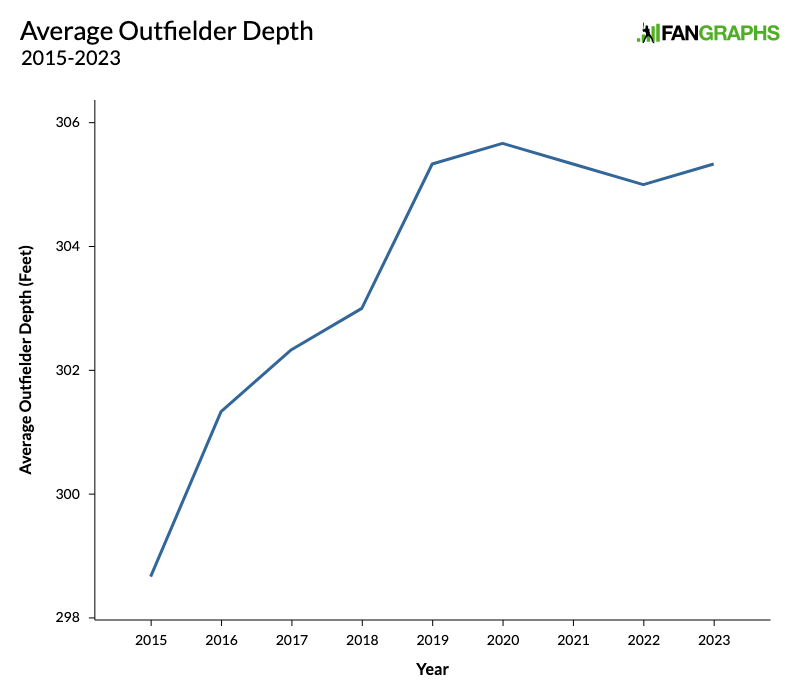
As David Waldstein wrote a few days ago in The New York Times, things are pretty regimented these days: “Many groundskeepers chafe at a recent trend in which visiting coaches wander the outfield grass with range finders before games. The devices are used to help position the outfielders, and the coaches sometimes scuff out marks in the grass with their heels, blemishing the near-perfect sod.” Now more than ever, there’s analytical rigor going into outfielder positioning. In other words, if you’re at the plate and the center fielder looks like he’s playing close enough to grab some sunflower seeds out of the shortstop’s back pocket, he’s not the only one insulting you. There’s a whole cadre of analysts, scouts, and coaches who have combed through the data, crunched the numbers, and come to the conclusion that you’re a big wimp.
I pulled the average depth of the outfielders for every batter who’s made at least 100 plate appearances on the road this season. It’s important to throw out PAs at home because ballpark dimensions skew the results pretty hard. For example, left fielders play 37 feet shallower when they’re playing in front of the Green Monster than they do when they’re in front of the Great Wall of Baltimore.
At 313.3 feet, Ronald Acuña Jr. is first on the list. He’s followed by a who’s who of sluggers: Austin Riley, Yordan Alvarez, Vladimir Guerrero Jr., Juan Soto… you get the picture.
We’re not concerned about that end of the list, so from here on out we’ll be turning it upside down. Arraez is indeed fifth on this new list, but take a look at the players ahead of him:
| Player | Team | LF | CF | RF | Average |
|---|---|---|---|---|---|
| Steven Kwan | Guardians | 276 | 310 | 293 | 293 |
| Myles Straw | Guardians | 296 | 312 | 276 | 295 |
| Andrés Giménez | Guardians | 285 | 318 | 294 | 299 |
| TJ Friedl | Reds | 284 | 318 | 295 | 299 |
| Luis Arraez | Marlins | 283 | 316 | 300 | 300 |
This article is no longer about Arraez; it’s about what the hell is going on in Cleveland. The top three players are all Guardians, and Kwan and Straw are separated from the rest of the pack by four feet. We’ve written a fair amount about Cleveland’s no-strikeout, no-power approach this year, but this is still a shocking lack of disrespect. Opposing fielders might as well be chanting, “Easy out, easy out.”
The funny thing is that the biggest gap between where fielders play the Guardians and where they play everybody else is in the opposite field. Relatively speaking, that’s where the Guardians have the most power. Their 83.6 mph exit velocity is the fifth-lowest in the game, but they’re dead last when hitting the ball straightaway and third-to-last when pulling it. Left fielders play seven feet shallower for Kwan than they do for anyone in baseball, and the same is true of Straw in right. Center fielders play both of them at least four feet shallower than Arraez, who’s in third place. In all three cases, we’re talking about a full standard deviation between Kwan and/or Straw and the next non-Guardian.
It’s not just Kwan, Straw, and Andrés Giménez either. Amed Rosario is eighth on the list. Will Brennan is ninth. Tyler Freeman doesn’t have enough PAs to qualify, but he’d slot in at 11th. Here’s a graph of the average outfielder depth for every team in the league. The Braves are in first at 309.7 feet. At the lower end of the spectrum, the Progressive Field grounds crew could drive a riding mower between the Guardians and every other team.

I know that I’ve now listed six Guardians who populate the top of the list, but it’s not just them either. For the table below, I’ve dropped the PA requirements way down so you can see how the team stacks up as a whole. This year, the league average outfield depth is 305.3 feet. I’ll highlight the players who get played shallower than that.
| Player | LF | CF | RF | AVG | Percentile |
|---|---|---|---|---|---|
| Steven Kwan | 276 | 310 | 293 | 293.0 | 1 |
| Myles Straw | 296 | 312 | 276 | 294.7 | 1 |
| Meibrys Viloria | 271 | 314 | 304 | 296.3 | 1 |
| Brayan Rocchio | 286 | 313 | 295 | 298.0 | 1 |
| Cam Gallagher | 296 | 316 | 284 | 298.7 | 1 |
| David Fry | 294 | 317 | 285 | 298.7 | 1 |
| Andrés Giménez | 285 | 318 | 294 | 299.0 | 1 |
| Amed Rosario | 299 | 317 | 285 | 300.3 | 4 |
| Will Brennan | 287 | 318 | 296 | 300.3 | 4 |
| Tyler Freeman | 298 | 318 | 286 | 300.7 | 5 |
| José Ramírez | 293 | 323 | 293 | 303.0 | 12 |
| Oscar Gonzalez | 298 | 322 | 290 | 303.3 | 15 |
| Josh Naylor | 290 | 323 | 298 | 303.7 | 19 |
| Gabriel Arias | 301 | 322 | 288 | 303.7 | 19 |
| Bo Naylor | 293 | 321 | 297 | 303.7 | 19 |
| Josh Bell | 294 | 323 | 295 | 304.0 | 22 |
| Mike Zunino | 300 | 323 | 291 | 304.7 | 27 |
Not a single Guardian gets played that deep. Not one! Amazingly, the only Guardian within one foot of league average is Mike Zunino. Yeah, that Mike Zunino — the one with the 63 wRC+ who just got DFA’d to make room for Bo Naylor. Zunino is in the 27th percentile. In other words, on a list of all qualified MLB players ranked by the depth of the outfielders when they’re at the plate, you’d have to scroll past 73% of the league until you got to one player from Cleveland (and 78% of the league until you got to one player who’s still there). Zunino and Josh Bell are the only Guardians above the 19th percentile.
Kwan, who nearly led the league in singles last year, is currently running a 97 wRC+. While he certainly doesn’t boast much power, his inclusion could at least conceivably be seen as a tribute in the vein of Arraez. He hits a lot of singles, so maybe teams are playing in less because they don’t fear his power and more because they fear all those singles he’s hitting. It’s not a particularly strong case for Kwan, but he’s the only player on the team for whom you can really make it.
The only real surprise here is José Ramírez. By his extraordinarily high standards, his 130 wRC+ is a disappointment. After surgery to repair a hand injury that sapped his power for most of the 2022 season, his hard-hit rate and average exit velocity have ticked back up, but opposing outfielders don’t seem to buy that he’s back. Regardless of whether he’s hitting righty or lefty, they’re playing him four feet shallower than they did last year. He has yet to make them pay for it, running a .219 ISO, his worst since 2019.
The Guardians are played three feet shallower than the next team, the Reds. In the nine years of data that we have, no team has ever had a gap that big. But the Guardians are also played five feet shallower than league average, and two teams have had a bigger gap. The first, at 6.7 feet below league average, is the 2020 Orioles, who were terrible, and about whom one sentence is more than enough. The second, at 5.3 feet, is the 2018 Tampa Bay Rays, who won 90 games but missed the playoffs. They posted a 107 wRC+, sixth-best in baseball, despite being in the bottom six of the league in ISO, barrel rate, hard-hit rate, and exit velocity. They were average in terms of walks, strikeouts, and baserunning, and they largely BABIP’d their way to their success. They hit a lot of line drives, and their batting average on grounders was nearly 50 points higher than their expected batting average.
Cleveland could certainly use some of that batted ball luck. The Guardians don’t have the worst offense in baseball this year; that honor goes to the Rockies and their 81 wRC+. Cleveland is tied for 24th place with a wRC+ of 88 but has the league’s lowest ISO, hard-hit rate, barrel rate, and average exit velocity. Nobody is afraid that a Guardian might hit a ball over their head, and unlike the 2018 Rays, the batted balls have yet to bounce their way. When the Guardians are at the plate, outfielders play at an average of 300.3 feet, the same as when Rosario and Brennan are at the plate. That is to say, if you removed all the individual Guardians and treated the entire roster like one player, that one player would be the fourth-least-feared hitter in all of baseball. All in all, it’s a pretty interesting Savant query.
Davy Andrews is a Brooklyn-based musician and a writer at FanGraphs. He can be found on Bluesky @davyandrewsdavy.bsky.social.
It’s too bad I can’t post a poll in the comments because I’d like to run one for the best sentence in this amazing article.
Contender 1: “The first, at 6.7 feet below league average, is the 2020 Orioles, who were terrible, and about whom one sentence is more than enough. ”
Contender 2: “This article is no longer about Arraez; it’s about what the hell is going on in Cleveland.”
Contender 3: “There’s a whole cadre of analysts, scouts, and coaches who have combed through the data, crunched the numbers, and come to the conclusion that you’re a big wimp.”
It’s like those Simpsons episodes that start out being about one thing and end up being about something entirely different a few minutes/halfway in, like the episode where a badger takes up residence in the dog house turning into an episode about area codes.
Spoiler! My vote for best sentence:
“That is to say, if you removed all the individual Guardians and treated the entire roster like one player, that one player would be the fourth-least-feared hitter in all of baseball.”