
Old Blood: Phillies Re-Sign Kyle Schwarber
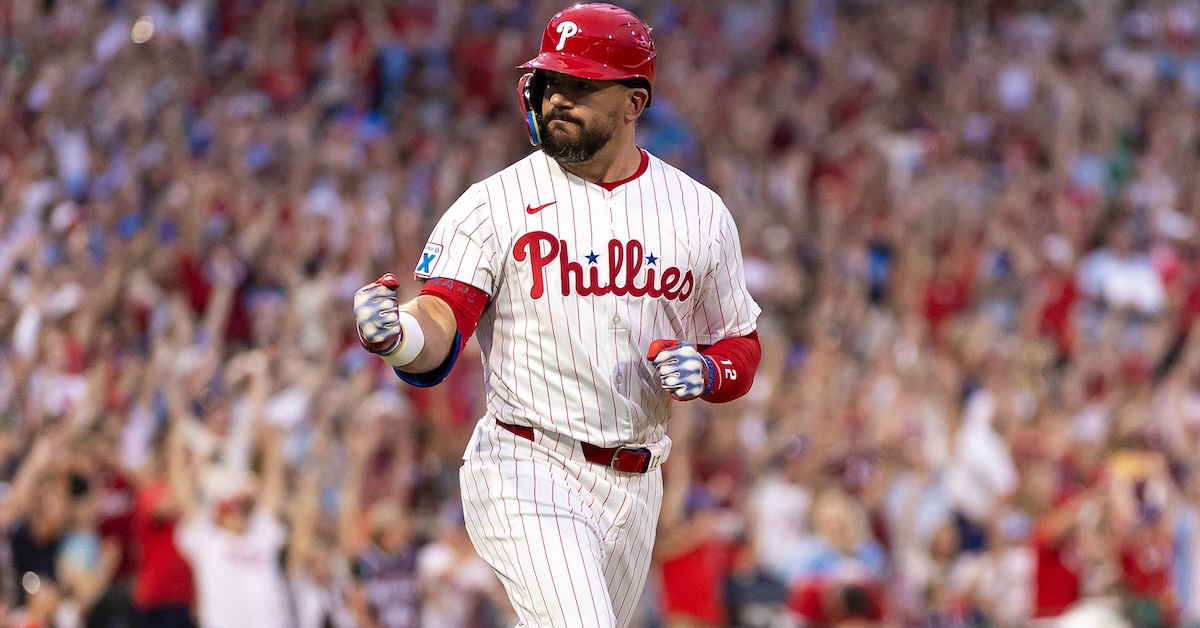
No player, not even Bryce Harper, has personified the Phillies’ recent run of four straight trips to the postseason more than Kyle Schwarber. Faced with the prospect of losing their signature slugger to the division rival Mets, Philadelphia instead retained Schwarber on a five-year, $150 million deal, news of which enlivened the Winter Meetings here in Orlando on Tuesday.
Schwarber, who turns 33 on March 5, hit .240/.365/.563 and led the National League with 56 home runs and 132 RBI while playing in all 162 games in 2025. He set career highs in home runs, RBI, games played, slugging percentage, wRC+ (152), and WAR (4.9). The last of those marks owed plenty to manager Rob Thomson’s limiting him to eight games in left field, where he’s a major liability, having totaled -37 FRV and -34 DRS in 2022–23. Only Shohei Ohtani took more plate appearances as a designated hitter in 2025 than Schwarber’s 687.
Schwarber’s season — which propelled him to a second-place finish in the NL MVP voting behind Ohtani (who won unanimously) — may have been a career year, but it was no fluke. Thanks to his ongoing work with hitting coach Kevin Long, who joined the Phillies just a few months before Schwarber signed his four-year, $79 million deal with them in March 2022, he has evolved from a pushover against lefties into a top threat in those matchups. From 2015–21 with the Cubs, Nationals, and Red Sox, Schwarber hit just .214/.324/.361 (86 wRC+) in 584 plate appearances against lefties, making 100 PA against them just twice and topping a 100 wRC+ against them only in the last of those seasons, during which he bounced from Washington to Boston. He has topped 200 plate appearances against lefties in all four of his seasons with the Phillies, and he was an above-average hitter against them in each of the last three. Over the past two years, his 524 plate appearances against lefties led the majors, while his 157 wRC+ (.275/.385/.547) and slugging percentage both ranked second behind Yordan Alvarez (albeit in just 247 PA). By comparison, he hit .244/.365/.525 (143 wRC+) against righties in that span.
As The Athletic’s Matt Gelb detailed in May, with Long’s help, Schwarber has overcome his fears when stepping in against the game’s best lefties. He’s taken to donning a C-Flap helmet and additional body armor for those plate appearances, and has adjusted his mindset as well as his mechanics:
Whenever Schwarber is in the cage with Long before a matchup against a tough lefty, Schwarber says the line. Be prepared to die. It must be a coincidence that few lefty hitters can match the success he’s enjoyed since adding the face guard.
“I mean, the mind’s a powerful thing, right?” Schwarber said. “You tell yourself one thing, and the next thing you know, you’re having success. But I feel there are a lot of different things, too, that went into that.”
…“It’s work,” Long said. “It’s willing yourself. It is understanding what a lefty is trying to do to you. Understanding the angles. Understanding what pitches do against lefties. He’s got a really good grasp on it. He’s shortened his swing since the time I met him to where he is now.”
You Aren't a FanGraphs MemberIt looks like you aren't yet a FanGraphs Member (or aren't logged in). We aren't mad, just disappointed. We get it. You want to read this article. But before we let you get back to it, we'd like to point out a few of the good reasons why you should become a Member. 1. Ad Free viewing! We won't bug you with this ad, or any other. 2. Unlimited articles! Non-Members only get to read 10 free articles a month. Members never get cut off. 3. Dark mode and Classic mode! 4. Custom player page dashboards! Choose the player cards you want, in the order you want them. 5. One-click data exports! Export our projections and leaderboards for your personal projects. 6. Remove the photos on the home page! (Honestly, this doesn't sound so great to us, but some people wanted it, and we like to give our Members what they want.) 7. Even more Steamer projections! We have handedness, percentile, and context neutral projections available for Members only. 8. Get FanGraphs Walk-Off, a customized year end review! Find out exactly how you used FanGraphs this year, and how that compares to other Members. Don't be a victim of FOMO. 9. A weekly mailbag column, exclusively for Members. 10. Help support FanGraphs and our entire staff! Our Members provide us with critical resources to improve the site and deliver new features! We hope you'll consider a Membership today, for yourself or as a gift! And we realize this has been an awfully long sales pitch, so we've also removed all the other ads in this article. We didn't want to overdo it. In case you didn't read all that, here's the short version. Membership includes:✓Ad-free browsing✓Unlimited FanGraphs & RotoGraphs articles✓Historical & platoon projections✓Leaderboard & player-page stat heatmaps✓One-click data exports✓Customizable player-page dashboards✓Dark & Classic site modes✓Weekly Members-only mailbag✓FanGraphs Walk-Off, your year in review✓Optional homepage photo removal✓Gift articles to non-Members✓Full postseason coverage
Statcast’s bat-tracking data goes back only as far as the second half of 2023, but since then, Schwarber’s average swing length has decreased from 7.9 feet to 7.5 without compromising his bat speed, which averaged 77.3 mph in 2025, placing him in the 98th percentile. This past season, he hit the ball harder than ever, setting highs in average exit velocity (94.3 mph), barrel rate (20.8%), hard-hit rate (a major league-high 59.6%), xSLG (.601), and xwOBA (.414) — all good for the 98th percentile or higher — and he maximized that impact by trimming his strikeout rate to the lowest it had been since 2021 (27.2%).
The big question is whether Schwarber’s maturation as a hitter can offset the gravitational effects of the aging curve, as this contract covers his ages 33–37 seasons. ZiPS is quite pessimistic; here’s the projection supplied by Dan Szymborski:
| Year | BA | OBP | SLG | AB | R | H | 2B | 3B | HR | RBI | BB | SO | SB | OPS+ | WAR |
|---|---|---|---|---|---|---|---|---|---|---|---|---|---|---|---|
| 2026 | .223 | .342 | .493 | 560 | 97 | 125 | 20 | 1 | 43 | 109 | 96 | 194 | 7 | 126 | 2.7 |
| 2027 | .214 | .333 | .461 | 518 | 84 | 111 | 18 | 1 | 36 | 94 | 87 | 183 | 6 | 115 | 1.8 |
| 2028 | .206 | .325 | .429 | 471 | 72 | 97 | 16 | 1 | 29 | 78 | 78 | 170 | 5 | 105 | 1.0 |
| 2029 | .199 | .316 | .403 | 417 | 59 | 83 | 14 | 1 | 23 | 63 | 67 | 155 | 4 | 95 | 0.3 |
| 2030 | .192 | .310 | .382 | 359 | 49 | 69 | 12 | 1 | 18 | 50 | 57 | 139 | 3 | 88 | 0.0 |
In case you’re wondering, that projection gets Schwarber to 489 home runs (he has 340), with ZiPS estimating his odds of reaching 500 at a healthy 48%. I’ll kick the Hall of Fame chatter can down the road while pointing out that the ZiPS contract suggestion for Schwarber’s projection is just $50 million. While his actual contract was always going to be well above whatever a strict projection-based valuation suggested, this deal blows past the figures from our Top 50 Free Agents list, where Schwarber ranked sixth. Ben Clemens forecasted just a $105 million commitment over three years ($35 million AAV), while our median crowdsource estimation came in at $112 million over four years ($28 million AAV). MLB Trade Rumors expected him to sign for five years and $135 million ($27 million AAV) and noted that this deal is the biggest free agent guarantee ever for a position player entering his age-33 season or later, far surpassing the $92 million Josh Donaldson received from the Twins in 2020 — and that was for four years.
Hell, the Pirates — the Pirates! — reportedly offered Schwarber a four-year contract worth around $120 million, according to The Athletic’s Ken Rosenthal, while the Reds (for whom Schwarber grew up rooting), Giants, Mets, Orioles, and Red Sox are among the teams known to have checked in on him. Such widespread interest was anticipated given that Schwarber is arguably the best pure hitter on the market and has a great clubhouse reputation as well. As Clemens wrote:
If you try to approximate Schwarber’s market based on the WAR projections you see above, you’re going to come up short. Teams are no dummies, and that number doesn’t do a good job of capturing Schwarber’s total value. He’s one of the best 15 or so hitters in the majors, and defensive ability matters far less when that’s the case. Someone has to play DH for every team, and Schwarber represents an upgrade for every team save the Dodgers and perhaps the Astros.
When it comes to pure offense, Schwarber is probably the best guy on the market, and if it’s not him, it’s the guy below him [Pete Alonso, no. 7 on our list]. That gives him a strong negotiating position. You can’t replicate Schwarber in the aggregate with two so-so hitters. You can’t fake a 50-homer DH. Teams might be risk-averse in the extreme these days, but there isn’t exactly a lot of risk in “will Kyle Schwarber hit next year?” The bigger risk, in fact, might be missing the best bat on the market when you’re trying to win now.
Only Schwarber’s age kept him from ranking higher on our list. Indeed, beyond the usual age-related concerns, one issue with regards to retaining him is the extent to which he’ll prevent Harper — who’s 33 years old himself and declined in the field in 2025, his second full season as a first baseman — from sliding into the DH slot down the road.
That’s just one more concern for a team that had the worst ranked defense among the 12 playoff participants this past year, and was bounced from the Division Series in four games by the Dodgers, due in part to defensive lapses. Again, though, the Phillies are already keeping their biggest defensive liability off the grass while retaining their most productive hitter, and it’s up to president of baseball operations Dave Dombrowski to figure out how they can improve elsewhere. Catcher J.T. Realmuto, whose defense has declined considerably, is a free agent, and the outfield needs a significant makeover; Dombrowski is looking to find a trade partner for right fielder Nick Castellanos, who has netted just 0.8 WAR over the past four seasons and is owed $20 million in 2026, the final year of his deal. Beyond that, Ranger Suárez is a free agent, Zack Wheeler is out past Opening Day following surgery to alleviate thoracic outlet syndrome, and Aaron Nola is coming off a 6.01 ERA, so the rotation could use substantial bolstering as well.
With Schwarber in place, the Phillies have checked one item off their shopping list, perhaps the biggest one. For at least the near term, this reunion promises to be an entertaining one as he launches more baseballs into the stratosphere. To keep the Phillies in the playoff hunt, however, will take even more than that.
Brooklyn-based Jay Jaffe is a senior writer for FanGraphs, the author of The Cooperstown Casebook (Thomas Dunne Books, 2017) and the creator of the JAWS (Jaffe WAR Score) metric for Hall of Fame analysis. He founded the Futility Infielder website (2001), was a columnist for Baseball Prospectus (2005-2012) and a contributing writer for Sports Illustrated (2012-2018). He has been a recurring guest on MLB Network and a member of the BBWAA since 2011, and a Hall of Fame voter since 2021. Follow him on BlueSky @jayjaffe.bsky.social.
I don’t care what anyone says: this is a great deal. The WAR is misleading because, from a team-building perspective, it doesn’t matter one iota that he’s a DH. If not him, you’d just be giving those DH at-bats to a worse DH. I don’t have the exact math down, but he was worth 2.5 (b)WAA at DH, where the average DH would probably be worth around -1. That gets Schwarber to be worth about 3.5 more wins than the average DH, which makes $30 million a year a bargain with the price of one WAR, not WAA, being around $10 million in free agency.
Even stripping all that away, right now Schwarber is a top 10 hitter in baseball at the absolute worst, in addition to being an excellent clubhouse guy. I would be willing to pay $40 million AAV for him (and the Mets were, too!). The last year or two is probably going to be rough, but the Phillies probably weren’t going to be good in 2030 anyway, so who cares?
Schwarber was a top ten hitter by wRC+ in 2025, but he was 20th in 2024 and 48th in 2023, so he’s definitely not top ten at the absolute worst.
The key to this deal is if Schwarber ages according to the league aging curve, as the average wRC+ drops like a piano off of a cliff at age 35, or if he can be an exception to the rule like Nelson Cruz.
The bigger key to understanding this deal, from a WAR perspective, is the fact that fWAR positional adjustments are based on napkin math from a quarter century ago and ignore any and all subsequent research.
One such example is the empirically proven existence of a “DH penalty.”
This is, of course, excluded from the same FanGraphs WAR framework which argues “Double, Sac Fly, Pop Up” is a FAR more valuable sequence of events from a reliever entering a bases loaded, one out situation than “GIDP.”
I think this is a good point, and an important one! I understand that a refresh would likely be a frustrating analytical not to mention technical endeavor, but consider the following thought experiments that frame the concept of value for position players:
Except that I’m not talking about WAR and I’m quite sure the Phillies don’t care about WAR. They care about what Schwarber’s offensive production is going to be. If his wRC+ next season is over 140 then they will be ecstatic with the price they paid. If it’s 130, they will be worried but not overly so. If it’s 118 like his 2023 season, they will be in full panic mode.
It’s not unprecedented for a late career surge to be maintained in a player’s mid-30s, which is why I mentioned Nelson Cruz, but it is more common for hitters of that age to decline. We’ll just have to wait and see.
Fair point!
What’s the best study proving the DH penalty? I’m sure they tried to control for this but would seem any measurable difference between offensive performance while DHing vs. playing the field would be explained by the fact that a player DHing is much more likely to be nursing an injury. Again, I’m sure they try to account for this but it seems borderline impossible to do so. Is there a best study or two to read through?
Jeff Zimmerman’s Positional Adjustments study from nearly a decade explicitly accounts for injuries, etc:
https://tht.fangraphs.com/re-examining-wars-defensive-spectrum/
It comes to roughly 5 runs a year, for players who normally DH, as opposed to 9 runs for players who normally play the field…which means that a DH should essentially be treated as an average defensive 1B, if you’re trying to value him empirically.
Thanks for providing this. It is a good piece and I think I remember reading it at the time it was published. However, the DH penalty portion is still entirely unconvincing to me for the same reason: players DHing are much more likely to be nursing injuries. Jeff seems to separate healthy and not healthy based on whether there was DL time—but often during any season players will DH while nursing an injury when 1) They do not go the DL in that season, and 2) The injury is at no point mentioned to the media or public. So I think this is basically an intractable problem (though I could be missing something). It wouldn’t surprise me, intuitively, that there could be a small DH penalty due to players not being as active in the game moment to moment, but the overall impact must necessarily be less than in this piece, due to the fact that there’s 100% injury-induced underperformance that is not being accounted for. Again, I could be off base / missing something and if so am happy to adjust—but this seems to be the case.
I totally get where you’re coming from…which is why I’d only use that 5 run penalty from players who *do* DH regularly (look at Yordan, JD, or Vladito’s splits!) rather than trying to create some sort of weighted average that includes folks nursing something.
Probably it mattered more a couple years ago, when the roster was more clogged with no-glove-all-bat guys and Schwarber wasn’t obviously head and shoulders above the rest of them (and Castellanos wasn’t just a sunk cost). But now, I agree, it doesn’t matter, and the Phillies are in pure win-now mode. This is one of those “I’m probably not going to be in charge by the time we get to the bad years” contracts for Dombrowski.
It doesn’t appear to matter today. But it means Bryce Harper can’t take a day off and DH nor could Kyle Tucker if they sign him or any other strong bat. And heaven forbid, Harper gets hurt and can only DH like a few years ago, forcing him to the bench or Schwarber to LF.
Wouldn’t the average DH, at least in theory, be worth about 2 WAA? Using your math and adding 1 WAR to each year of the deal they’re paying $150 mil for 10.8 WAR. Even with that charitable accounting it still comes out as only okayish.
You would expect that the average DH would be worth 0 WAA (Wins above average).
What you would expect does not necessarily bear on the reality based on data. Overall, I would expect the average DH to be a below-average player. Most teams don’t have a premium hitter at that position, few if any DHs contribute value on the bases, and all of them have below-average defensive value.
I don’t have the figures for average value, but I can tell you that min 400 PA, the median baserunning value in 2025 was -0.3, and the median positional value was -0.9. For the 21 hitters with 250 PA as a DH, the medians are -0.7 and -10.6, so that’s a value deficit of 10 runs for everything done without a bat. (Median batting is +9.1. )
The real full-time DHs can rack up -14 positional value, and a few get to -17. I notice that Schwarber racked up -2.6 in defensive skill, and which is pretty incredible for only 8 games in the field, suggesting he could put up a -50 as an everyday outfielder. (Seems hyperbolic, but he also was -32.4 over the previous two seasons in just 108 starts.)
Now that’s just one extreme data point, but it exemplifies the idea that a full-time DH is likely to find one or more ways to be below-average.
That difference between theory and reality has been empirically documented – it’s called “the DH penalty.”
fWAR ignores it.
I thought the point of WAR was to render positional considerations irrelevant?
The goal for teams is to put the best team on the field and we proxy this by their aggregate WAR. If whatever team you root for actually accumulates the most amount of WAR across the league, then they *should* be the team with the highest odds to win it all. I get the sentiment of wanting an impact bat especially given the scarcity of them. But I don’t see how the league average DH can ever amount to -1 WAR?
By construction, the WAR levels are subject to a replacement level player (AAA or equivalent) meaning that theoretically every DH *should* contribute positive WAR to his team (assuming WAR distributions aren’t extreme for a second) or they would get replaced and become the new definition of replacement level. In your assumption of a league wide average of -1 WAR this means that DH would contribute -25.5 WAR (29 DHs graded out at -1 and Schwarber’s 3.5). So just based on WAR’s construction this seems a little far fetched.
Looking at the league wide DHs stats in the leaderboards and I see they contributed ~ 66 WAR for ~ 30 DHs or 2.2WAR/DH. I think it’s fair to subtract the demigods of Ohtani, Judge, and Schwarber to get to 43 WAR or 1.6 WAR/DH. Sure there are going to be some rounding errors but the order of magnitude won’t be that significant.
And my last comment is that if you look at Schwarber’s value section (towards the bottom) and you add up the defensive value and the positional replacement for the past couple of years you’ll clearly see there’s no better place for him than DH. That doesn’t change the contributions his bat makes but it does discount them because it has the lowest barriers to entry. And there is a real cost associated with having a DH only on your team – Harper can’t move from 1B -> DH so now instead of pursuing the best 1B bat the Phillies have to sacrifice that productive bat to get a player who’s defensively capable at whatever their vacancies are.
In some sense, it’s almost as if Schwarber’s defensive limitations constrain the Phillies capacity to buy other good bats and the positional adjustment attempts to reflect this cost.
Anyways, I’m a big fan of Schwarber and I hope he does well but expecting him to be 3.5 WAR better than the league average DH is incredibly rosy scenario (maybe you meant replacement level which isn’t so far fetched). But when you claimed WAR is misleading, then arbitrarily assigned WAR values to his entire comp set, then use that hypothetical WAR differential, so you could then be able to use the empirical $/WAR estimates (based on WAR) I couldn’t stop myself from responding to the subsequent claims. Sorry for the diatribe but I hope Schwarber works out for you guys
Reminder. The positional adjustment isn’t about hitting, it’s about fielding. The reason it’s like -15 or -17.5 for a DH is just that the player is doing nothing compared to his teammates, who are fielding. It impacts the “def” side and isn’t about finding a replacement level of DH bats in the league. I think people often get that wrong.
I’m not so sure this is true? Keep in mind defensive value in WAR is relative to avg for the position. And that the positional adjustment is not isolated to defense. Someone with a firmer understanding please confirm or deny but the adjustments seem blunt caricatures that might be close to double counting.
WAR = (Batting Runs + Base Running Runs + Fielding Runs + Positional Adjustment + League Adjustment +Replacement Runs) / (Runs Per Win)
https://library.fangraphs.com/misc/war/positional-adjustment/
The issue is absolutely that the positional adjustment doesn’t account for the impact of playing a position on offensive performance, when we have studies showing that the average “full-time” DH improves by 5 offensive runs when they play the field and vice versa.
Jeff Zimmerman’s article from a decade ago uncovered that the reason Andres Giminez/Anthony Volpe types seem “undervalued” on a $/WAR basis is that public facing WAR models are giving them an inappropriately large boost while giving corner OFs an inappropriately large penalty:
https://tht.fangraphs.com/re-examining-wars-defensive-spectrum/
It would be great to see a follow up, now that we have a full decade of Statcast fielding data.
Thanks for the link. I read that a while back and forgot about it. It’s great. Either way I think WAR’s biggest issue is the lack of updates to those values.
Agreed!
I think rWAR’s adjustments get *closer* than fWAR’s…but I deeply prefer the *model* fWAR uses, even as it’s literal decades out of date.
I hadn’t come across this article but that does make sense, I remember reading about how pinch-hitters underperform compared to their average but didn’t know it was extended to DH. An update with all these new metrics would be a nice update to WAR.
Yup, if I remember the tango tiger blog that I read forever ago, he basically compared multipositional players defensive performance at each position and used the difference in runs saved between the positions to quantify “how many defensive runs better/worse would a player be if he were forced to play a different position.” Theoretically, if every DH were moved to 1B then their positional adjustment would go from -17.5 -> -12.5 but on average they would produce -5 runs (so WAR can be invariant of what position any player plays at).
Of course these estimates were empirical averages based on the dataset tango used, but for each individual player practically it will vary quite a bit.
Yep – and it’s based on 3 years of data from the 2005 version of UZR.
I see what you did that headline, and I love it
Kevin Long sprinkled his magic fairy dust when Schwarber signed a 1yr deal in DC, and I would argue his injury in the first week of July in 2021 was the de facto end of the Nats contention window.
I hate seeing him (and Long) with other former Nats in Philly.
I wish this site gave me more thumbs to up on this comment!
“Be prepared to die” is not usually how I psych myself up, but whatever works for him
Hoka hey!
He’s Bizarro World Inigo Montoya.
“He’s one of the best 15 or so hitters in the majors, and defensive ability matters far less when that’s the case.”
I might not understand at a nuanced enough level, but in fairness I haven’t read a convincing explainer yet. When I read statements such as this, I read that public models of WAR are very off-base when it comes to 1) defense proportion of WAR, and 2) positional adjustments.
More likely than not I’m missing something obvious. But I guess I just don’t see it. It *feels* like positional recalibration in WAR is needed.
This is what I was getting at in my mail bag question
How much more valuable is being an elite hitter? At what point(s) on the continuum (50ops+? 150 ops+ being opposite ends of the spectrum) does hitting value become non-linear?
You are correct – FanGraphs positional adjustments are based off of 25 year old napkin math that ignored the 0.5 run defensive gap between 2B and 3B for convenience…and has not been updated to include the empirically documented DH penalty.
It might be empirically documented, but it’s purely based on psychology right? Don’t some guys seem to hit just fine at DH (the guy in LA and the subject of this article to name two)?
Whether or not a skill is “purely based on psychology” doesn’t have any bearing on its existence…or its value.
Just ask Rick Ankiel, haha
I don’t know about that; I just feel a bit uncomfortable with the notion of giving a DH a bonus because of the “DH penalty” without understanding the reason. I mean should it be that hard to hit after sitting in the dugout?
Have you ever DHed, even in slow pitch?
Hell, have you ever tried to sprint without a warmup?
Even playing 1B is an athletic activity.
I DHed some games back in high school and didn’t have any trouble locking in for the at-bat. I honestly enjoyed it because I could horse around with my buddies on the bench and still get ABs
Can’t hitters use Trajekt machines in game now? If you’re due up 2nd in the bottom of the inning and can see who’s warming up in the pen, you can now go down to the cages to use a pitching machine specifically replicating that pitcher’s repertoire. Doesn’t that seem like an advantage?
Congrats on being an exception!
The numbers are what they are…and they aren’t ambiguous.
I don’t understand. You don’t get the idea that being in the top 2% of hitters makes you a valuable player? Top end hitting is always more valuable than top end defense. Obviously you’d love both, but it turns out it’s much harder to find a guy who can hit 55 homers and can’t field than to find guys that are amazing shortshops but can’t hit.
That doesn’t mean this won’t turn out to be a big overpay. It doesn’t mean that positional adjustments are perfect. But the Kyle Schwarbers of the world will continue to get paid because they are valuable and teams know that.
They pretty much had to do it. Of course that doesn’t always matter
On one side of the ledger there is Nelson Cruz. On the other is every other slugger since the end of a certain “era.” Heck, even with Cruz, there’s a decent reason to question the legitimacy of his defiance of the aging curve.
Anyway, I love this deal. I’m so happy for Schwarber that he’ll be getting so much money. As a Braves fan I honestly couldn’t be happier!
I think this is the correct take. WAR certainly undervalues what he does now. The decline in value that the WAR chart demonstrates is also certainly true. So, pick whatever number you think is appropriate at the start, and he’s going to be underwater before he’s done. (But not as underwater as Castellanos is and has been.)
Great point – by the time the Braves are relevant again, Schwarber will likely be a pumpkin.
Issue is…Middleton will happily pay to make up for it.
This was always how it was going to end. There is no world where the Pirates and Phillies offered equivalent contracts and Schwarber picks the Pirates. And the deals weren’t equal.
The Pirates have been leaking details like crazy, trying to set the all time record for We Trieds on a single player. But they’re doing this all wrong. First, you have to win enough that the free agent sees themselves as the player who gets them into contention, not that gets them to .500. And second, they have to do it with a guy where they are *actually* able to make it the high bid. They fell short on both counts here.
The Orioles actually made this offer. Schwarber’s agent then took it to the Phillies and asked them to match it, which they did.
I saw that report too. That means that the Orioles—as a better team with a better financial offer—were likely a lot closer than the Pirates were. The Pirates were really far away from winning this.
I don’t necessarily think the Orioles would have won this if the Phillies decided that they could only get close, but they were clearly in line before the Pirates. They’re a good example of a team that has built a roster that is strong enough (and therefore attractive enough to free agents) to get players’ attention.
I had the complete opposite reaction. After Burnes essentially did the same thing last winter by taking Baltimore’s offer to Arizona, it seems to me that free agents don’t take the Orioles seriously and only use them to drive up someone else’s price. Elias was vehemently criticized for his poor free agent signings last winter, but maybe they were the only ones willing to accept.
The Polar Bear is happy to take their money!
I really don’t understand what the Pirates were thinking here. Schwarber is a very valuable player for a team trying to win now, but he’ll have aged out by the time the new Pirates core is ready. Unless they were willing to sign Schwarber and Tucker and Bellinger, I don’t see the point. At least when the Rangers went on a premature free agency binge, they got two stars in Seager and Semien, and then deGrom the next year.
The core is Paul Skenes. Anything else is gravy.
Specifically, though, this is team where they already have pretty damn good starters.
Offensive value isn’t strictly linear, in my opinion. Once you get to the far ends of the “viable major league hitter” spectrum, that curve bends.
What do you think is a better offense, the Yankees 2025 offense (whose hitters produced 132.6 runs above average) or an offense of 9 2025 Daylen Liles (produced 15.1 runs above average * 9 for a total of 135.9 runs above average)?
Jay, thank you for your analysis. As always, you are thorough and convincing.
I have a pedantic question and follow up: when and why did you stop writing “RBI’s” and start saying “RBI” to refer to multiple runs batted in?
I was under the impression that “RBI” should be considered a singular unit of measurement that stands for “run batted in.” If so, I think “RBI’s” would be correct. I’m confident you used to say “RBI’s” but don’t understand when/why you changed.
If you choose to answer, thank you for indulging me.
Not my choice, actually. Site-wide we adhere to the SABR Style Guide for such matters, and on that one, they in turn cite the AP Style Guide. Tough one to fight! https://sabr.org/about/style-guide/
Thank you for the link and your response. I am confused because the article says the following:
“For SABR purposes we chose RBIs over RBI for the plural for the sake of clarity and readability.”
“RBIs (note plural, for clarity’s sake), not R.B.I.’s and not RBI.”
“RBIs—plural”
“run batted in (s.) runs batted in (p.) Abbreviate as RBI for singular, RBIs for plural.”
And I was wrong about “RBI’s.”Thank you for the correction
It should be “RsBI”.
Just a follow up
I was wrong about “RBI’s,” but it appears it should be “RBIs”
What am I missing?
Thank you for your polite pedantry.
I had a feeling Schwarber had a bunch left when the Nats let him go for nobody. Man I wish he had been re-signed. We gave away hundreds of homers.
ok its more like 180. but it feels like hundreds!
Wait a couple months, it’ll be hundreds!
Look on the bright side: the most games you’ve won since then was 71, so all Schwarber would have done is make you a better non-contending team!
The Phillies care about winning and Schwarber is both excellent and underrated by a WAR framework that ignores empirical data in favor of decades old inertia.
Good signing.
Separately, he’ll be done in three years…but Philly have structured their share of payroll room for that eventuality’s arrival.
Dombrowski going with big “in the long run we are all dead” energy
Or short term, if you’re a lefty batter facing Gregory Soto after a bad night of sleep
And baseball’s better for it, haha!
Middleton’s clearly on-board with them maximizing what they can while they have Wheeler…and this aligns Schwarber with the rest of their 33 year old core.
Yup, he’s always GM’d that way, but I think it’s a solid process when you have the money to outrun some mistakes.
It’s a solid process when you’re the smartest talent evaluator in the league. Which he has been for probably three decades now.
Other teams have built much better systems for evaluation and surpassed him, but he is the man when it comes to this stuff.
Seriously – who’s the best prospect Dombrowski’s dumped?
Is it Yoan Moncada?
With the state of their roster, they kind of are dead in a few years anyway so who cares
I fully agree that the positional adjustments are something that should be reviewed, for multiple reasons.
Perhaps it would be a good fangraphs crowd sourcing article to list all 9 hitying positions for 9 fictional players who are exactly average hitters, baserunners and fielders at that position and see WAR we’d assign to each.
But… Schwarber is a really bad fielder – and he gets a boost to his WAR by being a DH because he’s one of the few players whose defense is so bad that it is below the DH adjustment.
He’s also the rare batter with a positive offensive split at DH.
The general split for healthy players who “usually” DH is -5 OFF/650, relative to playing in the field.
For healthy players who normally field, it’s -9 OFF/650 – look at the career splits for Yordan and Vladito.
So yeah – Schwarber’s a uniquely valuable DH in a way that our existing models don’t capture effectively.
F@&$ yeah! Kyle Schwarber!
I hope this realistic contract for one of the best offensive players in baseball might help clarify the way the DH is perceived. I find a statement in this article misleading, if not just plain wrong. “This deal is the biggest free agent guarantee ever for a position player entering his age-33 season or later”. Just what position does the DH play? Left field, left out is closer to the truth. In this context it is embarrassing to see whoever is in this spot in the offensive lineup penalized for riding the pine when his team is on the field. The WAR that is generated for players such as David Ortiz, Edgar Martinez, J.D. Martinez, Nelson Cruz and Kyle Schwarber doesn’t come close to measuring the immense value a great DH provides. My point of comparison is the absolutely great Aaron Judge. I agree completely with his WAR, both f and b, and he accomplished these very lofty numbers despite having negative defensive numbers, quite negative in fWAR, in his incredible seasons of 2022, 24 and 25. That means that all of his WAR came from his offense. Again I have no quibble with his fWAR or his bWAR but, as good as his offense was, was it 5 WAR better than the offensive contributions of David Ortiz in numerous seasons, or 6 WAR better than Kyle Schwarber in 2025. I think not. With these numbers in front of us it seems to make sense to give the great DH’s their proper respect and give them a WAR closer to the level that Judge is on. Judge avoids being penalized by simply standing in the outfield when, if the opportunity presented itself, the Yankees would stronger of he was only the DH and a better defender played the outfield. It is time to recognize that the DH is a unique offensive player, not a position player, and needs to be unencumbered by the ridiculous DH penalty.
What? No. Aaron Judge’s offense was so good in 2024 and 2022 (and 2025) that you can’t wrap your brain around it. There has never been a hitter who was a primary DH who has ever hit like that. Ever. There are some amazing offensive seasons that some guys have had and they’re not in the same category as him.
And he was either playing an average (or slightly above average) corner outfield or faking it in center field during that time.
And it’s not like he was clogging up the bases either. Aaron Judge has broken our brains.
There are some good reasons to think the DH penalty is too harsh but this was not a good example to use. Aaron Judge was absolutely twice as valuable as Schwarber was in 2025.
Playing defense matters, and creating roster flexibility for your team matters. The DH penalty might be too high but it needs to exist.
It just has to be counterbalanced by the empirical fact that the typical healthy player hits performs significantly worse offensively while DHing than playing the field.
This isn’t just broken down folks who’ve been forced into the role – look at the career splits for guys like Vladito and Yordan.
Stanton started hitting even more when they had to put him in the field this year
Yes, exactly.
Look at his career splits as a DH vs a fielder.
Not necessarily. That is true only if these great hitters are capable of playing defense at a major league level. Those that I mentioned could not when they became full-time DH’s, yet, even after they couldn’t play in the field, they were of tremendous value to their team in the role of DH. This role, not truly a position, should be seen as someone who is to the offense what the pitcher is to the defense. Each has their unique niche in the fabric of baseball as it is played today. Pitchers are certainly not penalized for not batting and DH’s, who are not what we think of as position players, should not be penalized for not playing defense.
Defensive value isn’t theoretical. One guy’s out there doing something and the other guy isn’t. Not saying he couldn’t. But compare the two guys’ contribution on defense and you give a leg up to the first baseman. Would it be better if instead of -15, it was zero, and we added 15 to all the fielders positional adjustments for fielding?
It would definitely be better and more accurate to reduce the spread of positional adjustments from 30 to 15.
I don’t know, I think this is just way too long and way too much money for a 33 year old DH coming off a career year. Schwarber is a solid hitter but the idea of clogging up the DH spot on this team feels like it’s going to back fire. Harper is a 33 year old, constantly dinged up first baseman that is signed through 2031. He fields his position adequately now but he’s already starting to decline and you have to imagine that trend continues. Then you’ve got the worst defender in baseball stuck in right field. At least he’s in the last year of his contract but it would be awfully nice to let both of these guys rotate through that spot and Harper stay there for awhile when he’s inevitably nursing an injury.
Castellanos isn’t gonna be a Phillie in 2026 they’re either gonna eat 90+ percent of his contract and trade him for nothing or buy him out.
Something I’ve been mulling over is that positional adjustments in WAR need to be revisited particularly DH and 1st. If you look at the respective performances at the plate for those positions they underperform compared to a decade or two ago and underperform compared to other positions. Yet truly elite performances at the plate obviously add more wins over replacement than credited and a significant factor is the positional adjustments.
I have been taking lots of arrows for taking this position since I first joined this conversation many years ago. 1st base defense is crucial to a team’s success yet is considered of so little importance that even George Scott, 6 time GG recipient and seen by many, myself included, as one of greatest defenders to ever play the position, couldn’t squeeze out a positive dWAR in BR. DH is so unique that I see it from a completely different viewpoint. I see it as a role, not a position, and while the amount and quality of upside will vary dramatically that role has no downside, which poor defense clearly does.
I actually think everyone on this board agrees that the adjustments need to be revisited but we all disagree about how that should play out. Currently the adjustments are purely defensive, based on how players defensive performance changed when switching between positions. The main complaint I think I hear here is that the floor isn’t zero, so DH and 1B get big negative values versus their peers. That might just come out in the wash in the end though. Not everyone can be above average, and total defensive fielding value among all players can’t exceed what we believe to be the overall value of fielding.
Some argue that we should account for average hitting performance by position to make this adjustment. Makes some intuitive sense. I think replacement offensive value might need to be addressed as well though so we aren’t double counting something? As CLS points out, one benefit of this approach would be accounting for the observed effects defensive position has on offense.
But most importantly, even the current numbers/methodology in use aren’t getting recalculated based on new data. I’m kinda shocked this hasn’t been addressed.
I mean what I keep coming back to is someone has to play all the positions.
Thanks for sharing the ZiPS projection. I was really curious how it saw the end of the contract. I’m pretty pessimistic on both Schwarber’s 2025 being a true level of performance and his aging curve, but wowee is ZiPS negative. I still figured him for 12-13 WAR over the next 5 years. Honestly I’d be stunned if he only produces 6 WAR and doesn’t get to 500 HR.
I know you’re kicking the can down the road, but Schwarber (and Stanton) are going to open the conversation on whether 500 HR is still a magic number if you don’t have steroid suspensions or very strong rumors. Schwarber in particular seems likely to have 500+ HR and well less than 40 WAR while only one really good season (2025) and a few that are above average. Stanton is better but likewise seems to lack HoF credentials even with 50 more homers.
But in this era, a guy who is a reliable .350 OBA and 40 HR’s is pretty damn valuable no matter if he’s a DH. If you use that bar, then Schwarber has had several pretty good seasons. GM’s aren’t stupid and they seem to think he’s worth $30million/yr even at age 33, Phil. just wanted him bad enough to buy 5 years but supposedly even Pitt was willing to pay 4/$120million. WAR is not valuing him the same as the market does.
“GM’s aren’t stupid”
OK, they aren’t literally stupid, but look at any list of the 20 worst contracts in baseball — does FG still do a LEAST trade value article at the all-star break — and tell me these guys really know what they’re doing in terms of projecting and valuing players. This is the same team, not sure if it’s the GM, that threw a ton of money at Castellanos.
We aren’t that far removed from GMs signing pitchers based on Wins and ERA which have little predictive value. To assume GMs have perfect projection and valuation models seems a bit naive.
Another IU booster with deep pockets. Everything’s coming up Hoosiers this week.