
Opposing Hitters Are Watching Michael Soroka, and So Can You!
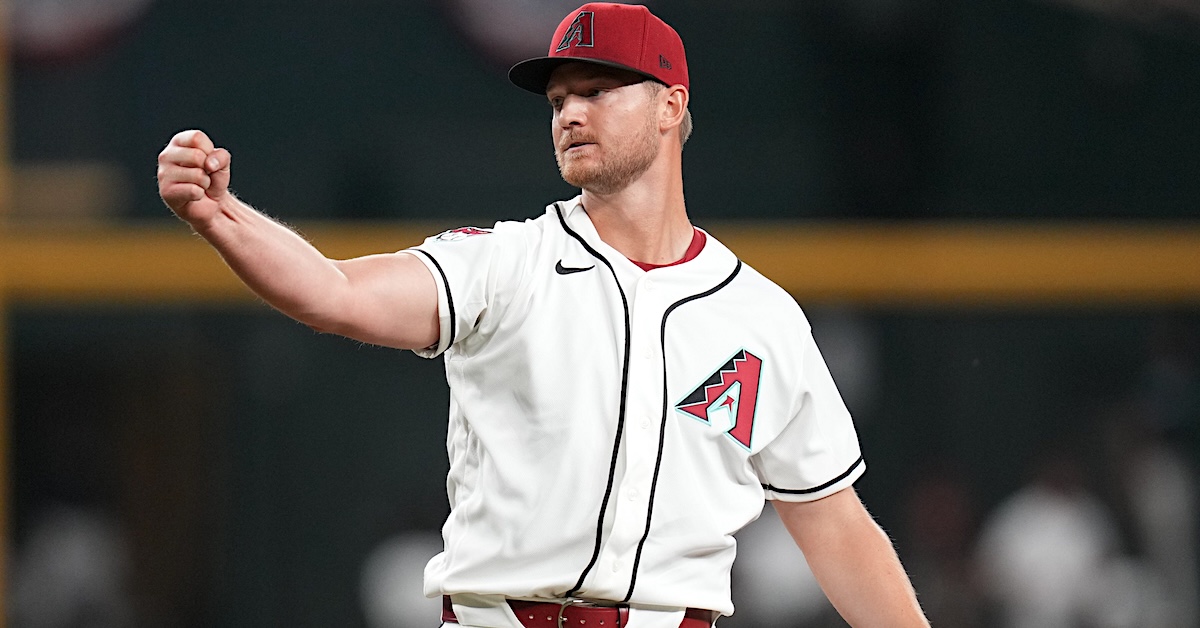
“Gee, Michael Soroka has been pretty good,” is the kind of statement that tells you more about the calendar than Soroka himself, but the point remains: Michael Soroka has been pretty good. The big Canadian steamrolled the Tigers (my pick for the AL pennant) with 10 strikeouts in five scoreless innings in his first start of the year. He followed that up with a solitary earned run over five innings against his former team, the Atlanta Braves.
The total bill, so far, is 13 strikeouts and 13 baserunners allowed (eight hits, four walks, one hit batter) in 10 innings, with a 0.90 ERA and 2.10 FIP. And against reasonably tough competition. So do the Diamondbacks, currently in dire need of pitching with seven big league arms currently on the IL, have something here?
It’s been a long time since Soroka was healthy and effective for a full season; in 2019, he went 13-4 with a 2.68 ERA, mostly as a sinker-slider guy. It was a terrific season that stood out even in a loaded rookie class: He finished second to 53-homer Pete Alonso in the NL Rookie of the Year voting, ahead of Fernando Tatis Jr. and Bryan Reynolds, who hit .314/.377/.503. I didn’t quite understand Soroka at the time. He’s always been imposing on the mound — Soroka was an ice hockey goalie growing up — but I see a 6-foot-5 guy from Alberta with kind of languid movements and think “1990s stay-at-home defenseman.” Like a Mike Rathje or Uwe Krupp type.
Despite that vast and intimidating frame, Soroka at his best generated neither compelling velocity (averaging 92 mph on his fastball), nor extension (second-percentile in 2019). He didn’t strike anyone out, but he garnered gobs of weak contact.
People who wish it was still 1955 want a pitcher like that to succeed, and in Soroka’s defense, his stuff never let him down. Instead, he suffered a gruesome Achilles tendon injury, and even when that healed, the shoulder problems that had plagued him throughout his ascendancy only got worse. Soroka missed literally two and practically four full seasons from 2020 to 2023, and when he came back it was as an itinerant backend starter.
A butterfly flaps its wings, and this ace-in-the-making for an ascendant Braves team is playing out his 20s for the White Sox and Nationals.
Soroka’s prime seems like a thing of the distant past, like he’s in a chain of homegrown Braves pitchers dating back to Kris Medlen or Kerry Ligtenberg. But because Soroka was so young when he debuted, he is literally now only 28 years old. If he wants to hang around posting high-4.00 ERAs for last-place teams, he could do that for another 10 years.
Or is he bound for something better?
For starters, Soroka’s not quite the same pitcher he was before. I don’t think that anyone will be surprised to learn that after seven years and about 100 shoulder injuries, Soroka has dropped his arm slot. He’s getting a little more slinging action and slightly higher velocity, though it’s worth noting that while Soroka’s average four-seamer velocity is up 1.4 mph since 2019, the league-wide average is up 1.3 mph, so relatively speaking he’s merely kept pace.
Soroka is still throwing the sinker, though that’s taken a backseat to his four-seamer, and that tight slider of 2019 has given way to a slower, slightly looser breaking pitch that Baseball Savant tags as a slurve. This is a bit of an oddity, as “slurve” took on a pejorative connotation about a decade ago. (Possibly related to the fact that it’s the only pitch type name that has “slur” in it.)
He started to go four-seamer over sinker in early 2024, and switched up his breaking ball later that year, going with the slurve full-time in 2025. This year, Soroka has (throws a dollar in the “he should add a cutter” swear jar) started mixing in the odd cutter, as well. I used our fancy-schmancy new Paired Pitches tool to show how all of his offerings interact in terms of movement and velocity.
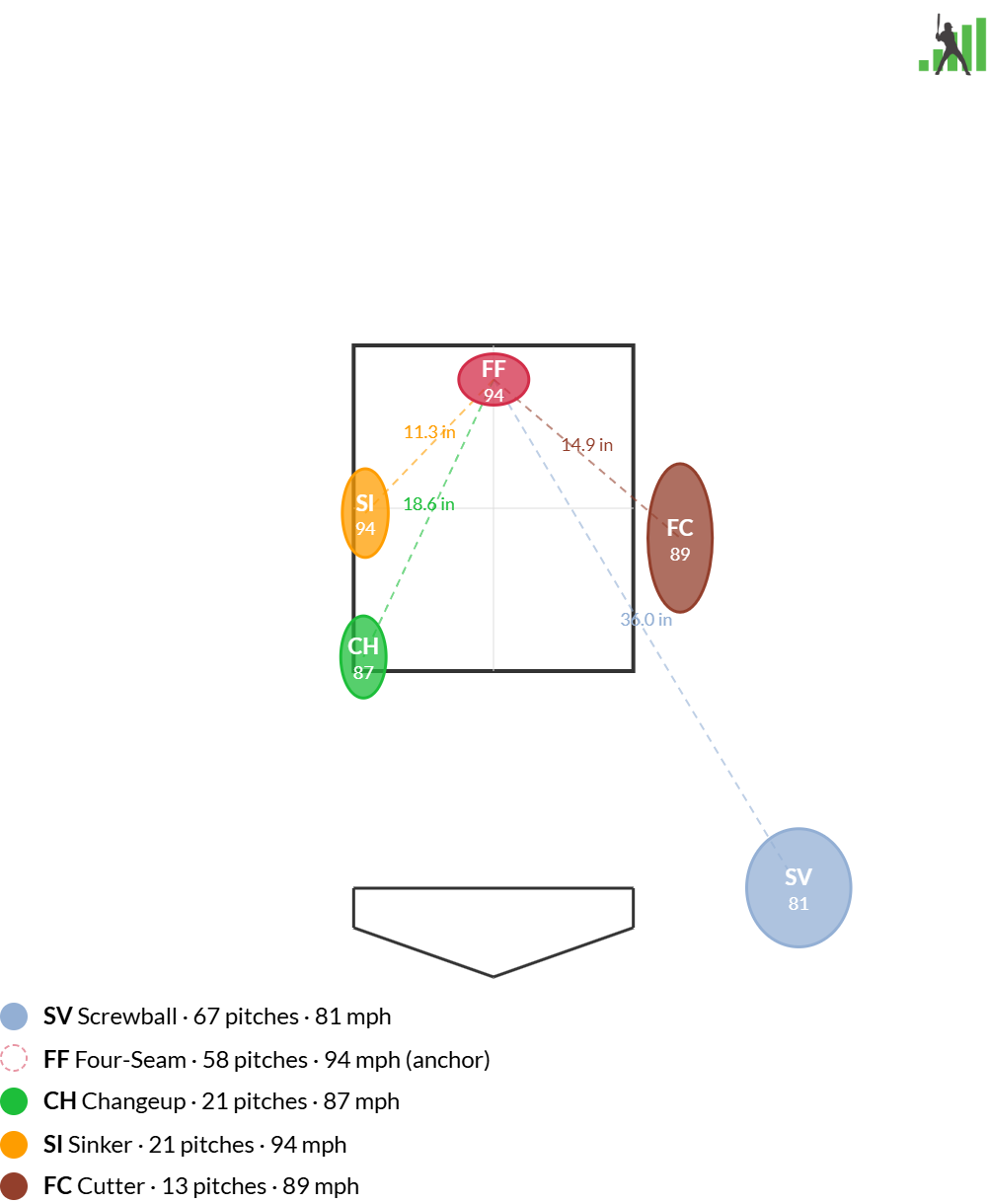
One interesting wrinkle is that Soroka had bang-average four-seamer movement in 2025. This year, he’s taken an inch and a half of IVB out of the heater, but the separation to his changeup and sinker has only grown, because those pitches are dropping even more. That could be small-sample nonsense, but it’s worth monitoring.
Has this new arsenal finally turned Soroka into a bat-misser? Not exactly. In that masterpiece against Detroit, Soroka only got 12 swings and misses, which is quite a feat for a 10-strikeout game. He also added 21 called strikes, giving him 33 combined called strikes and whiffs, the highest total of any start in his career.
Those 21 called strikes are a massive outlier; it’s tied for the second-highest called strike total of any game so far this season. And out of nearly 300 individual pitcher outings of 50 pitches or more, only five have had a higher percentage of called strikes than Soroka’s 23.6% against Detroit.
Three of those called strikes came on full-count fastballs, one perfectly dotted four-seamer each to lefties Riley Greene and Kerry Carpenter, and this two-seamer that clearly confused the heck out of Javier Báez.
Confused the heck out of me too — it isn’t exactly Báez’s style to leave the bat on his shoulder, regardless of count or location.
Maybe he should’ve swung, because here’s where I pour cold water on the whole thing. Soroka’s ERA and FIP are stellar, but his xERA is 6.03. Obviously, that number is going to come down just as quickly as his actual ERA goes up. Nevertheless, for now, Soroka is letting up a lot of hard contact and largely getting away with it.
Of the 24 batted balls Soroka has allowed through two starts, 11 have come off the bat at 95 mph or higher, and 12 (mostly, but not entirely the same ones) have had an xBA of .400 or higher. But Soroka is either scattering those dangerous batted balls, or his extremely fast outfield is turning them into outs. He has allowed six batted balls with a four-digit xSLG; three of those landed in the glove of either Alek Thomas or Corbin Carroll. There is no substitute for an army of little fast guys.
So we arrive at the disappointing, and yet highly predictable, conclusion to any analysis of a surprising pitcher two starts into the season: We’ll see. Soroka has looked good (and, more rarely and importantly, healthy) so far this year, though the quality of contact allowed and continued lack of swing-and-miss stuff mean we’re probably in for a regression. It’s April; what else did you expect?
Michael is a writer at FanGraphs. Previously, he was a staff writer at The Ringer and D1Baseball, and his work has appeared at Grantland, Baseball Prospectus, The Atlantic, ESPN.com, and various ill-remembered Phillies blogs. Follow him on Twitter, if you must, @MichaelBaumann.
What amazes me the most is that Soroka is still trying. Its been 7 years since his amazing 2019, and he’s still trying to come back. For sure, he’s made a lot of money in those 7 years as teams keep paying him for his potential. But it takes guts to keep coming back after so many injuries and setbacks