It’s Time to Pull the Plug on Pablo Sandoval

Last night, the Red Sox started Pablo Sandoval at third base, the first time in four games he’d been in the starting line-up. He responded by singling to lead off the second inning and miraculously drew a walk in the third inning, which should tell you how sharp Jeremy Hellickson was last night. In the 8th inning, he was replaced by Josh Rutledge for defensive purposes, despite the fact that Rutledge has regularly graded out as one of the worst defensive infielders in baseball. But for Sandoval, this was a pretty successful night, reaching base twice and handling all four balls that he fielded.

But the fact that this is what constitutes a successful game for a player on a team trying to win is why the Red Sox should realize it’s time to just move on.

Read the rest of this entry »


Projecting Astros Outfielder Derek Fisher

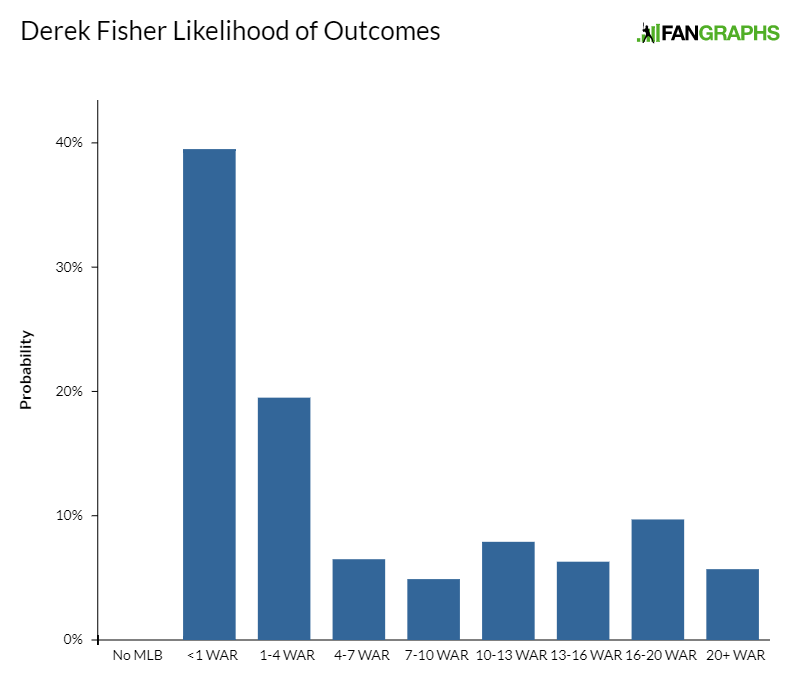
With Josh Reddick sidelined by a concussion, the Astros summoned 23-year-old center fielder Derek Fisher to the big leagues yesterday. The early returns are good: in his debut, Fisher went 2-for-3 with a homer and two walks.

Fisher had more than earned this opportunity, slashing .335/.401/.608 at Triple-A this year. A power-speed threat, Fisher eclipsed 20 homers and 20 steals in both 2015 and 2016, and Eric Longenhagen gave him raw power and speed grades of 60 and 70, respectively. Fisher had a bit of a strikeout problem in the past, but has managed to slice his strikeout rate from 27% last year to 19% this year without sacrificing any of his power.

KATOH loves Fisher, which shouldn’t come as much of a surprise given his excellent performance this year. I have him projected for 8.1 WAR over his first six seasons by stats-only KATOH and 6.3 WAR by KATOH+, which incorporates Eric Longenhagen’s relatively modest 45 FV grade. Those projections make him the 18th- and 48th-best prospect in baseball, respectively.

To put some faces to Fisher’s statistical profile, let’s generate some statistical comps for the toolsy center fielder. I calculated a Mahalanobis distance between Fisher’s Double-A and Triple-A performance and every season since 1991. In the table below, you’ll find the 10 most similar seasons, ranked from most to least similar. The WAR totals refer to each player’s first six seasons in the major leagues. A lower “Mah Dist” reading indicates a closer comp.

Please note that the Mahalanobis analysis is separate from KATOH. KATOH relies on macro-level trends, rather than comps. The fates of a few statistically similar players shouldn’t be used to draw sweeping conclusions about a prospect’s future. For this reason, I recommend using a player’s KATOH forecast to assess his future potential. The comps give us some interesting names that sometimes feel spot-on, but they’re mostly just there for fun.

Derek Fisher Mahalanobis Comps
Player Mah Dist KATOH+ Proj. WAR Actual WAR
Jayson Werth 2.9 5.4 12.0
Steve Hosey 3.8 8.6 0.1
Ozzie Timmons 4.6 4.6 0.9
Ray McDavid 4.6 3.8 0.0
Jack Cust 4.7 5.5 5.1
Franklin Gutierrez 5.2 4.0 13.1
TJ Staton 5.4 3.5 0.0
Wladimir Balentien 5.4 5.0 1.0
Trot Nixon 5.5 6.8 17.9
Ryan Ludwick 5.5 3.4 8.8

It’s not immediately clear how, or how often, Houston will work Fisher into their lineup once Reddick is healthy. But Houston would perhaps benefit from shifting some of Nori Aoki’s at-bats to Fisher, giving them an outfield of Fisher, Reddick and George Springer. Regardless, Fisher’s rare combination of power, speed, and contact ability makes his future look incredibly bright. And he made it clear with his 2017 performance that he has nothing left to prove in the minor leagues.


Eno Sarris Baseball Chat — 6/15/17

Chat begins at 12:45 PM ET.

1:37
Eno Sarris: Why not get into a funk, and not one like J.J. Hardy finds himself in?

12:00
Tanaka and Hendricks: Eno…you think the arrow is pointing up on these two for ROS?

12:01
Eno Sarris: Hendricks, yes. Tanaka? Throws cement mixer sliders and now cement mixer splitters, too. Wouldn’t be surprised if he’s on the DL soon.

12:02
Biden the Dog: You still holding Eickhoff in a 14 tm?

12:02
Eno Sarris: I’m intrigued by the fact that he’s throwing his curveball 40% of the time recently. Yes.

12:03
Terry’s Sarape: Who will lead baseball in HR:WAR ratio? Who will have the lowest?

Read the rest of this entry »


NERD Game Scores for June 15, 2017

Devised originally in response to a challenge issued by sabermetric forefather Rob Neyer, and expanded at the request of nobody, NERD scores represent an attempt to summarize in one number (and on a scale of 0-10) the likely aesthetic appeal or watchability, for the learned fan, of a player or team or game.

How are they calculated? Haphazardly, is how. An explanation of the components and formulae which produce these NERD scores is available here. All objections to the numbers here are probably justified, on account of how this entire endeavor is absurd.

***

Most Highly Rated Game
New York AL at Oakland | 22:05 ET
Montgomery (63.1 IP, 104 xFIP-) vs. Gray (47.1 IP, 73 xFIP-)
Oakland starter Sonny Gray throws either one or four or endless different sorts of breaking ball, Eno Sarris revealed in a post published this morning at the site. Among those infinite variations is this specific one, a pitch that travels at 94 mph and features slider-type break:

According to Gray himself, the movement here is a product of just a small alteration to his four-seam-fastball grip, which isn’t typically how human people are capable of producing such movement. At the margins of what is possible, is where Sonny Gray is located — at least so far as this one physical act is concerned.

Readers’ Preferred Broadcast: Oakland Radio.

Read the rest of this entry »


Projecting the College Players Taken on Day Three of the Draft

On Tuesday, I published a post projecting the players taken on day one of the draft. Yesterday, I did the same for the players taken on day two. Let’s take a look at what my math says about the players taken on the third and final day of the draft.

Below, you’ll find some quick thoughts on KATOH’s top-five hitters and top-five pitchers selected in rounds 11-40. Below that, you’ll find by a giant, sortable table with projections for all drafted players for whom I have projections. As a reminder, I only have projections for college players who logged at least 100 plate appearances or batters faced in a Division 1 conference. I do not have projections for JuCo or high-school players. Note: WAR figures are projected totals for the relevant player’s first six years in the majors.

Darren McCaughan, RHP, Seattle, 2.3 WAR

McCaughan allowed just 20 walks across 120 innings with Long Beach State this season, finishing up with a sparkling 2.50 ERA. He doesn’t rack up the strikeouts like many of the pitchers drafted before him but has three years of strong performance in the Big West to his name.

Read the rest of this entry »


Sonny Gray Is a Mystery

“Grips are meaningless,” Oakland A’s starting pitcher Sonny Gray once told me. Maybe that’s why we haven’t yet had a good talk, despite calling the same clubhouse home half the time. He didn’t quite mean “meaningless,” it occurred to me, when we finally discussed his repertoire. But there’s another reason he’s found it difficult to talk the way pitchers often talk to me: He’s changing things from pitch to pitch, according to what he sees. That includes grips, finger pressure and pitching mix. It’s hard to say he’s been doing something different when he’s always doing something different.

It’s difficult to figure out the righty. His breaking balls, for example: One classifying system says he’s currently throwing more sliders than ever. One says he’s in a three-year high for curveballs. A third says he’s right about where he’s always been, but that his recent good stretch may have coincided with an increased use of his slider.

Is he throwing more sliders now that he’s healthy? Gray shrugs. “Even before I got hurt, I was throwing sliders, and I was throwing them at 88, 89 mph,” he says. No system has him throwing a breaking ball that hard. “Whatever people call the pitch is what they are going to call it. It’s a hard curveball, I guess. The grip is a little bit different, but it does have a curveball action.”

Read the rest of this entry »


The Tony Wolters Experiment: The Making of a Receiver

Near the end of spring training in 2013, just days before the Cleveland Indians were to travel north, then-middle-infield prospect Tony Wolters was called into the manager’s office at the club’s complex in Goodyear, Ariz.

There, Terry Francona and a number of front-office members awaited. They offered Wolters a choice. One option was that he could remain a middle infielder, even though he might be unable to stick at shortstop and even though his .260/.320/.404 line the year earlier at High-A hinted at insufficient offensive production for second base. Furthermore, with Francisco Lindor and Jason Kipnis in the organization, his opportunities would be limited. The other option? He could try his hand at catching.

Wolter’s experience behind the plate, to that point, had been limited to catching one game at Rancho Buena Vista High, from which school the Indians had selected him in the third round of the 2010 draft. He was to turn 21 in June. He had not risen above A-ball.

“They gave me a day to think about it,” Wolters said. “It was kind of the end of spring, so I had to tell them. I couldn’t say ‘No’ to Tito [Francona]… The main thing was, I just wanted to do what they wanted me to do and I felt I could do it.”

Thus, one of the more unusual position changes — at least as measured by successful outcomes — in recent professional baseball began. A reverse Craig Biggio, a move from the middle infield to catcher. The Indians gave Wolters a brief tutorial. He borrowed a glove and caught his first bullpen. Who pitched? Pre-breakout Corey Kluber. “He was pretty good,” Wolters responded. “That day he wasn’t spotting up, so I kind of got messed up a little bit.”

As the Indians’ major- and minor-league teams departed to begin their respective seasons, the club held Wolters back for one week to receive a crash course in catching at their Arizona complex. After a week of experience, he was sent off to High-A ball to become the Carolina Mudcats’ starting catcher. Along the way, he worked with coaches like former major leaguer Sandy Alomar to learn some intricacies of the craft.

Now fast forward three years. Last season, as a member of the Rockies, Wolters ranked as the ninth-best framer and 10th-best overall defensive catcher in the majors, according to Baseball Prospectus’s catching metrics. Ever since Colorado claimed him off waivers on Feb. 16, 2016, Wolters has become one of the better values and under-the-radar additions in the majors. He entered play on Wednesday with a batting line just 10% shy of league average at one of the game’s weakest offensive positions. In 111 career games, he’s accumulated 1.5 fWAR and 2.2 bWARP. He’s helped the Rockies to a 42-26 mark, percentage points behind the Dodgers, entering Thursday.

But what is most interesting about the Wolters story, at least to this author, is how quickly he acquired the skills necessary to become one of the better defensive catchers in the game (even if he’s rated as more of a league-average catcher to date in 2017). Whatever the precise level of his skills, average or better than that, he reached that level quickly. It raises the question of how many other position players could have benefited themselves and their teams by making the move to catcher where the position’s collective wOBA (.307) is above only that of shortstop (.304) this season.

Read the rest of this entry »


Effectively Wild Episode 1071: I Would’ve Felt Silly Saying Boo

EWFI

Ben Lindbergh and Jeff Sullivan banter about position players pitching, another non-catcher catching, a Zack Cozart quote, and Ben’s latest home-runs research, then answer listener emails about Hunter Pence, better ways to make boundary calls, the number of plays at the plate, managerial aging curves, playing all nine positions in a game, the worst times to boo, the Freeze vs. Emilio Bonifacio, defining “moonshots,” MLB expansion, evaluating scouts and drafting, and more.

Read the rest of this entry »


The Era of Position Players Pitching

Yesterday, toward the end of an absolute thrashing at the hands of the Twins, the Mariners sent Carlos Ruiz to the mound. That’s notable for the fact that Ruiz is a catcher, and not a pitcher, and yet Ruiz pitched, and he even registered a strikeout! He also walked two guys and coughed up a homer. Not supposed to pitch. Did pitch. It happens.

It’s actually been happening kind of a lot. The day before, the tables were turned, and as the Mariners were maiming the Twins, the Twins sent out Chris Gimenez to pitch. A few days before, the Padres used Erick Aybar. The day before that, the Phillies used Andres Blanco. The day before that, the Twins used…Chris Gimenez. A week before that, the Twins used Chris Gimenez. And on, and on. It used to feel special when a non-pitcher would pitch. It’s still more fun in a blowout than the alternative, but some of the shine has come off the apple.

It’s not too hard to figure out why. These appearances were special because they were rare. They’re still not common, but they’ve become more common than they’ve been. Baseball right now finds itself within a number of eras, but among them, this is the era of position players pitching.

Read the rest of this entry »


2017 Top AL Contact Survivors

Last week, we took a look at the hitters who have been the most productive on balls in play in both leagues, and peeled back a layer or two of batted-ball data to see how much of it was real. This week and next, we’re going to do the same with pitchers. Today, the AL.

Read the rest of this entry »