
Pirates Righty (No, Not That One) Shuts Down Mets Stars
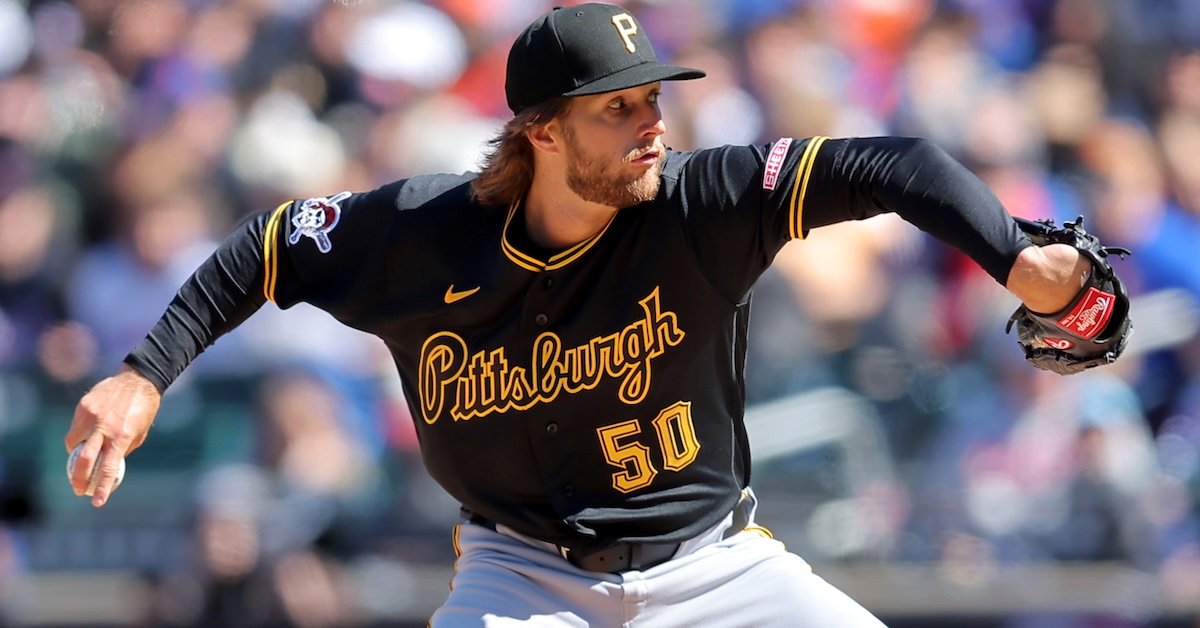
In general, the Pirates’ first series of the year could’ve gone better. What everyone’s going to remember from this past weekend is the worst start of Paul Skenes’ career — probably of his entire life. But it could’ve been worse. Winning one of three at Citi Field against the Mets is probably going to end up looking like even par for one of the tougher assignments in the National League, especially with one of those losses coming in extra innings.
Brandon Lowe hit three home runs. Even Skenes’ awful opening inning was only made possible by some horrendous defense and ridiculous batted-ball luck. And Carmen Mlodzinski struck out the side against the top of the Mets’ order on Sunday. Twice.
Every offseason, sooner or later, I just flat out run out of things to write about. But because the big wheels of content keep spinning, and because said wheels will run me over if I don’t keep moving, sometimes I have to dig deep for article fodder. That moment came on February 3 this year, when I wrote about Mlodzinski, a back-end-starter-turned-low-leverage-reliever on a bad, small-market team.
Mlodzinski had been terrible early last season as a starter, and got demoted to Triple-A. At the time, he had a slider-sweeper breaking ball combination that wasn’t very good to begin with and spent way too much time in the zone. His low-three-quarters arm angle and fastball combo of four-seamers and sinkers meant everything he threw came with a side-to-side movement profile of some form or other. And those secondary pitches were getting shelled.
When Mlodzinski came back, he left his old breaking balls in Indianapolis and picked up a new curveball on the way back. It changed everything. He posted a 1.63 ERA and 2.14 FIP in his final 23 appearances of 2025, and opponents posted a wOBA of just .165 against his curve. It looked like the Pirates had found something quite valuable: A high-end setup man for Dennis Santana, capable of stretching out to six outs if necessary. That’s a win — let’s not get greedy.
So when the news came that the Pirates were returning Mlodzinski to the rotation, I feared a relapse. Indeed, his first start wasn’t perfect; he lasted only 4 1/3 innings, and allowed two runs and six hits. He dominated the Mets’ top three the first two times through the order, but any crowing about that accomplishment must be dampened by what happened the third time he faced them.
Even so, Mlodzinski struck out eight batters without walking anyone. That’s a big deal for a pitcher whose previous career high was six. Especially because six of those eight strikeouts came against Francisco Lindor, Juan Soto, and Bo Bichette. There are dozens of ways to extol the virtues of that trio. Here’s mine: This year, the Mets are paying those three hitters a hair under $120 million, which is some $20 million more than the Pirates have ever spent on a 40-man roster over the course of a season. This was a mismatch.
Mlodzinski only got eight whiffs all game, but six of them came with two strikes to Lindor, Soto, and Bichette.
It helped that Mlodzinski worked ahead in the count; he threw strike one in four of those six at-bats. In the other two, he fell behind 1-0, but immediately got back ahead in the count, 1-2. Pitchers who get ahead in the count obviously have an easier job.
The first time through, Mlodzinski tried and failed to back-door a curveball and then a splitter to Lindor, who spat on both. After working the count full with pitches on the outer half, Mlodzinski went with a back-foot curveball that tied Lindor in knots.
The second time through, Lindor knew to look for the hammer. He took it for ball one, and then again as Mlodzinski tried to get him to chase a 2-2 breaking ball. So Mlodzinski came back with a four-seamer up in the zone, and Lindor swung straight through it.
I love Lindor’s obvious annoyance here. He knew he’d been bamboozled. A year ago, Mlodzinski didn’t have a breaking ball with the kind of downward movement required to drop it under Lindor’s bat, the way he did in the first inning. Adding the curveball not only got that swing and miss, it set up the strikeout on the four-seamer later on.
Back in February, I admitted that I didn’t really see the point of Mlodzinski’s sinker. I understand it better now. He threw it to Bichette in a 1-0 count in the first inning, and back-doored it over the black for a cheap called strike.
This is a niche reference, but for about four months in 2011, Vance Worley was better at back-dooring a sinker than any pitcher who ever lived. He’d get two strikes on a guy, line up the two-seamer, and start walking off the mound before the ball even got to the plate. This was a Vance Worley-ass sinker.
Bichette, being one of the best contact hitters in the league, filed that pitch away in his databanks. And with two strikes in his next at-bat, he saw a fastball on the outside corner and prepared to flip it down the right field line for a double.
Oh, darn, it’s the four-seamer, not the sinker. I guess that’s why you throw both of those pitches.
What of Soto, then? Well, the curveball might’ve fooled Lindor, but Soto had it dialed in from the first pitch. In his first two at-bats against Mlodzinski, Soto saw four curveballs low and out of the zone and didn’t swing at any of them. I guess he’s good at picking up spin or something. Splitters, however, don’t spin, or at least they don’t spin as much. And Mlodzinski got Soto to swing over one with two strikes in the first, and again in the third.
Mlodzinski was a little less precise with his fastball command to the hitters lower in the Mets lineup. Brett Baty and Luis Robert Jr. might not be as good as the hitters in front of them, but they’re still capable of lining a fastball into the outfield.
And when the top of the Mets order came up a third time, Mlodzinski wasn’t burying his secondary pitches, and the stars were ready for them. A first-pitch splitter to Lindor caught the bottom of the zone, and he lanced it to right-center for a triple.
That left Mlodzinski to face Soto, who finally bit at a curveball that just barely missed the zone low and in.
The next curveball caught enough of the zone for Soto to make contact, and his single to right scored Lindor and chased Mlodzinski.
Given what we saw from Pittsburgh’s outfield defense last week, I can’t help but notice that Ryan O’Hearn overran Lindor’s triple and was slow to get to Soto’s single. Which is not his fault — he’s a first baseman, and the Pirates chose to live and die by their iron-mitted defense — but I wonder if Mlodzinski might’ve escaped the fifth inning if his right fielder didn’t run like a menhir. Oh well.
There’s plenty for Mlodzinski to improve on from his first start of 2026. Despite the strikeout totals, his stuff wasn’t overpowering, and when his location wasn’t perfect he got hit. Whether that’s a stamina issue or evidence that he needs another weapon, I don’t know.
But it’s hard not to be encouraged by this impressive season debut. Maybe Mlodzinski’s got the makings of a solid starter after all.
Michael is a writer at FanGraphs. Previously, he was a staff writer at The Ringer and D1Baseball, and his work has appeared at Grantland, Baseball Prospectus, The Atlantic, ESPN.com, and various ill-remembered Phillies blogs. Follow him on Twitter, if you must, @MichaelBaumann.
Yeah, the Pirate’s D is definitely an issue.