
Ponce Injury Lowlights First Starts for NPB, KBO Free Agents
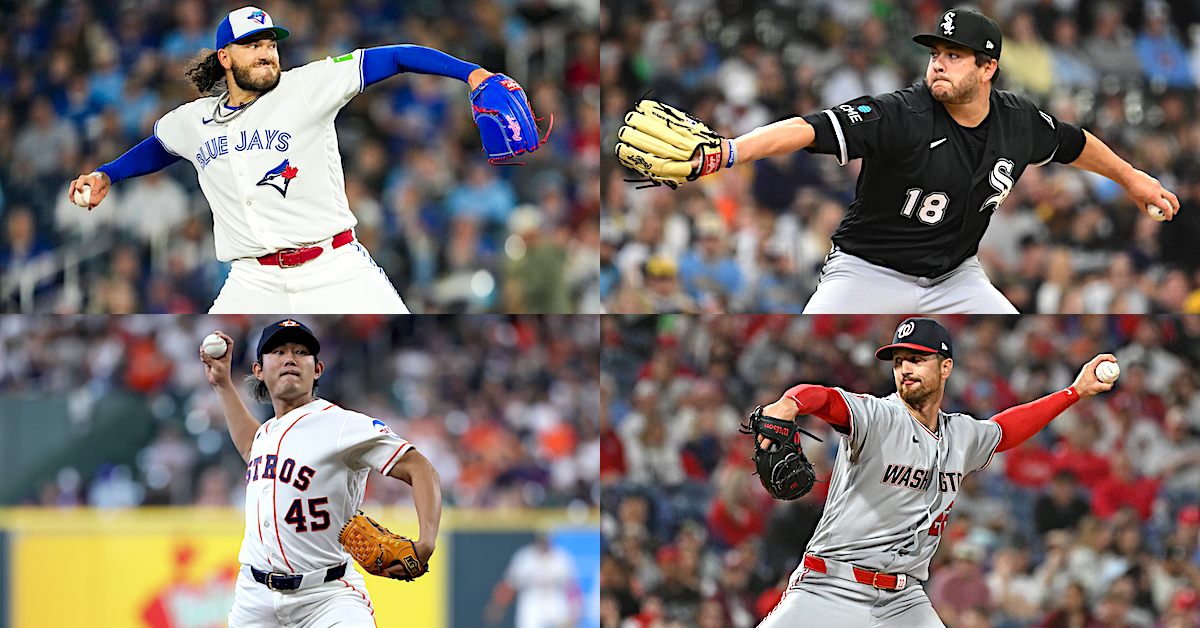
Cody Ponce left his first start on a cart with a trainer.
Ponce collapsed in considerable pain Monday after making an awkward attempt to field a grounder in the third inning against the Rockies. He appeared to twist his right knee in a direction it’s not meant to go. He stood and limped to the cart on his own before exiting. Blue Jays’ manager John Schneider said after the game that Ponce will get an MRI.
The injury is an unfortunate setback for Ponce, who was making his first start in the majors since 2021. He was perhaps the most anticipated in a quartet of free agent pitchers who signed out of the KBO or NPB this winter. I’d already planned to write about each of them, leading with Ponce for the reasons he displayed before the injury. And while I don’t want to overreact to one start, I think there are interesting takeaways from each that could inform the shape of their respective seasons to come.
The potential was obvious on Monday as Ponce dominated the Rockies’ lineup for 2.1 innings. He displayed a vertical, up-and-down arsenal, not too dissimilar to what he’d thrown in the big leagues before, but now with upper-90s heat. His four-seam fastball was an impressive 95.9 mph, nearly three full ticks higher than his last start in the majors, and featured a bit of late fade. He also threw a nice looking kick-change, and a big, bendy curveball, mostly to lefties. He generated 15 whiffs on 29 swings, the fourth-highest rate among starting pitchers in the season’s early going. That included eight whiffs on 10 swings against his slider (sometimes labeled a cutter), which was his primary pitch to righties. The pitch doesn’t have a lot of movement, but it has some late, sharp bite that seemed to fool the Rockies.
Ponce was drafted by the Brewers in 2015 out of Division II Cal Poly Ponoma. He never really settled into a role, splitting time as a starter and long reliever before getting shipped to Pittsburgh in 2019. He made a handful of appearances for the Pirates — enough to exhaust his rookie eligibility — but posted sub-replacement level numbers. Ahead of the 2022 season, he left for Japan, where the middling performance continued for three years.
It was when Ponce joined the KBO’s Hanwha Eagles in 2025 that things started to turn around. His conditioning improved, helping him add two ticks to his fastball, and he suddenly looked capable of dominating lineups deep into games. He doubled his strikeout rate to 36.2% last season while maintaining a 5.9% walk rate. The result was a 1.89 ERA and 2.15 FIP across 180.2 innings. The Blue Jays were impressed and gave him a three-year, $30 million deal this winter.
What’s next is unclear. The injuries continue to mount in the Blue Jays rotation, with Trey Yesavage, José Berríos, and Shane Bieber already on the injured list. Each are in the “throwing from various locations” stages of return. The team reportedly recalled Lazaro Estrada after the game, though he could be up to help cushion the bullpen, which covered nearly seven innings Monday. Adam Macko could also make a starts if Ponce needs IL time before Yesavage returns.
I don’t really know what else to say. The injury is unfortunate. There are few career arcs more admirable than the player who toils in the minors for years, goes overseas when his opportunities dry up, and returns with a new perspective (and often an improved repertoire), finding relevance where he was once an afterthought. Baseball’s meritocracy is part of its charm, and stories like Ponce’s are a nice reminder that stick-to-itiveness can sometimes prevail. Unfortunately, it’s also a reminder that there are always more hurdles to clear.
Tatsuya Imai
Tatsuya Imai was chased in the third inning Sunday, but he flashed the interesting stuff that made him a top name in free agency.
Imai was the Seibu Lion’s first round pick out of high school in 2016. He struggled with command early in his career but seemed to improve a bit each year. By 2025, he was one of the best pitchers in Japan, posting a 20.7% K-BB% and 2.01 FIP in 24 starts. The Astros signed him this winter for $54 million over three years, which was less than many expected. The deal also included opt-outs after each season, suggesting a gap between how the Astros viewed the right-hander and how Imai viewed himself. It was a prove-it deal, basically.
So did he prove anything in his first start on Sunday? Well, not really. He struck out four, walked four, gave up four runs, and was removed from the game in the third inning.
The first thing that sticks out about Imai is his athleticism. He has a simple, fluid, one-step wind up, and then whips his arm across his body out of a low slot. Pitching looks very natural to him. He mostly threw a four-seam fastball (50%) and slider (36%), mixing in a few splitters and cutters to lefties. His fastball averaged 95.6 mph and picked up several called strikes at the top of the zone, including his first big league strikeout, which came against Mike Trout.
The slider was… weird. I can at least see why there might have been some hang ups in free agency. It’s a much slower pitch, with a velocity gap like that of a sweeper. But rather than big, wide movement, it spins and spins and then folds over itself out of the bottom of the zone. In fact, Imai’s slider displays the least horizontal movement of any thrown at least 10 times this year. Stuff+ graded it at 85 (100 is average), the fourth worst among starters so far. PitchingBot graded it as a 44 (on the 20-80 scale), closer to the middle of the pack. And StuffPro at Baseball Prospectus had it at -0.4, tied for the 10th-best slider among starting pitchers so far.
Weird or not, the pitch was effective Sunday, generating five whiffs on 12 swings (41.7%), which roughly matches Imai’s rate in Japan. It certainly doesn’t look traditional, and the models don’t know what to make of it, but hey, that doesn’t mean it can’t be good:
Imai struggled to find the zone on Sunday, picking around the edges and running his pitch count up. This was another concern for him in free agency. He told reporters after the game that he was nervous, which is what manager Joe Espada attributed his struggles with command to.
Anthony Kay
Anthony Kay got his first start Sunday against the Brewers and displayed good velocity across five shapely pitches. But the issues with command that plagued his first attempt at the majors — the ones he appeared to fix last year in NPB — returned in his first outing.
The Mets drafted Kay out of high school in 2013 and then again out of UConn in the first round in 2016. He was eventually shipped to Toronto in 2019 in the deal for Marcus Stroman. He never quite settled into a role, bouncing between the rotation and the bullpen, and between Triple-A and the majors. He flashed solid strikeout totals and the ability to limit hard contact, but he had a tendency to tiptoe around the zone and offered up too many free passes. By 2023, he was waiver fodder, and opted to try his luck overseas instead.
Kay’s approach was largely the same in his first year in Japan, as James Fegan reported for Sox Machine. He continued to nibble at the zone and struggled to finish off batters. In 2025, however, he changed his mindset and attacked more aggressively, lowering his walk rate while continuing to limit hard contact. He chose the White Sox this winter on a two-year, $12 million deal because he admired their success with Erick Fedde in 2024.
But in his first start, Kay didn’t look like the more aggressive, more accurate version of himself from Japan. He struggled to find the zone, throwing 40 pitches in the chase and waste regions — the second-highest rate among starting pitchers so far. He frequently worked from behind, and issued four walks before finishing his day in the fourth inning at 92 pitches.
Still, his stuff was impressive, and it’s clear why teams wanted him back stateside. He mixed all five of his pitches, with a fastball-heavy approach to lefties and more breaking balls to righties. His four-seamer averaged 96.1 mph, landing him in the top 25% of hardest-throwing starting pitchers so far in 2026. The sinker was even more impressive in shape, with sharp arm-side bite that the stuff models loved. He also displayed a hard, tight slider (perhaps a cutter) at 90.5 mph, and then a slower, wider sweeper.
The changeup impressed the most, showing tremendous vertical depth and generating three whiffs on five swings.
Unfortunately, Kay struggled to locate his changeup, just like he struggled to locate his other pitches, and the Brewers were generally content to lay off. Again, Kay’s status in the majors has never been about stuff but rather his ability to throw it in the zone. If he can find his command from last year, he should be a more than serviceable big league starter.
Foster Griffin
Foster Griffin could fairly be considered the least heralded of this group (he at least signed for the smallest guarantee), but he certainly didn’t pitch that way Monday against the Phillies.
Griffin was drafted by the Royals in the first round way, way back in 2014, meaning 2026 is his 13th season as a professional baseball player. He toiled for years in the minors (and briefly in the majors), lacking the stuff to miss bats or the pinpoint control to limit walks. He was a pitchability lefty who never developed any plus tools. By 2023, it was clear his progress had stalled, and he chose to give it a go overseas, where he quickly became one of the best pitchers in Japan. He was doing all the things he could never do in the minors: missing bats, limiting walks, and otherwise stringing together excellent outings.
What changed? It’s not quite clear, and whether it will translate to lasting success in the majors is even less so. But in his first start of 2026, Griffin showed why the Nationals were willing to take a chance on his nascent success. He threw seven different pitches: cutter, four-seam, sweeper, changeup, splitter, sinker, curveball. None of them moved particularly fast, and none of them picked up many whiffs. But he mixed them evenly and effectively, and the Phillies never seemed to know when and where to swing. Stuff+ loved his arsenal, giving him an average grade of 110 across his pitches, though the other models were more reserved.
The kitchen-sink approach worked well on Monday. Griffin struck out five without issuing a walk, and only ran into a bit of trouble in his final turn through the order in the fifth inning. He pitches from a fairly steep, downward angle and was able to locate at the top of the zone, generating a bunch of weak fly outs. Of course, he also generated quite a few well-hit fly outs that might have spelled trouble on a different day. But Griffin is clearly a step above his former self, able to fool a talented lineup two or three times in an outing. It’s a development to monitor going forward.
Ryan Blake is a contributor for FanGraphs and Lookout Landing.
I actually randomly saw Foster Griffin start a playoff game in Tokyo, so I am rooting for him after his return stateside.