
Robbie Ray Is the Newest Strikeout Madman
It’s still sort of hard to fathom how quickly the league-wide strikeout spike snuck up on us. And after a one-year plateau between 2014 and 2015, they’re back on the rise again. On the one hand, a statement like, “Present-day Robbie Ray would’ve been baseball’s strikeout leader as recently as 2010” speaks volumes toward the current state of baseball and how much has changed just in the last five years. It also speaks volumes toward Robbie Ray, because era be damned, what he’s doing is impressive, and it seems like it’s flying under the radar. Funny how quickly we’ve come to take strikeouts for granted.
Robbie Ray has struck out 28% of all the batters he’s faced this season. That’s more than Jake Arrieta last year, higher than Danny Salazar’s current total. It’s higher than almost anyone, in fact, even in our strikeout-laden era. What follows is a complete list of pitchers who, this season, have (a) as many or more innings thrown, and (b) a higher strikeout rate than Ray:
That completes the list. Just five pitchers in baseball have ran a higher strikeout rate over as many innings as Robbie Ray, and they might just be the five best. Over his last eight starts, the strikeout rate’s up to 33%. It seems time to start paying some real attention to Robbie Ray, who suddenly looks like the second-hand man to Zack Greinke in Arizona.
Ray was never thought to be much. He lasted until the 12th round of the 2010 draft. He was traded by his original organization, the Washington Nationals, as part of a three-player package to Detroit for Doug Fister. A year later, the Tigers flipped him over to Arizona in a three-team deal that only netted Detroit Shane Greene. Before last season, he failed to crack the top-10 in Baseball America’s ranking of the Diamondbacks’ farm system. That report called his 2014 “uninspiring” and profiled Ray as “a No. 4 starter” who could spend time on the shuttle between Triple-A and the majors. Now look back at that list of five names above.
Clearly, something’s changed for Ray. That’s what we’re all interested in now. So, what’s changed? Here’s one thing that’s changed:
That’s Ray’s fastball hitting 97 in the sixth inning of a start from last week. It didn’t always used to be that way:
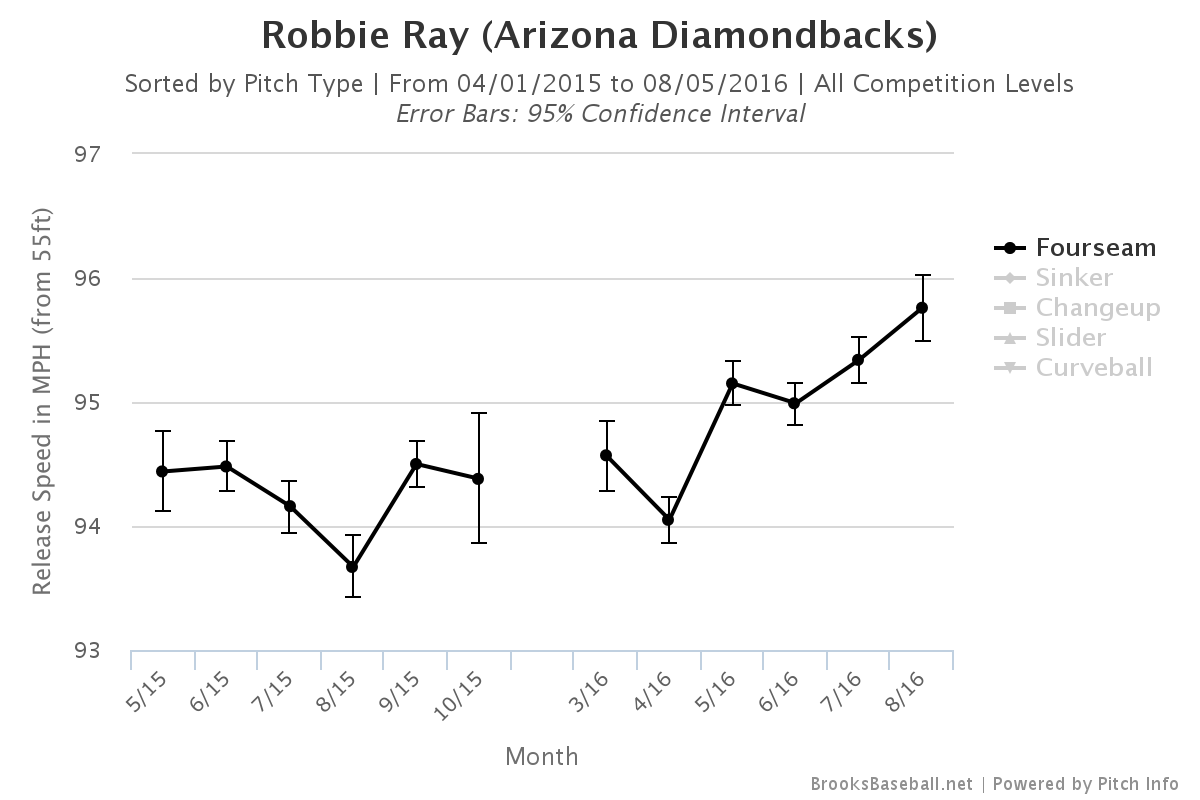
That’s Ray’s average fastball velocity, by month, since the start of last season. He’s averaged 95 this year, which gives him the third-hardest fastball by any active lefty starter. And that’s only been going up. In that start against the Brewers from the .gif above, Ray sat 96 and touched 99. He’s doing reliever things as a starter.
The slider’s coming along, too. This year, 84 starters have thrown at least 200 sliders. Ray’s ranks in the top-10 in getting swings-and-misses (44% of swings), and ranks in the top-10 at getting ground balls (57% of balls in play). It’s a good combination to have, whiffs and grounders. Some might say the best. It’s a lot for a pitch that was considered his least-consistent offering when Ray was still being considered a potential back-end starter.
Ray’s undergone a number of compelling developments. The fastball’s picked up velo, it’s always had great rise, and he’s now working it more efficiently up in the zone. He’s found more consistency in a slider that he’s doing a better job of burying, and he’s throwing it both outside to lefties and in on the feet of righties. It’s two plus pitches thrown by a 24-year-old lefty starter without major command issues. It’s a recipe for success.
At the same time, it’s not like the lack of hype surrounding Ray this season is completely unfounded. It’s not hard to see what’s holding it down at all. He’s got a 4.83 ERA. The strikeouts are great and all, and while they may be among the best single indicators of future success, they don’t mean much when the runs are still crossing the plate, and against Ray, the runs have been crossing the plate.
What gives? We’ll start with the “good” news. The “good” news is, Ray sure looks like the unfortunate victim of poor timing this year. It’s as simple as this: there’s little in the way of evidence that shows players should be expected to perform much differently based on the situation. Guys are who they are. However! This can vary in such small samples throughout the course of a season, and it can go a long way toward skewing results.
Take Ray. Ray, overall, has allowed a .791 OPS this year. In low- and medium-leverage situations, the OPS allowed has been .755. In high-leverage spots? In high-leverage sports, Ray’s allowed a .955 OPS. The strikeout rate in those spots is 35%; Ray’s still looked dominant. But the balls in play have fallen in (.422 BABIP) when he’s needed them to be caught. It’s a tough break. It’s a number of tough breaks. Just last year, he was one of baseball’s very best pitchers in high-leverage situations. This year, he’s been among the worst. Neither is indicative of any underlying characteristic. There’s no rhyme or reason. Odds are, winds up somewhere in the middle, and the ERA comes back down to earth.
But then here’s the less-good news. For as exciting as the strikeouts are, and as fluky as the ERA might be based on the unfortunate distribution of Ray’s hits allowed, there’s a problem about Ray as a starter that looks to be real. It looks like this:
| Pitcher | Season OPS | 3PA OPS | tOPS+ |
| Nathan Eovaldi | 0.782 | 1.164 | 193 |
| Kenta Maeda | 0.623 | 0.893 | 186 |
| Francisco Liriano | 0.814 | 1.087 | 165 |
| Robbie Ray | 0.791 | 1.038 | 159 |
| Mike Leake | 0.762 | 0.981 | 155 |
Ray has gotten crushed the third time through the order. Facing batters a third time, he’s allowed a 1.038 OPS, indicating one of the largest performance drops of any pitcher in baseball. You may be thinking, “This is a small sample that can be fluky, too!” And that’s definitely true. Always going to be some noise in here.
But the thing about Ray is, he’s essentially a two-pitch pitcher. Around 70% of his pitches are fastballs. Another 20% are that excellent slider. What Ray hasn’t yet been able to find is a consistent changeup, the pitch that used to be considered his go-to secondary offering in the minors. This year, batters are hitting .471 with a 1.353 OPS against it. By our pitch type run values, it’s been the most detrimental changeup in baseball. Ray has trouble going deep into games, not because he isn’t holding his plus velocity, but because he’s only got two real pitches to show batters, and by the third time through they’ve got him timed up.
The boring conclusion here is that Ray remains something of an enigma. The lack of a third pitch is a real problem, and you can see that manifest itself the third time through the order. That probably helps inform the high-leverage numbers a bit, too. But plenty of pitchers struggle to find a third pitch, and not all of them strike out nearly a third of the batters they face over 120 innings. That’s the representation of Ray’s upside. It might be limitless if he can harness the change. There’s still work to be done.
August used to cover the Indians for MLB and ohio.com, but now he's here and thinks writing these in the third person is weird. So you can reach me on Twitter @AugustFG_ or e-mail at august.fagerstrom@fangraphs.com.
Sounds like the perfect candidate for a shutdown reliever. Hopefully he develops his change.
Funny how his teammate Rubby De La Rosa is another functional two-pitch pitcher who throws gas, possesses a dirty slider, a bad changeup, who’s also had bad results compared with his xFIPs.
Both coming in trades, it feels like the Diamondbacks have identified a certain type of pitcher that they value but can’t seem to fix. Or perhaps the rest of the league has identified this type of pitcher as having a fundamental flaw that the Diamondbacks aren’t aware of…
Robbie Ray, In Pieces by Jeff Sullivan – May 7, 2014
Doug Fister since the trade: 2.9 fWAR
Robbie Ray since the trade: 3.9 fWAR
My purpose in posting this isn’t to rag on Jeff, but rather to point out that it’s not just prospects who get overrated. This site went on and on over multiple columns about what a dumb move it was for Dombrowski to trade Fister for Ray, with Dave calling it “the most lopsided trade we’ve seen in years.” In retrospect we can see that Fister’s valuable production with the Tigers was dependent upon a strikeout rate that he proved unable to maintain into his 30s. Given his profile as a soft-throwing, command-dependent starter, the possibility of him experiencing a sudden and dramatic decline should have been foreseeable, as his margin for error was already thin. What’s important both for prospects and established major leaguers isn’t just their recent history, but also the nature of their existing profile and how that affects their potential outcomes over the short and long-term.
I don’t disagree with you, but I think it’s only fair to point out that the numbers look pretty different by pure run prevention:
Doug Fister 2014-16: 6.5 bWAR
Robbie Ray 2014-16: 1.3 bWAR
And the Tigers only got 30 crappy major league innings out of Ray before they included him in the trade that got them Shane Greene, who has also not provided much value.
That’s fair, but even in bWAR, Ray has been more valuable than Fister over the last two seasons combined.
Remember part of what made it a bad trade was the believe that a number of other teams would have offered more for Fister (value at 2014) than the Nationals did. And given how quickly Detroit flipped Ray, I’m not inclined to give them credit for discovering him.
I’ve never heard or read anything about another team offering more. As for Ray, he was rated the fifth best prospect in the Nationals system by Baseball America, so he wasn’t an unknown. Dave and Jeff just thought Fister should have fetched quite a bit more, which is a very reasonable position if you look at Fister’s fWAR in the seasons leading up to the trade, but his profile should have indicated that Fister wouldn’t necessarily continue to be so productive.
Right, no other team offered more because they didn’t know Fister was on the block at all.
Not true at all. Dombrowski was candid about his process. They identified a dozen pitchers who they would consider for him and called each of those teams – and they got a dozen teams declining. Ultimately, Washington reconsidered and agreed to trade Ray.
While the return for Fister was startling, it was also clear they weren’t going to get any more.
I’ve never understood that whole sequence of trades. Dave Dombrowski was right about Fister declining (although he dumped him a year before Fister turned into a pumpkin) and right about Ray’s potential, but then he gave up on Ray way too soon and got basically nothing in return for him. Dombrowski made it a bad trade by not giving Ray a chance to develop with the Tigers.
True, but I wouldn’t be surprised if Ray and Greene end up in the same place, as above-average late-inning relievers