
Ryan Sloan and Kade Anderson Profile as Seattle Aces in the Making
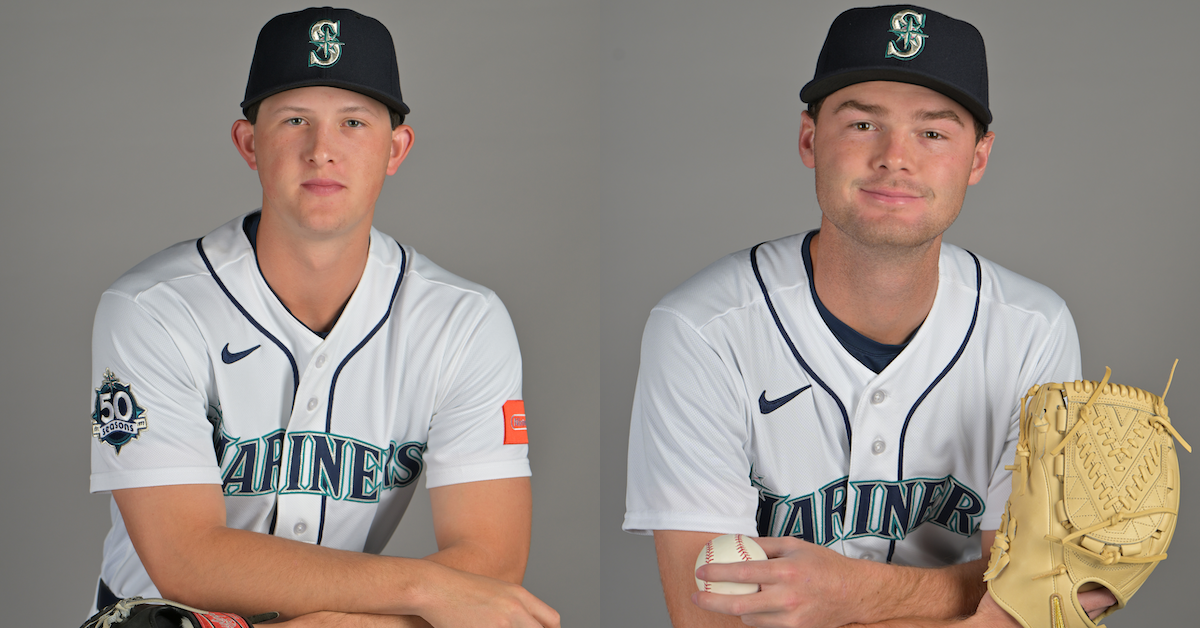
The Seattle Mariners boast two of the game’s most promising young arms. Second and third respectively in a highly regarded farm system, Ryan Sloan and Kade Anderson also reside in the front half of our 2026 Top 100 Prospects list. Sloan, a 20-year-old right-hander, ranks 20th, while Anderson, a 21-year-old southpaw, comes in at no. 50.
How do the two compare in terms of repertoire and approach? Both are profiled in the write-ups that accompany the aforementioned rankings, but what about how the pitchers see themselves? Moreover, how are they viewed by a catcher who knows them well and a prominent member of the organization’s pitching brain trust? Wanting to find out, I spoke to Anderson and Sloan, as well as to Luke Stevenson and Trent Blank, at Seattle’s spring training complex late last month.
Before we get to those perspectives, here are brief snapshots, augmented with quotes from our prospect analyst team of Eric Longenhagen, Brendan Gawlowski, and James Fegan:
Drafted third overall last year out of LSU, Anderson, who threw his first professional pitch this spring, was described as follows: “Maybe the best pitcher in the 2025 draft, [he] projects as a quick-moving mid-rotation starter with a great breaking ball.”
Sloan, who was drafted 55th overall in 2024 out of York Community High School in Elmhurst, Illinois, debuted professionally last season and logged a 3.73 ERA, a 3.18 FIP, and a 27.0% strikeout rate over 82 innings between Low-A Modesto and High-A Everett. “The upside is sky-high here,” wrote our prospect analysts, “and it’s not too early to say Sloan is one of the best pitching prospects in baseball.”
Blank serves as Seattle’s director of pitching strategy, so let’s start with his thoughts.
“I think the similarities are mainly the maturity of where they’re at in their careers as professionals,” said Blank. “The way they go about their bullpens, the way they’ve handled these live BPs so far. There’s not a lot of fear for either one of them.
“The differences is probably in their arsenals,” he continued. “[Anderson] is a little bit more north-south and [Sloan] is a little bit more east-west. But both of them have power. I also think they have the arsenals they’re going to have, for the most part, throughout their careers.”
Sloan’s repertoire comprises a four-seam fastball, a sweeper slider, a changeup, and a sinker that is new to this year. For Anderson, the mix is a four-seamer, a gyro slider, a changeup, and a curveball. As for which of them possesses the better raw stuff, the elder of the youngsters believes that his contemporary has a clear edge.
“Guys like Ryan, who have monster stuff, can get away with attacking the middle of the zone more than I can,” Anderson told me. “I do go after hitters, but I’m more of a feel pitcher. I have to hit locations, because I can’t just throw everything by guys. I try to truly pitch. My thinking is that I’m a pitcher, not a thrower.”
Was Anderson being overly humble in suggesting that he doesn’t possesses plus raw power?
“I don’t have monster stuff,” he replied. “But my goal is to get there one day.”
As Blank pointed out, the SEC stalwart led the country in strikeouts last season, doing so — this per our own write-up — with “a fastball that generated a whopping 35% miss rate,” as well as a wipeout slider and a changeup that he “sells with his whip-cracking arm speed.”
Does Sloan indeed have the edge in raw stuff?
“Right now, he does,” said Blank. “I do think Kade has a pretty good motor. He also has the ability to run it up there, but the ease in which Sloan is doing it in bullpens — sitting 97, touching 99 — is impressive. The ceiling for velocity is high for both of these guys. Kade has been up to 97, and he’s also very young for a college guy, so we’ll see if there is more there.
“We also had a pretty strict pitch count on [Sloan], and an innings limit, so we’ll see how he handles a little more bulk this year,” Blank added. “For both of them, let’s see if we can raise the floor a little bit. The ceiling isn’t as important. Can they raise the floor and hold their velo deep into games and throughout the season?”
When I asked Sloan what he considers to be his best pitch, I fully expected him to say his fastball. His reply raised my eyebrows.
“Probably my changeup,” the righty said. “I started throwing it my junior year, just a straight circle changeup, but then turned it into a kick change in pro ball. Someone showed me the grip, I messed around with it in catch play, and it turned out pretty good. I started throwing it in games last year, and it’s been a good pitch.”
Blank and Stevenson, who caught Sloan in the minors last season, offered interesting responses when queried on the subject.
“His fastball is unbelievable, and his slider is really good, too,” said the 21-year-old catcher. “His changeup is also nasty. Honestly, he’s got four or five really good pitches.
“Kade also has a lot of really good pitches,” continued Stevenson, who ranks eighth on our Mariners list. “I love catching his changeup — he has the ability to throw it to both sides — and his breaking stuff is really good, too. I think they both have great stuff. But Ryan… his stuff is electric. He throws fuel, absolute fuel.”
Unlike the young backstop, Blank first brought up Sloan’s change-of-pace.
“I think the pitch we need to learn more about is his changeup,” said Blank. “His fastball is obviously really good. It’s unique — you don’t see a lot of guys who cut a fastball like that at 96-99 — but the changeup shows a lot depth off of that, with velo separation. That’s going to be a hard pitch for hitters to handle. We’ll learn more about it this spring and early this season.”
Sloan more or less echoed the pitching strategist. He described his four-seamer as having cut-ride, an indirect result of his working to add an actual cutter. Previously “more dead zone-y,” his fastball “started morphing into a cut-ride shape, which we like.” He added that the pitch now plays best when he throws it glove side and up.
According to Anderson, his own array of offerings is largely status quo. And while that’s not to suggest he isn’t striving to improve their overall quality, you likely won’t find him in the pitching lab parsing metrics and/or chasing specific movement profiles.
“The Mariners do a good job of making us understand how our stuff plays, and in which locations of the zone, but for me it’s fairly similar here compared to college,” he explained. “I haven’t changed any of my pitches, and I haven’t been told to throw any of my pitches in different locations. It’s really more of a compete thing for me. Pitching is also all about sequencing. There is always something to learn about pitching — you’re never truly at your best — and that’s what makes it so much fun. It’s a constant battle of trying to get a little bit better every day.”
But again, not in a pitch design sort of way.
“I do have a pretty good foundation for the analytics behind pitching, but while it can be good at times, it can also be bad at times,” Anderson opined. “It kind of depends on how you use it. Being in this locker room helps — learning from the other guys how they go about using it — but personally, I’m not too big into it. I just focus on throwing strikes and let the analytics take care of themself.”
Sloan had a somewhat different take, particularly in terms of tone.
“Pretty much everything,” Sloan said of what he’s learned entering pro ball. “Coming out of high school, you don’t have access to a ton of stuff, especially compared to here. Here, you have everything you need, or would want.
“They’re giving me all of the numbers — how it plays, where it plays, counts, finish counts — and that gives me confidence to go out and throw strikes. As much as anything, they’ve let me know that my stuff plays at a big league level. If I throw strikes, if I stay ahead in counts, I’m going to do well.”
To this point in time, doing well hasn’t been an issue for Sloan, nor has it been one for Anderson. But while each possesses the raw talent to become a frontline starter in a major league rotation, it is important to remember where they’re at in their fledgling careers. The righty is 20 years old and yet to reach Double-A, while the lefty is 21 years old and yet to pitch professionally in a regular season game. The promise is clearly there, but building blocks remain.
“They’re both young with an opportunity to move really fast,” said Blank. “But we also haven’t really seen them fail yet, which is a part of development. We don’t want to see it happen, but we do want to see how they handle adversity. We need to see how they handle the challenges of being a professional pitcher throughout a full season.”
David Laurila grew up in Michigan's Upper Peninsula and now writes about baseball from his home in Cambridge, Mass. He authored the Prospectus Q&A series at Baseball Prospectus from December 2006-May 2011 before being claimed off waivers by FanGraphs. He can be followed on Twitter @DavidLaurilaQA.
The M’s have really turned into a pitching dev powerhouse. Maybe as good as Guardians and Rays by now.
Now if we can just get one of these young bats to make it…
Maybe as good as Rays by now? Other than McClanahan who have they drafted and developed? M’s have 4 starters they drafted and developed into studs.
It’s funny: Especially Miller and Woo were out of nowhere accomplishments, but Gilbert and Kirby are also delivering more than you might expect from later 1st round picks.
Kade should have gone 1-1, based on his last year of college. And Sloan is the same 99-MPH, 5-pitch, 6’5” 230 pounder he was in High School. It’s going to be harder to credit Seattle’s special sauce for the success of these two.
Development extends to the big league level as well. They’ve turned a handful castoffs into legitimately solid #3/4 starters in recent years. Rasmussen, Springs, and Littell (if you like bWAR with him) being the three most notable pitchers in the same timeframe who were below average relievers and/or had bounced around a bit before landing in Tampa and revamping their games.