
Sal Stewart Has Leveled Up
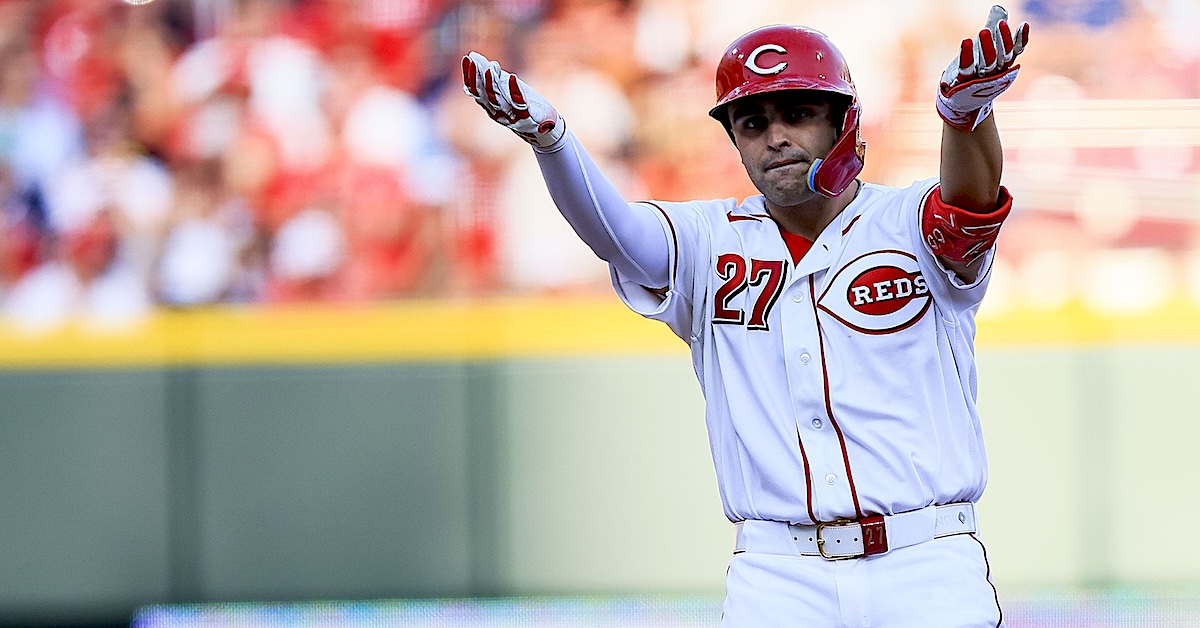
Sal Stewart made a promising showing when the Reds called him up last September, clubbing five home runs in 18 games while helping Cincinnati reach the postseason for the first time since 2020. His 2026 campaign is off to a flying start, as well. Not only did he bank NL Player of the Week honors for the season’s opening week, but his performance underscores the notion — supported by both scouting and statistical projections — that he’s leveled up significantly.
Through the Reds’ first six games, the 22-year-old first baseman has put up video-game numbers, batting .474/.615/.947 (313 wRC+) with two homers in 26 plate appearances. His hot streak began with an eventful Opening Day; while the Reds lost to the Red Sox, 3-0, it was hardly his fault. He went 3-for-4, including a pair of bases-empty doubles, one apiece off starter Garrett Crochet and reliever Garrett Whitlock, as well as a single to right field off Crochet with men on first and second. With third base coach Willie Harris wary of testing two-time Gold Glove winner Wilyer Abreu’s arm, lead runner Matt McLain was held up and ultimately stranded.
Stewart also survived a scare in the fifth inning, when a 110-mph liner off the bat of Roman Anthony hit his left wrist as he tried to backhand the ball. He was shaken up but remained in the game, and reassuringly collected two of his three hits after being drilled.
Two days later, in Cincinnati’s second game against the Red Sox, Stewart went 2-for-4 with an RBI single and 399-foot wall-scraping solo homer off Sonny Gray, and he later drew a walk in the Reds’ 6-5, 11-inning victory. He went 2-for-2 with a pair of walks and a double off reliever Jovani Morán in Sunday’s 3-2 win over Boston, and then 1-for-2 with another pair of walks in a 2-0 win over Pittsburgh on Monday. With that, Stewart became the first Red in 38 years to reach base three times in each of the team’s first four games of the season. The last to do so had been Kal Daniels in 1988, and the last Cincinnati player to start the season with even three such games was Barry Larkin in 2001. According to MLB.com’s Sarah Langs, at 22 years and 113 days old, Stewart also became the youngest player for any team to do so since at least 1900.
Stewart collected just one hit in Tuesday’s 8-3 loss to the Pirates, a solo homer off Hunter Barco, and then finally went hitless in another 8-3 loss on Wednesday afternoon. His 0-for-3 included a walk that immediately preceded Eugenio Suárez’s two-run pinch homer; the best he could manage against Paul Skenes was a 96.5-mph groundout.
We’re in small-sample season, but what’s been impressive about Stewart thus far is how hard he’s hit the ball, in line with what he did during last year’s call-up, and how selective he’s been, in contrast to that stint. I’ll get to the statistical comparisons, but first, some background.
The Reds chose Stewart out of Westminster Christian School with the 32nd pick in the 2022 draft, a compensation pick for losing Nick Castellanos in free agency. Though Stewart had committed to Vanderbilt, he signed for a $2.1 million bonus. He hit well at every stop from the Complex League on up, moving through A-level Daytona and High-A Dayton in 2023, and through Double-A Chattanooga and Triple-A Louisville in ’25. He likely would have split the 2024 season between Dayton and Chattanooga had he not suffered a freak injury during that year’s All-Star break. While wading in the ocean, he slipped and landed on a shell that severed a tendon in his right wrist, requiring season-ending surgery.
No matter. Still just 21 at the time, Stewart hit .306/.377/.473 (146 wRC+) with a 15.5% strikeout rate in 80 games at Chattanooga last year, earning a spot in the Futures Game and a promotion to Triple-A. During that run in Chattanooga, Eric Longenhagen gave Stewart a 40+ FV, praising his ability to adjust to breaking pitches and his consistent contact and power data, but expressing reservations about his ability to catch up to higher velocity and his limited athleticism. As had been the case since the start of his minor league career, he was primarily playing third base, with some time at second, as well. Longenhagen noted Stewart’s good hands and quick exchange, but also his limited range and subpar throwing, grading his fielding 30 PV/40 FV.
Stewart made short work of Louisville, batting .315/.394/.629 (152 wRC+) with 10 homers in just 38 games before being called up by the Reds. Manager Terry Francona shoehorned him into the lineup around corner infield incumbents Spencer Steer and Ke’Bryan Hayes. Though Stewart had played just two minor league games at first base to that point, the Reds slotted him there for his September 1 debut and for 11 of his 17 defensive appearances, with his other six at third. His defensive metrics in that time don’t tell us much, though Baseball America noted that his fastest throw from third base (78.4 mph) was still 7 mph below the major league average at the position (85.6 mph).
The bigger story was Stewart’s bat. He hit .255/.293/.545 (124 wRC+) in 58 plate appearances, with out-of-character walk and strikeout rates of 5.2% and 25.9% (compared to 9.3% and 15.6% at Louisville), but eye-opening Statcast metrics on his 40 batted balls: a 95.4 mph average exit velocity, 17.5% barrel rate, 52.5% hard-hit rate, and .626 expected slugging percentage. Forty batted balls is on the edge of where exit velocity starts to stabilize, and that EV matched Aaron Judge’s 2025 average, which ranked second in the majors. While Stewart’s maximum exit velocity of 112.6 mph was only on the fringe of the upper third of qualifiers, the other numbers cited above would have placed him in the 94th percentile or higher.
Upgraded to a 50-FV prospect, Stewart placed 34th on our preseason Top 100 Prospects list, with his hit tool improving from 35 PV/45 FV to 50/55, and his raw power from 50/50 to 55/55. Our prospect team noted his adjustments:
He tends to be late on fastballs and is rarely on time to pull them in the air, and we worried his contact ability would dip as he faced better velo, and that this would make his overall production more demure, especially if/when the immobile Stewart moves to first base. Though he still has a stark inside-out batted ball profile, he’s made mechanical tweaks to preempt this potential issue, and he is such an exceptional hitter in basically every other way that he is arguably as sure a thing as a bat-first prospect can be after torching the upper minors…
The prospect team further gushed about Stewart’s pitch recognition, ability to adjust his swing on the fly, and knack for making high-quality contact even when chasing pithes out of the zone. With regards to higher-velocity stuff, they added, “He’s still often late on fastballs, but not so late that he misses them altogether. He simply keeps the second baseman and right fielder busy by driving them the other way. His splits against high-velocity heaters were very favorable: In a 225-pitch sample against pitches 94 mph and above in 2025, he had a 1.042 OPS.”
Stewart has yet to pull a four-seamer or sinker in the air this year; in fact, he has pulled just one pitch of any type in the air thus far (6.3% of his batted balls), his double off a curveball from Morán.
In terms of what is showing up in the numbers, a few things stand out, including how Stewart is standing in the batter’s box. Relative to last September, he’s moved about four inches closer to the plate, widened the distance between his feet by about three inches, closed his stance by five degrees (from 16 degrees open to 11 open), with a steeper tilt to his swing (from 29 degrees to 33), and taken a more opposite-field attack direction (from two degrees to 11).
Beyond that, last year with the Reds, Stewart swung at 52.1% of pitches and chased 32.7% outside the zone. So far this year, he’s cut way back, swinging at just 41.7% of pitches overall, with a 22.8% chase rate. He’s got a ridiculous 26.9% walk rate and an 11.5% strikeout rate to show for it (seven walks and three strikeouts in 26 plate appearances), but unfortunately, the Reds haven’t done much to capitalize. Suárez batted just .190/.227/.333 while hitting fifth behind him during the first five games before coming off the bench to homer on Wednesday. Steer, who has hit sixth in five of the six games, is batting just .059/.150/.059 so far. All told, the Reds have scored just 17 runs in six games while hitting a collective .187/.298/.316 (78 wRC+), with Suárez (now .217/.250/.478 for a 100 wRC+) and Elly De La Cruz (.208/.296/.458, 111 wRC+) the only other players with at least 10 plate appearances and a wRC+ of at least 100.
The other thing that stands out about Stewart is his Statcast numbers:
| Season | BBE | EV | LA | Brl% | HH% | AVG | xBA | SLG | xSLG | wOBA | xwOBA |
|---|---|---|---|---|---|---|---|---|---|---|---|
| 2025 | 40 | 95.4 | 18.0 | 17.5% | 52.5% | .255 | .289 | .545 | .626 | .355 | .398 |
| 2026 | 16 | 95.6 | 8.9 | 25.0% | 62.5% | .474 | .448 | .947 | .935 | .640 | .618 |
| Total | 56 | 95.5 | 15.5 | 19.6% | 55.4% | .311 | .323 | .649 | .693 | .443 | .457 |
He has hit the ball even harder than last year, albeit in a smaller sample. Even setting that exit velocity aside, I don’t think there are many players running barrel and hard-hit rates or expected slugging percentages and wOBAs that high over their first 56 batted balls in the majors. If we look at his performance since September 1, 2025, he’s on leaderboards with the big boys. Here’s the xwOBA top 10 over that span:
| Player | Team | BBE | EV | EV90 | Brl% | HH% | AVG | xBA | SLG | xSLG | wOBA | xwOBA |
|---|---|---|---|---|---|---|---|---|---|---|---|---|
| Aaron Judge | NYY | 79 | 95.7 | 112.6 | 26.6% | 68.4% | .314 | .339 | .676 | .816 | .462 | .525 |
| Yordan Alvarez | HOU | 60 | 95.5 | 111.1 | 16.7% | 60.0% | .400 | .364 | .693 | .697 | .493 | .471 |
| Dominic Canzone | SEA | 51 | 94.6 | 109.3 | 23.5% | 60.8% | .358 | .335 | .672 | .732 | .459 | .467 |
| Sal Stewart | CIN | 56 | 95.5 | 108.5 | 19.6% | 55.4% | .311 | .323 | .649 | .693 | .443 | .457 |
| Shohei Ohtani | LAD | 78 | 94.7 | 109.5 | 26.9% | 55.1% | .288 | .262 | .649 | .666 | .442 | .436 |
| Ronald Acuña Jr. | ATL | 76 | 91.6 | 109.5 | 18.4% | 50.0% | .267 | .282 | .457 | .599 | .380 | .430 |
| Juan Soto | NYM | 99 | 91.0 | 107.6 | 16.2% | 46.5% | .317 | .299 | .602 | .610 | .422 | .421 |
| Francisco Lindor | NYM | 97 | 92.2 | 105 | 11.3% | 45.4% | .239 | .286 | .469 | .529 | .380 | .421 |
| Mike Trout | LAA | 61 | 94.0 | 109.1 | 23.0% | 55.7% | .245 | .258 | .500 | .586 | .381 | .414 |
| Iván Herrera | STL | 92 | 91.2 | 107.7 | 14.1% | 50.0% | .257 | .289 | .514 | .588 | .376 | .413 |
When I set out to write this article, colleague Dan Szymborski shared with me that he was starting to regret leaving Stewart out of his annual “Booms and Busts” piece, mainly because his ZiPS-driven list also included McLain, and he didn’t want to go with three different pairs of teammates. (His list of Booms already featured two Royals and two Brewers.) Szymborski did offer a comparison between Stewart’s five-year projections coming into 2025 and then into ’26. They jibe with the updated scouting reports. Here he is coming into last year:
| Year | BA | OBP | SLG | AB | R | H | 2B | 3B | HR | RBI | BB | SO | SB | OPS+ | WAR |
|---|---|---|---|---|---|---|---|---|---|---|---|---|---|---|---|
| 2026 | .234 | .315 | .360 | 397 | 54 | 93 | 18 | 1 | 10 | 49 | 45 | 84 | 8 | 83 | 0.9 |
| 2027 | .240 | .321 | .370 | 416 | 58 | 100 | 19 | 1 | 11 | 54 | 47 | 86 | 8 | 87 | 1.2 |
| 2028 | .246 | .328 | .385 | 418 | 60 | 103 | 20 | 1 | 12 | 56 | 48 | 84 | 8 | 93 | 1.6 |
| 2029 | .245 | .326 | .383 | 420 | 61 | 103 | 20 | 1 | 12 | 57 | 48 | 83 | 8 | 92 | 1.6 |
| 2030 | .252 | .333 | .399 | 421 | 62 | 106 | 21 | 1 | 13 | 58 | 49 | 81 | 7 | 98 | 1.9 |
And here’s where he stood this preseason:
| Year | BA | OBP | SLG | AB | R | H | 2B | 3B | HR | RBI | BB | SO | SB | OPS+ | WAR |
|---|---|---|---|---|---|---|---|---|---|---|---|---|---|---|---|
| 2026 | .263 | .331 | .444 | 486 | 76 | 128 | 28 | 0 | 20 | 80 | 45 | 104 | 12 | 108 | 2.4 |
| 2027 | .266 | .335 | .454 | 504 | 81 | 134 | 29 | 0 | 22 | 86 | 48 | 104 | 12 | 112 | 2.8 |
| 2028 | .269 | .339 | .466 | 517 | 85 | 139 | 30 | 0 | 24 | 90 | 51 | 103 | 11 | 116 | 3.2 |
| 2029 | .270 | .342 | .470 | 530 | 88 | 143 | 31 | 0 | 25 | 95 | 54 | 103 | 11 | 118 | 3.6 |
| 2030 | .270 | .343 | .474 | 534 | 90 | 144 | 31 | 0 | 26 | 96 | 56 | 101 | 10 | 119 | 3.7 |
“Statistically, before 2025, Stewart looked like one of those walk-heavy guys with little defensive value who would fade out in the upper minors,” wrote Szymborski in a note accompanying those projections. “But in 2025, he was more aggressive at the plate and was absolutely plastering the balls, without a commensurate increase in outs. In the space of a single year, his 2026 OPS projection in ZiPS jumped up a hundred points, and ZiPS, like most projection systems, tries to avoid recency bias like the plague.”
That’s an impressive jump. While I wouldn’t expect Stewart to maintain such a lofty perch on the Statcast leaderboards given his lack of top-end raw power, the Reds appear to have a real middle-of-the-order force for their lineup.
Brooklyn-based Jay Jaffe is a senior writer for FanGraphs, the author of The Cooperstown Casebook (Thomas Dunne Books, 2017) and the creator of the JAWS (Jaffe WAR Score) metric for Hall of Fame analysis. He founded the Futility Infielder website (2001), was a columnist for Baseball Prospectus (2005-2012) and a contributing writer for Sports Illustrated (2012-2018). He has been a recurring guest on MLB Network and a member of the BBWAA since 2011, and a Hall of Fame voter since 2021. Follow him on BlueSky @jayjaffe.bsky.social.
Jay, be honest. Was the decision to write this article at all influenced by that guy who crashed out about Stewart’s ranking during the prospects chat a couple days ago?
The first thing I thought when I saw this article title was about that person who just kept badgering BG about the fact that FanGraphs has been lower on him. Sal Stewart looks pretty good now, but I don’t want to let that person off the hook. Whoever that person was, they still suck.
Haha – i came to see if that person had commented in the article for validation. And for your last comment – agreed.
We’ll know if Jay’s next article is about the theoretical matchup between Sal Stewart and Jonah Tong.