
Skubal Becomes Ta-Richest Player in Arbitration History
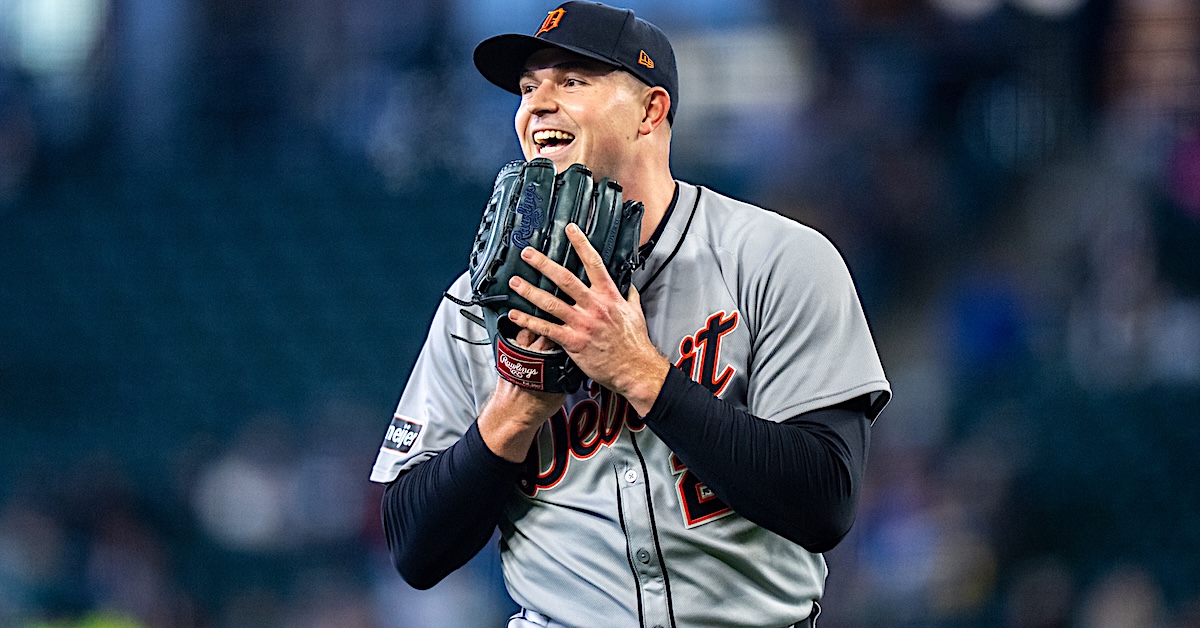
Seldom, if ever, has the baseball world waited on tenterhooks to hear the result of a salary arbitration case, but most arbitration-eligible players are not Tarik Skubal. On this point, the arbitrator seems to have agreed, granting the Tigers left-hander a record $32 million salary for his final year of team control.
Arbitration cases themselves are usually back-page news. The question is not whether a player will return to his previous team, but how much he’ll be paid. Only people who work in baseball and unrecoverable RosterResource addicts care about such things, especially because the club’s offer and the player’s request usually only differ by a small amount.
I can think of few players who need less context in this audience than Skubal. Big dude, heavy fastball, great changeup. Two-time defending AL Cy Young winner, incumbent ace of a Tigers team that’s made the playoffs two straight years. If there’s an argument that Skubal is not both the best left-handed pitcher in baseball and the best pitcher in the American League, I’m all ears, but anyone making such a case would be defending a minority position.
What makes Skubal’s case fascinating is the fact that he filed at $32 million, while the Tigers came in at $19 million.
That’s a huge gap, and by rule, the arbitrator could not split the baby (not that you could split the baby in King Solomon’s days either). There would be no meeting in the middle. Having a $13 million question mark in February is a big deal for any team, especially the Tigers, who signed Framber Valdez to a three-year, $115 million contract on Wednesday night while they were waiting for the decision to come down.
The timing of the Valdez contract launched a thousand tin foil hats. The Tigers knew they’d won the case, and therefore would have the money to sign Valdez. Or, the Tigers knew they’d lost the case, and therefore were already preparing to trade Skubal.
It doesn’t help things that Skubal’s quality and contract situation — he’s a free agent after this season — have made him a frequent target of trade rumors. Some people think (either genuinely or sarcastically) that even a contender like Detroit can’t afford to let its best player walk for nothing, and that every star produced in the heartland will eventually become a Los Angeles Dodger.
But let’s not get ahead of ourselves. The Tigers are running back a team that’s lost paper-thin division series in each of the past two years. Adding Valdez could be enough to snag a pennant in an American League without a heavy preseason favorite. If they keep Skubal, maybe he walks, but with a World Series ring on his finger. Surely no one Detroit would trade him for would help the team as much in pursuit of that goal.
The Tigers know this, so how did they expect to convince an arbitrator that Skubal was worth $13 million less than he wanted? Even knowing that teams throw rhetorical elbows in arbitration hearings — sometimes to the point of alienating their star players — that seems like a stretch.
The $32 million award is a record for a player in his last year of arbitration, but in absolute terms it’s an incremental step. Just two years ago, Skubal’s agent, Scott Boras, settled with the Yankees on a $31 million deal for Juan Soto. The year before that, Shohei Ohtani and the Angels shook hands on a $30 million deal for his last season of team control. That broke the record set in January 2020, when Mookie Betts and the Red Sox settled at $27 million.
I don’t think it’s a stretch to put Skubal in a class with Soto, Ohtani, or Betts — i.e., the class of the best players of their generation — but unlike those three, Skubal doesn’t hit.
Until Thursday, the record one-year contract for an arbitration-eligible pitcher belonged to another Cy Young-winning Tigers left-hander: David Price.
Man, that was a long time ago, I can hear you thinking. And it was. That record stood for 10 years, because almost every elite young pitcher gets a contract extension before he reaches this point.
Last season, 19 pitchers got at least one Cy Young vote. Seven (Max Fried, Carlos Rodón, Aroldis Chapman, Jacob deGrom, Yoshinobu Yamamoto, Nick Pivetta, and Zack Wheeler) were veterans who’d reached free agency already. Four others (Paul Skenes, Hunter Brown, Bryan Woo, and Andrew Abbott) had yet to amass enough service time to qualify for arbitration. Another five pitchers (Garrett Crochet, Drew Rasmussen, Cristopher Sánchez, Logan Webb, and Freddy Peralta) had already signed contract extensions that took them out of arbitration.
Given the uncertainty of a young starting pitcher’s health, and the riches on offer even in an under-market pre-arbitration extension, it’s obvious why most choose the safer path. So only three of last year’s 19 Cy Young vote-getters went into this season going through arbitration the old-fashioned way: Skubal, Trevor Rogers, and Jesús Luzardo.
Rogers and Luzardo settled, the latter for just $11 million in his final year before free agency. I think if Luzardo’s worth $11 million, you can make a case that based on his achievements, Skubal’s earned $32 million, but getting that out of an arbitrator is easier said than done.
Because Price’s record payday, all the way back in 2015, was just $19.75 million. Boras and Skubal didn’t just have to beat the record, they had to beat it by more than half. I admit I wasn’t optimistic they would; the question of what a pitcher like Skubal was worth in a final year of arbitration simply had not been asked in so long that I had a hard time imagining the record going up by that much in one hearing. Maybe Boras was making a statement, softening the ground for the arbitration scale for pitchers to move belatedly, in the hope of enriching MacKenzie Gore or Jackson Jobe in the future.
How wrong I was. Skubal had not just Boras Corp. in his corner, but MLBPA deputy executive director and lead negotiator Bruce Meyer as well, according to ESPN’s Jeff Passan.
The rules of arbitration are spelled out in the CBA under Article VI, Section E(10), which instructs the arbitration panel to use the salaries of players “not exceeding one annual service group above the Player’s annual service group” as a guide for determining an appropriate salary. So when Skenes hits arbitration next year, he’ll be awarded a salary not based on what guys like Skubal and Valdez are making, but on precedents set by other first- and second-year arbitration players.
However, that same section exempts players with five or more years of service time — e.g. Skubal — and continues with the following provision: “This shall not limit the ability of a Player or his representative, because of special accomplishment, to argue the equal relevance of salaries of Players without regard to service, and the arbitration panel shall give whatever weight to such argument as is deemed appropriate.”
In other words, the reigning back-to-back Cy Young winner could argue that if Wheeler and deGrom and Gerrit Cole were making $30-odd million a year, why couldn’t he?
The arbitration panel didn’t have to buy that case completely, it just had to find it more persuasive than the argument that Skubal should make less now than Price did back in the Paleolithic Age.
With Skubal winning his case, RosterResource’s latest estimate places the team’s payroll at around $215 million, and its competitive balance tax payroll at $244,086,251, which is a figure I would ordinarily not go to nine significant figures on before spring training. It is, however, notable that the first luxury tax threshold this year is $244 million on the dot.
If the Tigers stayed at that number, the actual tax liability would be close to nil. At just $86,251 above the threshold, they’d owe only $17,250 in tax, a trivial sum to the Ilitch family, which probably loses that much between the sofa cushions every day. It would open the Tigers up to an additional 10% repeater penalty if they went over the tax again in 2027, but if they want to avoid that, they can shed $100,000 in payroll more or less at will.
Besides, the Tigers — who had zero $30 million-a-year pitchers 24 hours ago, and now have two — are in an in-for-a-penny, in-for-a-pound situation here. Their payroll is due to go up some $60 million from 2025, and no other team in the AL Central has a projected payroll of more than $146 million. Detroit is spending twice as much on its players as the Twins, and more than what the Guardians and White Sox are paying their players put together. This team is in win-now mode, and the outcome of Skubal’s case does nothing to change that.
But the impact of this case on the league at large is quite meaningful — Meyer’s participation in the hearing is strong evidence of that. The pre-arbitration extension has taken a bit of steam out of the free agent market; my sense was that Soto was going to be the last half-billion-dollar free agent for a while.
Maybe that’s still going to be the case, but with Skubal raising the ceiling for arbitration, and setting a new precedent for what pitchers can earn, going through arbitration is going to be more attractive for players who would otherwise be thinking about settling down with the first seven-year contract offer they saw. At the very least, those extensions for homegrown players are going to get more expensive.
By shooting the moon here, Skubal made the next group of pitchers to come through behind him — Skenes, of course, but also Brown, Woo, Jacob Misiorowski, you name it — a ton of money when their time comes. Skenes in particular should be penning a truly groveling thank-you note to Skubal as soon as possible.
We talk sometimes about contracts that reset the market quite a lot, but there is no better example than Skubal’s arbitration award. When the train comes in for the big lefty, everybody rides.
Michael is a writer at FanGraphs. Previously, he was a staff writer at The Ringer and D1Baseball, and his work has appeared at Grantland, Baseball Prospectus, The Atlantic, ESPN.com, and various ill-remembered Phillies blogs. Follow him on Twitter, if you must, @MichaelBaumann.
Good for Skubal, that team offer was offensive.
I was convinced it was Slubal’s side that was crazy and Boras was an idiot and all that because that’s basically all you heard about this until today. Everyone likes to poke at a small handful of failures, but if your goal as a player is to make as much money as possible, Scott Boras is your man! He shows this time after time. Those misses are talked about a lot but they’re also rare.
Yeah, the way some people talk about him on here, you’d think he was a bumbling idiot
Way less here than most of the internet.
It’s funny, I said something similar about this in a different article (before the arb outcome was announced) and people voted my comment down.
I realize orgs have to be careful about their arb proposals (not just for their own $$ but also mindful of setting a new precedent). However, they also should be equally careful of not alienating important franchise players in the negotiation process. Especially so in a player’s walk year.
I agree teams shouldn’t alienate their best players, but if they’re going to, if they don’t plan to resign him, the walk year probably is the *best* time to so.
I’m trying to imagine working for the Tigers and attempting to make the point that Skubal isn’t that good and deserves to be paid less than Robbie Ray and Seth Lugo in 2026.
So much so that they probably thought they’d lose but it was worth a shot. The alternative would have been to offer $27m or something, and they still might lose.