Sunday Notes: DH Dilemma, Indians, Gallardo, Glasnow, HoF Managers, more

The Cleveland Indians have two sluggers on their roster. Mike Napoli and Carlos Santana each hit 34 home runs in the regular season. They did so while splitting time between the first base and designated hitter positions, which will pose a problem come the middle three games of the World Series. Unless Cleveland gets creative — and bold — one of them will be out of the lineup.

Given the importance of their bats, Terry Francona may want to find a way to make it happen. As Paul Swydan pointed out on Thursday, this was The Lowest-Scoring ALCS in History. Furthermore, the Cubs turn batted balls into outs better than anyone. It’s not easy to string together hits against best defensive team in baseball.

The Indians have scored 27 runs so far this postseason, and 15 of them have come via the long ball. Napoli and Santana have combined to hit just three of the club’s 11 home runs, but they remain the biggest power threats. There is also on-base to consider. The duo finished one-two on the team in walk rate during the regular season, and Santana’s .366 OBP was bettered only by Tyler Naquin’s .372. Napoli has eight seasons of postseason experience and is the de facto team captain.

How to get both in the lineup when the Series shifts to Wrigley Field? Read the rest of this entry »


Sunday Notes: Eaton, Liriano, Cueto, Cubs, Postseason Pressure, more

Adam Eaton had an excellent defensive season in right field for the White Sox. The 27-year-old former centerfielder had 20 Defensive Runs Saved, the third most of any outfielder. His 22.1 UZR was second to none. He gives his teammates a lot of credit for those for those numbers.

“Metrics see it as individual effort, but it’s not,” opined Eaton. “The addition of Austin Jackson early in the season really helped. When he was in the outfield with me, I had complete confidence that my back was covered. I could be more aggressive to the gap. Same thing with (JB) Shuck. His speed and defensive ability allows me to make plays I wouldn’t otherwise make.

“Same thing with assists,” added Eaton, whose arm rating ranked as best in both leagues. “I can throw the ball as well as I want to, but if the guy cutting it off doesn’t make a perfect throw on the relay, I don’t get an assist. If the catcher doesn’t make a perfect catch, and make the tag on time, I don’t get an assist. Stats can’t see that. I’m happy that I look great in the metrics, but without the guys around me, I’m just another average ballplayer.” Read the rest of this entry »


Sunday Notes: Baez, Jankowski, Hughes, Opening Day, more

Javier Baez has been burdened by strikeouts. The promising young Cub has a 38.5% k-rate and an 18.5% swinging strike rate in 309 big-league plate appearances. There were a plethora of whiffs in the minors as well, so his contact issues extend beyond the expected MLB learning curve.

Baez has plus power, especially for a middle infielder. He hit 37 home runs between high-A and Double-A in 2013, and a year later he went deep 23 times in 434 Triple-A at bats.

Reaching the bleachers isn’t his primary goal.

“I’m not trying to hit for power,” Baez told me this spring. “I’m just trying to make contact, and if it goes over the fence, fine. I’m trying to hit the ball hard.”

Hitting it at all has been a challenge, and the 23-year-old former first-round pick is aware of his deficiencies. Ironing them out is the hurdle. In his eyes, mechanics aren’t the problem. Read the rest of this entry »


Kyle Schwarber on Handling High Heaters

Kyle Schwarber is a student of hitting. Even so, there are limits to how much he wants to learn. The Chicago Cubs slugger crunches video, but he draws the line at spin rates.

Schwarber understands the concept. He knows that four-seam fastballs with a high spin rate have carry as opposed to sink. He knows they are an invitation to pop up when located up and over the zone. Well and fine. An individual pitcher’s ability to defy gravitational pull isn’t something he wants to delve into from a StatCast perspective. Once he’s in the batter’s box, it’s all about seeing the ball and reacting accordingly.

On a recent visit to the Cubs spring training facility, I asked Schwarber the following question: As a hitter, how aware are you of an opposing pitcher’s spin rate?

———

Schwarber on spin rate and high fastballs: “Hitting-wise, knowing a guy’s spin rate would just be adding extra information to what I already have. It would probably be kind of a mind-crunch for me.

“When you’re in the box, you only have a split second. You don’t have time to think, ‘This guy’s ball is going to move four inches, because his average spin rate is this.’ There might be hitters who would disagree, but my personal philosophy is to crunch video and go from there. Read the rest of this entry »


Sunday Notes: Murton’s Return, Archer, Angels, Twins, more

Matt Murton had a lot of success in NPB after fading out in MLB. In six seasons with the Hanshin Tigers, he slashed .310/.352/.437. Now, at age 34, he’s back stateside, trying to win a job with the Chicago Cubs.

Murton’s path to Japan and back is a curious one. A first-round pick by the Red Sox Sox in 2003, he went to the Cubs a year later in the Nomar Garciaparra deal. From 2005-2007, he hit a solid .303/.370/.462. From 2008-2009, he appeared in a grand total of 57 games with three organizations. In 2010, he changed continents.

“It was either fight for a spot in a situation where I was out of options, or take something that was more of a guarantee,” Murton said of his decision. “I was 28 years old, and as crazy as this might sound, I came to the realization that this is what I do for a living. I have a family to provide for, and it was a good opportunity to do that.”

Murton has mixed feelings on his initial big-league tenure. He did his best and feels he was reasonably successful. He also feels he could have done a better job. He has a lone regret. Read the rest of this entry »


David Ross: Future Big-League Manager

David Ross would like to manage in the big leagues some day. According to several of his peers, he’ll be a worthy candidate. The 38-year-old Chicago Cubs catcher was by far the most popular choice when I asked a cross section of uniformed personnel: Which Current Players Are Future Managers?

What will Ross’s managerial style be, when and if he’s given an opportunity to lead a big-league team? In a followup to yesterday’s column, Ross shared several of his philosophies.

———

Ross on what his managerial style would be: “I’ve gotten to play for some great managers. Bobby Cox, Dusty Baker, John Farrell, Joe Maddon. Jim Tracy was phenomenal. Terry Francona. Bruce Bochy. A lot of great ones.

“One thing I see from the best managers is that they let the players be the players. They have a rule or two, but as long as [the players] work hard and do the right thing, they mostly let them do their thing. They let them be men. The manager manages the game on the field and lets the veterans on the team police the clubhouse. And if they do need to talk to someone, they do it behind closed doors. They don’t show them up.

Read the rest of this entry »


Evaluating the 2016 Prospects: Chicago Cubs

Other clubs: Braves, Diamondbacks, Orioles, Red Sox.

Cubs fans had to be thrilled with how the 2015 season played out, as many of the top prospects in their system decided they didn’t need an adjustment period and sprinted out of the gates. Looking at the number of young players contributing to the playoff run, you could assume the minor league pipeline would take a step back after graduating so many high-level players. Fortunately for Cubs fans, there is still a wealth of both high-floor and high-upside talent under team control.

There is a strong mix of pitching and hitting assets. Most of the top offensive reinforcements will be knocking on the big league door within a year or two, while the higher-ceiling pitchers may take another year to show up. The overall quantity of guys who were in the conversation for this list was itself an impressive compliment to the Cubs’ scouting and player development efforts.

For the hitters, I’m a little higher on Billy McKinney and Dan Vogelbach and lower on Willson Contreras and Jeimer Candelario than you might see elsewhere. None of them grade out poorly in my opinion, but it may be a different ranking than even some Cubs officials would prefer. Pitchers Dylan Cease and Jake Stinnett are ranked favorably, especially in comparison to CJ Edwards and Pierce Johnson for reasons that are explained in each respective player’s report.

Read the rest of this entry »


Sunday Notes: Fife, Guerrieri, Braves, Brewers, Twins, more

A plethora of under-the-radar transactions take place every offseason. One you might have missed happened last week when Stephen Fife signed with the Chicago Cubs. The 29-year-old right-hander, fully recovered from Tommy John surgery, was inked to a minor-league deal that includes a spring training invite to big-league camp.

If you’re not a Dodgers diehard, you probably aren’t aware that Fife was one of six Los Angeles pitchers to start 10-or-more games for the 2013 NL West champions. He finished that year 4-4 with a 3.86 ERA, but was unceremoniously left off the postseason roster. Come playoff time, he was told he wasn’t welcome in the dugout, although he could come to the games and watch from the stands.

Originally in the Red Sox organization, Fife came to LA as part of a three-team trade in July 2011. According to Fife, he turned a corner the following season with the help of Josh Bard. The newly-named Dodgers bullpen coach was one of the club’s catchers that season, and he told Fife that adjustments were in order. Read the rest of this entry »


The Revitalization of Trevor Cahill

We had a pretty good idea of who Trevor Cahill was: owner of a career 4.13/4.27 ERA/FIP, back-end starter, ground ball pitcher. He lost his rotation spot while pitching for the Diamondbacks in 2014. During 2015, he was released by the Braves after a failed transition to the bullpen, and, after opting-out of a minor league contract with the Dodgers, there was the possibility that this might be the end of any meaningful career for him. Still only 27 years old, he wouldn’t have been the first fringy starter to flame out of the league.

In late August, however, he signed a minor league deal with the Cubs, and two weeks later they called him up to the major league bullpen. Something pretty drastic had happened over the course of his time in the bullpens of the three teams he was employed by during 2015, and it all seemed to culminate in his 17 September and October innings for Chicago: he posted a stellar 27% K-BB% during that stretch, returning successfully to his ground ball ways (61.8%) and a 2.12/3.13 ERA/FIP.

Those 17 innings were, of course, a tiny sample size. But in those innings, as well as his successful work during the playoffs, we glimpsed who the new Cahill might be, and it was the pitcher the Cubs think they just signed to a low-risk, one-year, $4.25 million deal last week.

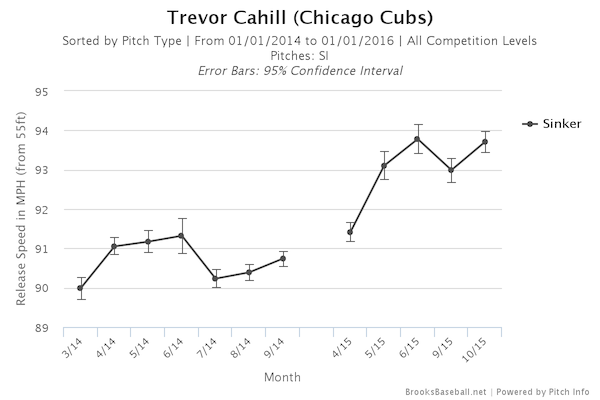
First, we saw a big velocity jump from Cahill in 2015. He almost exclusively throws a sinker as his main fastball, and he increased its velocity in 2015 by about two and a half mph from its highest point in 2014. Take a velocity look at a chart for his sinker for the months of 2014 and 2015, courtesy of Brooks Baseball:

Cahill_Sinker_Velo

Read the rest of this entry »


FG on Fox: The Historic Significance of the 2016 Cubs Lineup

The Chicago Cubs won 97 games last season, went to the National League Championship Series, and had one of the top prospects in baseball debut with outstanding success. Many teams might look at such a season, nod their heads with approval, and try to simply maintain a semblance of that high level of achievement when planning and making moves for the following season. The current version of the Cubs, however, are in win-everything mode, and they seem desperate to improve upon a 97-win season. With an aggressive Theo Epstein, deep-pocketed owners, and a clear window to make a run at a long-absent title, the Cubs have already made some of the biggest acquisitions of the 2015 offseason.

The biggest, of course, is Jason Heyward, a top 15 player by Wins Above Replacement during the 2015 season. With his eight-year, $184 million contract, he joins Anthony Rizzo and Kris Bryant as the young core of a team that could challenge for World Series titles for the foreseeable future. It’s easy to proclaim the Cubs as favorites to win one of the strongest divisions in baseball after this move – they did, in essence, turn one of their rivals’ best players into one of their own – but that idea is cemented by the fact that they now have three of the best 20 position players from last season by WAR. Take a look at the top 20 position players by WAR, with each player’s 2016 team:

Top 20 Position Players by WAR, 2015
2015 Rank Name Current Team 2015 WAR
1 Bryce Harper Nationals 9.5
2 Mike Trout Angels 9.0
3 Josh Donaldson Blue Jays 8.7
4 Paul Goldschmidt Diamondbacks 7.4
5 Joey Votto Reds 7.4
6 Manny Machado Orioles 6.8
7 Yoenis Cespedes Free Agent 6.7
8 A.J. Pollock Diamondbacks 6.6
9 Lorenzo Cain Royals 6.6
10 Kris Bryant Cubs 6.5
11 Jason Heyward Cubs 6.0
12 Andrew McCutchen Pirates 5.8
13 Buster Posey Giants 5.7
14 Chris Davis Free Agent 5.6
15 Kevin Kiermaier Rays 5.5
16 Anthony Rizzo Cubs 5.5
17 Matt Carpenter Cardinals 5.2
18 Jason Kipnis Indians 5.2
19 Curtis Granderson Mets 5.1
20 J.D. Martinez Tigers 5.0

The Cubs head into next season with three out of 20 of this past season’s best players, and that’s the kind of statement that forces everyone to sit up and take serious notice. Having two position players of this caliber is rare enough for a team in a given year; having three is a foundation on which dynasties are sometimes built.

If we assume that all three players will stay healthy and produce at around the same level next year, each will be in the top 20 or better for position players (per Steamer projections on FanGraphs, Rizzo, Bryant, and Heyward are all projected to be top 10 players, in fact). This got me thinking: what is the track record of teams that have this level of talent in their lineup? Have they accounted for a disproportionate number of World Series victories, even if we don’t take into account the strength of their respective pitching staffs?

Read the rest on Fox Sports.