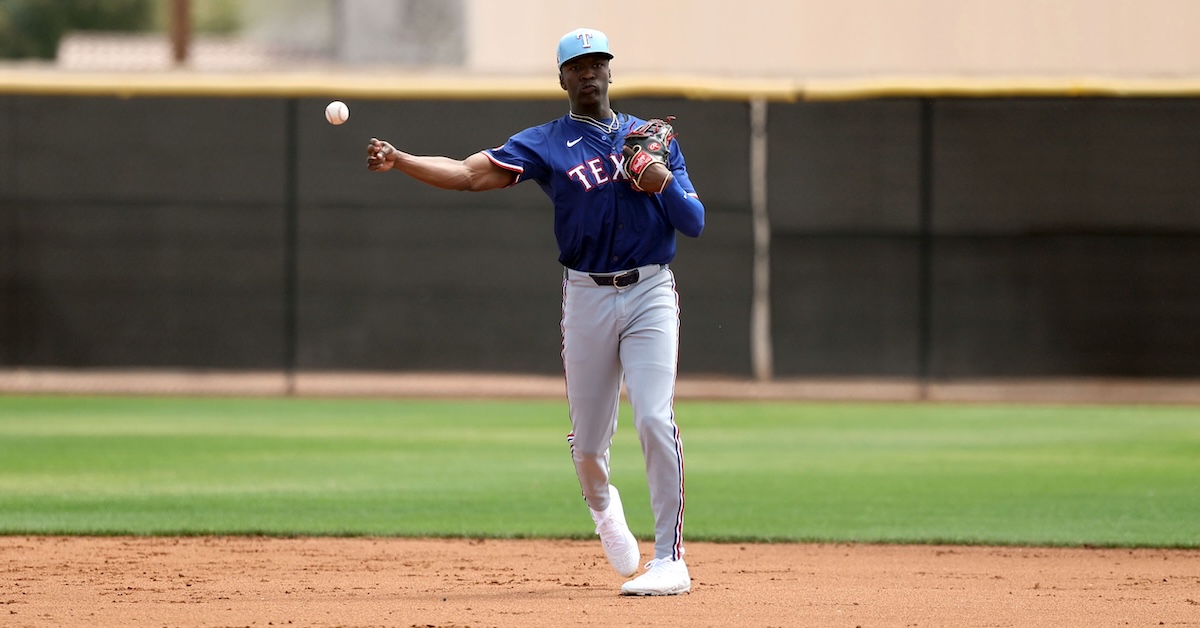
Texas Rangers Top 38 Propsects

Sebastian Walcott

Below is an analysis of the prospects in the farm system of the Texas Rangers. Scouting reports were compiled with information provided by industry sources as well as my own observations. This is the sixth year we’re delineating between two anticipated relief roles, the abbreviations for which you’ll see in the “position” column below: MIRP for multi-inning relief pitchers, and SIRP for single-inning relief pitchers. The ETAs listed generally correspond to the year a player has to be added to the 40-man roster to avoid being made eligible for the Rule 5 draft. Manual adjustments are made where they seem appropriate, but we use that as a rule of thumb.

A quick overview of what FV (Future Value) means can be found here. A much deeper overview can be found here.

All of the ranked prospects below also appear on The Board, a resource the site offers featuring sortable scouting information for every organization. It has more details (and updated TrackMan data from various sources) than this article and integrates every team’s list so readers can compare prospects across farm systems. It can be found here.

Rangers Top Prospects
Rk Name Age Highest Level Position ETA FV
1 Sebastian Walcott 20.1 AA SS 2028 55
2 Yolfran Castillo 19.2 A SS 2030 50
3 Caden Scarborough 21.0 A+ SP 2028 50
4 David Davalillo 23.6 AA SP 2026 50
5 Winston Santos 24.0 AAA SP 2026 50
6 Jose Corniell 22.8 MLB SP 2026 45
7 Paxton Kling 22.9 A+ CF 2027 45
8 Josh Owens 19.3 A TWP 2031 40+
9 Cameron Cauley 23.2 AAA SS 2026 40+
10 Seong-Jun Kim 18.9 R TWP 2031 40+
11 Paulino Santana 19.4 A RF 2030 40+
12 Leandro Lopez 23.8 AA SP 2027 40+
13 Marc Church 25.0 MLB SIRP 2026 40+
14 Ismael Agreda 22.5 A+ MIRP 2028 40
15 AJ Russell 21.8 A SIRP 2029 40
16 Dylan Dreiling 23.0 AA LF 2027 40
17 Malcolm Moore 22.7 A+ C 2027 40
18 Emiliano Teodo 25.2 AAA SIRP 2026 40
19 Izack Tiger 25.2 A+ SIRP 2027 40
20 Enyel Lopez 20.6 A SIRP 2031 40
21 Josh Stephan 24.4 AAA SP 2026 40
22 Carter Baumler 22.7 MLB SP 2025 40
23 Gavin Collyer 24.9 AAA SIRP 2026 40
24 Elian Rosario 17.3 R RF 2032 40
25 Aidan Curry 23.8 A+ MIRP 2027 40
26 Dalton Pence 23.6 A+ SIRP 2028 35+
27 Anthony Gutierrez 21.4 A+ CF 2028 35+
28 Elorky Rodriguez 18.3 R LF 2031 35+
29 Jacob Johnson 19.9 R SP 2030 35+
30 Ryan Lobus 25.6 AA SIRP 2026 35+
31 Enrique Segura 21.3 A+ MIRP 2028 35+
32 Jesus Lafalaise 21.2 A SIRP 2029 35+
33 Wilian Bormie 23.1 AA SIRP 2028 35+
34 Josh Trentadue 24.2 AA MIRP 2027 35+
35 Keith Jones II 24.0 AA RF 2027 35+
36 Robby Ahlstrom 26.8 AAA SIRP 2026 35+
37 Jack Wheeler 19.8 R 3B 2031 35+
38 Paul Bonzagni 24.0 A+ MIRP 2027 35+
Reading Options
Detail Level
Data Only
Full
Position Filter
All

55 FV Prospects

Signed: International Signing Period, 2023 from Bahamas (TEX)
Age 20.1 Height 6′ 4″ Weight 195 Bat / Thr R / R FV 55
Tool Grades (Present/Future)
Hit Raw Power Game Power Run Fielding Throw
30/45 55/70 45/60 50/50 40/50 60

Walcott has been one of the toolsiest and most projectable players in the game from practically the moment he signed as part of the 2023 international class. Slim, high-waisted, and with huge bat speed, he has developed above-average raw power even as he’s still a teenager with tons of development in front of him yet. He was an above-average hitter as a 19-year-old in the Texas League last year, where he hit 13 dingers and posted solid walk and strikeout rates. He’ll miss most or all of the 2026 season recovering from surgery to repair a torn UCL — the Rangers are hoping for an August return — but even factoring that in, his blend of present production and tantalizing physicality gives him one of the highest ceilings in the minors.

At the plate, it doesn’t take long to identify both Walcott’s upside and the work ahead to reach it. He’s the kind of player who even casual fans can watch and go, “Whoa, that guy takes a mean cut!” He swings hard, with loft, and has the bat speed to hit pitches wherever they wind up. But that doesn’t mean he always does. The effort in his swing has him behind fastballs sometimes, the way he pulls off the plate limits his ability to drive pitches on the outer half, and he doesn’t track the ball real well, which led to a big whiff rate on spin last year. The approach is also immature; in particular, he has a frustrating tendency to let too many good pitches pass him by. He has the physical talent to hit, and has shown an ability to lace pitches from his letters to his shoestops, but the range of outcomes on his hit tool is pretty large.

The other big question is where he ultimately fits on defense. So far, Walcott has retained enough mobility to at least continue developing at shortstop. But, partially due to his lever length, he isn’t the cleanest operator out there. He can do freaky things, like uncork plus throws from all manner of angles and stretch for balls in the hole in a way few fielders can. But he can also get tangled, some of his throws are pretty far off line, and it’s fair to wonder if the future strength gains we’re all anticipating make him a better fit at third anyway. Texas must be thinking along that line, because he started working at third base in Frisco last season.

You Aren't a FanGraphs Member
It looks like you aren't yet a FanGraphs Member (or aren't logged in). We aren't mad, just disappointed.
We get it. You want to read this article. But before we let you get back to it, we'd like to point out a few of the good reasons why you should become a Member.
1. Ad Free viewing! We won't bug you with this ad, or any other.
2. Unlimited articles! Non-Members only get to read 10 free articles a month. Members never get cut off.
3. Dark mode and Classic mode!
4. Custom player page dashboards! Choose the player cards you want, in the order you want them.
5. One-click data exports! Export our projections and leaderboards for your personal projects.
6. Remove the photos on the home page! (Honestly, this doesn't sound so great to us, but some people wanted it, and we like to give our Members what they want.)
7. Even more Steamer projections! We have handedness, percentile, and context neutral projections available for Members only.
8. Get FanGraphs Walk-Off, a customized year end review! Find out exactly how you used FanGraphs this year, and how that compares to other Members. Don't be a victim of FOMO.
9. A weekly mailbag column, exclusively for Members.
10. Help support FanGraphs and our entire staff! Our Members provide us with critical resources to improve the site and deliver new features!
We hope you'll consider a Membership today, for yourself or as a gift! And we realize this has been an awfully long sales pitch, so we've also removed all the other ads in this article. We didn't want to overdo it.

Even as Walcott has moved quickly through the minors and produced along the way, there are some evaluators who have pushed back on him as an elite talent. There are fair reasons: He swings through a lot of fastballs, he isn’t an especially instinctual player, and we’re still waiting on a lot of that immense physical projection. All of this was true before the UCL injury, too. Here, we still love him and see huge upside, but between that feedback and the injury, we’re cooling our forecast a degree or two.

50 FV Prospects

Signed: International Signing Period, 2024 from Dominican Republic (TEX)
Age 19.2 Height 6′ 3″ Weight 190 Bat / Thr R / R FV 50
Tool Grades (Present/Future)
Hit Raw Power Game Power Run Fielding Throw
25/55 40/55 20/50 55/55 40/50 55

Castillo is the latest in a long line of young, athletic, ultra-projectable middle-of-the-diamond players who the Rangers have signed out of Latin America. Like so many other such signees down through the years, Castillo is loose and fast with a tapered frame, the kind that effortlessly generates notable power and speed while teasing the possibility he could develop more of both. And as has been the case so many times before, things look good under the lights too, as both his actions in the field and mechanics at the plate check most of the boxes you want to see in a toolsy ballplayer.

Castillo has the bat speed and looseness in his swing to project an above-average hit tool. He’s not there yet, in part because there’s a big gap between his hardest hit balls and how often he squares one up, and also because the way he pulls off the plate now leaves him a little vulnerable on the outer half. But his 81% contact rate last year was quite good and the aforementioned max exits indicate the kind of bat speed that lets us project 55s on both the future bat and power. The way he rips his wrists through the ball to reach pitches upstairs is special, and the sort of trait that makes us comfortable projecting big on a guy whose production has been just so-so up to this point.

Castillo also projects as a shortstop and could be a pretty good one. He’s an above-average runner with good hands and clean actions. He isn’t a flawless defender, as like many players his age, the internal clock and reliability components are still a work in progress. But he looks like he’ll stay where he is, as he’s likely to remain spry enough for the job even if he grows into a good bit more strength.

There is a clash between the scouting and the narrative here. For as good as Texas is at unearthing this type of player, the club’s track record of molding all that talent into productive big leaguers hasn’t been particularly robust. We’re ignoring that in this projection. We’re here to evaluate Castillo, not Texas’ history of scouting and developing Latin American talent, and it’s not really fair for the shadows of Leody Taveras and Anthony Gutierrez to cloud the picture. But while the Rangers themselves should be excited about their man, it’s fair for Rangers fans to want to see a little less projection and a little more proof in the pudding before fully sharing that enthusiasm. For us, though, Castillo projects as an everyday player with star potential, and that’s enough to crack our Top 100.

Drafted: 6th Round, 2023 from Harmony HS (FL) (TEX)
Age 21.0 Height 6′ 5″ Weight 180 Bat / Thr R / R FV 50
Tool Grades (Present/Future)
Fastball Slider Changeup Command Sits/Tops
50/60 50/60 40/50 30/45 93-96 / 97

Scarborough was one of the more projectable high school pitchers in the 2023 draft at a gangly 6-foot-5, and was signed away from a Dallas Baptist for $515,000. He struggled badly with walks during his very limited 2024 pro debut, but then flipped the script in 2025 as he worked 88 innings (mostly at Low-A, with a late promotion tucked in) and walked just 21 guys. He carried a 2.45 ERA on the season and didn’t allow a single earned run in three starts at High-A Hub City after he was promoted.

Scarborough’s command of his fastball is particularly impressive, and is a necessary component of his success as a starter. He’s bringing nearly six-and-a-half feet of arms and legs down the mound, with enough extension to add a tick of perceived velo to his 93-96 mph fare, and his low arm slot creates upshot angle that facilitates elevated swing and miss. When he’s locating to the upper arm-side quadrant, his fastball has pretty nasty rise/run life; in the rest of the zone, Scarborough’s heater is pretty hittable, but he successfully peppered that optimal area of the zone throughout the 2025 season.

His breaking ball is an 80-84 mph sweeper with plus horizontal action. His command of the pitch isn’t as crisp, though it’s a very nasty in-zone weapon against righties, who Scarborough’s sweeper often makes flinch and freeze. His slider generated plus-plus miss in 2025 and spins at around 2,800 rpm on average. Though Scarborough only threw a few dozen changeups throughout last season, he has feel for killing spin, and his loose, whippy arm action allows for projection on the pitch. He isn’t higher on the Top 100 because we want to see how his command and velo play when his workload isn’t as manicured as it was in 2025, when he was working roughly four innings per start. His delivery does have a bit of violence, and at times he looks flat-footed and his arm stroke is late. None of that mattered from a strike-throwing standpoint in 2025, though we don’t consider Scarborough to be totally out of the relief risk woods yet. He’s still a great prospect who was an emphatic arrow up dev success within two years of being drafted. He’s building up in extended after undergoing surgery in February to remove a melanoma.

Signed: International Signing Period, 2022 from Venezuela (TEX)
Age 23.6 Height 6′ 1″ Weight 190 Bat / Thr R / R FV 50
Tool Grades (Present/Future)
Fastball Slider Curveball Splitter Command Sits/Tops
45/45 45/55 55/60 70/70 40/50 92-95 / 96

Davalillo wasn’t all that highly regarded in the international market and didn’t sign until he was 19. He had a $30,000 deal in place with the Mets that was voided late and pushed him to Texas for an even lower bonus. The Rangers appear to have found a bargain, as Davalillo’s blend of control and quality secondaries have propelled him through the system quickly. He had success at Double-A last season — 2.73 ERA, 3.43 FIP, and gorgeous peripherals in 56 innings spread across 12 appearances — and is in position to contend for starts this summer.

Davalillo is a good athlete. He’s loose and able to repeat a somewhat busy delivery, a rock-and-fire with a high leg kick and powerful stride down the mound, but without the big head whack and heel grind that often accompanies this level of effort. His arm stroke is loose and he’s able to maintain arm speed on everything, which helps an already great split play like a plus-plus out pitch.

Davalillo has a deep mix and needs to, because his fastballs play best in a complementary role. He’ll touch 96 with both but sits in the low 90s, and the shape isn’t anything special. He’s reliably in the zone with them, which helps set up all the secondaries that do miss bats. In addition to the aforementioned split, he’ll flash an above-average slider, steal strikes with a sharp curve, and he’ll also mix in an occasional cutter. Unpredictability is his friend. Cutter aside, his usage of the rest of the mix was balanced, between 14-26% per Trackman. Perhaps there’s room to use the split a little more — his whiff and chase rates were top of the scale — at the expense of the sinker, but by and large, the varied attack seems to suit him.

There are a couple of elements in Davalillo’s game that keep us from really going nuts. He’s a control-over-command guy, and his slightly open stride limits his deception. Between that and about average arm strength, there’s a ceiling here. The floor is pretty high, though. Davalillo is relatively stretched out, has been mostly healthy as a pro, and has a deep mix that should let him turn over lineups a couple times. He has the look of a good no. 4 starter.

Signed: July 2nd Period, 2019 from Dominican Republic (TEX)
Age 24.0 Height 6′ 0″ Weight 180 Bat / Thr R / R FV 50
Tool Grades (Present/Future)
Fastball Slider Changeup Command Sits/Tops
55/55 45/55 55/55 40/50 94-97 / 99

Despite good size and plus athleticism, Santos was just a $10,000 signee in the 2019 international class. Even with plus arm strength, he’s risen unevenly through Texas’ system, amidst the pandemic and an extended search for a viable breaking ball. He’d found one by the spring of 2024, and with a much-improved slider in tow, he dominated High-A that summer. He then looked like a potential mid-rotation guy at times in the spring of 2025, but missed most of last year with a stress reaction in his back. He returned in time for the Fall League, where his velo was intact and he struck out more than a batter per inning.

Santos has an enviable blend of velocity, changeup quality, and athleticism. He comfortably sits in the mid-90s with a little tail and can bump the heater up to 99 without much obvious exertion. It doesn’t have great shape, and perhaps he should throw it a little less. He has alternatives, as his slider has taken big strides since his days as a raw-but-projectable righty, and it now projects as an above-average offering, as does his change.

Last year, hitters whiffed a bunch but tended to hit Santos hard when they did make contact. He can be loose within the zone — his delivery is smooth, easy, and clean with the exception of a moderate head whack — and he doesn’t consistently execute his secondaries. I’m optimistic those things will get better. After all, Santos is a good athlete, and he’s shown an aptitude for improvement throughout his minor league career. And even if he does prove a little too hittable in the rotation, the arm strength and power arsenal should play toward the back of a big league bullpen. He was a late addition to our Top 100 — I liked him a bit more than Eric if y’all want to make fun of one of us later on — and he projects as a no. 4 with upside for more if his execution takes a big step forward with continued reps.

45 FV Prospects

6. Jose Corniell, SP

Signed: July 2nd Period, 2019 from Dominican Republic (SEA)
Age 22.8 Height 6′ 3″ Weight 190 Bat / Thr R / R FV 45
Tool Grades (Present/Future)
Fastball Curveball Changeup Cutter Command Sits/Tops
50/55 55/55 45/50 40/45 40/55 94-97 / 99

Corniell was once a Mariners pitching prospect, an expensive pre-pandemic J2 signee who was shipped to Texas in a deal for Rafael Montero. With the Rangers, Corniell progressed slowly and didn’t break out until 2023, when he posted a sub-3.00 ERA across both A-ball levels and won the organization’s Minor League Pitcher of the Year award. Elbow trouble the following spring led to Tommy John surgery, which kept him out until last summer.

Upon his return, Corniell was throwing gas. He mostly sat in the low 90s and touched higher back in 2023, but he lived at 94-97 and bumped 99 in 2025. He did so with a corresponding uptick in the sharpness of his breaking ball, an 11-5 offering that looks like a curve or a slider depending on how hard he throws it, anywhere from the upper 70s to the mid-80s. He’s also got an average sinking change and a fringy cutter, the latter of which has too much velo separation off the fastball for him to lean on it. As has long been part of his profile, Corniell threw strikes last year as well, which is no sure thing for a guy throwing harder or returning from TJ, much less both. All of that earned him his first big league call-up last September.

If you could bottle Corniell’s stuff from last summer and spread it across 160 innings, you could justify a 50 FV here. I was tempted to do it anyway, and were I scouting for a club, with the liberty to get aggressive and to think more about talent and less about value, I probably would have. There are reasons to stay cautious for now, though. First, Corniell did most of his work in short stints: He reached the fifth just twice and never fired more than 68 pitches. It’s possible, likely even, that he’ll need to sit lower over the course of longer outings and a longer season. For that reason, the topline grades may look a little conservative for someone who can hit 99. He’s also primarily working to one side of the plate. His delivery is fairly clean, but he opens a little early and there’s a pronounced glove-side lean to his locations. I wouldn’t be surprised to see him pepper the other side more as he matures, but as is, it’s a backend starter’s mix of locations and stuff.

7. Paxton Kling, CF

Drafted: null Round, 2025 from Penn State (TEX)
Age 22.9 Height 6′ 0″ Weight 210 Bat / Thr R / R FV 45
Tool Grades (Present/Future)
Hit Raw Power Game Power Run Fielding Throw
30/50 45/55 30/50 60/60 45/50 45

Kling started his college career at LSU and was a regular presence on the club’s championship team in 2023. After a more muted sophomore year, he transferred to Penn State for his junior campaign, and his big year there propelled him to a seventh-round selection and a $375,000 bonus, on the high end for a player in his draft orbit.

Kling is a plus athlete and runner with a strong lower half and projectable power. At the plate, his swing is simple but effective. He has a small stride, really more of a tap, and a short, late load up. His swing is steep but malleable, and he has above-average bat speed. It’s a connected swing, and the way he fires his hips and is able to incorporate his lower half is a sign of how he’s able to generate decent pop even though he’s not a huge guy. Kling has a little vulnerability to spin low and away, as the way his swing works makes it hard for him to adjust to that particular spot. His pitch recognition looks fine, though, and he’s able to manipulate the bat head and direct the barrel just about everywhere else.

Defensively, Kling looks like an average center fielder on tape. His reads and routes aren’t perfect, but they’re pretty good. He’s able to leave his feet, and he can make plays by the wall. His arm isn’t great, but it’s not going to turn into a track meet out there, either. Were I scouting for a team, I’d put an everyday regular grade on him. For us, with a scant pro track record, all at the lower levels, he belongs here. He’s a candidate to move up quickly if he hits this spring, and is a dark horse Top 100 candidate for next year.

40+ FV Prospects

8. Josh Owens, TWP

Drafted: 3rd Round, 2025 from Providence Academy HS (TN) (TEX)
Age 19.3 Height 6′ 3″ Weight 185 Bat / Thr L / R FV 40+
Tool Grades (Present/Future)
Hit Raw Power Game Power Run Fielding Throw
20/40 40/55 25/55 50/50 30/45 55
Fastball Slider Command Sits/Tops
45/55 40/55 30/40 92-94 / 97

The Rangers paid Owens $1.10 million to forgo his commitment to Georgia Southern. He’s a sinewy and athletic two-way player with a long way to go but real upside on both sides of the ball.

Owens oozes projectability, perhaps especially at the plate, where he has a pretty and lofted swing. It’s a manipulable bat path too, and there’s exciting power projection here given his looseness and athleticism. He’s rawer on some of the finer points of hitting: His pitch recognition and tracking skills in particular aren’t great and he had a rough ride during his Low-A cameo last season. Defensively, he’s speedy enough to cover short, but is again clearly not a finished product. His throwing stroke is odd, elongated, and for a guy with experience on the bump, not particularly natural looking. The speed of the game also caught up to him during the Rangers’ Spring Breakout Game, where his internal clock lagged behind much older competitors.

On the mound, Owens is similarly raw but enticing. He worked almost exclusively with his sinker and slider last year. Out of a low, nearly sidearm slot, he generates above-average tail and touches 97. His slider is a little underbaked and doesn’t get quite the sweep you’d expect from his slot, but his raw feel for spin is decent, and this is a pitch to project on. While his delivery has a gangly look, he’s under control and the hesitation in his motion, the one that makes his throws from short look odd and unnatural, might have a deceptive effect off the mound. Were he solely a pitching prospect, he’d be pretty interesting.

Generally, two-way prospects are quite a bit better on one side of the ball than the other in a way that lets evaluators feel comfortable projecting the guy as either a pitcher or a hitter. Somehow, the Rangers have stumbled into two teenagers where that’s not the case just yet. With Owens, you have a pitcher who already has viable arm strength and some deception, with plenty of paths forward on the secondaries, though not so much arm talent to think he’s a budding ace. He’s not “safe” exactly, but there are a lot of ways this could work. At the plate, there’s big upside if pro instruction and reps sharpen up his approach and skills at the plate as he grows into his considerable tools, but there’s also a non-zero chance that he’s not much of a hitter. For now, it makes sense to keep plugging away on both sides. Ultimately, Owens has a case as the highest-variance prospect in all the minors, and he’s a player of considerable interest to catch on the complex this season.

Drafted: 3rd Round, 2021 from Barbers Hill HS (TX) (TEX)
Age 23.2 Height 5′ 10″ Weight 170 Bat / Thr R / R FV 40+
Tool Grades (Present/Future)
Hit Raw Power Game Power Run Fielding Throw
35/40 40/50 35/45 70/70 55/60 50

Anyone tempted to write players off after a rough pro debut should at least keep Cauley’s career trajectory in mind. He didn’t hit a lick on the complex after he was drafted in 2021, followed that up with a 79 wRC+ at Low-A in 2022, and posted a 32.4% strikeout rate in his second spin through the level in 2023. Across those three years, he homered just 14 times. The production has caught up to the tools since, and he hit 15 bombs at Double-A last year with a 112 wRC+ and a career-low 24.7% strikeout rate. Now 23, he’s at Round Rock and on the cusp of the big leagues.

Cauley is calm in the box, with a small hand load and barely more than a toe tap. He has average bat speed and a slightly lofted bat path. It’s a much shorter swing than back when he was younger, and while he still isn’t a great contact hitter (70% contact last year), it’s miles better these days, and he’s actually able to pull the ball, which wasn’t always the case.

The contact/power blend is probably a little light for everyday duty, but Cauley’s defensive chops give him a high floor as a utility player. He compensates for a fair arm with a very quick release and online, if at times dirty, throws at short. He’s not going to make too many plays in the six-hole, but his instincts are solid and his hands reliable, and he should take care of everything else. For a guy who hasn’t spent a ton of time in center, he also looks comfortable there, with advanced reads and routes for his experience level and the wheels to handle the job. Contenders generally have a guy like this who can flex in and out of the lineup and around the diamond, and Cauley projects to have a long career doing just that.

10. Seong-Jun Kim, TWP

Signed: International Signing Period, 2025 from Korea (TEX)
Age 18.9 Height 6′ 2″ Weight 185 Bat / Thr R / R FV 40+
Tool Grades (Present/Future)
Hit Raw Power Game Power Run Fielding Throw
20/45 30/50 20/45 50/50 35/50 70
Fastball Slider Changeup Command Sits/Tops
30/50 45/55 30/50 20/50 91-93 / 96

After their unsuccessful pursuit of Roki Sasaki, the Rangers redirected some of their leftover IFA money to Kim. The two-way talent from South Korea signed last May and played a few games toward the end of the DSL season. He was in Arizona this spring and should make his stateside debut in the ACL.

While not especially physical, Kim is a smooth athlete with excellent body control. On the mound, he has no trouble repeating his textbook delivery, and displays advanced touch and feel for a teenager. There’s a downside to that: He isn’t deceptive at all, and the lack of oomph in his motion is part of why he only sits 91-93 (he touched 96 twice over the course of two in-person looks this past spring), and why both of his breaking balls are on the softer side. In short, the underlying foundation for a starting pitching prospect is present, but the stuff is underbaked.

At the plate, Kim’s inside-out swing path, front leg torque, and leveraged finish will look familiar to KBO watchers (yes, there’s also a bat flip). He tracks pitches well but doesn’t yet have the strength or bat speed to project much power, and likely doesn’t have the frame to grow into more than average pop; it’s a middle infielder’s offensive profile. Defensively, his reputation is good, but he understandably didn’t get much time on the infield this spring. We’ll learn more soon.

There’s more uncertainty here than with most two-way players. Double duty is a pipe dream for just about all of these guys, as they usually are far better on one side of the ball than the other, and lack the physicality to burn the candle at both ends all year long. The latter bit looks like a real issue for Kim, but the former piece is cloudy, as there are clear ups and downs both at the plate and on the mound. While my gut says he fits better on the mound, I don’t have a ton of conviction in it. Even if it’s hard to imagine him doing it forever, at this point it makes sense to keep plugging away with the two-way experiment and let the game pick his lane sooner or later.

11. Paulino Santana, RF

Signed: International Signing Period, 2024 from Dominican Republic (TEX)
Age 19.4 Height 6′ 1″ Weight 170 Bat / Thr R / R FV 40+
Tool Grades (Present/Future)
Hit Raw Power Game Power Run Fielding Throw
20/40 50/60 30/55 55/55 40/55 55

The Rangers are as good as anyone at identifying and signing good athletes in Latin America, and Santana fits the mold. He’s high waisted, with an enviable blend of speed, present strength, and physical projection. And for anyone lamenting that only the lefties get the “pretty swing” label, I’ll submit Santana’s, a lofted and connected cut built to do damage.

As is often the case with the physical and toolsy Latin American teens Texas always has running around their complex, Santana’s skills lag behind his athleticism. He struck out more than a quarter of the time in the ACL last year, where he posted a sub-league-average line and got eaten up by offspeed pitches in particular. He doesn’t identify breaking balls well out of the hand, and he’s not going to reach this projection if he keeps whiffing half the time against spin.

If you’re looking for optimism, it’s notable that Santana recently made subtle bat path adjustments and shortened his swing a tick in an effort to pull the ball more. It has worked, at least to my eye, and it demonstrates that he’s got the aptitude to make positive changes. If he can find a way to fight sliders and curves to a draw, everything else may just fall into place. He has a fast bat and is already producing exit velocities at the big league average. Defensively, he’s not quite quick enough for center, but he projects above average in a corner and has a path to everyday duty if he just hits enough. That’s a huge “just,” of course, but it’s worth staying patient here, because Santana has some of the highest upside at the plate in the entire system.

12. Leandro Lopez, SP

Signed: International Signing Period, 2021 from Dominican Republic (TEX)
Age 23.8 Height 6′ 1″ Weight 200 Bat / Thr R / R FV 40+
Tool Grades (Present/Future)
Fastball Slider Curveball Changeup Command Sits/Tops
50/50 55/55 50/60 40/45 40/45 93-96 / 98

Lopez was known as Leandro Calderon when he signed, which made digging up his video on Synergy more of a task than I’d have imagined. Anyways, he signed for $10,000 in the 2021 international class, a figure that looks like a real bargain after he finished 2025 with a 2.40 ERA and 28.9% strikeout rate across 101.1 innings split between High- and Double-A.

Lopez works with a fairly low-effort delivery. He pitches out of the stretch, strides short and straight, falls off slightly, and even though there’s a heel grind, he’s under control and tends to throw strikes. He’ll touch 98, but sits 93-96 with unremarkable shape; he gets an average of 17 inches of vertical break on the fastball, though out of a nearly over-the-top slot and the carry plays about as hitters are expecting. Lopez throws a ton of breaking balls, and uses his slider about as often as his fastball. It’s a tight, above-average north-south breaker in the upper-80s, and he’s also got a 12-6 curve with great snap to it and longer, though otherwise similar, shape. He can run both of them on and off the plate, and his ability to get the ball to the back foot against lefties has helped him run reverse platoon splits even with a fringy changeup. His best changes have decent fade, but he lacks the same kind of feel for it that he has with his breakers.

Lopez has paths to the big league rotation. His arsenal is light on east-west movement, and developing the change would be useful, even if it’s fringy, just to give him another look for lefties. You’d also like to see him maintain his stuff over longer outings — like many in this system, he averaged a little more than four innings per outing last year — and have his command reach the projection above. All of that seems possible. His stuff isn’t loud but it is functional, and it ultimately feeds a back-of-the-rotation profile, with late-inning upside in relief if he doesn’t prove to have the arsenal depth to turn lineups over multiple times.

13. Marc Church, SIRP

Drafted: 18th Round, 2019 from North Atlanta HS (GA) (TEX)
Age 25.0 Height 6′ 3″ Weight 190 Bat / Thr R / R FV 40+
Tool Grades (Present/Future)
Fastball Slider Changeup Command Sits/Tops
60/60 60/60 40/50 35/45 94-98 / 101

Church made the Opening Day roster last year, but a series of injuries — he battled an oblique strain, elbow inflammation, and then a torn teres major muscle in his shoulder — turned 2025 into an otherwise forgettable campaign. He was optioned early this year as well, as a lat strain put him behind schedule and didn’t give him time to ramp up in time for the season opener.

Church’s stuff is late-inning quality. He sits in the mid-to-upper 90s, and while the plane and shape of the heater isn’t the sort that misses bats, it tunnels perfectly with his north-south slider. That pitch breaks sharply in the upper 80s, and he can both hit the box with it or bury it in the dirt. He also occasionally throws an inconsistent change. It flashes above average with a tick of late sink and tail; at other times, it’s a hamburger in the low 90s. Church intermittently throws quality strikes, and the way he’s able to run his slider on and off the plate in particular makes it all the more frustrating when he overthrows and loses feel for the zone entirely. At his best, he has a closer’s blend of stuff and command. More realistically, the thin arsenal and history of scattered control portend a setup ceiling.

40 FV Prospects

14. Ismael Agreda, MIRP

Signed: International Signing Period, 2021 from Venezuela (TEX)
Age 22.5 Height 6′ 0″ Weight 150 Bat / Thr R / R FV 40
Tool Grades (Present/Future)
Fastball Slider Curveball Changeup Command Sits/Tops
60/60 45/55 55/60 40/45 30/40 94-97 / 100

Agreda is an undersized righty with a lightning-quick arm. His motion starts slow and finishes fast, with big hip torque and a head whack at finish. The acceleration in his delivery, as well as the arm speed and short path, are deceptive, which feels a tad unfair for a guy who can hit 100. Neither the extension nor the shape stands out, but let’s not overthink this: When you throw this hard and can also spin it, you’re in a pretty good place. Agreda has been developed as a starter thus far, and it’s worth continuing to do so as he sharpens his secondaries, even if the lack of a change and below-average control suggest a future in relief.

Agreda is another guy in this system with decent raw ability to spin the ball but underdeveloped breaking balls. The shapes on both the curve and slider are fine in a vacuum, but there’s so much velo separation off the fastball that opponents have plenty of time to adjust. He doesn’t quite finish his slider the way he does his fastball, which makes me think he’s got a good power breaker in him, he’s just taking something off to get his current one to land it in the right spot. It’s worth projecting on the slider, and having done so, I’m also forecasting him as a seventh-inning reliever, with variance up or down depending on how much or little that offering develops.

15. AJ Russell, SIRP

Drafted: 2nd Round, 2025 from Tennessee (TEX)
Age 21.8 Height 6′ 6″ Weight 207 Bat / Thr R / R FV 40
Tool Grades (Present/Future)
Fastball Slider Curveball Changeup Command Sits/Tops
60/70 40/50 30/40 40/50 30/40 93-95 / 97

Texas’ second-rounder in the 2025 draft, Russell signed for late-first-round money. He’s a traits bet with a big ceiling but a ton of question marks, starting with his health. Russell’s UCL barked during his sophomore season and in lieu of Tommy John surgery, he opted for the internal brace procedure. He returned ahead of schedule last February, but then got shut down in March and moved to the bullpen upon his return.

On stuff, Russell leans on his fastball, a mid-90s offering with tail, carry, and extension, thrown out of a low slot despite his massive frame. When he locates at the top rail, hitters can miss pretty badly. They don’t tend to miss much on the secondaries, however, which are all below average presently. Both the slider and change flash, but his feel for location and execution are both a work in progress and obvious developmental priorities in 2026. It’s a complicated path forward, because Russell is more of a powerful athlete than a fluid one — he looked more limber as a freshman — and he’s already close to maxed out on deception. There are certainly things to like here, but given his draft position and fairly high relief risk, he’s more of a project than you might expect.

16. Dylan Dreiling, LF

Drafted: 2nd Round, 2024 from Tennessee (TEX)
Age 23.0 Height 5′ 11″ Weight 197 Bat / Thr L / L FV 40
Tool Grades (Present/Future)
Hit Raw Power Game Power Run Fielding Throw
30/45 50/55 30/45 55/55 45/50 45

Dreiling was one of the big heroes on Tennessee’s CWS championship squad in 2024, when he homered in all three games of the Finals and took home the tournament’s Most Outstanding Player award. As a pro, he hasn’t hit for the same kind of power he did in school, and likely won’t, as he’s of average size and build, and his swing doesn’t generate the kind of bat speed or lift that tends to produce big home run totals. He made a ton of contact when he turned it loose at High-A last year (83% overall, 88% in zone) but hit just .226/.319/.381. Part of that stems from a passive approach, but his swing also produces a bunch of airborne contact to the opposite field. His spray chart is odd: When he’s able to turn on something and lift it in the air, it tends to leave the yard, but because he didn’t do it all that often, there’s a lot of empty contact everywhere else. In this way and others, velo looms as a problem. His swing is geared for pitches low in the zone and a good chunk of his whiffs came on fastballs up.

Defensively, Dreiling has seen time at all three outfield spots. He can handle center in a pinch, but both his speed and his still-developing reads and tracking skills fit better in a corner. There’s enough utility on that side, and enough contact and impact to think he can help in a reserve role. He projects as a Jack-of-all-trades type of fourth outfielder.

Drafted: 1st Round, 2022 from Stanford (TEX)
Age 22.7 Height 6′ 2″ Weight 210 Bat / Thr L / R FV 40
Tool Grades (Present/Future)
Hit Raw Power Game Power Run Fielding Throw
30/45 40/50 30/40 30/30 40/45 45

Texas picked last for the best possible reason in the 2024 draft, and signed Moore at the back of the first round for $3 million. At the time, he projected as a quick-moving bat with a mature approach and a few things to clean up defensively. He had a rough transition to pro ball, as a broken finger last April undercut his season before it really began. He was off to a fast start in his first nine games, and then hit .183 with just eight extra base hits in 53 contests after returning.

Moore had plenty of questions to answer at the plate even before the injury. His swing has a big, looping load, and then a steep swing plane. That can work, but his timing and instincts are going to have to be good because there’s some length to the path and it isn’t a fast bat. We’re left guessing on a couple things. Was the 40-grade raw power he generated last year dampened entirely by the finger, or is he one of those guys who lost a lot of juice in the shift from metal to wood? Is he a 74% contact guy going forward, or is it just really hard to hit when you’re simultaneously catching everyday and trying to nurse an injured digit?

These questions loom large in 2026, particularly because Moore was drafted as a bat-over-glove backstop. Defensively, he isn’t especially mobile, which shows up in all three phases. He’s a fair framer but isn’t a great blocker presently. He threw out 17% of basestealers last year, and this part of his game will likely remain below average as well, as he’s somewhat slow out of the crouch and doesn’t have a rocket arm to compensate; he can post a 1.95 pop time when everything lines up and if he can do so consistently, he can battle the running game to a draw.

I have less conviction in this report than most I’ve written at the site; I just don’t have much information, statistical or visual, on Moore as a healthy player swinging a wood bat. Based on all I have at my disposal, he looks like a backup catcher who can help on both sides but without a carrying tool to play every day. More so than with most guys, though, if he ends up profiling quite differently, I’m not going to feel too bad if I have to tip my cap to Moore and start over.

18. Emiliano Teodo, SIRP

Signed: July 2nd Period, 2019 from Dominican Republic (TEX)
Age 25.2 Height 6′ 1″ Weight 165 Bat / Thr R / R FV 40
Tool Grades (Present/Future)
Fastball Slider Command Sits/Tops
55/60 60/60 20/30 95-98 / 101

There have been times in recent seasons when Teodo has looked like a closer, or even an effectively wild five-and-dive type. But while he was never great at landing his high-90s sinkers and sharp sliders over the plate, his ability to hit the box collapsed last year, and his first outings at Rock Round in 2026 haven’t gone any better.

Teodo is a max-effort thrower with a tense, full circle arm stroke and a big head whack at finish. It looks like he’s putting a bit more effort into it now than he did at his peak (and is also throwing a tick slower), but regardless, he’s thrown more pitches six inches wide of the plate than over the dish thus far. It’s a big problem for a guy whose high-90s fastball has been surprisingly hittable at the upper levels. The slider remained as venomous as ever last year, but it’s only going to matter so much if Teodo can’t reliably throw strikes. At his best, he has late-inning stuff, but you can also imagine a future in which his lack of feel doesn’t allow him to profile at all. This forecast splits the difference, baking in a viable level of strikes with a more pessimistic assessment of the fastball and command than in previous years.

19. Izack Tiger, SIRP

Drafted: 7th Round, 2023 from Butler County CC (KS) (TEX)
Age 25.2 Height 6′ 1″ Weight 175 Bat / Thr R / R FV 40
Tool Grades (Present/Future)
Fastball Slider Splitter Command Sits/Tops
65/65 55/60 30/40 30/45 94-97 / 100

Eric and I had a chance to sit next to each other at Texas’ Spring Breakout Game in 2024, where we kept giving each other “Who is this guy?” glances throughout Tiger’s dominant outing. Out of the bullpen, he sat 96-98 with explosive life and the day’s best breaking ball, a buck nasty 88-90 mph cutter/slider. That afternoon remains resonant because Tiger had barely been seen before — he was a relatively small signing out of a Kansas junior college and had thrown all of four innings in pro ball — and has only tossed 46 frames since. Tommy John cost him the back half of the 2024 season and all of 2025; he had a setback early this spring as well. Normally I’d be inclined to shuffle a profile like this off to the Honorable Mentions, but Baseball Sasquatch’s stuff is simply too good for that. I saw it. I swear. At least… I think I did…

20. Enyel Lopez, SIRP

Signed: International Signing Period, 2025 from Dominican Republic (TEX)
Age 20.6 Height 6′ 4″ Weight 180 Bat / Thr L / L FV 40
Tool Grades (Present/Future)
Fastball Slider Curveball Command Sits/Tops
55/60 45/60 50/60 20/40 96-98 / 99

Lopez was an older 2025 international signing. The Rangers had him skip the Dominican complex and plugged him into the ACL rotation, where he was wild but touched 96 while flashing two plus breaking balls. While still very lean, sources within the org say that Lopez has gotten significantly stronger — the word “emaciated” was used to describe his physical condition when he signed — and that seems to have facilitated a velo uptick. He sat 92-94 while touching 96 last summer, and was up to 96-98 in my backfield looks this spring. It also appears that his arm slot is lower. The delivery is still a little messy and the effort level suggests a relief future. He’s got time to develop a little more touch and feel, though, and if he’s able to reach triple digits with a correspondingly sharper slider in short stints, he’s going to have a lot of wiggle room on his control. The road ahead is long, but the ceiling in relief is pretty high here and starting isn’t yet entirely out of the question.

21. Josh Stephan, SP

Undrafted Free Agent, 2020 (TEX)
Age 24.4 Height 6′ 3″ Weight 185 Bat / Thr R / R FV 40
Tool Grades (Present/Future)
Fastball Slider Changeup Cutter Command Sits/Tops
40/40 55/55 45/50 45/50 55/60 90-93 / 95

Stephan has worked through the minors at a steady pace, throwing strikes and doing just enough to miss barrels to keep progressing. The 24-year-old reached Triple-A at the end of last year and is back in Round Rock again after notching a 4.67 ERA with an 18.7% strikeout rate and 6.4% walk rate across a season spent mostly at Double-A. As you might infer from the previous sentence, he has some of the best command in the system and he needs it, as his fastballs have both fringy velocity and round-down shape. He leans heavily on his slider, a mid-80s breaker with late break down and to the glove side. It flashes plus and plays ahead of its visual “nastiness” due to the righty’s ability to work it around the plate and add/subtract velocity and movement; he also has a cutter that emulates the shape at a couple ticks higher. This is not a player dynasty leaguers need to have on their radar, but Stephan should have real-world value as a guy who can wear a couple of hats: He can spot start, long relieve, and also has a path to a more traditional middle relief role if he gains a few ticks in short stints. The perfect-world outcome is a no. 5, and the big outfield in Arlington presents as good of a place as any to reach it.

22. Carter Baumler, SP

Drafted: 5th Round, 2020 from Dowling Catholic HS (IA) (BAL)
Age 22.7 Height 6′ 2″ Weight 195 Bat / Thr R / R FV 40
Tool Grades (Present/Future)
Fastball Slider Curveball Changeup Command Sits/Tops
55/55 40/50 55/60 35/40 35/45 93-96 / 97

Pittsburgh selected Baumler in this year’s Rule 5 draft and then shipped him to Texas in exchange for Jaiker Garcia. He pitched well this spring and had his moment in the sun when Rangers manager Skip Schumaker informed him that he’d made the Opening Day roster during a mound visit. He mostly kept runs off the board in four pretty wild appearances to begin the season before an intercostal strain put him on the shelf.

It’s the latest setback in a career full of them. Tommy John and shoulder surgeries limited Baumler to 20 or fewer innings in each of his pro seasons until 2025, when he reached Double-A and threw nearly 40 frames while dealing with shoulder and back problems. If he can stay healthy, he has big league stuff. His fastball velo stepped forward in 2025, up to 93-97 with exploding life, and he maintained those gains this spring. He generated fastball miss and chase rates of about 33% last year, both plus-plus markers. Off of that he bends in a 12-to-6 curveball that pairs nicely with the pure vertical ride of his heater, a pitch best deployed in the strike zone before Baumler elevates his fastball to put hitters away. He’ll also occasionally toss a mid-80s slider that looks average. Baumler projects as a quality mid-to-high-leverage reliever, and provided that the intercostal strain is just a speed bump, he’s in line to reach that just about now.

23. Gavin Collyer, SIRP

Drafted: 12th Round, 2019 from Mountain View HS (GA) (TEX)
Age 24.9 Height 6′ 1″ Weight 180 Bat / Thr R / R FV 40
Tool Grades (Present/Future)
Fastball Slider Cutter Command Sits/Tops
60/60 55/60 50/55 30/35 96-98 / 99

Collyer’s been a slow burn as a prospect. Drafted all the way back in 2019, the Rangers paid him $600,000 to forget about Clemson. While he missed plenty of bats across both A-ball levels, he didn’t reach Double-A until the very end of 2024, as a reliever. In that role, he’s sitting in the upper 90s with tail and carry out of a low slot and also has two projectable breaking balls. Between that and his great feel for spin, he has a lot of the traits you look for in a late-inning reliever, and he pitched well in extensive big league work this spring. But Collyer has always struggled to throw strikes, due to some blend of a long stroke, the big movement on all his pitches, and unsolved mysteries that make this game fun and humbling to analyze.

In addition to control, Collyer has had a bit of trouble harnessing his ability to spin the ball into useful offspeed offerings. In theory, his low-three-quarters slot would be ideal for a sweeper, but his hand tends to stay on top of the ball and so even though he can spin it well, the break isn’t all that sharp and minor league hitters hit it pretty hard. His cutter is better, 93-95 and pretty tight, though without the kind of depth you generally need to miss big league bats consistently. Something in the middle of those two pitches seems ideal, and if he can find it, he has a path to middle relief work even if he’s still a little wild, with upside beyond that if he can hit the box just a little more often. Even though Collyer has been in the minors for a while now, there’s still development ahead, and with his ingredients, the juice should be worth the squeeze.

24. Elian Rosario, RF

Signed: International Signing Period, 2026 from Dominican Republic (TEX)
Age 17.3 Height 6′ 2″ Weight 210 Bat / Thr R / R FV 40
Tool Grades (Present/Future)
Hit Raw Power Game Power Run Fielding Throw
20/45 50/60 25/55 40/40 30/40 50

This one is from Eric’s overview of the 2026 international class: Rosario was one of the first athletes in the 2026 class to start growing into meaningful strength and power, and so his verbal deal with Texas came pretty early during the scouting process. He’s a typical big-framed corner outfield power bat looking to pull the ball with authority. He signed for $2.5 million in January.

25. Aidan Curry, MIRP

Undrafted Free Agent, 2020 (TEX)
Age 23.8 Height 6′ 5″ Weight 185 Bat / Thr R / R FV 40
Tool Grades (Present/Future)
Fastball Slider Curveball Changeup Cutter Command Sits/Tops
55/60 50/55 50/55 55/60 45/50 30/40 94-96 / 97

Curry was an undrafted high school signee in 2020. He’s still growing into his long levers, but he’s slowly ticked up in all facets over the last several years. He’s gone from touching 95 to touching 97, he’s added and subsequently sharpened his cutter, and he generated much better results in 2025, his second spin through the Sally League. Curry’s been working in a multi-inning role throughout his career, and he has a lot of functional weapons, but he’s almost certainly going to be a reliever. He doesn’t repeat his moderately high-effort motion all that well and has a pronounced head whack on top of that, and amidst an otherwise positive campaign, he walked more than 4.50 per nine last year. It’s worth continuing to develop him as a starter for the reps, which he’s doing in a repeat High-A assignment, as he’s the type of player who needs to throw as much as possible. He projects to have an unusually deep arsenal of 55s and 60s in short stints, and has late-inning upside if he’s a late-blooming strike-thrower, which is in play given his frame.

35+ FV Prospects

26. Dalton Pence, SIRP

Drafted: 11th Round, 2024 from North Carolina (TEX)
Age 23.6 Height 6′ 2″ Weight 215 Bat / Thr L / L FV 35+
Tool Grades (Present/Future)
Fastball Slider Curveball Changeup Command Sits/Tops
55/60 40/45 40/40 40/50 35/40 91-93 / 95

Pence was a priority 11th-rounder — his $350,000 bonus is closer to fifth- or sixth-round money — and he dominated the lower levels in his first pro season. In 82.1 innings split between the A-ball levels, Pence racked up 103 strikeouts and notched a 2.73 ERA with strong peripherals. The fastball has been key for him. It mostly sits 91-93 and touches 95, missing bats due to big carry, good extension, and his ability to pepper the top rail of the zone. His secondaries aren’t great right now. The slider and change flash average, and the former in particular doesn’t suit his arm slot in its current form; the curve is an occasional parachute to steal a strike. Long-term, he’s likely a reliever, as the moving parts in his delivery make it difficult for him to get the ball anywhere else, and shorter stints could help his power breaking ball play up.

Signed: International Signing Period, 2022 from Venezuela (TEX)
Age 21.4 Height 6′ 3″ Weight 180 Bat / Thr R / R FV 35+
Tool Grades (Present/Future)
Hit Raw Power Game Power Run Fielding Throw
30/45 40/50 30/45 50/55 45/55 55

Gutierrez is one of the proverbial “guys who stand out when they walk off the bus.” He’s a loose and projectable 6-foot-3, with the athleticism, speed, and actions of an impact center fielder. But for as graceful as he moves, for how pretty his best swings look, for as much as it looks like he’s going to grow into serious power, and for however capably he’s hung in there as a young-for-the-level player, Gutierrez remains mostly projection. Now 21, his measurable power is still 40 grade, he hasn’t posted an above-average line anywhere outside the complex, and he’s not even as fast as his gaudy steal totals or strong defensive reputation in center would suggest. He’s back for a third season in High-A and it’s tempting to write him off as a tease.

I can’t do it quite yet. There’s plenty of evidence to suggest that he’ll stay lean and continue beating balls into the ground, getting front-footed by spin, and chasing too many pitches off the plate in a way that limits him to an up-down role in the end. If it clicks, though, and he’s able to get to even average power, this profile jumps in a hurry. Arizona prospect Jose Fernandez is in a similar bucket, and as with the D-backs shortstop, it’s worth staying patient in the slow lane here because there is latent athleticism-based upside if he’s a late maturer. The most likely outcome is a fourth or fifth outfielder, but of all the players this far down on the list, Gutierrez is the guy you want if you want to dream on a regular.

Signed: International Signing Period, 2025 from Dominican Republic (TEX)
Age 18.3 Height 5′ 10″ Weight 175 Bat / Thr L / R FV 35+
Tool Grades (Present/Future)
Hit Raw Power Game Power Run Fielding Throw
25/55 40/45 20/40 45/45 30/50 45

Rodriguez was one of Texas’ top signees in the 2025 international class and got a $1.1 million bonus. He’s an undersized lefty stick with barrel feel and a nice swing, but limited power and physical projection. He had a bright debut season in the DSL, batting .337/.473/.506 with six homers and more walks than strikeouts. Defensively, he played a mix of center and second. He attacked the latter position like an outfielder, with great directional reads off the bat and a glove that needs reps. Some kind of multi-positional fit already seems like the best and safest path for him because it’s hard to see enough pop coming for an everyday role. He projects as a rich man’s Tony Kemp.

29. Jacob Johnson, SP

Drafted: 11th Round, 2025 from Pearl River CC (MS) (TEX)
Age 19.9 Height 6′ 3″ Weight 165 Bat / Thr R / R FV 35+
Tool Grades (Present/Future)
Fastball Slider Changeup Command Sits/Tops
45/55 45/55 30/45 35/55 93-94 / 95

Johnson is an exciting developmental arm. After missing his senior year of high school recovering from TJ, he went to a Mississippi JUCO and threw well enough there to get selected in the 11th round and sign for $300,000. He’s a loose righty with good body control and a low-slot fastball-slider mix that flashes above average. He’s been sitting 93-95 on the backfields and during extended spring training, with plus tail and sink that is dominating the low-level hitters he’s facing. His slider is long with bite in the mid-80s, and he’s able to locate it to both sides of the plate. Johnson arguably has better command of that pitch, as his fastball tends to either wind up glove side or tail wildly to the arm side. He has a change, but he isn’t throwing it much. If he can find a third pitch, he has the other attributes of a groundball-generating starting pitcher prospect, and he otherwise looks advanced enough to see time at A-ball this season.

30. Ryan Lobus, SIRP

Undrafted Free Agent, 2023 (TEX)
Age 25.6 Height 6′ 2″ Weight 180 Bat / Thr R / R FV 35+
Tool Grades (Present/Future)
Fastball Slider Command Sits/Tops
40/40 60/60 40/50 88-92 / 94

Lobus is a low-slot fastball-slider reliever who went undrafted out of Mercer. He posted a 6.96 ERA in his final year in college but has kept that mark in the low-to-mid-3.00s as a professional. The bender is his bread and butter, and he uses it about 55% of the time. It’s long with good spin, and he throws it fairly hard (anywhere from 82-86) given the first two clauses in this sentence. His fastball touches 94 but doesn’t miss many bats even with a favorable release height. Lobus isn’t especially twitchy, and between that and the gumby-ish nature of his delivery, he doesn’t look like he’d be a great strike thrower. But he’s hit the box throughout his career and pretty reliably gets the slider to useful locations. Ideally he’d find a way to generate more groundballs with his sinker, but even as a pure slider monster, he projects to have utility as an optionable reliever. After striking out nearly 11 per nine and surviving the hitter-friendly Texas League with strong numbers across the board, Lobus has a shot to debut in 2026.

31. Enrique Segura, MIRP

Signed: International Signing Period, 2022 from Dominican Republic (PHI)
Age 21.3 Height 6′ 3″ Weight 185 Bat / Thr R / R FV 35+
Tool Grades (Present/Future)
Fastball Slider Changeup Command Sits/Tops
40/45 45/55 45/55 30/45 90-93 / 95

Segura came to Texas in exchange for reliever Daniel Robert. He’s another in a long line of tall and lean international arms, in the physical mold of Triston McKenzie or Miguel Castro. He’s worked as a starter for most of his career, where his stuff has played on the fringy to average spectrum. He projects to throw a little harder as he fills out and may also get a few more ticks if or when he winds up in relief.

Segura works with a low slot, which should theoretically help him miss bats up top or bend a bat-missing slider away from righties. Thus far he’s been platoon neutral without big whiff rates, perhaps in part because he’s not all that deceptive and is fairly easy to time. Arguably, the change is his most projectable offering, as it comes out of the hand well with late fade and sink. He throws enough strikes that you can dream on a starter, particularly if he grows into more velocity, and he should be developed that way for as long as possible. More likely, the stuff isn’t quite sharp enough for repeated runs through the order, particularly since he tends to spray the ball around a little. He projects as a middle reliever.

32. Jesus Lafalaise, SIRP

Signed: International Signing Period, 2024 from Dominican Republic (TEX)
Age 21.2 Height 6′ 1″ Weight 175 Bat / Thr R / R FV 35+
Tool Grades (Present/Future)
Fastball Slider Changeup Command Sits/Tops
55/60 45/60 35/45 35/45 94-98 / 100

Lafalaise is a sleeper with a strong arm and a projectable slider. He’s a powerful athlete with a moderately high-effort delivery and a long stroke. He stays in control, though, and can hit the target on the arm side pretty reliably. It’s also big stuff: He touches 100 and sits in the mid-to-upper 90s, if without great shape. His two-plane slider flashes above-average and could have another half-gear in it. The level of effort, lack of a refined third pitch (he’s thrown a few changeups), and history of control problems suggest a relief future. To the eye though, he’s at least close to the zone often enough to keep giving him a shot in a length role, even if he’s 90/10 to wind up in the bullpen. He’s opened the year in Hickory’s rotation and if nothing else, the reps should help him work on getting his fastball to the glove side more often. He projects as a middle reliever with a little upside.

33. Wilian Bormie, SIRP

Signed: July 2nd Period, 2019 from Dominican Republic (TEX)
Age 23.1 Height 6′ 3″ Weight 175 Bat / Thr R / R FV 35+
Tool Grades (Present/Future)
Fastball Slider Command Sits/Tops
60/65 50/60 20/30 94-98 / 101

Bormie is a good case study in what successful growth and development looks like in a small-dollar prospect. An older, small-dollar signee, Bormie was a projection flier with a loose arm and a fastball that reached the low 90s when he debuted in 2022. Two springs later, he was touching 95 and had dumped his slow, mostly useless curve for a much sharper slider. Last year, he started hitting 98 and had further refined his breaking ball into a bat-missing snapper with very tight break. He’s added strength year over year and is now touching triple digits, and while his slider didn’t look quite as good at this year’s Spring Breakout Game — it’s a little more north-south and a couple ticks lower — we’re now talking about an upper-levels reliever who projects to have two plus pitches. Bormie’s still wild, and as a guy with just fair body control and a lot of moving parts in his delivery, he likely always will be to an extent. But like with everything else, this too should continue improving as he gets stronger. Bormie projects as an optionable reliever, a fantastic outcome for org and player, and a triumph for Texas’ developmental apparatus.

34. Josh Trentadue, MIRP

Drafted: 14th Round, 2023 from College of Southern Idaho (TEX)
Age 24.2 Height 6′ 2″ Weight 185 Bat / Thr L / L FV 35+
Tool Grades (Present/Future)
Fastball Slider Changeup Command Sits/Tops
50/55 50/55 50/55 35/45 95-97 / 98

Trentadue was a small-school draftee, and he’s gotten significantly stronger and better since signing. Once a projectable lefty with soft stuff and a low-90s fastball, he was sitting 95-97 in the Spring Breakout Game, and flashes an above-average sweeping slider and change to go with it. His control fell apart following a late-season promotion to Frisco last year, but for the most part he’s thrown strikes as a pro, and has the body control and arm action to think he’ll be a viable strike-thrower.

Trentadue drops his slot from high three-quarters on the fastballs to low three-quarters on the secondaries. It’s not unusual for guys to go a little lower on some offerings and higher on others, but the magnitude and consistency of how he does it looks very predictable in its current form. Perhaps there’s a path to dropping down on everything? The extra carry would surely help the heater play at the top of the zone and it may even help bring Trentadue into the zone more, as he was off target with the four-seamer more than the slider last season. Adding an element of unpredictability would also help, as the offspeed is more good than great. He can add and subtract with the slider, but it doesn’t have elite bite, and the change almost always winds up arm side; he could use the extra deception.

Trentadue worked primarily as a starter last year, though without a ton of length. He projects as a reliever, one who could flex between one-inning and hybrid work. He has the ceiling of a solid middle reliever if he gets his control, well, under control. It will be a real missed opportunity if he doesn’t wear the number 32.

35. Keith Jones II, RF

Drafted: 9th Round, 2024 from New Mexico State (TEX)
Age 24.0 Height 6′ 1″ Weight 220 Bat / Thr L / L FV 35+
Tool Grades (Present/Future)
Hit Raw Power Game Power Run Fielding Throw
30/40 55/60 40/50 40/40 40/40 55

Jones was a small-dollar senior sign out of New Mexico State who played his way to Double-A in his first full season. It’s not often that we get to call a 6-foot-1, thickly built corner outfielder with below-average wheels “scrappy,” but Jones fits the bill, as he’s a grinder who gets himself on base more often than he should simply by running out the lost causes. He’s also got legitimate pop, above average now, and even though he’s not especially projectable, he’s young enough to get the extra tick or two on his max EVs (112.5 mph last year) to round up to plus.

Jones swings hard, but his path is long and his bat speed is just average. Still, there’s some hit skill here, as he can flatten the bat on pitches up and he sees spin well. He actually swings and misses at fastballs more than spin, which is unusual and may explain why he didn’t post much of a platoon split last year. That fastball miss is a bit concerning, though, given the bat speed and how much more velo is coming at the highest level. In some ways, it’d be easier to see a clean roster fit if he had a clear use case as a masher against righties. But while there’s a risk that Jones is just a Quad-A bat, his power, quick ascension, and motor has me rounding up a tick. There’s no defensive value here — his lack of speed shows up much more on defense — but Jones still projects as a last man type, a danger bat off the bench and a guy who could compete for a roster spot in 2027.

36. Robby Ahlstrom, SIRP

Drafted: 7th Round, 2021 from Oregon (NYY)
Age 26.8 Height 6′ 3″ Weight 195 Bat / Thr L / L FV 35+
Tool Grades (Present/Future)
Fastball Slider Curveball Changeup Command Sits/Tops
50/50 50/50 50/50 40/40 40/40 93-95 / 96

Ahlstrom was drafted by the Yankees and then traded to Texas for Jose Trevino, who immediately went on to earn All-Star accolades; no pressure, kid. Ahlstrom has climbed about a rung of the ladder per year since and is now on the cusp of the big leagues. He has a somewhat generic mix with no clear out pitch. His fastball sits 93-95 with ride out of a high slot, while his slider and curve are both average with two-plane break; he also has a get-me-over change. His control is on the average/fringy line. If he were a righty, he’d be in the HM section and hoping for a cup of coffee. As Ahlstrom is a lefty, he’s going to get a lot of looks. He projects as an optionable reliever, and chances are good that he’ll need to change his home address frequently over the next few years.

37. Jack Wheeler, 3B

Drafted: 6th Round, 2025 from Morris HS (IL) (TEX)
Age 19.8 Height 6′ 5″ Weight 205 Bat / Thr R / R FV 35+
Tool Grades (Present/Future)
Hit Raw Power Game Power Run Fielding Throw
20/40 40/55 20/50 40/40 30/45 50

Wheeler is a tall, physically projectable infield prospect who signed for an over-slot $525,000 out of last year’s sixth round. He’s going to be a project. His swing is uphill and comes with a huge leak that pulls him far off the dish. His battle with the outer half of the plate will be further stress-tested by breaking balls, which he isn’t picking up well right now. It’s too early to write him off for those things. This is a long-levered high school draftee who wasn’t on the showcase circuit much, and that tends to be a raw, slow-moving demographic. Check back in as the ACL gets going, when we’ll have a better idea of Wheeler’s progress. I can’t help but think that this is a case where short-season ball would have been helpful, either this summer or next.

38. Paul Bonzagni, MIRP

Drafted: 12th Round, 2023 from Southern Illinois (TEX)
Age 24.0 Height 6′ 3″ Weight 180 Bat / Thr R / R FV 35+
Tool Grades (Present/Future)
Fastball Slider Changeup Command Sits/Tops
55/55 50/55 30/40 30/40 93-97 / 98

A 12th-rounder in 2023, Bonzagni was an arrow-up arm heading into 2025 but missed most of the season with elbow inflammation. That’s scary for anyone, particularly a guy who missed significant time in college recovering from Tommy John surgery. When he’s on the bump, Bonzagni is primarily a sinker-slider guy. He touches 98 and has generated a ton of grounders at the lower levels. He’s a slow-twitch guy and not especially deceptive, and between that and the injuries, I’m skeptical he’ll be able to start. He projects as a groundball specialist reliever, and has the ceiling of the 22nd or 23rd guy on the roster.

Other Prospects of Note

Grouped by type and listed in order of preference within each category.

Triple-A Depth
Aaron Zavala, OF
Trevor Hauver, OF
Dane Acker, RHP
Peyton Gray, RHP
Trey Supak, RHP

Zavala and Hauver are corner outfielders without a carrying tool. Strangely, neither Acker’s velo nor his control improved upon a shift to relief. He’s a four-pitch guy who sits 93-95 with good extension. When he keeps his slider down, it’s above-average; when he doesn’t, it’s a line drive. Gray is a 30-year-old journeyman who missed a ton of bats during a monster spring. Hitters struggle with his hopping changeup; he otherwise has 90s-era stuff. I always root for phantom big leaguers to get their Maggi moment, and Supak has the requisite durability, control, and breaking stuff to eat low-leverage innings to earn his.

Reliever Metroplex
Ben Abeldt, LHP
Eric Loomis, RHP
Joey Danielson, RHP
Kolton Curtis, RHP
Brock Porter, RHP
Michael Valverde, RHP
Maicol Reyes, RHP
Adrian Rodriguez, RHP
Janser Lara, RHP
Geury Rodriguez, LHP
Alejandro Chiquillo, RHP
Owen Proksch, LHP
Wily Villar, RHP

Like the Dallas area itself, there’re quite a few people here. Abeldt was Texas’ fifth-rounder last year. The southpaw missed his junior year at TCU recovering from Tommy John surgery. Prior to the injury, he was an excellent reliever with good stuff out of a low slot and deceptive motion. If nothing else, he looks like he’ll be a nightmare for lefties. Loomis is a late-round pick from the 2024 draft. He charged to Double-A in his first pro season and has a couple things that jump off the sheet, including a low release and good whiff rates on his fastball and slider. He’s a stiff mover with below-average control, though. He’s a guy analysts will probably like more than scouts. Danielson touches 98 and flashes an above-average slider. He crushed High-A, but he struggled at Frisco and in the AFL last year, and has the look of a potential up-down arm. Curtis can spin it, and between below-average deception and a low-90s fastball, his best path is probably leaning on the breaking ball in a relief role. While 2023 Porter doesn’t seem like he is coming back, Brock righted the ship somewhat last season after an alarming 2024. He still has the arm strength and stuff to pitch in a big league bullpen.

Even by the standards of “big stuff, no clue where it’s going” that characterize this section, Valverde’s an extreme case in both directions. Last year, Eric wrote that “Valverde’s best sliders are right up there with the best ones you’ve ever seen in your life” and that’s true. He might also never get out of A-ball. Reyes touches 98 and could have two plus pitches at maturity. He’s a 40 athlete, though, and was very scattered after a late-season promotion to the Carolina League last year.
Adrian Rodriguez has two plus pitches and throws 100, but at some point you have to hit the box. Lara was out of affiliated ball for about half a decade before he reappeared with Texas last season. Now 29, he’s got two average pitches and has performed pretty well at Double-A. Geury Rodriguez is a lefty with average arm strength. He can spin it, too. The rub is that he’s not in the zone much and the stroke is pretty long. Chiquillo leans on his above-average slider and has a chance to get to an average fastball in short stints, which makes him a potential middle relief option. Proksch was Texas’ ninth-rounder last year. He’s a lefty with 40 arm strength, but his deceptive delivery resembles Madison Bumgarner’s and he’s got a plus slider. Villar is a 6-foot-4 IFA who signed last year at the age of 26, which is unheard of. He touches 100 and can spin it, though he hasn’t found a good breaking ball yet and can be wild. Regardless, there’s developmental runway left, and it’s a great story even if he never pans out. You’re never too old to follow your dreams.

Carolina Bats
Braylin Morel, OF
Luis Marquez, INF
Maxton Martin, OF
Antonis Macias, 2B
Gleider Figuereo, 3B
Pablo Guerrero, 1B
John Taylor, INF
Rafe Perich, INF
Hector Osorio, OF
Marcos Torres, OF

Morel has thumped on the complexes for a few years, but his measurable power was down in 2025. That’s not ideal for a maxed-out corner outfielder with no approach and shaky pitch recognition skills. Marquez doesn’t have big tools, but he could play forever as a singles hitter with a reliable glove up the middle. A little more speed and/or arm strength would get him to average at short and do wonders for his career. Scouts familiar with the family have noted the uncanny physical and swing resemblances between Maxton and his older brother Mason, a power hitter who topped out in Triple-A due to hit tool issues. Martin the younger also has crude feel to hit and often looks unbalanced against spin. He has a fourth outfielder ceiling. Macias has barrel feel and a good approach, but light tools everywhere else. Figuereo has power but also a lot of miss and chase, and there’s a good chance he’s a first baseman at the end of the day.

The son of Vlad and younger brother of Vlad Jr., Pablo Guerrero is also going to have plus power or better. He has his dad’s approach but not nearly his athleticism nor feel to hit, and he’s raw defensively at first. Taylor was an indy ball signing last year. He’s the least flashy guy in the system, but he’s reliable at short and I think he’s going to play in the big leagues. After seeing Perich go nuts on the backfields one day, he’s always been “Rake” in my internal monologues. He’s a switch-hitter with a viable blend of power and contact from both sides. It hasn’t materialized into production yet, but there are ingredients to stay with. Osorio has hit skill and a mature approach; he’s got a tweener’s blend of speed and power. Torres is still playing center, but he’s in a similar overall bucket with a bit more pop and a lesser approach. I was mildly surprised to see that those two have been asked to repeat Low-A, where they were solid, if not special, last season.

Catchers
Josh Springer, C
Julian Brock, C
Ian Moller, C

Springer has feel to hit and a projectable frame. There are enough question marks — Will the closed stance give him problems covering inner-third velo? Can he get his pop times on the right side of two seconds? — to keep him down here for now, but this was a nice find in the 12th round for Texas. Brock can block and, at least when he’s not trying to launch the ball from his knees, throw. It’s a light bat with a little pop but not much feel to hit. He projects as a team’s third or fourth catcher. Moller is, or at least was, a somewhat famous catching prospect. He’s reached Double-A, but it doesn’t look like he can hit.

Possible Starters
Mason McConnaughey, RHP
Dylan MacLean, LHP
Kamdyn Perry, RHP

McConnaughey has good command and quality secondaries, enough so that he likely would have been an early-round pick in the 2025 draft even with 40 arm strength. He blew out early in the season, though, and fell to Texas in the fourth round. Hopefully he’ll get back on the mound later this season. MacLean signed for more than a million bucks back in 2020. He’s a pitchability lefty with good control but pretty light stuff outside of an above-average curve. Perry was a late-round high school pick in 2023 who held his own at Low-A last year. His low-slot, sinker/slider blend looks spot-starter quality.

Complex Kids
Johander Rubio, RHP
Anthony Astudillo, RHP
Jhon Simon, INF
Saivel Zayas, OF
Oliver Guerrero, OF
Javier Sanchez, C/1B
Marco Argudin, CF
Andry Batista, RF
Rashawn Pinder, OF
Jayln Pinder, INF

Rubio isn’t a big guy, but he touches 96 in his starts and gets nearly 20 inches of vertical break on average. He pairs that with a sweepy breaking ball, sometimes slurvy, sometimes flatter. The IVB and feel to spin jump off the spreadsheet, and Rubio posted good numbers in the DSL. It was his junior year there, though, and his feel for release isn’t great despite an otherwise low-maintenance delivery. He’s a person of interest on the domestic complex this year. Astudillo throws strikes and performed in 2025. It’s 40 stuff and arm strength presently, though, so he’ll need to find more velo, which’ll be a challenge because he’s not all that projectable. Simon produced in the DSL and looks more physical than a lot of his peers, which is not necessarily a good thing. Zayas was one of the younger players in the DSL last year. He has power and speed, so it’s worth keeping tabs on him even though his immature feel to hit keeps him in the slow lane for a while.

Guerrero has a looping, low-ball swing and has the look, if not yet the data or production, of a corner outfield masher. Sanchez was one of the ACL’s youngest players in 2025. He mostly played first base but caught a little bit as well. He makes a lot of contact, and it’s age-appropriate for him to repeat the complex and see if he can hit for more pop in the second go around. Argudin was a 19-year-old Cuban signee last year. He’s a plus runner with good instincts in center, and while his age makes it tough to take his dominant batting line at face value, he has a nice swing and made too much good contact for us to not keep tabs on him. Batista has power projection, and for a guy who’s really raw, he made a viable amount of contact last summer. Older brother Pinder is toolsy and twitchy, and despite limited baseball feel, held his own in the ACL last summer. He’s the kind of athlete teams keep around just to see if something will eventually click. Younger brother Pinder is cut from a similar cloth.

System Overview

Trades have thinned this system considerably. The MacKenzie Gore blockbuster especially, but there are still prospect-eligible players who left Texas in deals that shored up the Rangers’ championship roster in 2023. It’s a tolerable price to pay for all the rectangular fabric dangling off of flagpoles from Arlington to Surprise.

Strong work from the international group has kept this system afloat even with those departures, particularly in the small-dollar demographic. Winston Santos and David Davalillo were Top 100 guys for us this winter, and they cost all of $40,000 combined to sign. On top of that, there are relevant prospects who signed for peanuts running around all over the place. Emiliano Teodo, Leandro Lopez, Wilian Bormie, Jesus Lafalaise: All of them inked deals for $10,000. There’s a similar, if less extreme, dynamic at work domestically, as this list also has plenty of mid-round players projected ahead of more expensive signees from recent drafts.

The big money on the international side has flowed toward intriguing athletes, which the Rangers have long had a knack for finding. The throughline of projectable Latin American signees connects across GMs and scouting directors, and has continued in recent years with guys like Paulino Santana, Yolfran Castillo, and Elian Rosario. Out of this seemingly ideal putty, though, the Rangers haven’t reliably generated impact baseball players. Leody Taveras, Maximo Acosta, Yeison Morrobel, Anthony Gutierrez if things don’t click soon… These are just a few examples of really interesting teenage athletes who didn’t quite figure it out at the plate to the extent that once looked possible. It’s perhaps unfair to apply that lens to guys like Castillo or Santana, but you can understand why there might be some projectability fatigue among Rangers fans.

I have one other Eeyore-ish observation. If I had to pref out all the 40+ and higher types I’ve written about this cycle, I think a lot of the names on the list above would settle toward the bottom of their respective tiers. The 50-FV players did on our Top 100 list, and three of the 40+ guys are very volatile and years away from contributing. They belong where they’re ranked, but this is perhaps a system more vulnerable to rolling snake eyes a bunch than you’d think just looking at the list.

To conclude more optimistically, the strength of the system is its upper-level pitching, which is ideal for a franchise on the back nine of its competitive window. Texas is well stocked in upper-level starters who can eat innings this summer, and there are several relievers who are either ready to go now or who could be pushed into big league roles with just a bit more seasoning. And, as always, there is no shortage of lower-level athletes who can be tossed into a deal to help at the deadline if the Rangers stay competitive.


Brendan covers prospects and the minor leagues for FanGraphs. Previously he worked as a Pro Scout for the Pittsburgh Pirates.

3 Comments
Oldest
Newest Most Voted
Inline Feedbacks
View all comments
mattMember since 2023
32 minutes ago

MIL: 309.5
DET: 291
NYM: 277.5
STL: 275
CLE: 268
LAD: 248
SEA: 241.5
CHWS: 197
Tex: 192.5
TOR: 179.5
CIN: 174
AZ: 171
Col: 160
PHI: 158.5
A’s: 145
NYY: 142.5
LAA: 121
ATL: 114.5
Hou: 68

JuuuustAnotherBaseballFanMember since 2018
32 seconds ago
Reply to  matt

Though these numbers have been posted throughout, a new person may not know what they mean without context/words.