
The Ancient of Jays: Scherzer Returns to Toronto
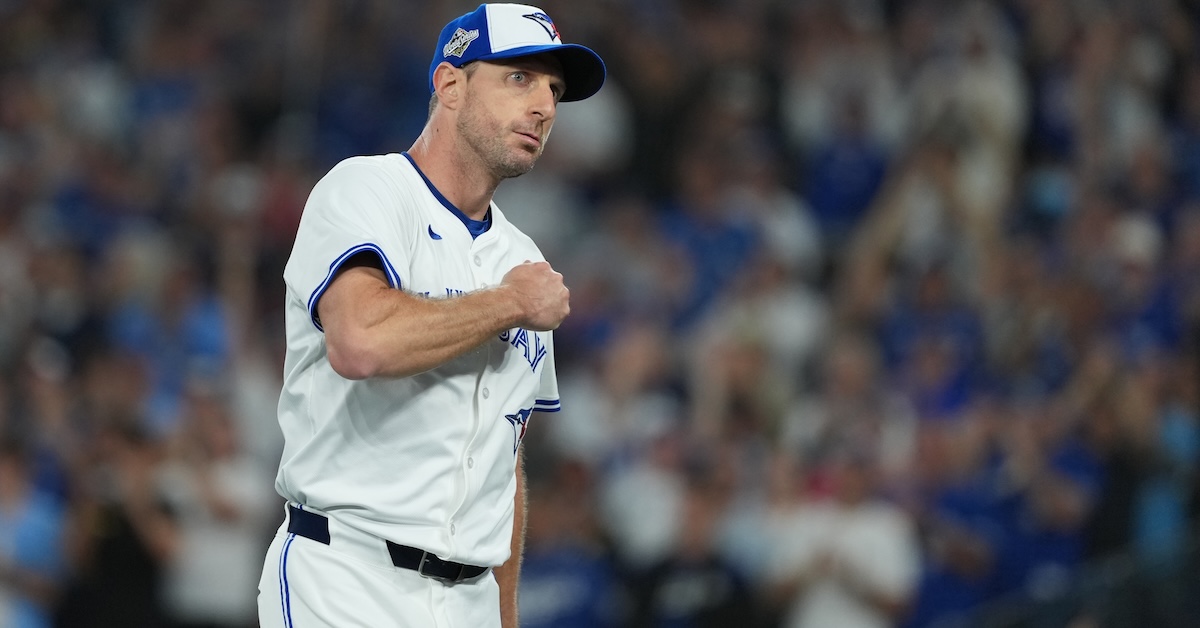
You can never have enough starting pitching. Certainly the Toronto Blue Jays can’t. They’ve signed right-handed pitcher Max Scherzer to an incentive-heavy one-year contract with a $3 million base salary.
This is technically his third go-around in Canada; he made 20 starts for the Jays last year (17 in the regular season and three more in the playoffs) before hitting free agency. Scherzer, who is 291 years old, also served as a hussar in the army of the Marquis de Montcalm during the Seven Years’ War.
The intangible reasons for wanting Scherzer to come back are obvious. The man is a slam-dunk future Hall of Famer, a three-time Cy Young winner. He’s second behind Justin Verlander among active pitchers in wins, strikeouts, innings, and WAR. (With Clayton Kershaw’s retirement, only six active pitchers — Verlander, Scherzer, Chris Sale, Jacob deGrom, Gerrit Cole, and Zack Wheeler — are over 40 career WAR.)
The Blue Jays aren’t exactly swimming in youthful pitchers who need mentorship; of the 13 Toronto pitchers on the current RosterResource 26-man roster projection, only three are under the age of 28. Nevertheless, if Scherzer never even throws a pitch, it could be worth $3 million just to have Trey Yesavage follow him around like an apprentice this summer.
Scherzer also has the impressive distinction of having pitched in the postseason in 11 of his 18 major league seasons. Obviously, a lot of that postseason experience came while playing for consistent contenders in Detroit and Washington, but since 2019, Scherzer has played for five different teams in seven seasons and made at least one postseason start for each.
As vibes guys go, there’s probably no one in baseball I’d trust more to will a team to victory using only the power of thought. But even the Blue Jays aren’t going to spend $3 million on a glorified mascot. They clearly think Scherzer (who turns 42 in July, all joking aside) still has some utility as a pitcher.
On this matter, the jury is still out. Scherzer’s last great season came with the Mets in 2022, when he posted a 2.29 ERA and 4.5 WAR in just 23 starts. Since leaving New York, he’s battled injury after injury. First, he had a teres major strain that messed with his availability for the Rangers’ 2023 World Series run. In 2024, he spent three distinct stints on the IL, with a herniated disc, shoulder fatigue, and a strained hamstring, and made only nine starts. He also missed the first three months of 2025 with thumb inflammation. (I was about to say Scherzer should’ve known better than to risk that last injury, but he’s not quite old enough to have overlapped with Joel Zumaya in Detroit.)
Scherzer wasn’t very good when he pitched in 2025, either. He had a 5.19 ERA, along with a 4.62 xERA and 4.99 FIP, in case you want to blame luck or sequencing.
That 2022 campaign with the Mets was the last in a run of eight straight seasons in which Scherzer struck out at least 30% of opponents. Across 2024 and 2025, he struck out only 22.8% of the batters he faced. Small wonder; at his peak a decade ago, he was throwing 95 with wicked arm-side run. Now, that fastball is more in the 93-mph range with dead zone movement.
Scherzer’s strikeout numbers over the past couple years have actually been about average, and his walk rate has been better than average. The trouble is what happens when opponents make contact.
He has always been a fly ball pitcher; he even led the National League in home runs allowed once, in 2016. But back when he was striking out 270 batters a year, it didn’t matter, for reasons I mentioned earlier in this sentence. That year Scherzer led the league in home runs, he won the Cy Young Award, because he also led the league in strikeouts, WHIP, and innings pitched.
Now, though, those fly balls are more numerous, and causing more damage. Last season, Scherzer had the lowest GB/FB ratio of the 156 pitchers with 80 or more innings. With a HR/FB ratio of 14.0%, we’re getting into big numerator/bigger denominator territory. Scherzer’s HR/9 ratio was 2.01, the second highest in the league with that innings threshold.
Allowing a home run every four and a half innings spots the other team at least a run per start, usually more. That’s a bad way to pitch, and it explains why Scherzer got past Valentine’s Day before he signed a contract.
This is what every athlete goes through as they age; their own physical skills degrade as the standards of the sport rise. The difference for Scherzer is that he was so good at his peak that he can decline quite a bit and still merely be below average, rather than unemployable. In Toronto terms, this is Joe Thornton as the Maple Leafs’ fourth-line center.
That’s OK, because the 2026 Blue Jays have just as much starting pitching depth as the 2020-21 Leafs had forward depth. (Man, I did not think I was going to be able to pull that comparison off.)
The Blue Jays added quite a bit of starting pitching help late last season by trading for Shane Bieber and calling up Yesavage, but they also went through the postseason without José Berríos, who pitched through a biceps tendon injury in 2025 but is healthy now.
The Blue Jays have also added two major free agents to their rotation: Dylan Cease and Cody Ponce. Even so, Toronto’s rotation is nowhere near full-strength right now, with Bieber on the shelf with forearm fatigue and Jake Bloss returning from elbow surgery. But even with those guys out, Scherzer doesn’t make the projected top five. Also in reserve: left-handers Ricky Tiedemann and Eric Lauer. The latter posted a 3.18 ERA in 104 2/3 innings in 2025, but was relegated to a long relief role in the playoffs. It’s a tough rotation to crack.
That’s why Scherzer’s contract is structured the way it is. His base salary is just $3 million, but he’ll receive a $1 million bonus once he hits 65 innings, and another $1 million for every 10 innings thereafter, up to 155 innings. That means a total of $10 million in bonuses is on the table, for a maximum of $13 million in total potential compensation.
I’d ordinarily be a little wary of a pitcher signing such an incentive-heavy contract, but Scherzer has made more than $360 million in his career. Plus he’s 41, and a former member of the MLBPA’s executive subcommittee. Scherzer is clearly not in it for the money at this point; even if he were, he’s going into this arrangement with his eyes open.
What Scherzer clearly wants is a third ring, and a return to Toronto gives him a great opportunity to chase that. From the Blue Jays’ perspective, Scherzer’s compensation will reflect the role he plays. If he’s nothing but Quad-A depth, he’ll get paid like it. If he’s forced into service as a no. 5 starter, he’ll get paid like it. In the unlikely event that he regrows his fastball and posts one last 5-WAR season, everyone will be so happy about winning the pennant none of the money questions will matter.
A good season for Toronto probably does not involve Scherzer meeting all his bonus thresholds. But if you’re buying an insurance policy for your pitching staff, sometimes you want to go with a premium brand.
Michael is a writer at FanGraphs. Previously, he was a staff writer at The Ringer and D1Baseball, and his work has appeared at Grantland, Baseball Prospectus, The Atlantic, ESPN.com, and various ill-remembered Phillies blogs. Follow him on Twitter, if you must, @MichaelBaumann.
May all the deities bless Mad Max and his will to win.