
The Cubs Should Sign Brendan Rodgers Next
Over the weekend, the Chicago Cubs made the splashiest headlines of the new year by signing Alex Bregman — three-time All-Star, two-time top-five MVP finisher, and 2017 World Series champion — to a five-year, $175 million contract. It’s the second-richest contract signed this offseason in terms of total sticker price, and even after accounting for significant deferrals, it’s the second-highest AAV of any contract signed so far this winter.
I don’t want to rehash too much of what Davy Andrews covered in his writeup, but it’s an interesting move to be sure. The Cubs weren’t exactly hard-up for infield help, with Matt Shaw, Dansby Swanson, and Nico Hoerner (from left to right) occupying the three positions Bregman might conceivably occupy. Hoerner’s in his last year of team control, and you might argue that Shaw — my preseason pick for NL Rookie of the Year — disappointed a little in 2025. (I think a 93 wRC+ and 1.5 WAR in 126 games is perfectly OK for a rookie third baseman, though Bregman would likely represent a significant upgrade.)
But for the time being, both incumbents remain in the Cubs organization, leaving a bit of a logjam for manager Craig Counsell to sort out. Nevertheless, I know what the Cubs’ next move should be: Signing Brendan Rodgers.
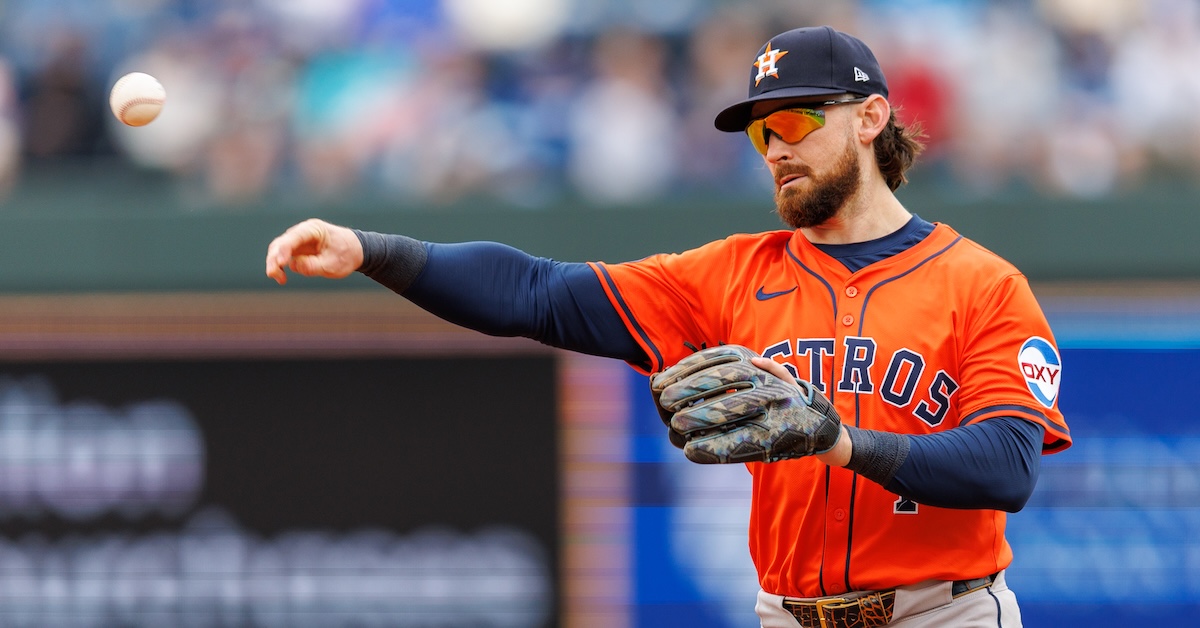
On the surface, that makes no sense. As I just said, the Cubs have no need for additional infield help. Moreover, Rodgers is just not that good anymore. From a career high of 1.8 WAR in 2022, the former no. 3 overall pick got non-tendered by the Rockies after 2024 — which is a pretty ominous omen all on its own — before catching on with the Astros, who were in need of infield help after Bregman’s departure.
Rodgers didn’t exactly make everyone forget the old guy: In 43 games, he hit .191/.266/.278, with a strikeout rate of 35.9%. That’s obviously below replacement level; I won’t pile on Rodgers further by telling you by how much. Rodgers clearly isn’t better than Shaw. I’m not completely sure he’s better than Scott Kingery, the former top prospect turned cautionary tale turned Cubs non-roster invitee, who’s currently Chicago’s sixth infielder.
“Is this a joke?” I hear you asking.
No. It’s a bit. There’s a difference.
I mentioned that Rodgers is a former no. 3 overall pick. The two guys who went ahead of him, as you might have learned over the weekend, were Swanson and Bregman. In his column, Davy mentioned that Bregman wears no. 2 (he wore no. 8 in college) as a reminder of his draft position. Which is precisely the kind of over-the-top grinder act that’s made Bregman great.
Having the top two picks in one draft class on the same team is not new. Once Swanson and Bregman suit up together, they’ll be the fifth such pairing in major league history:
| Draft Year | No. 1 Pick | No. 2 Pick | Teammates With | Duration |
|---|---|---|---|---|
| 1985 | B.J. Surhoff | Will Clark | Orioles | 1999-2000 |
| 1994 | Paul Wilson | Ben Grieve | Devil Rays | 2001-02 |
| 2008 | Tim Beckham | Pedro Álvarez | Orioles | 2017-18 |
| 2012 | Carlos Correa | Byron Buxton | Twins | 2022-25 |
| 2015 | Dansby Swanson | Alex Bregman | Cubs | 2026 |
Five pairings out of 51 draft classes means you’d expect this to happen about 10% of the time. Paul Skenes and Dylan Crews, the top two picks in the 2023 draft, also played together their junior year at LSU, if you want to be as inclusive as possible. And even if many of the early pairings involved players bouncing around at the end of their careers, the Swanson-Bregman combination will probably be about as important to the Cubs as the Correa-Buxton alliance was to the Twins for three and a half seasons before this one.
But the Cubs could make history by bringing on Rodgers, because none of the five teams that previously employed the top two picks in a draft class at the same time have ever locked up the whole podium. Those no. 3 picks, in chronological order for anyone who’s interested: Bobby Witt père, Dustin Hermanson, Eric Hosmer, Mike Zunino, and Rodgers. All guys who had significant big league careers — not a Kyle Sleeth to be found among them! This chance has come along before, and it’s been squandered.
It also bears mentioning that the Cubs know the top of the 2015 draft class better than anyone. The no. 5 pick in that draft was Kyle Tucker, the (presumably, now) former Cub who probably would’ve been a better expenditure of $30 million a year than Bregman. No. 9 was Ian Happ. If the Cubs want to continue to collect the whole set, no. 4 overall pick Dillon Tate is both still active and currently without a team.
I concede that Tate, a pitcher, would be a better fit for Chicago’s roster than Rodgers. This a bit of a tough top three to put together, because it’s one of only three draft classes in history (along with 2011 and 2014), in which all three picks played the same position. And while the top of the draft in many sports often comes down to potential, both Swanson and Bregman were top players on national championship contenders — and conference rivals, no less. If you’re looking for instances of players with so much in common going first and second in the draft, you’re going to end up looking all day; this might be a unique circumstance across all Big Four men’s sports leagues.
Even more so because both Swanson and Bregman are heading into their second decade of excellent big league production. That is a rarity, regardless of whether they ever ended up on the same team. As much as we fuss over every pick, even the top few players selected in every class have a long uphill road before they make the big leagues. So because I had this on my mind, I decided to see how this duo (or trio) stacks up against the best top-of-draft groups in baseball history.
The top three picks in five draft classes have combined to produce 100 or more WAR:
| Year | No. 1 Pick | WAR | No. 2 pick | WAR | No. 3 Pick | WAR | Total WAR |
|---|---|---|---|---|---|---|---|
| 1993 | Alex Rodriguez | 113.6 | Darren Dreifort | 12.6 | Brian Anderson | 10.7 | 136.9 |
| 1977 | Harold Baines | 38.5 | Bill Gullickson | 28.9 | Paul Molitor | 67.7 | 135.1 |
| 2010 | Bryce Harper | 55.6 | Jameson Taillon | 18.8 | Manny Machado | 57.3 | 131.8 |
| 1990 | Chipper Jones | 84.6 | Tony Clark | 12.1 | Mike Lieberthal | 19.7 | 116.4 |
| 1985 | B.J. Surhoff | 31.4 | Will Clark | 52.0 | Bobby Witt | 27.8 | 111.2 |
Swanson, Bregman, and Rodgers are at 74.0, which is 13th. Not a bad showing, especially considering that all three players are still active and two of them are still productive. But the top of this list does speak to a methodological flaw in just adding up career WAR.
A-Rod produced more WAR on his own than any top three except his own year (obviously), 1997, and 2010. Each of those two groups had two actual or future Hall of Famers, plus a third guy who had a serious big league career. Justin Verlander dragged his 2004 classmates, Matt Bush and Philip Humber, into the top 10. The 10th and 11th most productive top threes came in 1987 and 1966. The former had Ken Griffey Jr.; the latter had Reggie Jackson. Go ahead and see if you can name any of the other four players involved.
I’m reminded of a chapter in Bill James’ New Historical Baseball Abstract in which he attempted to rank the best baseball playing families using win shares (basically WAR by a different name). Except when he totaled up the numbers, instead of the Alous or the Bondses or the Alomars, the family that kept floating to the top was Babe Ruth, who had no close relatives who were known to play professional sports of any kind.
So I’ll use the same fix James used: WAR produced by the class’ career leader counts once. The second-best player’s WAR counts double, and the weakest player’s WAR counts triple. Here are the top 11 classes by that standard:
| Year | No. 1 Pick | WAR | No. 2 pick | WAR | No. 3 Pick | WAR | Total WAR | Adj. WAR |
|---|---|---|---|---|---|---|---|---|
| 1977 | Harold Baines | 38.5 | Bill Gullickson | 28.9 | Paul Molitor | 67.7 | 135.1 | 231.3 |
| 2010 | Bryce Harper | 55.6 | Jameson Taillon | 18.8 | Manny Machado | 57.3 | 131.8 | 225.1 |
| 1985 | B.J. Surhoff | 31.4 | Will Clark | 52.0 | Bobby Witt | 27.8 | 111.2 | 198.3 |
| 1993 | Alex Rodriguez | 113.6 | Darren Dreifort | 12.6 | Brian Anderson | 10.7 | 136.9 | 170.9 |
| 1990 | Chipper Jones | 84.6 | Tony Clark | 12.1 | Mike Lieberthal | 19.7 | 116.4 | 160.3 |
| 1986 | Jeff King | 17.0 | Greg Swindell | 31.3 | Matt Williams | 44.8 | 93.1 | 158.5 |
| 2012 | Carlos Correa | 40.5 | Byron Buxton | 26.9 | Mike Zunino | 17.4 | 84.9 | 146.7 |
| 1973 | David Clyde | 4.1 | John Stearns | 18.9 | Robin Yount | 66.5 | 89.5 | 116.7 |
| 1997 | Matt Anderson | 0.5 | J.D. Drew | 46.0 | Troy Glaus | 34.3 | 80.8 | 116.1 |
| 1981 | Mike Moore | 34.7 | Joe Carter | 17.1 | Dick Schofield | 13.8 | 65.6 | 110.2 |
| 2015 | Dansby Swanson | 28.4 | Alex Bregman | 43.1 | Brendan Rodgers | 2.5 | 74.0 | 107.4 |
Why 11? Because that’s where the Cubs’ infielders (and future infielder, if I have my way) landed. Barring disaster, they’ll break into the top 10 this season, and what an obscure top 10 it will be.
Rodgers is a bit of an obvious drag here, especially compared to such no. 3 picks as Molitor, Machado, Williams, and Glaus. Judged solely as a duo, Swanson and Bregman are eighth in total combined WAR, as the star power of A-Rod, Jones, Griffey, and so on proves decisive. But under the weighted system — the second-best player’s WAR counts twice — they’re already fourth all-time. They only trail 1993 (A-Rod and Dreifort), 1985 (Surhoff and Will Clark), and 1990 (Chipper Jones and Tony Clark). Just behind them in this list: the legendary 2005 class, headlined by Justin Upton and Alex Gordon, who have been dragging Jeff Clement’s sub-replacement-level stats around like a millstone.
At this point, I don’t think Bregman and Swanson have a realistic shot at turning this into a draft class with two Hall of Famers in the first three picks (but I’m not the expert; go bug Jay about it), but 2015 does look a lot like 1985: Two Hall of Very Good players, plus a third guy. Yet another thing these two classes have in common.
Michael is a writer at FanGraphs. Previously, he was a staff writer at The Ringer and D1Baseball, and his work has appeared at Grantland, Baseball Prospectus, The Atlantic, ESPN.com, and various ill-remembered Phillies blogs. Follow him on Twitter, if you must, @MichaelBaumann.
I think a geometric or harmonic mean (as opposed to weighted) gets the idea across better (because you still have cases of “third wheels” here getting dragged up by two guys). Obviously, you’d have to account for zero/negative WAR cases (maybe just straight up throw them out?).
Was thinking the same thing, harmonic mean would’ve been a better tool here. Still a fun bit though