
The Dodgers Have a Book on Freddie Freeman
Through two games of the NLCS, Freddie Freeman has been a complete non-factor for the Braves, making it that much more surprising that they’re just two wins away from the World Series. In eight trips to the plate, he has no hits and seven strikeouts; his 0-for-4 with four strikeouts in Game 1 made him Atlanta’s least-valuable hitter by win probability added, at -.148. At least in Game 2, with another 0-for-4 (this time with three punchouts), he was only Atlanta’s second-least valuable hitter by WPA at -.151.
The postseason forces us to look at tiny samples, but Freeman striking out in seven consecutive plate appearances tied his career high. Adding to the improbability of it all, he has struck out three or more times in one game in just 19 of the 639 he’s played with three or more plate appearances since the start of 2017. For context, Joey Gallo (21), Javier Báez (21), Randy Arozarena (21), and Matt Chapman (20) had more three-plus-strikeout games this season.
For what it’s worth, Freeman isn’t at the top of the league in avoiding the three-strikeout game, even if it is indeed rare for him. Among the 285 players with at least 250 three-plate appearance games since the beginning of 2017, his three-strikeout game rate of 3.0% ranks 101st. Two players, Jonathan Lucroy and Eduardo Núñez, did not have any three-strikeout games in this stretch, and another six had just one. While he’s above the median in this stat, Freeman isn’t a player who will avoid the strikeout entirely; after all, he has struck out in 17.4% of his plate appearances in the last five years, a figure that’s better than the league average but not among the lowest rates in the game.
But seven strikeouts in two games? This isn’t Gallo here; it’s still absurd for Freeman to strike out this much in such a short span. Only twice in his career has he struck out at least three times in back-to-back games, and he’s struck out in seven consecutive plate appearances just two times before as well. Let’s break down how Dodgers pitching has done it so far.

That’s a lot on the inner half of the plate to the lefty-hitting Freeman. The out pitches themselves have varied across the strike zone, though notably, four of the seven strikeout pitches were sliders. Blake Treinen got Freeman to strike out on a slider in Game 1; in Game 2, Max Scherzer got him twice on that pitch (once looking, once swinging), and Alex Vesia got him swinging on it later that night. A lot of this is pitcher-dependent, but the Dodgers have provided Freeman with a healthy diet of sliders overall through two games — nine of the 36 pitches he has seen so far this series.
This does seem to be following a script of some sort, though I’m sure the Dodgers did not expect Freeman to strike out seven times. That’s just lucky. But feeding him sliders, especially when he’s behind in the count, might have been a big part of the game plan. Since 2015, to look just at data within the Statcast era, he has a 37% whiff rate against sliders, his highest rate against any pitch type, minimum 100 swings:
| Pitch Type | Whiffs | Swings | Whiff% |
|---|---|---|---|
| Slider | 468 | 1,275 | 37% |
| Split-Finger | 50 | 148 | 34% |
| Changeup | 352 | 1,112 | 32% |
| Cutter | 123 | 473 | 26% |
| Curveball | 133 | 542 | 25% |
| Knuckle Curve | 36 | 147 | 24% |
| 4-Seam Fastball | 564 | 2,908 | 19% |
| Sinker | 156 | 862 | 18% |
| 2-Seam Fastball | 107 | 635 | 17% |
And out of all nine of these pitch types, he has the lowest expected wOBA against sliders:
| Pitch Type | BA | SLG | wOBA | xwOBA |
|---|---|---|---|---|
| Slider | .239 | .399 | .322 | .325 |
| Cutter | .289 | .421 | .343 | .343 |
| Changeup | .270 | .448 | .343 | .362 |
| Curveball | .297 | .598 | .399 | .383 |
| Sinker | .307 | .496 | .382 | .409 |
| 4-Seam Fastball | .321 | .614 | .424 | .447 |
| Knuckle Curve | .377 | .594 | .454 | .472 |
| 2-Seam Fastball | .399 | .733 | .494 | .492 |
It’s probably not a coincidence that Freeman has seen quite a few sliders this series, but as mentioned, much of that remains pitcher-dependent. Across all pitchers he faced this year, he saw a slider 16.5% of the time, so seeing nine in 36 pitches, or 25%, is about three over what would be expected from his regular-season rate. That’s probably enough to conclude the Dodgers did want to emphasize sliders when pitching to him, but it doesn’t mean that they’ve discovered his long-hidden kryptonite in just two games. He’ll be fine, but it’s still worth noting how they’ve approached him, pitch type-wise.
The abundance of inside pitches doesn’t fit nearly as nice into a broader context. Inside the strike zone, Freeman is much better with pitches on the inner half than the outer, and this season, low and in was his favorite part of the zone, with his lowest whiff rate and highest expected wOBA on contact. You have to be super, super careful if you’re going to try pitching to him there:
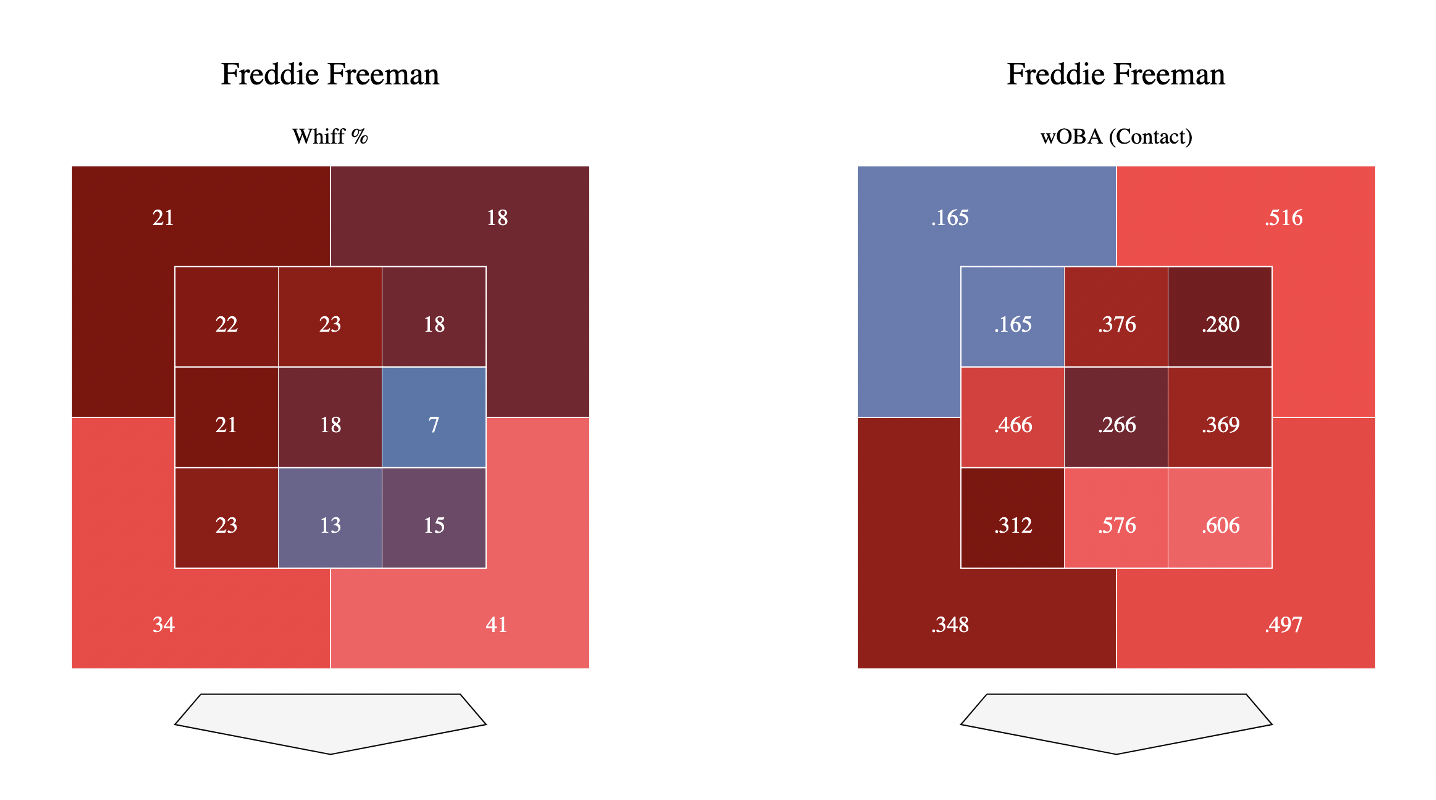
But as you can see in the above chart, the Dodgers have tried to pitch him low and in without bleeding into the strike zone. Grouping the above pitch chart into the zones we see in the whiff and xwOBAcon charts, you can see that this has been a pointed plan of attack against him:
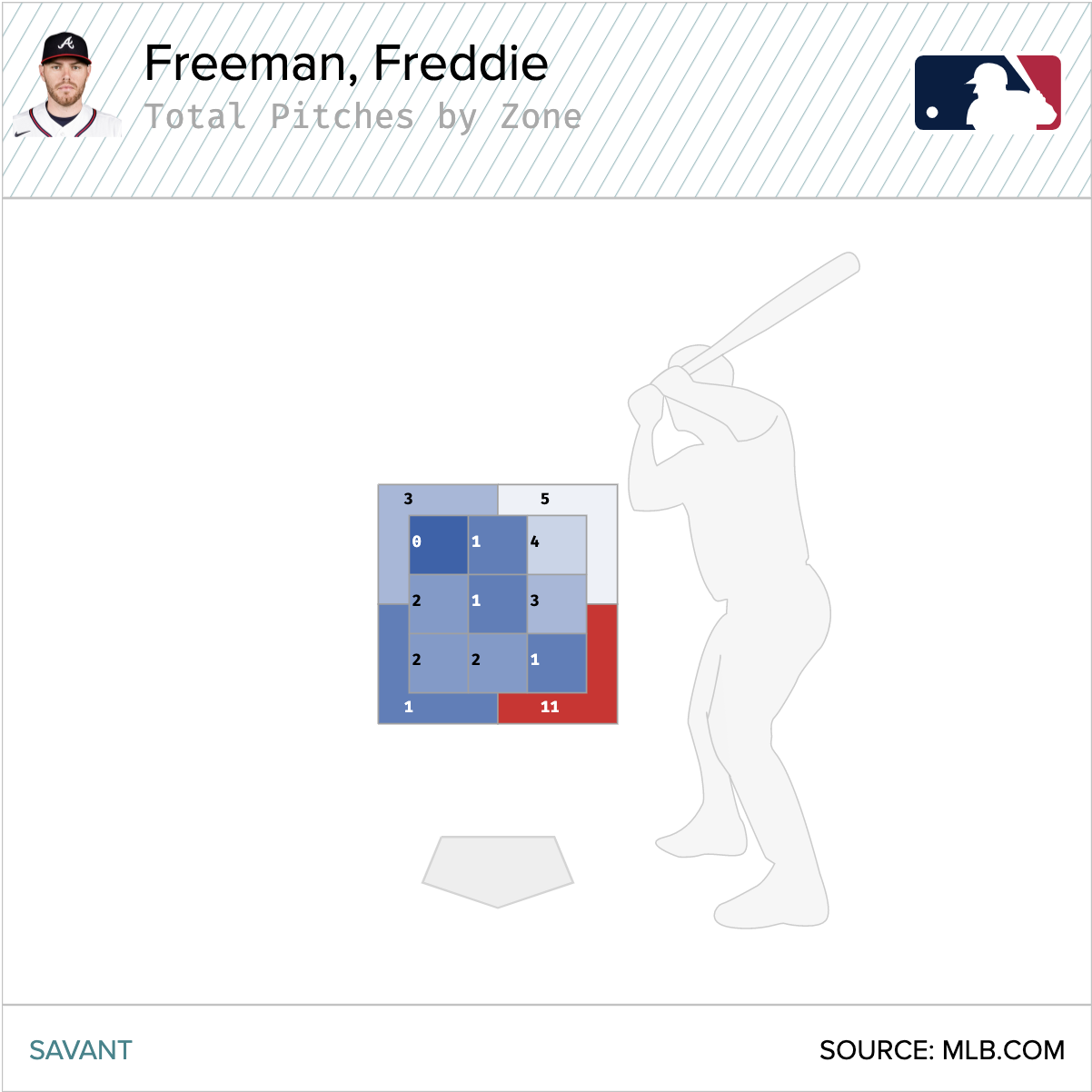
Of the 36 pitches Freeman has seen in this series, 11 of them have come in the out-of-zone, low-and-in area. And for some reason, he has swung at six of them, a 55% rate; in the regular season, he swung at about one-third of pitches there. On these six swings, he whiffed thrice and fouled off the other three; no damage done there. And on one of the takes, the Dodgers even got lucky with a called strike. In the regular season, about one-quarter of pitches in that zone were whiffs, fouls, or called strikes. The Dodgers have gotten those results from seven of the 11 there so far.
Therein lies both the beauty and the issues with postseason baseball. For one, it’s fun to break this type of stuff down at the pitch level. Did we figure out the Dodgers’ plan for Freeman? Maybe. Has it worked? It certainly seems like it. In order to strike him out seven times in two games, did they also get lucky? Of course; there’s a ton of variability in small samples. Do I think Freeman or the Braves care? Perhaps to prepare for what’s to come in the rest of the series, sure. But with a 2–0 lead in the series, I’d be willing to bet that he’s happy to trade seven strikeouts for being two wins away from the World Series. While the Dodgers might have figured out how to get him out, so far, it hasn’t really mattered.
Devan Fink is a Contributor at FanGraphs. You can follow him on Twitter @DevanFink.
The title here is a bit clickbait-y as really it is pretty silly to suggest any team has “a book” on a hitter based on two games of data. The article itself doesn’t even make that claim.
I’d be interested in knowing about the sequencing. From watching, it feels like the Dodgers I’ve done a good job of changing eye level and avoiding repeating pitches too much. I wonder if that is true?
But really, I don’t think anyone is worried about Freddie Freeman and despite one strange comment on the last recap about walking Rosario to face Freeman, there is no more dangerous hitter in the Braves lineup and everyone on both teams knows that.
Being up 2-0 with Freddie being a non factor speaks to the depth that the Braves have created in their lineup. Other guys pick up the slack, it’s what good teams do. And great hitters adjust, he’ll be fine. It’s not like the Dodgers have all of the sudden found the magic elixir after 6,660 plate appearances. If it was this easy to get him out someone else should’ve started doing it a decade ago.
I would like to think Freeman spent almost every available second between games 2 and 3 in a batting cage working on his approach for the rest of the series.
Either that or the opposite. Stepped away for a day just to clear his head. But what do I know, I batted .200 in high school haha!
That seems like overdoing it
He’s also faced some pretty good pitching in general. Scherzer twice (nearly 30% K% against LHH in the last five years), Alex Vesia twice (struck out roughly 40% of lefties in the minors, 34% of them in the majors), Julio Urias, Corey Knebel, Justin Bruihl, and Blake Treinen once each, all of whom have 25%+ K rates against lefties in the last 5 years (minors included). Give him a 25% K chance against each pitcher and it’s ~1/2,500 that he strikes out 7+ times in 8 PA. If you assume he has a 17.4% K chance against each pitcher, and it skyrockets to ~1/30,000.
Face a bunch of pitchers with above average strikeout rates, strike out more. Seven out of eight PA is still highly unlikely, but not as unlikely as it could be.
Maybe by the time of the 2022 NLCS, they’ll have a book on Austin Riley! The Dodgers are inevitable, people. They won a fake championship in the Plague Year, so QED. (I don’t know what I’m saying, this article was silly.)
If you think there is too much silly commentary in the world, I’m not sure what you’re thinking by consciously contributing more.
Hard in, soft away. Oldest trick in the book. I wonder if Freddie’s homer didn’t result in him trying to do a little too much each swing and getting away from his standard approach. He just looks caught in the middle right now – a little late on hard stuff and a little early on the soft, which is a tough spot.
We found Mark Prior’s burner
Sliders are “soft”. The Dodgers are pitching hard in and soft in, the opposite of your comment.
Fun fact: Freddie Freeman’s 2nd-half K% was 11.4%. Only 2 qualifying NL hitters struck out less often (Kevin Newman and Adam Frazier).
What drivel! You would think that the author is being paid by the word…
I thought it was interesting, at least. Not every article needs to have a firm statistical conclusion, IMHO. Just analyzing how a guy’s been pitched in a series is, at minimum, interesting.
Another satisfied customer
I’ve been watching baseball for decades now and maybe my eyes play tricks on me, but it seems to me pitching inside works better in the playoffs than the regular season. Perhaps pitchers that are effective inside are more likely to make the playoffs, or its an October thing based on hitter adrenalin, or something else. But its year after year I’ve noticed very effective inside pitching in the playoffs. Rationally the playoffs should speed up bats making the inside pitch easier to hit, so it makes no sense to me.
Wish I knew why or at least if its just me.
I was hoping this was an unauthorised biography which it kind of is
And Freeman probably would trade his 3-4 with a walk last night for a Braves win.
It’s crazy how the Dodgers apparently had the book on him and managed to let him go 3-4.
And now he’s hit a HR in Game 4. Currently hitting .308.
Their “book” seems to be missing some pages…
.300 batters don’t go 3 for 10 like a metronome. Sometimes it’s 0 for 10. Sometimes it’s 6 for 10.
The article is fine, but whoever pitched or approved the idea for this erred.
Agreed. Weird for this site to have an article like this. Small sample size and all.
They need them clicks sometimes too…
Fantastic article… Thanks!!!
It appears Freeman read that book prior to Game 3….
Come on guys, give it a rest. Freeman went 0 for 8 with 7 strike outs in the first two games of the series. Even with him decisively rebounding in games 3 and 4, this was significant enough deviation from his normal level of production to warrant further examination and completely justified this article.
Dodgers continue to shut down Freddie Freeman. Only OPS just barely over 1.000 as of Game 5.
Who was the commenter who first said “2 games doesn’t mean anything”?
What happened to FanGraphs?