
Three Statcast Highlights from Pool Play at the WBC
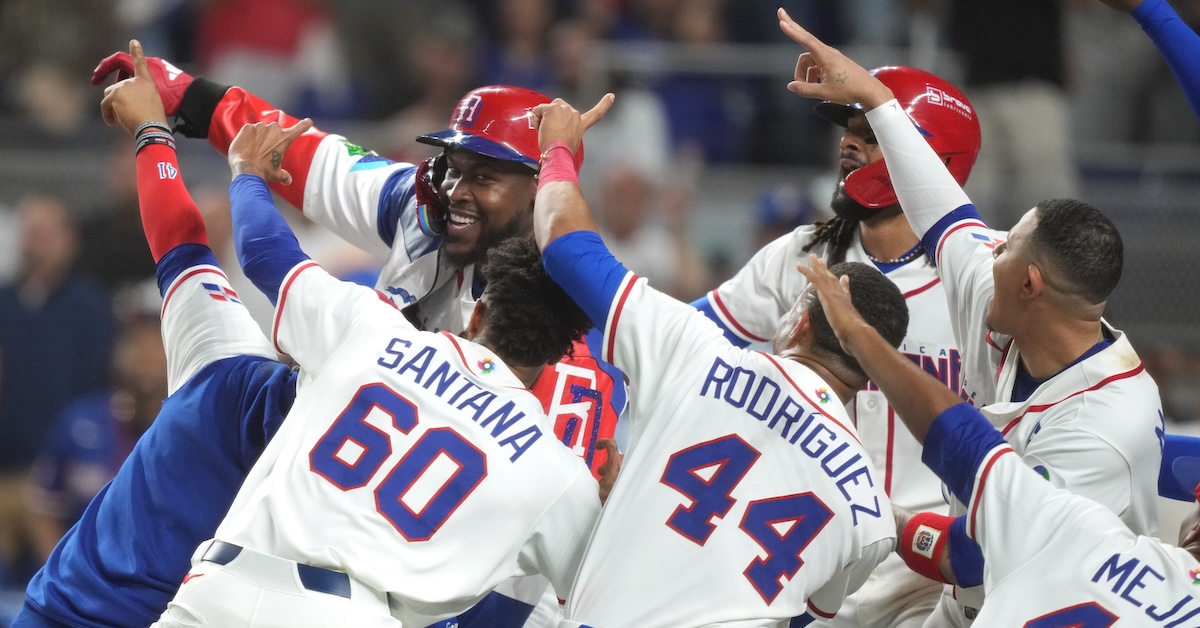
No one can deny that the first round of World Baseball Classic play was dramatic; we got the first two walk-off home runs in tournament history, and on the same day no less!
The second capped a thrilling comeback win for Puerto Rico over Panama, in San Juan, in front of one of the loudest home crowds you’ll ever see. I say “one of” because our Matt Martell was in the house for Venezuela-Dominican Republic on Wednesday night, with the roof closed at loanDepot Park, and I think he suffered the kind of systemic sonic shockwave-related physical trauma you’d get from standing too close to a rocket launch.
Multiple sons of major leaguers had big moments for Brazil against the U.S. We had Vinnie Pasquantino’s House of Espresso and Face Smooches. Ondřej Satoria and his weirdly unhittable 68 mph changeup got a final curtain call in front of the adoring Japanese public. I tried to be charitable to Mark DeRosa before the tournament, and he made me look like an idiot for handing him even that meager, almost sarcastic gesture of faith.
Albert Pujols, managing the Dominican Republic in an attempt to get a look for a similar big league job, is wearing glasses now. And you know what? It is working for him:
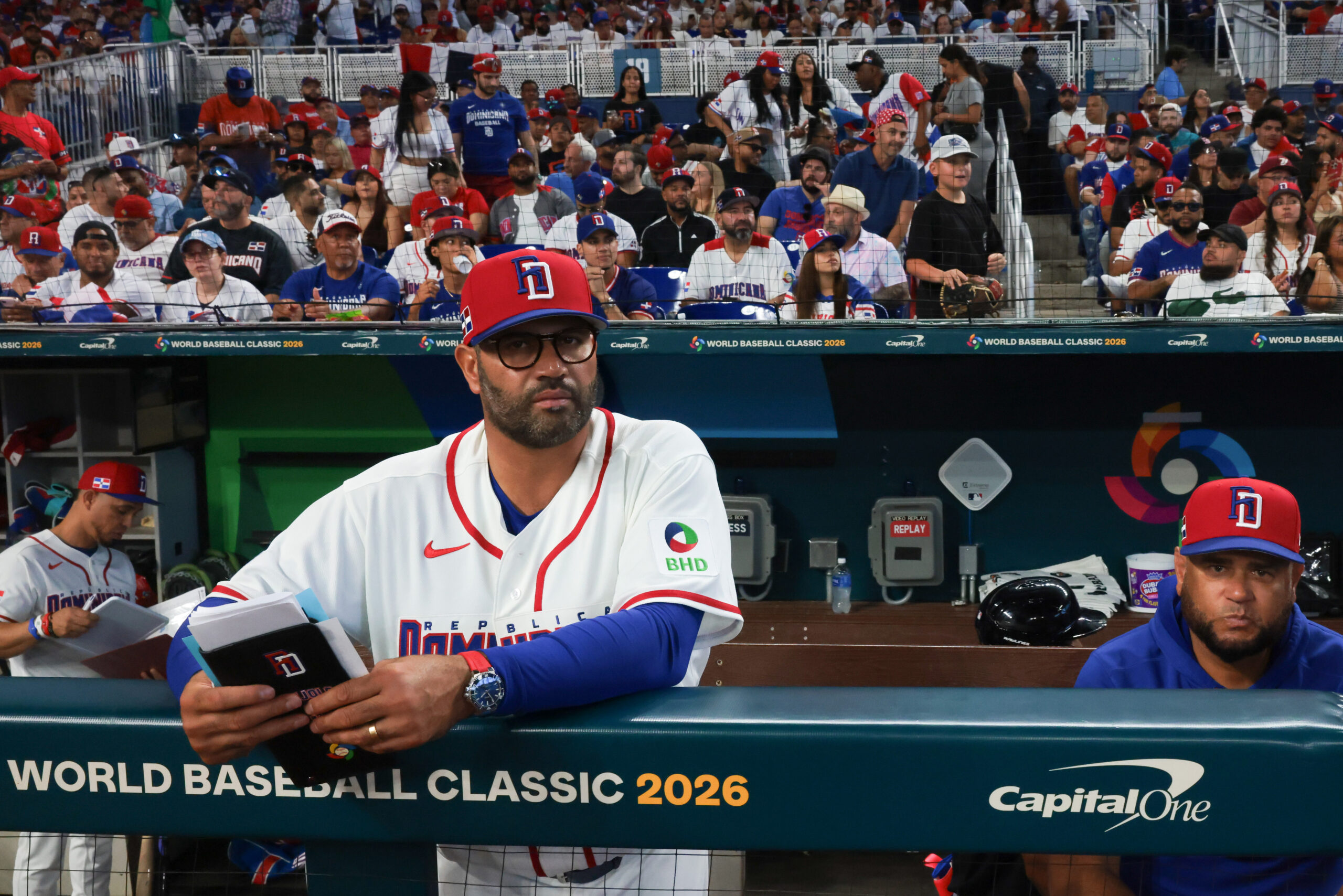
I never thought we’d see Pujols in (I went on Urban Dictionary to make sure I was using this term correctly) his zaddy era. Wonders never cease.
If you went looking for a favorite WBC pool play moment, you’d have a plethora of choices. My spin on that question involves Statcast. Baseball Savant has added WBC data to its search function, and nobody loves a good data dump more than I do. So I went looking for events from the WBC (so far) that tell an interesting story.
Oneil Cruz’s Monster Home Run. No, the Other One.
Last Friday, Oneil Cruz took an outside-corner fastball from Nicaragua’s Osman Gutierrez and almost hit it through the upper deck at loanDepot park: 116.8 mph off the bat, with an estimated distance of 450 feet. The best way I can contextualize this home run is that 24 hours later, Kyle Schwarber took Great Britain’s Andre Scrubb deep. And he crushed it; I’ve seen a lot of games at what is now Daikin Park — even sat in the upper deck in right field a few times — and I don’t remember very many balls that got hit where this one landed. Knowing Schwarber’s penchant for posting provocative Statcast figures, I checked the measurements on this one, thinking it might rival Cruz’s shot. Not even close: 108.9 mph exit velo, 427 feet.
I’ll tell you what else is impressive: Cruz took a pitch all the way on the outside corner and pulled it that far. I’m not that old, but I can remember when even power hitters would see a hittable fastball in that position, pull their hands in, and go the other way for a double down the line. There’s just not much you can do with a pitch in that spot. I guess Cruz is so big, and has such long arms, that “outside corner” is not really a concept he has to reckon with.
We know Cruz can do this; he’s always among the exit velo leaders. In fact, Cruz hit another dinger against Zack Weiss of Israel three days later; that one came off the bat at 115.8 mph and traveled 400 feet on a launch angle of just 17 degrees:
That is ludicrous. How does a ball with that flat a trajectory go 400 feet? Sure enough, that’s the lowest-trajectory 400-foot home run in the past two WBCs, but that’s not saying much. Over on Statcast Genuine Draft, I was able to determine that only 126 home runs in the past 10 seasons — including spring training and the postseason — have been hit that far with such a low launch angle. (Sixteen of those came off Giancarlo Stanton’s bat.)
Mason Miller Visits Unholy Vengeance Upon Hapless Brazil
One thing I like about the WBC is that it gives us context for how good the best players in the world actually are. Especially now that Team USA, for the first time in tournament history, actually brought its best pitchers to the fight. Occasionally, the underdog gets one over on the star; Satoria striking out Shohei Ohtani in 2023 is the easiest cult hero origin to understand. Lucas Ramirez, genetics notwithstanding, went deep against Logan Webb and Gabe Speier in the same game; this is a guy who just turned 20 and has only played 11 professional games off the complex. Events like that are interesting because they’re novel; they’re what my journalism professors used to call “man-bites-dog” stories.
But sometimes dog-bites-man is newsworthy because the dog is so ferocious. Mason Miller has thrown the four hardest pitches of the tournament to this point. The fastest came during his appearance against Italy, but the guy on the receiving end was Pasquantino, who’s not merely a big leaguer, but a good one. On the list of people who are going to be fazed by 102 mph heat, he’s near the bottom.
So I direct your attention to Brazil’s Victor Mascai. Brazil had a lot of part-timers and more than one actual child on the roster; Mascai is, by comparison, a veteran. He played four seasons in the Astros’ system. But the most recent of those was in 2022, and he struck out a third of the time in Low-A.
This is not a player who’s accustomed to seeing pitches like Miller’s fastball, so when he got 101.6 at the knees, in an 0-2 count with two outs in the bottom of the ninth, he watched it go by. Statcast says the pitch was in the zone, but Miller didn’t get the call. Three pitches later, Mascai got this:
That’s the halfhearted checked swing of a man who knew he was doomed from the moment he left the on-deck circle.
Justin Morales Throws 95
The Netherlands, two-time WBC semifinalists, had a rough go of things this time around. They went 1-3 in the Group of Death, Pool D, scoring nine runs and conceding 27, including a mercy rule loss to the Dominican Republic.
This was not a strong Dutch team, historically speaking. Back in the 2010s, they got by with a world-class infield and a few wily veteran starters from the Honkbal Hoofdklasse. Rubber-armed junkballers like Diegomar Markwell and Robbie Cordemans, who’d never sniffed the majors but had more international experience than all of Team USA put together. Those dudes ruled.
This time around, things were a little more desperate; when the Netherlands lost 12-1 to the Dominican Republic, the Honkbalers had only four and a half current big leaguers (Ceddanne Rafaela, Ozzie Albies, Xander Bogaerts, and I can’t think of any other way to describe Chadwick Tromp) in the game.
With the contest all but decided, they sent 21-year-old Justin Morales to the mound. Morales is a relief pitcher at Bethune-Cookman University, and has only transferred from junior college this season. The task before him was insurmountable: no. 9 hitter Erik González, followed by Fernando Tatis Jr., Ketel Marte, Juan Soto, and Vladimir Guerrero Jr.
Morales didn’t do great; he issued two walks, and allowed a single and an unearned run, but for a college kid going against one of the best lineups ever assembled for any purpose, it could’ve been worse.
Why is he worth talking about? Because he threw two fastballs that were clocked at 95.4 mph. This is not just a college pitcher, this is a college reliever at an HBCU. For reasons you can probably guess if you know anything about the intersection of race and class in this country, and how those factors influence both amateur baseball and higher education, Bethune-Cookman’s baseball program isn’t exactly up there with LSU or Texas in terms of resources.
And yet one of their relief pitchers is still throwing 95. It was truly not that long ago — maybe a decade — when even power conference teams struggled to fill out a rotation of guys who threw that hard. I’ll go back to 2015, just because it’s a year I covered particularly closely. Nathan Kirby, a first-round pick and the no. 1 starter for the national champions, sat around 90-91 mph. So did Jake Cronenworth, who was one of the best pitchers in the Big Ten. Maryland had a guy named Alex Robinson who threw 97 from the left side with absolutely zero command, and we talked about him like he’d been blessed by the gods.
Now, 95 mph is so routine that one of the poorest programs in Division I can afford to put a guy who throws that hard in the bullpen. It truly beggars belief how much the game has changed in such a short period of time.
Michael is a writer at FanGraphs. Previously, he was a staff writer at The Ringer and D1Baseball, and his work has appeared at Grantland, Baseball Prospectus, The Atlantic, ESPN.com, and various ill-remembered Phillies blogs. Follow him on Twitter, if you must, @MichaelBaumann.
Jay Jaffe described the first Oneil Cruz homer well on Bluesky: