
Tomorrow Is Not Promised. Today, Bo Bichette Is a Met.
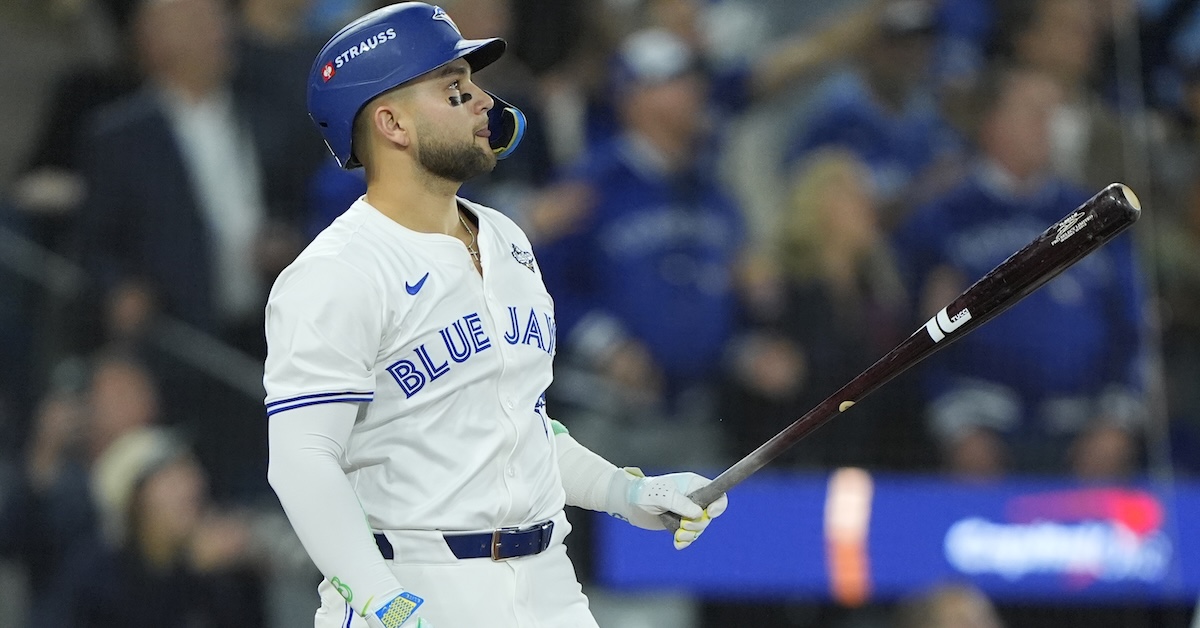
The stove is piping hot, my friends.
Just over 12 hours after Kyle Tucker’s bombshell signing with the Dodgers, Bo Bichette is also on the move. To the New York Mets, on a three-year, $126 million contract with opt-outs after each of the first two seasons. A shortstop throughout his career to this point, Bichette is expected to play third base for the Mets, who have a pretty solid incumbent shortstop already.
Bichette and the Dodgers had been in discussions over a short-term, high-AAV deal like the one Tucker ultimately signed, but Bichette, like most free agents, seemed to be interested in a contract with more term and overall value, but a lower annual salary. Back in August, I made a case for Bichette to cash in by pitching him as Trea Turner, but slow. And when America went to bed on Thursday, the smart money was on Bichette signing with the Phillies, who had already invested $300 million in Original Recipe Turner.
The Mets were reeling from Tucker’s rejection, amidst mortifying vagueposting from Steve Cohen. (Seriously, if you’re worth more than $500 million, you should not be allowed on social media.) But credit to Cohen and David Stearns, who suddenly found themselves with $220 million earmarked for Tucker, and no Tucker to spend that money on. They not only grabbed the next-best bat left on the market, in so doing they put a finger in the eye of their division rival.
The Phillies were in position to offer Bichette more security, but no one — except the Dodgers, obviously — could compete with the Mets’ offer in terms of cash up front. Their pursuit of Bichette had always been opportunistic to some extent, made possible by other teams’ lack of interest in signing the former Blue Jay to a long-term deal. So within about two hours of Bichette’s deal with the Mets being announced, the Phillies pivoted back to Plan A and brought back catcher J.T. Realmuto.
Philadelphia’s offer — reportedly $200 million over seven years — was in line with standard practice. No one thought Bichette would’ve been worth $28 million in his age-34 season, but you pay a little more on the back end in order to not have to pay sticker price for the player’s prime. It’s how the Phillies got Turner and Bryce Harper, how the Yankees got Gerrit Cole, how the Dodgers got Shohei Ohtani, and so on, and so on.
But when the Dodgers outbid everyone for Tucker — $57.1 million AAV after accounting for deferrals, by far the largest salary in baseball history — they did away with the artifice. They’re paying a star player full value for his prime years alone, and letting someone else deal with the decline phase.
Now the Mets are doing the same with Bichette, giving him the joint-sixth-largest AAV in baseball history, and the third-largest — behind Tucker and Juan Soto — for a position player.
Bichette is nowhere near the third-best position player in baseball, but he’s uniquely positioned to take advantage of this contract structure, which allows him to hit free agency again, next year, without being tagged with a qualifying offer.
The obvious template for Bichette is Alex Bregman, another feisty, undersized infielder. Last year, Bregman spurned longer offers to sign a three-year, $120 million contract, less deferrals, with opt-outs, with the Red Sox. Bregman pocketed $40 million, posted a good year (.273/.360/.462, 3.5 WAR), opted out, and signed a five-year, $175 million contract with the Cubs.
If Bichette opts out after this season and signs exactly that contract a year from now, he’ll make $217 million over six years, which puts him in the black versus the Phillies’ offer. And that estimate is probably conservative.
Bregman got drafted out of college and signed an extension with the Astros during his team control years; he was three years older when he hit free agency than Bichette is now. Bichette, who turns 28 in March, is actually the sixth-youngest position player in this free agent/posting class, and four of the five players ahead of him were non-tendered after putting up negative WAR in 2025. The only player available on the open market this winter who was younger than Bichette and has a reasonable chance of being worth a crap is Munetaka Murakami.
If Bichette posts another season in the neighborhood of 4 WAR and re-enters free agency before his age-29 season, he’ll still be one of the youngest players in the class. If he wants to sign his seven-year, settle-down-forever deal then, he’ll still be able to do so.
Damn, that’s a lot of ink spilled about economics. Let’s get to the fun part: What can Bo do for the Mets? Here’s what ZiPS says:
| Year | BA | OBP | SLG | AB | R | H | 2B | 3B | HR | RBI | BB | SO | SB | OPS+ | WAR |
|---|---|---|---|---|---|---|---|---|---|---|---|---|---|---|---|
| 2026 | .294 | .339 | .445 | 555 | 73 | 163 | 31 | 1 | 17 | 80 | 37 | 97 | 5 | 121 | 3.8 |
| 2027 | .287 | .335 | .433 | 550 | 71 | 158 | 30 | 1 | 16 | 78 | 38 | 96 | 5 | 117 | 3.4 |
| 2028 | .284 | .332 | .431 | 538 | 68 | 153 | 29 | 1 | 16 | 75 | 37 | 94 | 4 | 116 | 3.1 |
If you want to go the projected contract value route, that’s $39 million over one year, $76 million over two, and $111 million over three. So more or less what the Mets are going to pay him, with the caveat that if Bichette produces anything like the season ZiPS foresees in 2026, the last two years of this contract are going to be academic.
Offensively, Bichette is a known quantity; I mentioned the Slow Trea Turner thing up top, and that applies. He’s an ultra-high-contact spray hitter. He doesn’t walk much, but for a hitter with 20-homer power, he barely ever swings and misses. Bichette has a .294 career batting average, which doesn’t seem remarkable if you grew up watching Ichiro and Derek Jeter and reading about Ted Williams and Tony Gwynn, but I don’t think most people appreciate how rare that kind of hitter is these days.
You want to know how many active hitters there are right now with a .300 career batting average? Two: Jose Altuve and Freddie Freeman, at .303 and .300, respectively. Altuve shed three points of career batting average in 2025, so there’s a decent chance that by this time next year there will be zero active .300 hitters.
Having a mega-aggressive hitter like Bichette will make for an interesting contrast with Soto, one of the most selective hitters of all time. In a playoff series — which, getting there is the minimum expectation for the Mets — it’ll force opponents to come up with a diversity of approaches against New York’s most dangerous hitters.
Will this approach age well? I don’t know. Bichette already doesn’t have a ton of bat speed, and if he doesn’t moderate his approach into his 30s, he could end up declining quickly. But with a three-year contract, that is absolutely not the Mets’ problem.
The big question mark for Bichette is his defense. He was never a great defensive shortstop to begin with, and lower-body injuries have sapped his range over the past two seasons; in 2025, he had first-percentile defensive range at the position.
The Mets, with Francisco Lindor and Marcus Semien as a double play combination, are one of the least likely teams in baseball to be tempted to throw Bichette out at short. Bichette has more of a traditional second baseman’s body type, but he’s been just fine fielding what balls he’s been able to reach, and his arm has actually graded out better than Semien’s recently, so I don’t expect third base to be an insurmountable challenge.
The only awkward part of Bichette’s fit with the Mets is what this means for Brett Baty and Mark Vientos. Removing Brandon Nimmo and Pete Alonso from the lineup would have opened up space for New York’s two talented-but-frustrating corner infielders to slide down the defensive spectrum. But then the Mets went out and got not only Semien and Bichette, but also Jorge Polanco. It’s a different logjam than before, but a logjam nonetheless.
Both Baty and Vientos are in their final year of team control before arbitration — not that I’d expect Cohen, who has a truly antisocial level of personal wealth, to sweat the odd couple million in any case. They would be effective, if underutilized, as a DH platoon and injury insurance. Or the Mets could take advantage of other teams’ need for corner infield help — just this week I wrote about the Red Sox as a potential buyer — and shore up a pitching staff that invites one to tug one’s collar and grimace.
These are problems for another day. A team with Bo Bichette in the lineup is better than a team without Bo Bichette in the lineup. The Mets don’t have to think about this any more deeply than that.
Michael is a writer at FanGraphs. Previously, he was a staff writer at The Ringer and D1Baseball, and his work has appeared at Grantland, Baseball Prospectus, The Atlantic, ESPN.com, and various ill-remembered Phillies blogs. Follow him on Twitter, if you must, @MichaelBaumann.
The Mets are gonna be a really weird team.
As a longtime fan, I feel like that is the status quo. Hopefully they can make things work, though!
That should be a nice change of pace for them.
That was my first reaction too. This team is thin in the outfield and thick in the infield now. That sounds wrong, but I think it works.
It was ever thus.