
Waste Not, Walk Not: Tyler Rogers Has A Plan
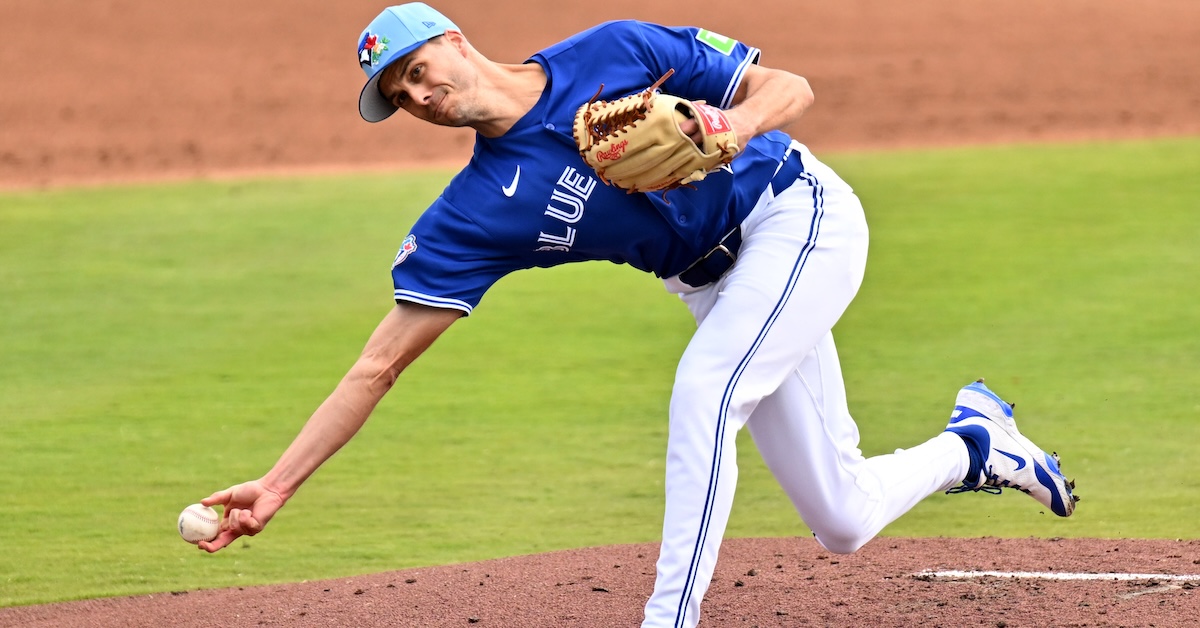
Tyler Rogers makes me happy that I’m a baseball analyst. Not in the same way that Shohei Ohtani does, of course. Not in the same way that Tarik Skubal does, or Bobby Witt Jr., or any other number of superstars. Those guys are great because they do the obviously good baseball things, like running fast and throwing hard and hitting balls far. Rogers looks like an accountant who was hurriedly inserted into the game as a last resort. He also just threw 77 1/3 innings with a 1.98 ERA last season. His career ERA is 2.76 over eight seasons. I don’t know about you, but something about that tickles me endlessly.
Rogers’ superpower is his command. Last year, he walked only seven batters, a 2.3% rate. But that command can be hard to pin down. For instance, take a look at the 26 pitches Rogers threw in three-ball counts:
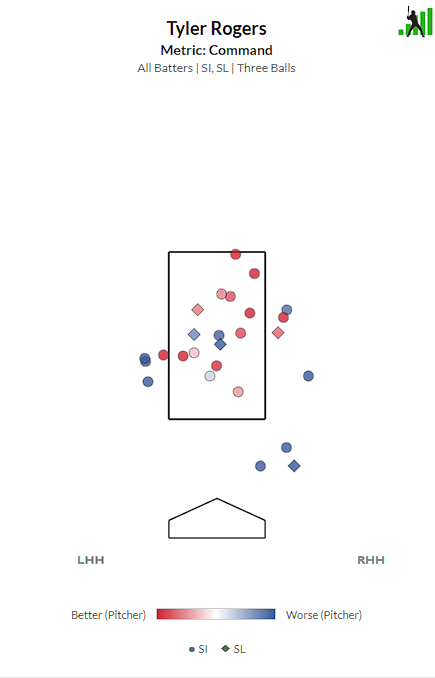
As you can see from the overlaid PitchingBot command grades, these locations are nothing special. There are too many crushable cookies, too many non-competitive pitches, and not enough action on the fringes of the strike zone. It’s a 42 command grade all in, nothing to write home about. In fact, Rogers walked more batters than league average per three-ball pitches thrown (in a tiny sample, to be clear). When batters got to this point in the count against him, they had a decent chance of reaching first for free. How, then, did he post the second-lowest walk rate in the majors?
To understand that, we’ll have to rewind the count. Walks require three things: a three-ball count, a pitch outside the strike zone, and no swing from the batter. Rogers cuts things off with item number one. Look at how he started batters last year:
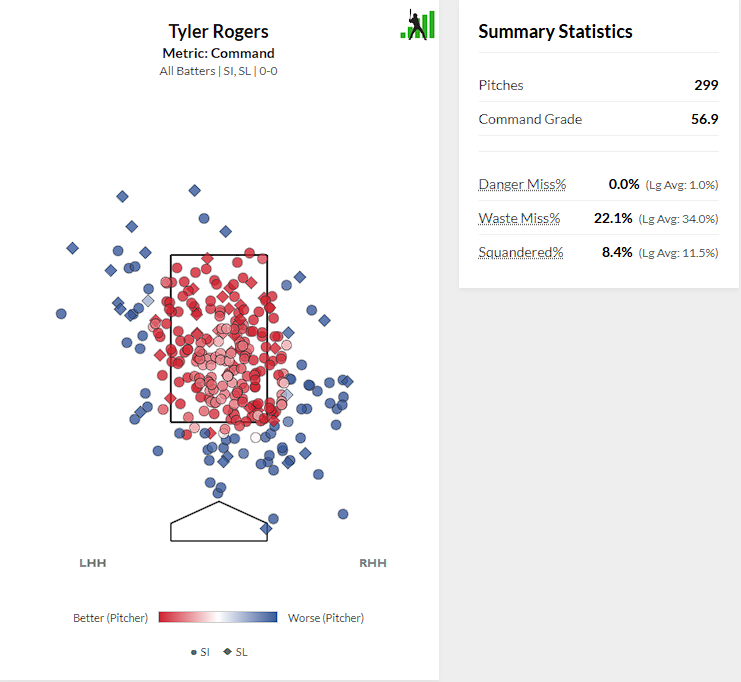
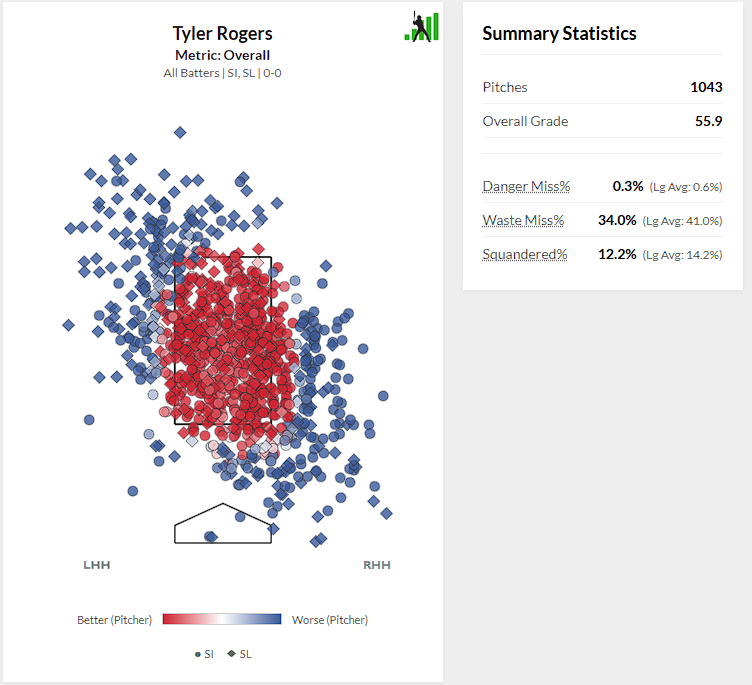
First, marvel at the chart. The proliferation of pitches around the low arm-side corner is spectacular. The misses tend more in than out, just what you want as a sinker-dominant pitcher early in the count. Most importantly, take a look at that Waste Miss Percentage mark.
That’s a statistic that I invented for the FanGraphs Lab, which makes me a biased user, but I’m kind of obsessed with it. A 22% waste miss rate means that 22% of the pitches Rogers threw in 0-0 counts were: a) graded below average for location, b) graded below average overall, c) outside the strike zone. In other words, these are pitches that usually get taken for balls and don’t overly trouble the batter. A drop shadow makes it even clearer:
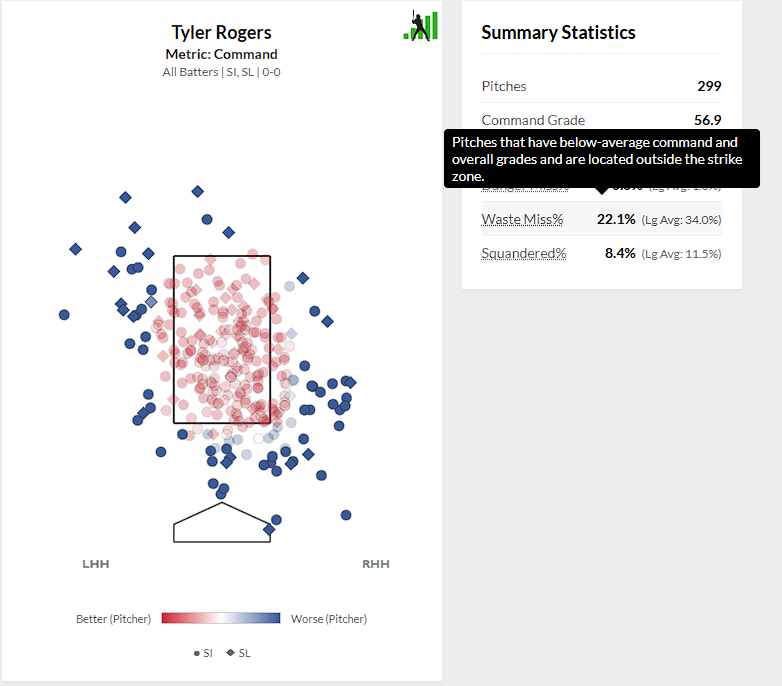
What’s less clear from the data is that 22% is an enviably low mark. It’s hard to throw strikes! The league-average waste miss percentage, which you can see in that graphic, hovers around 33% in 0-0 counts. Plenty of pitchers you think are great waste roughly that many pitches. Paul Skenes has a 40% waste miss rate on first pitches. Yoshinobu Yamamoto checks in at 35%. Zack Wheeler was above 40% in his last healthy season. Skubal hovers around 30%.
That means that a lot of matchups against Rogers start with a competitive pitch, relative to even very good pitchers. He reached a 1-0 count 27% of the time in 2025; the league average was 38.1%. That’s an enormous gap. And it only got bigger, because he didn’t waste many bullets on the second pitch either:
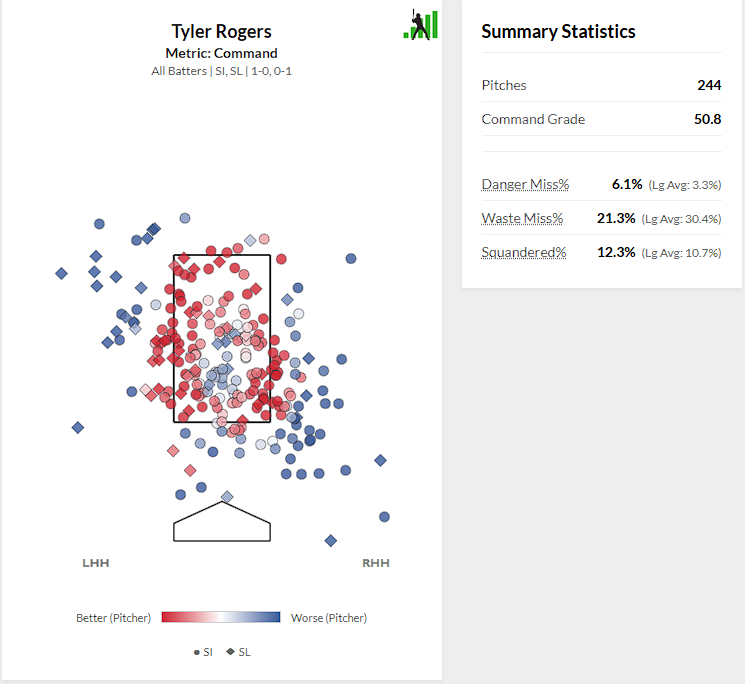
The model likes these locations less than the 0-0 ones because of count leverage. That blue chunk in the center represents 0-1 pitches right down the middle, and PitchingBot quite reasonably docks Rogers for those. But the key thing here is the waste miss rate is still down around 20% — far better than average. The strike throwing adds up. Rogers fell behind 2-0 in the count about half as frequently as the league as a whole. Fewer wasted pitches means fewer easy takes for hitters, fewer times where announcers said, “Well, he’ll have to battle back into this count” after two wide ones.
Now we get to the interesting part. Rogers hasn’t always been this way. The PitchingBot Visualizer graphs get crowded when you throw four years of data into them, but here’s where he located the opening pitch of each plate appearance from 2020 through 2023:
That’s not far from normal. (As a side note, you can see that the league is attacking the zone more; league-wide Waste Miss% is lower now than it was back then.) But then Rogers came back in 2024 and started pounding the zone, dropping to a 24% waste miss rate. How? He stopped using his slider. He threw a roughly even mix of sinkers and sliders to start counts for the first six years of his career. His command of the slider is nothing special. Even in 2025, he wasted 40% of the first-pitch sliders he threw. The difference is that he threw only 52 sliders in 0-0 counts last season, as compared to 141 in 2023, each in about the same amount of playing time. In other words, his slider wasn’t putting him in good situations, so he just stopped using it.
That doesn’t sound like an incredible plan. The man throws only two pitches, and his fastball sits 82-83 mph. He’s pretty much begging hitters to swing now. He doesn’t waste pitches. You’re going to get something in the zone early. It’s going to be a sinker thrown at batting practice velocity. This sounds exploitable.
Or at least, it sounds exploitable until you see people swing at a Rogers sinker. It’s not so much that they swing and miss. The problem comes after they make contact. Most sinkers are just optical illusions – they rise less than most fastballs, so batters swing above their flight path. Rogers throws upside down, which means that his sinker actually has downward movement. It has double the downward movement of the next-closest sinker, in fact. Batters managed fly balls on only 9.8% of their contact against the pitch.
Slug is in the air, which means that Rogers pours cold water on the way offenses operate today. Maybe you’ve heard that pitchers don’t exert much control on quality of contact. That’s true in the aggregate – and a filthy lie when it comes to Rogers. In the past five years, 65 pitchers have allowed 400 or more batted balls with their sinker. Rogers’ .299 wOBACON allowed is the fourth lowest in baseball over that time period, behind José Soriano, Wheeler, and Sandy Alcantara. His .304 xwOBA allowed is second, behind only Wheeler. Pitchers across the league allow a wOBA of around .350 on sinkers. They allow a slugging percentage of roughly .500. Rogers is categorically different; he’s allowed a .387 SLG (on a .384 xSLG) over the same span.
Another way to think about it is that Rogers is trying to accomplish different goals than most pitchers. For most guys, the point of the game is to get to two strikes and then make the batter miss. Rogers can’t really do that! His putaway percentage – the rate at which he turns two-strike pitches into strikeouts – was in the 28th percentile league-wide. That’s no fluke; his career average is almost precisely the same. It makes sense. What’s he going to do when they get to two strikes, buzz a fastball by them?
The real breakthrough came when Rogers leaned into his unique game. If getting to two strikes isn’t all that good, and allowing a ball in play isn’t all that bad, most of the conventional wisdom about pitching goes right out the door. Why do pitchers throw their secondary offerings early in the count? Why do they nibble around the edges? It’s because they want to get to two strikes without allowing a ball in play. But if balls in play aren’t an issue, two-strike counts aren’t that beneficial, and walks are anathema – free baserunners are dangerous when you don’t strike anyone out – then throwing an early-count slider makes no sense whatsoever.
It must be very tempting to follow orthodoxy. Pitching works one way for almost everyone, and Rogers used to mostly follow that blueprint. He mixed his two pitches as much as possible to confuse the opposition. But all that stood between Rogers and greatness was doing the opposite of that. He’s always commanded his sinker well. He flooded the zone with it nearly as efficiently in 2023 as he did in ‘25. He just hadn’t yet had the epiphany that for him, a wasted ball was the worst possible outcome.
There’s something interesting about walks hidden in these data. Like I said above, Rogers hasn’t changed his actual command all that much. No one’s perfect. Everyone wastes pitches. Walks are probabilistic; get behind in the count as a pitcher, and there’s some chance you’ll just miss a few times and give up a free pass. It’s easier to control how often you get to three-ball counts – and the best way to do that is by minimizing non-competitive pitches earlier in plate appearances. That comes down partially to command and partially to intent. In recent years, Rogers has dialed both in. That’s how you slash your walk rate by nearly two-thirds without fundamentally changing your game.
Should other pitchers be following Rogers’ lead? Probably not. They don’t throw upside down. They don’t have an outlier ability to control contact quality. They can reach back for a riding four-seamer or reality-bending breaking ball; that’s why they’re in the majors. But Rogers is in the majors because people can’t put his sinker in the air. Now that he’s pitching to maximize that talent, it’s a sight to behold.
Ben is a writer at FanGraphs. He can be found on Bluesky @benclemens.
Question about the Danger Miss%. League average is 1% and even the homer prone have teeny tiny numbers (Jake Irvin .1%, Kutter Crawford .4%). Is the league wide first pitch swing rate so low that only the middlest of middle middle is a bad location?
It’s a mixture of two things. First, low swing rates. Second, it’s all about measurement relative to alternatives. In neutral counts and when the pitcher is behind, the tradeoff in the zone isn’t the worst. Some called strikes, some fouls, some dangerous contact – it’s not so bad relative to the average plate appearance. In two strike counts, that’s less true. Danger Miss % is 9%, and Waste Miss is only 27%, there. Basically, whether a miss is dangerous or wasteful is heavily dependent on count leverage.