
“What Is a Slider, Anyway?” Featuring Shane Greene
Shane Greene just had a nice start the other day against the Pirates. He didn’t throw a changeup. He didn’t even throw a curve, according to one pitch-type algorithm. It was all fastballs and… well… breaking balls? Greene features a cutter and a slider, but where one begins and the other ends is tough to decide.
Let’s take a look at all of his non-fastballs from Wednesday, graphed by horizontal and vertical movement and velocity. Maybe you can see two pitches, even if one system saw three. Then flip the tab to see all of his breaking balls over his career. Now how many pitches do you see?
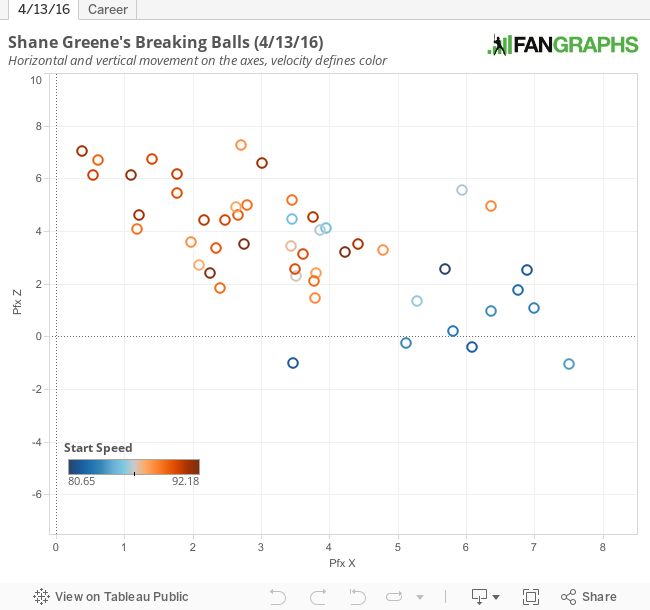
I think the case could be made for four in the career tab. There’s the 90-plus cutter centered somewhere around +2 inches (horizontal) and +6 inches (vertical), something softer in the high 80s centered around +4 and +4, what you might call a slider in the mid-80s centered around +6 and +1, and then I guess a curve out there at +8 and 0 in the mid-70s. Buy your favorite pitch algorithm a drink because this is tough work.
We have fancier tools now! Spin rate! Spin direction! They won’t help much in this situation.
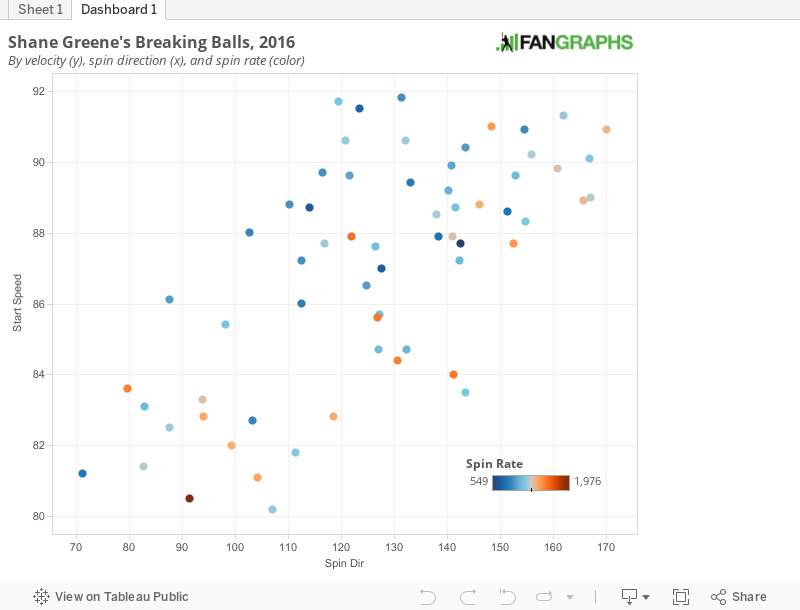
Greene still threw some harder breaking balls with less spin, and some with more spin. You’d think maybe he didn’t have great feeling in his fingers yet, except it looks like he does it on purpose.
Let’s use our eyeballs. Here are two pitches with similar velocities but different spin rates, directions, and movements. You’d round all of these pitches to 91 mph, but their spin rates vary from 714 to 170 and directions from 121 to 171. They were all labeled sliders in PITCHF/x and cutters at Brooks Baseball, and they are all from the first inning of Wednesday’s game.
They’re all cutters, you might be saying with a shrug. Except that last one to Polanco (on the far right) dropped four inches more than the one to Jaso (on the far left). And the one to Freese (in the middle) had four inches less glove-side cut as the one to Jaso.
They can all still be cutters, sure. But for his career, Greene’s “cutter” has three inches more drop and two inches more run than the average right-hander’s cutter. So it’s already a weird pitch on average, and that is before he starts to manipulate it from batter to batter and pitch to pitch.
It’s something I’ve been hearing recently, that the slider is a “feel” pitch. Collin McHugh lamented the loss of feel on his slider to me last year. Zack Greinke talked about losing the slider and cutter to some sort of hybrid two years ago. Oakland reliever Ryan Dull laughed with me about not knowing what a slider was anyway, and then talked about manipulating the release point and pressure on his fingers in order to feel his way through a few different versions of his slider. Luke Gregerson is the godfather of the feel slider.
We’ve always thought of the changeup as the feel pitch, or at least that’s what a person learning a changeup might say. But look at the spin rates and velocities of the various pitch types, thanks to Mike Petriello, and it’s the breaking balls that have the widest diameters.

You can barely see the changeups hiding there behind the curves and sliders.
To tie this all into a ball that might be meaningful in any way is difficult. Shane Greene was probably better on Wednesday because he was throwing 95 and could feel his fingers again. But that feel in his fingertips — which was failing him before nerve surgery — helped him manipulate his best pitch or pitches.
And it’s that part of Greene’s struggle that is universal. The slider and cutter and curve are some of the most nebulous pitches in baseball, with the largest variety of movements and spins and velocities. The breaking ball truly is a feel pitch, and it might be as many as four or five feel pitches.
When Max Marchi did his infamous Platoon Splits 2.0 article, he broke breaking pitches up into five categories — cutter, slider, tight curve, slurve, roundhouse curve. Each “pitch” moves slightly differently, and we might even be able to add a “clutter” or “slutter” in between cutter and slider, if Greene is any guide.
Each pitch had a distinctly different platoon split! So when we talk about a fastball/slider guy not being able to handle lefties, we are perhaps being too imprecise. A better approach might be to look at the concentration of their breaking-ball movements, and look for more pitch types hidden within those heat maps. Because, in the case of a pitcher like Greene, it seems way too dismissive to call him a fastball/breaking-ball guy.
Sure, except he has four breaking balls.
With a phone full of pictures of pitchers' fingers, strange beers, and his two toddler sons, Eno Sarris can be found at the ballpark or a brewery most days. Read him here, writing about the A's or Giants at The Athletic, or about beer at October. Follow him on Twitter @enosarris if you can handle the sandwiches and inanity.
Does anybody love anybody, anyway?
Calling a pitch a “slutter” sure would make sports bars a little more wild.
Inside Edge already uses “slutter” in its pitching lexicon.
Nothing’s worse than thinking you got a real nice slutter but then you find wood.
It sounds like it would be easy to hit a home run off of a slutter. But I think there is still a lot of swing and miss in that game.
I have to say, I find myself quite confused on what “spin direction” is. Spin axis is a two-dimensional variable, corresponding to a point (or pair of opposite points) on the surface of a ball. What does a one-dimensional spin axis variable mean?
This spin is all back-estimated from the observed Magnus force. The only spin that’s observable is ‘transverse’ spin; ‘rifle’ spin is invisible because it causes no deflection. So that’s why it’s a one dimensional quantity.
I would think that axis could get a little wacky with a slider, which is generally thrown with rifle spin almost precisely.
Wish there was a simple way to find out from the pitcher what he was trying to throw after each one. Perhaps the catcher could be mic’d up and asked to mutter what the pitch was after each one…
Seriously, though, it’s amazing how much variation there can be here. Nice research.
Was that first GIF (on the left) really as fast as the other two? Looking at them, it looks like a changeup, a bad slider (he doesn’t get the bite and the ball stays in the middle of the plate) and a good slider.
All 91-92.
Eno man. This is good stuff. May you dream of benevolent caterpillars.
great stuff Eno! Two things: 1. Would be a safe bet to devalue a P that relies a lot on horizontal movement in cold weather, or too much of a generalization? 2. Any chance you may know of a link to the 2008 John Walsh article mentioned in the Platoon 2.0 piece? Sorry, I realize it’s a request on something two-times removed.
My pee relies a lot on horizontal movement in cold weather. Can’t aim vertically cause snow’s so damn cold (and deep too!)
Just neighing.
Great piece. I wonder if we could watch the catcher’s fingers just before the pitch to see if it was the same call three times or some number of different calls.
Thanks for this. Great info. Love this guy for daily right now. He won’t be priced down for long. He looks like the guy who broke in with the Yankees again.
When I went to this page on my iPhone, my browser was immediately hijacked to the Apple Store to look at a product I would never even consider purchasing. This happens with unhappy regularity on Fangraphs. You cannot expect us to pay to support your site if you’re going to have obnoxious, hijacking ads like this on it.
Do better.
It’s an ad provider problem, and all we can do is tell them the problem ad, so unfortunately, this comment by itself is unhelpful.
Eno, are there any plans to fix the problem? Also, let me add that my “Fangraphs Supporting Member” tag has vanished, even though I just paid two months ago.
I’ll look into the supporting member thing! Right now, it’s whack a mole on the ads, we pass any offending ad on to our ad provider and they axe it. Really, we just need to be big enough to make direct deals, but of course we are trying to figure out how to deal with this.
Here’s more on the issue. http://www.fangraphs.com/blogs/instagraphs/fangraphs-advertising-help-us-improve/
We can help better if you tell us more about your operating system, age of machine, and your browser.
thanks!
Thank you very much for fixing the tag, Eno.
iPhone 6s, iOS 9.3.1, Safari.
Johnston wrote:
16 April 2016 15:42
Member Support Fangraphs
When I was on the same page on my iPhone, my browser has been hijacked in the Apple store to see the product without even thinking buying. This is what happened to Fangraphs unfortunate regularity. I do not expect to pay to support your site, if you have abhorred, robbed a pub like this.
Possibly.
That’s pretty much me when I’m drunk. Nice job!
{Johnston, you’re welcome lol. The reason this one made the cut was the “Member Support Fangraphs” part, which fit your post too perfectly. Now please go rob a pub so we can see a live post of you when drunk 😉 – Serb}
I often wonder how accurate radio and tv announcers are when they call a pitch a slider, a cutter, a curve ball, a change up, etc. I know when I go to a game I probably couldn’t get more than 25% correct.