
You Can Go Home Again: Eugenio Suárez Signs with the Reds
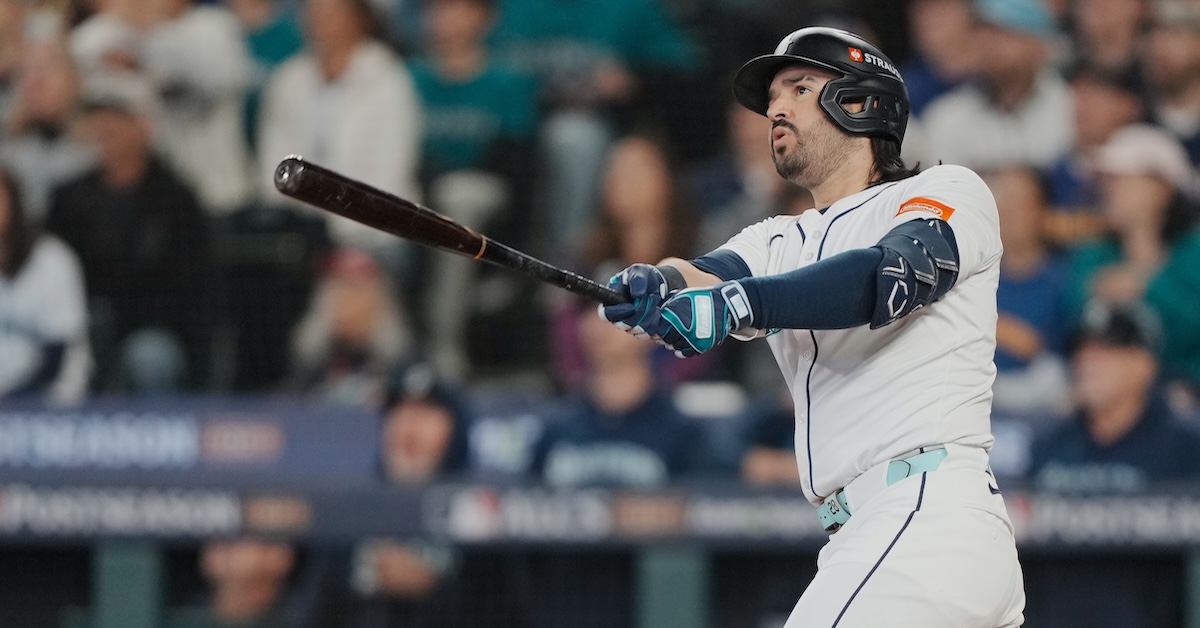
It took all the way until February, but the last few free agency dominos are starting to fall. The Reds were one of the first teams to dip their toes into the market this winter, signing Emilio Pagán to a two-year deal at the start of December. Now they’ve made it a bookend set – over the weekend, they signed Eugenio Suárez to a one-year, $15 million deal, as first reported by Jeff Passan.
I missed high on my contract estimate for Suárez. I had him down for two years at $25 million a year, while our crowdsourced projections thought he’d get three years at $20 million each. The lowest public-facing projection I found for him was two years at $22.5 million per. In other words, Suárez settled for less than predicted, and he signed late as a result. It’s a classic example of the fact that free agents who sign later sign for less.
At a top-line level, seeing Suárez sign for this little is surprising. He isn’t some flash in the pan seeking a 10-year deal. He’s been one of the best power hitters in baseball for quite a while now. The 2025 season was the fourth out of the last five where he’s topped 30 homers. He socked 49 while spending half the year in a home run graveyard in Seattle, though he did most of his damage before the trade; he posted a 91 wRC+ as a Mariner. Teams pay for projection, not performance, but Suárez’s wRC+ over the last three years is better than his career mark. But that power didn’t overwhelm a host of other question marks.
At 34, Suárez is squarely headed into the back half of his career. He just posted his highest swinging strike rate ever, on the back of swinging more than ever. He tied for a career-low contact rate, too. In other words, he took big swings more often, with all the associated upsides and downsides. That led to a cratering walk rate, a low on-base percentage, and yes, 49 homers. In my projection, I looked at the power vs. contact balance and found myself swayed more by the power side, but I don’t think I was the only prognosticator who shaved my estimate down for the risk. You can strike out 30% of the time and still produce, but that’s a dangerous game; whiff too frequently, and the whole thing can fall apart very quickly.
I’ve always had trouble telling whether Suárez is aging well or poorly. He has 25th-percentile sprint speed – that sounds like he’s declining. But that sprint speed is actually faster than the mark he posted in 2018 and 2019, and he hit 83 homers with a 132 wRC+ and 8.8 WAR in those years. His bat speed isn’t impressive for a power hitter – 53rd percentile, 72.3 mph on average. But that’s the same mark he’s had in each of the three seasons we have bat tracking for. He’s had an old man’s game since he was young, in other words, and that makes modeling this much trickier. His defense has fallen from plus to sketchy, but that’s actually happened before in his career, albeit thanks to a poorly-planned attempt to pivot to shortstop. Modeling that might be even harder – if he’s going to play defense this season, that is.
ZiPS and Steamer, ever the responsible forecasts, are taking a down-the-middle approach to his projection. They have him down for a 111 wRC+, a small decline from what he’s done the past three years, but one that’s entirely in line with aging curves. They think he’ll strike out a ton, walk a little, and sock 35 homers in cozy Cincinnati. Sure, we’re projecting him as a full-time DH, which eats into his WAR a little bit, but even then, the models say that this is a nice deal with upside.
If you had told the Reds they’d sign Suárez for less guaranteed money than it took to land Pagán before this offseason started, they wouldn’t have believed you. No one would have. But among the free agency supermarket’s various aisles are two labeled “dudes we want” and “bargains,” and the Reds shopped in “dudes we want” for Pagán’s deal. They signed him right at the beginning of the winter and gave him a player option to differentiate their offer from other clubs. I wasn’t wild about that signing, but I understood it: They needed a closer, they had a limited budget, and getting the guy they liked on a deal that’s still petite in the grand scheme of things, even if it’s more than he was projected for, seems like a solid compromise.
The flip side of that coin is that if you’d be happy to sign a wide variety of players and are willing to wait, you might land someone for much less than expected. The Reds have enough interesting-but-not-overwhelming position players that they could accommodate hitters at a wide variety of positions – no one’s replacing Elly De La Cruz at shortstop, but everything else feels negotiable to me. That means that they could scour the entire population of hitters for deals, and that’s just what they did.
With defensive whiz Ke’Bryan Hayes at third, Suárez slots cleanly into DH here. But if Hayes misses time, would you be surprised to see Suárez back in the field? I certainly wouldn’t – and ZiPS, whose defensive projections I like best, has him down as an average third baseman this year. In other words, he’s a great fit for the Reds, and quite honestly, he might have been the only difference-maker left. This much offense, for that little money? I like Suárez a lot more than the other available options. It’s even better that he was a longtime Red and that his offensive game suits the park well. Truly, this feels like a serendipitous deal.
Now for a few caveats. When I investigated the performance of late signers last year, I found that players who sign late in the winter provide less per-dollar value than their early-signing counterparts. I didn’t look into a cause, but it’s not hard to intuit what’s going on: The signal of no team putting that player in the “dudes we want” bucket is meaningful, or at the very least, players who stick around on the market a while do so because teams had reasonable reservations about them. To put it in the terms I used in that article:
Teams that are attempting to wring the most out of a limited free agency budget probably shouldn’t wait out the market and attempt to sign whoever is left at the end, even if the contract they sign represents a team discount compared to pre-offseason expectations. Those players might command lower salaries, but they also perform worse. If efficiency is the goal and marquee free agents are off the table, the data suggest that almost any time is better than the very end of the offseason to add new players.
Now, that conclusion is about a broad aggregate. Plenty of late signers have been better than expected. The fact that his cohort has performed poorly on the whole isn’t meaningless, though. It makes me want to shade Suárez’s projections down. Most teams could use power in a can, and yet none of them beat one year and $15 million. Maybe they’re too risk-averse. Almost certainly they’re too risk-averse, in fact: There are 30 teams and only one AJ Preller. But not incorporating that information seems silly. It has to mean something.
A reasonable counterpoint is that teams really are quite risk-averse, and that Suárez is a particularly risky-feeling player. He’s already been salary dumped twice in his career – first to Seattle as salary ballast in a trade for Jesse Winker, then to Arizona after the Mariners acquired another third baseman in the offseason and were looking to save money themselves. The lows are low, in other words. Of course, the highs are high too, and teams seem to like the experience: The Mariners traded for him again last summer, and the Reds just re-signed him. But even though Suárez seems to put up 3.5 WAR every year, he’s a complete roller coaster in how he gets there, and we have good evidence that teams react poorly to that variance.
More caveats: Suárez’s fit with Great American Ball Park can’t be ignored. His lift-and-pull approach – he’s hit more fly balls than grounders in each of the last seven seasons, and he pulls the crap out of the ball too – is a great fit for the second-homer-happiest park in baseball. If you play in Cincy, you should be playing a homer-centric game, because the park doesn’t tilt particularly far towards offense despite the ease of hitting homers. In other words, you want your team to be full of dudes who get on base and then a bunch of Suárez types. Pretty convenient to get the genuine article on a pillow contract, then.
How much does this affect the team’s playoff chances? Boy, Suárez signed at a great time for me to answer that question. Thanks to writing about the initial release of our playoff odds this morning, I have a hard copy of what the odds looked like Friday evening, before this signing. Adding Suárez moved the Reds from 77.1 to 77.6 projected wins, and from a 13.9% chance of making the playoffs to a 15.6% chance. Ho hum, in other words.
I like the signing more than that. I think we underestimate his impact because we had Spencer Steer plugged in at DH, and Steer looks like a solid major leaguer, meaning that Suárez was upgrading from a high-ish floor. But Steer was unlikely to be a full-time DH in reality, because the Reds have a squad full of guys with injury and availability concerns. His actual position in 2026 was shaping up to be a blend of first, DH, and the outfield corners. Now he’s more of a super sub and platoon bat. In other words, the Reds’ best starting lineup might not have changed much, but their depth gets a lot better with Suárez on the roster.
Fold all of that together, and I find myself a fan of this deal, albeit not as much of one as I would have been before I saw Suárez sit on the market for a few months. There are real concerns about how he’ll age, and 2025 did have a number of red flags. But the Reds got a discount for that. How much of a discount is still an open question, but there’s little doubt that he’s a much better bet to hit in 2026 than the alternatives who are still around. Between the homecoming vibes and the friendly park dimensions, I wouldn’t even be all that surprised by a resurgent season that beats our projections, though maybe that’s just my warm and fuzzy heart speaking rather than my cold analytical brain.
Most importantly, the Reds are in a spot on the win curve where moves like these matter most. They made the playoffs in 2025 and brought back most of their best players from that run. A full season from Hunter Greene beckons. Upper-70s win totals don’t make the playoffs; lower-80s win totals often do. Was this the correct signing? Time will tell. The future is unknown and unknowable; we can only guess at probabilities. But making a signing was clearly important, and the Reds got a consensus top 20 free agent with connections to the franchise for a one-year pittance. How can you say it’s anything other than a good job?
Ben is a writer at FanGraphs. He can be found on Bluesky @benclemens.
No such a thing as a bad year deal and this one is a bargain imo. I’ve read Suarez will be the dh so that leaves runway for Stewart to play plenty between first and second base. Stewart I’d bet would outhit Steer and Steer can move around the infield and OF. The lineup is still light but Suarez will help.