
Zack Littell Signs With Nationals
This is Ryan Blake’s first piece as a contributor for FanGraphs. He is a former newspaper reporter in the Inland Northwest and a current writer for Lookout Landing, where his work on the batter’s eye at T-Mobile Park was nominated for a 2026 SABR Analytics Conference Research Award.
A bottom-ranked pitching staff got a little deeper this weekend.
Zack Littell and the Nationals have agreed on a one-year contract, as several outlets reported Sunday. The price tag is currently unknown, though the deal includes a mutual option for 2027. Littell, 30, ranked next-to-last on our Top 50 Free Agents list this offseason. As it happens, he is also next-to-last to sign (only Lucas Giolito remains available).
Littell threw a career high 186.2 innings in 2025 across 32 starts for the Rays and Reds. Only 10 pitchers threw more innings last year. His 3.81 ERA was above average among qualified starters, and his 4.2% walk rate was the best in the majors. On the other hand, his 4.88 FIP, 17.1% strikeout rate, and 1.74 HR/9 each ranked in the bottom five. It was a mix of strengths and weaknesses that, taken together, made him the 88th-most valuable starting pitcher by WAR — useful depth for most organizations.
Littell’s value comes from his reliability. He posted an average Game Score of 51 each of the last two seasons (50 is average). Game Score isn’t a perfect metric, but the version developed by Tom Tango is based in DIPS theory, with some measured assumptions for the value of hits and runs. It’s a quick approximation for how a pitcher contributed to their team’s chances of winning, including (crucially) how deep they went in the game. Not only is Littell’s average Game Score exactly average, his individual Game Scores are clustered tightly around that mark. In fact, I found only four pitchers with a narrower range of Game Scores. He’s the ultimate low ceiling/high floor starter who’s just as unlikely to implode as he is to dominate. He gives his team a chance to win every night, while rarely guaranteeing it.
One reason Littell can get exactly average outings from a bottom-ranked FIP is his in-game longevity. He threw five innings in 51 of his 61 starts the last two seasons. It’s a simple matter of efficiency. About three-quarters of Littell’s pitches the last two years were over the heart and shadow regions of the plate, making him among the most aggressive starters in the majors. As a result, he averaged just 3.73 pitches per at-bat from 2024 to 2025. He’s a prime example of the “just throw the ball near the zone and it’ll probably be OK” theory of pitching.
Littell pounds the zone with a contemporary arsenal: two types of fastballs, two types of sliders, and a split for good measure. The fastballs sit at just 92 mph, with the four-seamer more likely to appear against lefties and the sinker against righties. The slider neither spins nor breaks, and frankly seems to hang (it got the second-fewest whiffs among sliders last year), while the sweeper is a big, slow, looping pitch that he’s more reluctant to throw. Littell’s most impressive offering is the splitter, which gets excellent vertical depth to encourage a bit of chase on the rare occasion he leaves the zone. The result is a broad, diverse arsenal that can fool batters long enough for him to survive three turns through the order, even if it isn’t always pretty:
The Nationals are Littell’s ninth professional organization. He was drafted out of high school by the Mariners in the 11th round in 2013. He was traded to the Yankees in 2017 and then flipped to the Twins, debuting primarily as a reliever with Minnesota in 2018. He bounced between bullpens for parts of the next five seasons, not quite excelling, not quite playing his way out of a career.
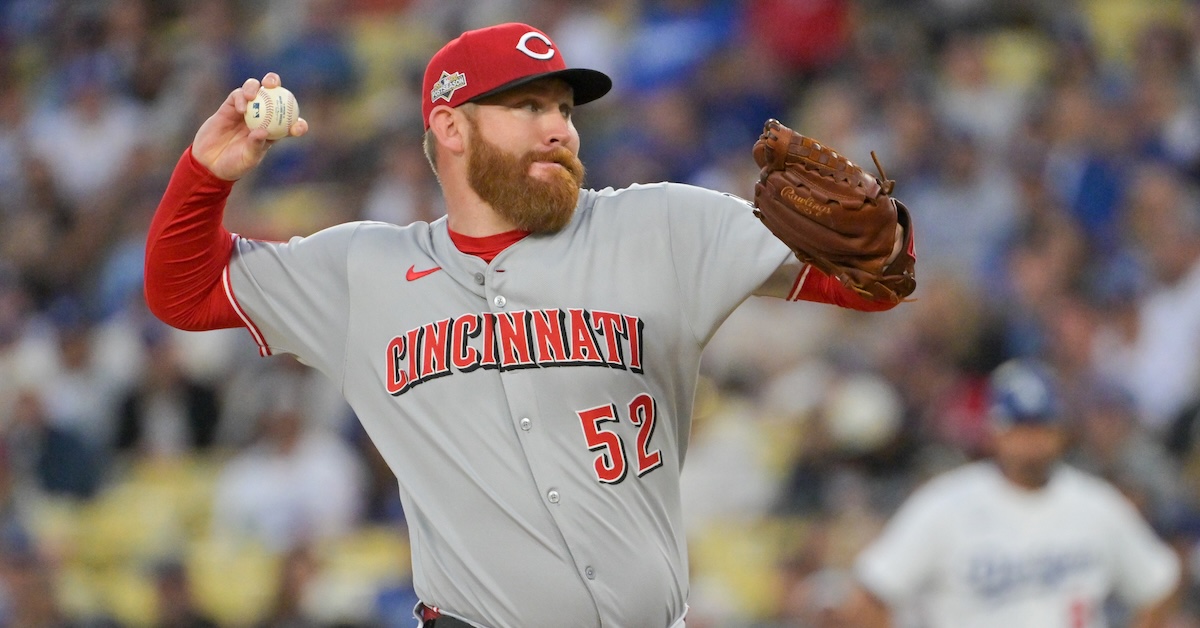
The Rays claimed him off waivers in May 2023, and he was converted to a starter soon after. The Rays being the Rays, it was a quick success. He ditched the fastball-slider combo (which was the style at the time) for the broader arsenal he sports today. He helped prop up the backend of the Rays rotation through July 2025, when he was dealt to the playoff-bound Reds at the trade deadline. Littell continued his reliable, if unspectacular, performance with Cincinnati, though he proved no match for the Dodgers in his Wild Card start, taking the Reds’ final loss of the season.
Now Littell is in Washington (pending a physical, of course). After dealing MacKenzie Gore to the Rangers earlier in the offseason, the Nationals rotation is projected 29th by WAR for 2026. Again, Littell is a solid, major league-caliber pitcher, but he doesn’t move the needle much, scooting them forward a few tenths of a win. And that’s assuming they plan to use him as a starter, as they find themselves with something of a log jam in their rotation.
Veterans Miles Mikolas and Foster Griffin signed major league deals earlier in the offseason. Former top prospects Cade Cavalli and Josiah Gray are now recovered from Tommy John surgery, though there’s some question about Gray’s availability for Opening Day. Jake Irvin and Mitchell Parker both made about 30 starts in each of the last two seasons, though both hovered around replacement level in 2025 and may have lost a bit of favor. Finally, Brad Lord finished 2025 as a starter after bouncing between the rotation and bullpen throughout the season.
So while there isn’t much quality in the Nationals rotation, there are still several classic depth options, making Littell feel a bit redundant. Perhaps they’ll make room, or perhaps he’ll return to the bullpen. On a short-term deal at age 30, his primary role appears to be “trade fodder,” in whatever form that may take.
Ryan Blake is a contributor for FanGraphs and Lookout Landing.
Zack Littell is definitely one of the pitchers we’ve ever seen.