
2025 End-of-Season Top 100 Prospects Update
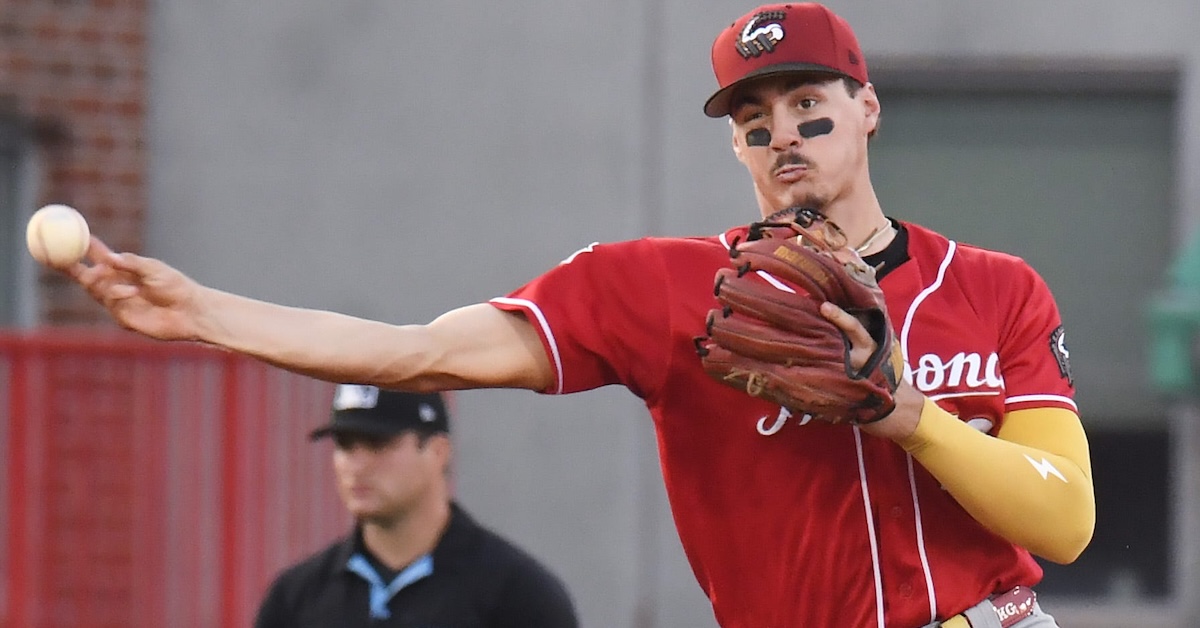
Today’s postseason off day provides a nice opportunity to push an update to my Top 100 Prospects list. This is a “low-hanging fruit” update, more of a polishing and augmentation of the current list than an omnibus analysis of the entirety of the minor leagues. I mainly focused on the players who are closest to graduation, players who got a cup of coffee in the big leagues (sometimes a big cup, close to the maximum roster days without losing 2026 rookie eligibility) and who we basically can’t know any more about than we currently do before they graduate next year. I took a pass at the guys who were already on the Top 100 in a variety of ways; the cement is dry on their season-long stats and their underlying performance data, so everyone got a checkup in this regard, as well as via a TrackMan data check-in. I also watched all of these players swing and play defense at least a little bit just to re-establish an end-of-season visual understanding of their look.
Immediately below, you’ll see the updated list along with trend arrows indicating if a player’s FV grade has changed on this update, and then below that my thoughts on the clusters of players that formed throughout this process. The number of players on whom I have a grade of 50 or better is currently a little below 100, and the number of healthy players is even lower than that. As the offseason list-making process gets underway, there will probably be more players added to this tier, and any player’s grade is potentially subject to change as the down time allows for deeper analysis.
| Rank | Name | Position | Age | Team | FV | Trend |
|---|---|---|---|---|---|---|
| 1 | Konnor Griffin | SS | 19.4 | PIT | 65 | ↑↑ |
| 2 | Jesús Made | SS | 18.4 | MIL | 65 | ↑↑ |
| 3 | Kevin McGonigle | 2B | 21.1 | DET | 60 | |
| 4 | Samuel Basallo | C | 21.1 | BAL | 60 | |
| 5 | Bubba Chandler | SP | 23.1 | PIT | 60 | |
| 6 | Sebastian Walcott | SS | 19.6 | TEX | 60 | |
| 7 | Max Clark | CF | 20.8 | DET | 60 | |
| 8 | Colt Emerson | SS | 20.2 | SEA | 55 | ↑↑ |
| 9 | JJ Wetherholt | 2B | 23.1 | STL | 55 | |
| 10 | Leo De Vries | SS | 19.0 | ATH | 55 | ↑↑ |
| 11 | Aidan Miller | SS | 21.3 | PHI | 55 | |
| 12 | Nolan McLean | SP | 24.2 | NYM | 55 | ↑↑ |
| 13 | Andrew Painter | SP | 22.5 | PHI | 55 | ↓↓ |
| 14 | Carson Williams | SS | 22.3 | TBR | 55 | |
| 15 | George Lombard Jr. | SS | 20.3 | NYY | 55 | |
| 16 | Bryce Eldridge | 1B | 21.0 | SFG | 55 | |
| 17 | Josue De Paula | RF | 20.4 | LAD | 55 | |
| 18 | Thomas White | SP | 21.0 | MIA | 55 | ↑↑ |
| 19 | Liam Doyle | SP | 21.3 | STL | 55 | |
| 20 | Alfredo Duno | C | 19.7 | CIN | 55 | |
| 21 | Ethan Holliday | 3B | 18.6 | COL | 55 | |
| 22 | Noah Schultz | SP | 22.2 | CHW | 55 | |
| 23 | Jarlin Susana | SP | 21.5 | WSN | 55 | |
| 24 | Angel Genao | SS | 21.4 | CLE | 50 | |
| 25 | Franklin Arias | SS | 19.9 | BOS | 50 | |
| 26 | Travis Bazzana | 2B | 23.1 | CLE | 50 | |
| 27 | Eli Willits | SS | 17.8 | WSN | 50 | |
| 28 | Josuar De Jesus Gonzalez | SS | 18.0 | SFG | 50 | |
| 29 | Luis Peña | SS | 18.9 | MIL | 50 | |
| 30 | Walker Jenkins | LF | 20.6 | MIN | 50 | |
| 31 | Josue Briceño | C | 21.0 | DET | 50 | |
| 32 | Parker Messick | SP | 24.9 | CLE | 50 | |
| 33 | Jonah Tong | SP | 22.3 | NYM | 50 | |
| 34 | Kade Anderson | SP | 21.2 | SEA | 50 | |
| 35 | Trey Yesavage | SP | 22.2 | TOR | 50 | |
| 36 | Luis Morales | SP | 23.0 | ATH | 50 | |
| 37 | Arjun Nimmala | SS | 20.0 | TOR | 50 | |
| 38 | Aiva Arquette | SS | 22.0 | MIA | 50 | |
| 39 | Joe Mack | C | 22.8 | MIA | 50 | |
| 40 | Leonardo Bernal | C | 21.6 | STL | 50 | ↑↑ |
| 41 | Thayron Liranzo | C | 22.2 | DET | 50 | |
| 42 | Carter Jensen | C | 22.3 | KCR | 50 | |
| 43 | Harry Ford | C | 22.6 | SEA | 50 | |
| 44 | Kevin Alcántara | CF | 23.2 | CHC | 50 | |
| 45 | Zyhir Hope | RF | 20.7 | LAD | 50 | |
| 46 | Braden Montgomery | RF | 22.5 | CHW | 50 | |
| 47 | Emmanuel Rodriguez | CF | 22.6 | MIN | 50 | |
| 48 | Chase DeLauter | RF | 24.0 | CLE | 50 | |
| 49 | Ethan Salas | C | 19.3 | SDP | 50 | ↓↓ |
| 50 | Robby Snelling | SP | 21.8 | MIA | 50 | ↑↑ |
| 51 | Brandon Sproat | SP | 25.0 | NYM | 50 | |
| 52 | Chase Petty | SP | 22.5 | CIN | 50 | |
| 53 | Trey Gibson | SP | 23.4 | BAL | 50 | |
| 54 | Alex Freeland | SS | 24.1 | LAD | 50 | |
| 55 | Jefferson Rojas | SS | 20.4 | CHC | 50 | |
| 56 | Cooper Pratt | SS | 21.1 | MIL | 50 | |
| 57 | Gage Jump | SP | 22.5 | ATH | 50 | |
| 58 | Payton Tolle | SP | 22.9 | BOS | 50 | |
| 59 | Carson Benge | CF | 22.7 | NYM | 50 | |
| 60 | Ryan Waldschmidt | LF | 23.0 | ARI | 50 | ↑↑ |
| 61 | Cooper Ingle | C | 23.6 | CLE | 50 | |
| 62 | Michael Arroyo | 2B | 20.9 | SEA | 50 | |
| 63 | Jacob Reimer | 3B | 21.6 | NYM | 50 | |
| 64 | Brody Hopkins | SP | 23.7 | TBR | 50 | |
| 65 | Jurrangelo Cijntje | SP | 22.3 | SEA | 50 | |
| 66 | Jaxon Wiggins | SP | 24.0 | CHC | 50 | |
| 67 | Kyson Witherspoon | SP | 21.1 | BOS | 50 | |
| 68 | Tyler Bremner | SP | 21.5 | LAA | 50 | |
| 69 | Jett Williams | CF | 21.9 | NYM | 50 | |
| 70 | Jonny Farmelo | CF | 21.1 | SEA | 50 | |
| 71 | Rainiel Rodriguez | C | 18.7 | STL | 50 | |
| 72 | Eduardo Quintero | CF | 20.0 | LAD | 50 | ↑↑ |
| 73 | Khal Stephen | SP | 22.8 | CLE | 50 | |
| 74 | Edward Florentino | 1B | 18.9 | PIT | 50 | ↑↑ |
| 75 | Felnin Celesten | SS | 20.1 | SEA | 50 | |
| 76 | Kayson Cunningham | 2B | 19.3 | ARI | 50 | |
| 77 | Jimmy Crooks | C | 24.2 | STL | 50 | |
| 78 | Tre’ Morgan | 1B | 23.2 | TBR | 50 | |
| 79 | Rhett Lowder | SP | 23.6 | CIN | 50 | |
| 80 | Jackson Ferris | SP | 21.7 | LAD | 50 | |
| 81 | Hagen Smith | SP | 22.1 | CHW | 50 | |
| 82 | George Klassen | SP | 23.7 | LAA | 50 | |
| 83 | Quinn Mathews | SP | 25.0 | STL | 50 | |
| 84 | Carson Whisenhunt | SP | 25.0 | SFG | 50 | |
| 85 | Connor Prielipp | SP | 24.7 | MIN | 50 | |
| 86 | Brandon Clarke | SP | 22.5 | BOS | 50 | |
| 87 | Tink Hence | SP | 23.2 | STL | 50 | |
| 88 | River Ryan | SP | 27.1 | LAD | 50 | |
| 89 | Jeferson Quero | C | 23.0 | MIL | 50 | |
| 90 | Logan Henderson | SP | 23.6 | MIL | 50 | |
| 91 | Didier Fuentes | SP | 20.3 | ATL | 50 | |
| 92 | Ricky Tiedemann | SP | 23.1 | TOR | 50 | |
| 93 | Jake Bloss | SP | 24.3 | TOR | 50 | |
| 94 | Travis Sykora | SP | 21.4 | WSN | 50 | |
| 95 | Moisés Chace | SP | 22.3 | PHI | 50 |
| Rank | Name | Position | Age | Team |
|---|---|---|---|---|
| 1 | Konnor Griffin | SS | 19.4 | PIT |
| 2 | Jesús Made | SS | 18.4 | MIL |
Griffin and Made have separated themselves from the rest of the group, in my opinion. Griffin reached Double-A and posted a roughly average contact rate on the big league scale after his amateur performance in that area was concerning. He’s built like an NFL tight end prospect, has enormous strength in his hands and wrists, does huge damage on contact already at age 19, and projects to have even more power at his physical peak. Physically, he should settle in the Corey Seager/Carlos Correa area. In the short term, his plus-plus speed will also help his hit tool play closer to average despite what I expect will be a below-average contact rate in the big leagues due to his issues swinging inside sliders. What Griffin lacks in soft and deft hands on defense he makes up for with spectacular athleticism and effort.
The offensive skill set of Made, a switch-hitter who is a year younger than Griffin, is driven by incredible, full-body bat speed and preternatural feel for contact. He’s a better pure contact hitter than Griffin, but his power isn’t nearly as actualized yet, both due to Made’s immature physicality (relative to Griffin, anyway) and the flatter nature of his fledgling swings. Made has roughly average power right now, which is incredible for an 18-year-old, and it wouldn’t surprise me if an offseason in the weight room closes some of the gap between him and Griffin in this regard. Made also has a higher ceiling as a defender, which you can learn more about here. It’s possible that I’ll flip their order when I publish the 2026 Top 100 in February, or that someone from further down my current list will join these two upon a deeper offseason review, but for now these two are in a tier on their own. Look at the shortstop WAR Leaderboard from this season. Even a down year from Gunnar Henderson produced nearly 5 WAR. That’s the range I expect this duo will produce in with regularity.
| Rank | Name | Position | Age | Team |
|---|---|---|---|---|
| 3 | Kevin McGonigle | 2B | 21.1 | DET |
| 4 | Samuel Basallo | C | 21.1 | BAL |
| 5 | Bubba Chandler | SP | 23.1 | PIT |
| 6 | Sebastian Walcott | SS | 19.6 | TEX |
| 7 | Max Clark | CF | 20.8 | DET |
I didn’t make changes to the 60 FV tier beyond moving Made and Griffin up and moving Painter down. Things keeping this group from being in the tier above are nitpicky, but that’s the reality when we’re splitting hairs up this high. McGonigle is arguably the most stable all-around prospect in baseball due to his proximity to the bigs and his exceptional feel for contact. Twelve months from now we might feel about him the way we did Jackson Merrill at the end of 2024. He doesn’t have the monstrous long-term physical projection of these other guys; he has more of a stocky build and probably isn’t a shortstop. He could provide Detroit with a seamless transition away from Gleyber Torres next year. Samuel Basallo is the polar opposite, a power-hitting leviathan with a risky lack of plate discipline, which becomes scarier if he fails to improve as a defender and needs to move permanently to first base. He has absurd power for a catcher and a great arm when he’s healthy.
Chandler wrapped up his third consecutive season of 100-plus innings with his first big league cup of coffee. He sustained a velo spike throughout the entire season, averaging 98 mph while setting a personal best for single-season innings total. His secondary stuff is still inconsistent. To that end, his forecast is very positive; it’s common for pitchers with this kind of arm speed to develop better control later than their soft-tossing peers, and Chander is the sort of athlete (both in size and mobility) whom we should feel comfortable projecting on in this regard. The arc of his next several years could look like the first few years of Hunter Greene’s big league tenure.
Max Clark (a compact athlete with freaky contact feel, plus speed and center field defense) and Sebastian Walcott (plus-plus power projection and a shot to stay at shortstop) have a chance to move further up the list if they find a way to get to more power in games. Walcott’s shrugable slash line (.255/.355/.386) was still good for a 111 wRC+, great for a teenager in Double-A ball. Clark had more walks than strikeouts and didn’t skip a beat when he was promoted to Double-A Erie. He has a sensational leadoff hitter’s profile.
| Rank | Name | Position | Age | Team | FV | Trend |
|---|---|---|---|---|---|---|
| 8 | Colt Emerson | SS | 20.2 | SEA | 55 | ↑↑ |
| 9 | JJ Wetherholt | 2B | 23.1 | STL | 55 | |
| 10 | Leo De Vries | SS | 19.0 | ATH | 55 | ↑↑ |
| 11 | Aidan Miller | SS | 21.3 | PHI | 55 | |
| 12 | Nolan McLean | SP | 24.2 | NYM | 55 | ↑↑ |
| 13 | Andrew Painter | SP | 22.5 | PHI | 55 | ↓↓ |
| 14 | Carson Williams | SS | 22.3 | TBR | 55 | |
| 15 | George Lombard Jr. | SS | 20.3 | NYY | 55 | |
| 16 | Bryce Eldridge | 1B | 21.0 | SFG | 55 | |
| 17 | Josue De Paula | RF | 20.4 | LAD | 55 | |
| 18 | Thomas White | SP | 21.0 | MIA | 55 | ↑↑; |
| 19 | Liam Doyle | SP | 21.3 | STL | 55 | |
| 20 | Alfredo Duno | C | 19.7 | CIN | 55 | |
| 21 | Ethan Holliday | 3B | 18.6 | COL | 55 | |
| 22 | Noah Schultz | SP | 22.2 | CHW | 55 | |
| 23 | Jarlin Susana | SP | 21.5 | WSN | 55 |
A few of the middle infielders who sat at the very top of the 50 FV tier throughout the 2025 season have crept into the 55 FV tier on this update based on continued performance and improved proximity to the bigs. Several players in this group – Colt Emerson, JJ Wetherholt, Leo De Vries, and Aidan Miller – all have issues on defense that might prevent them from remaining at shortstop. Emerson, Wetherholt, and De Vries have arm strength and accuracy issues, while Miller’s hands were sketchy and error-prone late in the year. This entire group projects to hit enough to be good players even if they’re flawed defenders or need to move to another position altogether, but again, it’s little things like these that create daylight between them and the 60 FV players.
Nolan McLean’s 2025 per pitch performance data is somewhat pedestrian in terms of chase and miss. Aside from what Synergy Sports has classified as his curveball, none of his pitches has generated plus miss on the season. But let’s not kid ourselves here: McLean’s breaking stuff is obviously plus or better, and he commands a distinct pair of fastballs to the locations in which they’re each most effective, with the sinker variant looking especially nasty. This is a pitcher who can play “X Games” with his fastballs and many nuanced breaking balls, with pitches finishing in every quadrant of the zone. McLean’s changeup has funky sinking action and is an effective surprise right now, and it has exciting long-term projection because of his athleticism, mechanical consistency, and relatively fresh focus on pitching. He ends the year as the second-best pitching prospect in baseball.
Painter’s season was disappointing in light of the perhaps overzealous expectations laid out for him by people like me, who posited he might kick down the door and play a meaningful role for a contending team. Instead, he posted an ERA over five and missed fewer bats with his fastball than I would have guessed if you’d have told me Painter would be sitting 96 all year. But in a vacuum his season has been fine. He’s a 22-year-old who hadn’t thrown a pitch at an affiliate since 2022, and yet was aggressively pushed to Triple-A. When you look at the 2025 season as a whole, Painter’s stuff has performed like it’s made of average-or-below components across the board, but for the last six weeks of the season he upped his changeup usage a ton. Both it, and his slider, played more like plus offerings in terms of miss and chase during that window. If there’s a real issue looming here it’s Painter’s lack of fastball miss. This is a 6-foot-7 guy who’s only generating a little over six feet of extension; he’s not getting way over his front side on release and his heater has the downhill plane associated with “round down” fastballs. This is different than before, as Painter’s delivery is different now than it was during his dominant, meteoric rise prior to injury.
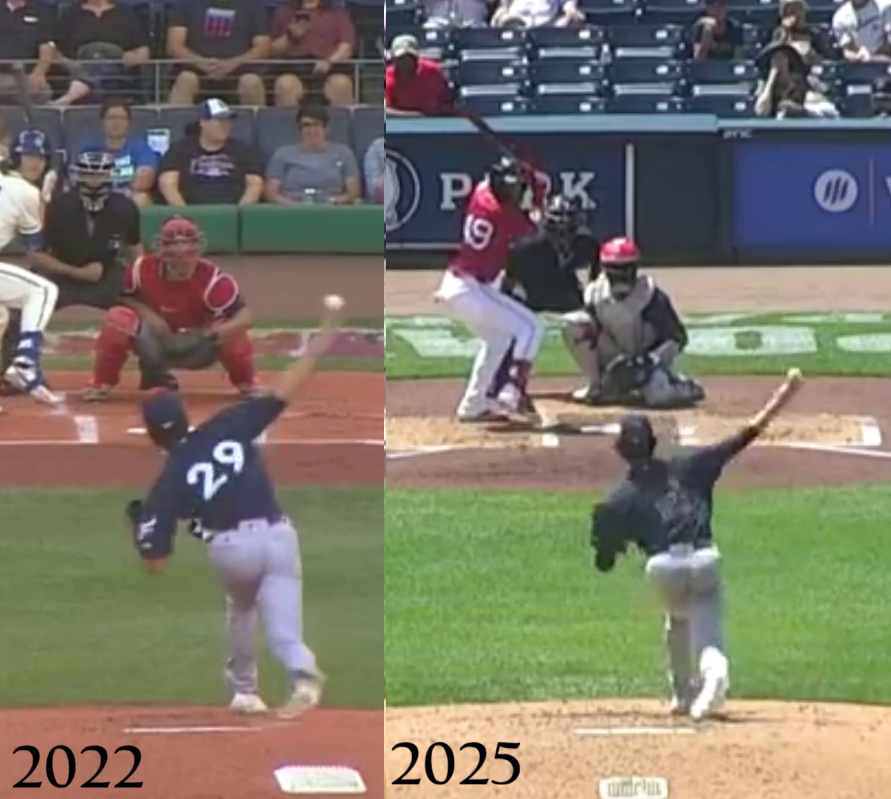
Painter’s newer delivery features a good bit less tilt in his torso and a slightly lower arm angle. The current release point looks easier for him to execute and repeat than the one in 2022, and this newer slot probably helps him move the ball laterally more than his old one, but these changes have also sucked some of the pure vertical life out of his pre-surgery fastball. Here we have visual evidence that reinforces what the data suggest; something here has changed and negatively impacted the bat-missing ability of Painter’s fastball compared to when he was last pitching for an entire season.
He still has a very favorable overall forecast as a mid-rotation workhorse with good secondary stuff and command, but it’s tough to project him as a contender’s no. 1 or no. 2 starter if he doesn’t have an impact fastball, and so he slides down an FV tier on this end-of-season update.
| Rank | Name | Position | Age | Team | FV | Trend |
|---|---|---|---|---|---|---|
| 24 | Angel Genao | SS | 21.4 | CLE | 50 | |
| 25 | Franklin Arias | SS | 19.9 | BOS | 50 | |
| 26 | Travis Bazzana | 2B | 23.1 | CLE | 50 | |
| 27 | Eli Willits | SS | 17.8 | WSN | 50 | |
| 28 | Josuar De Jesus Gonzalez | SS | 18.0 | SFG | 50 | |
| 29 | Luis Peña | SS | 18.9 | MIL | 50 |
Bazzana is the most polished of this group by a lot, but also the least projectable. I’ve seen enough of Josuar Gonzalez in Arizona to consider him in lockstep with Willits, who just went first in the draft. Gonzalez is an incredible athlete with amazing athleticism and range on defense. He’s built like a young Francisco Lindor. Players in this group are the favorites to move into the upper-level FV tiers during the next 12 months.
| Rank | Name | Position | Age | Team | FV | Trend |
|---|---|---|---|---|---|---|
| 30 | Walker Jenkins | LF | 20.6 | MIN | 50 | |
| 31 | Josue Briceño | C | 21.0 | DET | 50 | |
| 59 | Carson Benge | CF | 22.7 | NYM | 50 | |
| 60 | Ryan Waldschmidt | LF | 23.0 | ARI | 50 | ↑↑ |
| 62 | Michael Arroyo | 2B | 20.9 | SEA | 50 | |
| 63 | Jacob Reimer | 3B | 21.6 | NYM | 50 |
Jenkins is a great contact hitter with OK power, but not the kind of juice a corner outfielder needs to be a superstar. Briceño isn’t throwing well and is trending toward first base. Waldschmidt is a well-rounded hitter who is average or better in basically every facet of offense, especially his plate discipline, and he joins this cluster from outside.
| Rank | Name | Position | Age | Team | FV | Trend |
|---|---|---|---|---|---|---|
| 32 | Parker Messick | SP | 24.9 | CLE | 50 | |
| 33 | Jonah Tong | SP | 22.3 | NYM | 50 | |
| 34 | Kade Anderson | SP | 21.2 | SEA | 50 | |
| 35 | Trey Yesavage | SP | 22.2 | TOR | 50 | |
| 36 | Luis Morales | SP | 23.0 | ATH | 50 |
This is a fairly self-explanatory group. I expect Anderson will move quickly enough through the minors to perhaps debut in 2026 and nearly keep pace with the other four guys, who have already debuted. The deliveries of Yesavage and Tong are quirky enough to have kept them out of the 55 FV tier. Morales has the most significant relief risk of this group, but he also might have the highest ceiling.
| Rank | Name | Position | Age | Team | FV | Trend |
|---|---|---|---|---|---|---|
| 39 | Joe Mack | C | 22.8 | MIA | 50 | |
| 40 | Leonardo Bernal | C | 21.6 | STL | 50 | ↑↑ |
| 41 | Thayron Liranzo | C | 22.2 | DET | 50 | |
| 42 | Carter Jensen | C | 22.3 | KCR | 50 | |
| 43 | Harry Ford | C | 22.6 | SEA | 50 | |
| 61 | Cooper Ingle | C | 23.6 | CLE | 50 |
The way this group is ordered might change during the offseason. If you’re a fantasy player looking for the best pure hitters of the bunch, Ingle and Bernal are your guys. Liranzo and Jensen have big power but are going to strike out a ton. Joe Mack, too. He’s currently at the front of the group for me because he’s doing some absurd things throwing the baseball, stuff I’ve never seen before.
Incredible play by catcher Joe Mack. Double steal & he comes up to throw to 3B but sees that the runner is going to be safe. While aligned to throw to 3B & fully open he redirects the throw to 2B. The brain & body of elite catchers can do amazing things. pic.twitter.com/obTRahv0ai
— Jerry Weinstein (@JWonCATCHING) September 6, 2025
| Rank | Name | Position | Age | Team | FV | Trend |
|---|---|---|---|---|---|---|
| 37 | Arjun Nimmala | SS | 20.0 | TOR | 50 | |
| 38 | Aiva Arquette | SS | 22.0 | MIA | 50 | |
| 44 | Kevin Alcántara | CF | 23.2 | CHC | 50 | |
| 45 | Zyhir Hope | RF | 20.7 | LAD | 50 | |
| 46 | Braden Montgomery | RF | 22.5 | CHW | 50 |
Nimmala and Arquette are freaky big shortstops with power. Their defensive fits give their hit tools more room to breath, while the rest of this group is likely to occupy a corner outfield spot.
| Rank | Name | Position | Age | Team | FV | Trend |
|---|---|---|---|---|---|---|
| 47 | Emmanuel Rodriguez | CF | 22.6 | MIN | 50 | |
| 48 | Chase DeLauter | RF | 24.0 | CLE | 50 | |
| 49 | Ethan Salas | C | 19.3 | SDP | 50 | ↓↓ |
Salas hasn’t played during Padres instructs, which makes me think he won’t actually play in the Arizona Fall League, even though he was announced as being part of Peoria’s roster. It’s common for Fall Leaguers to tune up during instructional league play, and the Padres guys have done so, except Salas. It’s possible he could end up playing later in the AFL schedule, or skip AFL entirely and play winter ball in Venezuela or Puerto Rico. Persistent injury causes him to slide here.
| Rank | Name | Position | Age | Team | FV | Trend |
|---|---|---|---|---|---|---|
| 50 | Robby Snelling | SP | 21.8 | MIA | 50 | ↑↑ |
| 51 | Brandon Sproat | SP | 25.0 | NYM | 50 | |
| 52 | Chase Petty | SP | 22.5 | CIN | 50 | |
| 53 | Trey Gibson | SP | 23.4 | BAL | 50 | |
| 73 | Khal Stephen | SP | 22.8 | CLE | 50 | |
| 79 | Rhett Lowder | SP | 23.6 | CIN | 50 | |
| 80 | Jackson Ferris | SP | 21.7 | LAD | 50 |
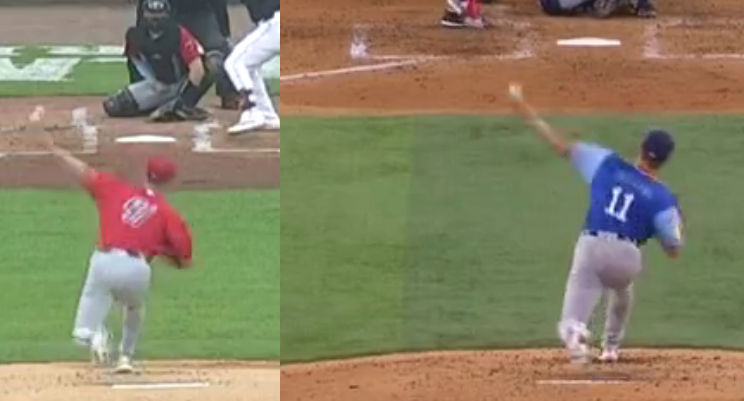
I’ve tended to be lower on Snelling and had him pegged as more of a backend starter than a mid-rotation type for basically his entire pro career. Since acquiring him from San Diego, the Marlins have changed Snelling’s placement on the rubber (he’s shifted from the middle to the first base side), and he’s had a nearly three-tick velocity spike across his entire repertoire.
| Rank | Name | Position | Age | Team | FV | Trend |
|---|---|---|---|---|---|---|
| 54 | Alex Freeland | SS | 24.1 | LAD | 50 | |
| 55 | Jefferson Rojas | SS | 20.4 | CHC | 50 | |
| 56 | Cooper Pratt | SS | 21.1 | MIL | 50 |
There has to be a gap between this contingent and the more explosive group at the very top of the 50 FV tier because of the latter’s upside, but the players here are tracking like 2-WAR everyday infielders in their own right.
| Rank | Name | Position | Age | Team | FV | Trend |
|---|---|---|---|---|---|---|
| 57 | Gage Jump | SP | 22.5 | ATH | 50 | |
| 58 | Payton Tolle | SP | 22.9 | BOS | 50 | |
| 64 | Brody Hopkins | SP | 23.7 | TBR | 50 |
Jump’s slider improved this year while Tolle’s secondary stuff is still pretty generic.
| Rank | Name | Position | Age | Team | FV | Trend |
|---|---|---|---|---|---|---|
| 65 | Jurrangelo Cijntje | SP | 22.3 | SEA | 50 | |
| 66 | Jaxon Wiggins | SP | 24.0 | CHC | 50 | |
| 67 | Kyson Witherspoon | SP | 21.1 | BOS | 50 | |
| 68 | Tyler Bremner | SP | 21.5 | LAA | 50 |
This group is a tad further away from the big leagues than the high-floored, major league-ready no. 4 starters on this list, but this cluster also has a little more ceiling than the Parker Messick types.
| Rank | Name | Position | Age | Team | FV | Trend |
|---|---|---|---|---|---|---|
| 69 | Jett Williams | CF | 21.9 | NYM | 50 | |
| 70 | Jonny Farmelo | CF | 21.1 | SEA | 50 | |
| 71 | Rainiel Rodriguez | C | 18.7 | STL | 50 | |
| 72 | Eduardo Quintero | CF | 20.0 | LAD | 50 | ↑↑ |
| 74 | Edward Florentino | 1B | 18.9 | PIT | 50 | ↑↑ |
| 75 | Felnin Celesten | SS | 20.1 | SEA | 50 | |
| 76 | Kayson Cunningham | 2B | 19.3 | ARI | 50 |
Lots of variance here. Eduardo Quintero moves in largely because he was better incorporating his top hand into his swing late in the season, helping him cover the inner third with pull power. Florentino, a projectable lefty corner bat with great barrel feel, might soon be the next Walker Jenkins, a corner bat with a 60-grade hit tool and 50-grade power.
| Rank | Name | Position | Age | Team | FV | Trend |
|---|---|---|---|---|---|---|
| 77 | Jimmy Crooks | C | 24.2 | STL | 50 | |
| 78 | Tre’ Morgan | 1B | 23.2 | TBR | 50 |
Both of these guys have below-average offensive skill sets, but they’re elite defenders at positions that touch the baseball constantly.
| Rank | Name | Position | Age | Team | FV | Trend |
|---|---|---|---|---|---|---|
| 81 | Hagen Smith | SP | 22.1 | CHW | 50 | |
| 82 | George Klassen | SP | 23.7 | LAA | 50 | |
| 83 | Quinn Mathews | SP | 25.0 | STL | 50 | |
| 84 | Carson Whisenhunt | SP | 25.0 | SFG | 50 | |
| 85 | Connor Prielipp | SP | 24.7 | MIN | 50 | |
| 86 | Brandon Clarke | SP | 22.5 | BOS | 50 | |
| 87 | Tink Hence | SP | 23.2 | STL | 50 |
| Rank | Name | Position | Age | Team | FV | Trend |
|---|---|---|---|---|---|---|
| 88 | River Ryan | SP | 27.1 | LAD | 50 | |
| 89 | Jeferson Quero | C | 23.0 | MIL | 50 | |
| 90 | Logan Henderson | SP | 23.6 | MIL | 50 | |
| 91 | Didier Fuentes | SP | 20.3 | ATL | 50 | |
| 92 | Ricky Tiedemann | SP | 23.1 | TOR | 50 | |
| 93 | Jake Bloss | SP | 24.3 | TOR | 50 | |
| 94 | Travis Sykora | SP | 21.4 | WSN | 50 | |
| 95 | Moisés Chace | SP | 22.3 | PHI | 50 |
Eric Longenhagen is from Catasauqua, PA and currently lives in Tempe, AZ. He spent four years working for the Phillies Triple-A affiliate, two with Baseball Info Solutions and two contributing to prospect coverage at ESPN.com. Previous work can also be found at Sports On Earth, CrashburnAlley and Prospect Insider.
I get it was a small sample, but Jesus was Carson Williams’ time in the bigs terrifying.
Also, I thought Lombard was only a 50 on the last update
Carson Williams’ offensive performance is a counterpoint to everyone who says “it doesn’t matter how much you strike out in the minors if you hit for enough power.” Sorry, it absolutely matters if you are running a 64% contact rate in AAA. The Willy Adames comp was always very optimistic, he was always more of a Gabriel Arias type of player. And right now he doesn’t look like a major leaguer of any kind.
I suppose the counterpoint to your counterpoint would be Colson Montgomery. I don’t know what adjustment he made, but his athleticism finally won out. Perhaps Williams’s will too.
Colson Montgomery was a very risky prospect and is now a risky major league player but his contact rate was 10 points higher than Williams’ pretty much at every level.
Right now Montgomery is running about a 70% contact rate, which is pretty close to the floor for being a functional hitter unless you have Judge / Ohtani / Wood level power. Williams’ contact rate in AAA was lower than any MLB player with more than 400 PAs…except Gabriel Arias.
Right, and I would add that it’s too soon to know if Montgomery will be able to maintain this level of production. If we want to go with another White Sox example, Jake Burger had similar contact/power numbers, and he’s only had one cromulent offensive season.
Nice
It looks like he’s going to stick at shortstop, and that means he’ll get a lot of time to work through any issues.
He’s more in the 60-grade raw category than 70-grade so it does put some pressure to make a bit more contact. He was on a pace to hit something like 45 homers this year and that would play at any position but it’s something you cannot count on continuing.
But since he’s a good shortstop he mostly just has to not get worse at contact to continue to get everyday reps and work through things. I’m sure the White Sox would breathe easier if he had a bit more margin for error on either the raw power or contact side.
Burger as an average shortstop would be a good player. 4 out of 5 of his seasons have had an above 100 wRC+. Burger would be a better hitter with a league average walk rate, which Montgomery did eventually end up with this season.
Burger’s 1st 2 seasons were 42 and 183 PAs, so he’s only really had 3 full(ish) seasons. But yes, Montgomery with those numbers over full seasons with average defense would still be a good SS, but not the Seager comp that some White Sox fans have been throwing out forever.
I think the Seager comparison was largely tall shortstop who isn’t supposed to stick at the position. And it does seem like he may have staying power there. The idea of him as a well-rounded hitter like Seager has kind of sailed over the last two years.
Jake Burger has only had one non-cromulent season, this year, when he played through a wrist injury that he’s already had surgery on. Even still he had a 81 wRC+ in the 1st half, and a 114 in the 2nd half, he has a 108 wRC+ for his career, literally the only thing he’s good for is providing cromulent offensive seasons.
This is a terrible, terrible comp. Adames has a career 109 wRC+. Semien does too. Story has a 106. Dansby Swanson has a 96. Brandon Crawford had a 94.
No offense, but you don’t know what you’re talking about. Not cromulent at all, dude..
Related to this: Spencer Jones has a 61.7% contact rate in AAA. Under sixty-two percent! Excluding the shortened 2020 season, there has not been a single qualified hitter with a contact rate that low since Joey Gallo in 2018.
If you want to know what Spencer Jones’s career might look like, you can look at three different stages of Gallo’s career.
If things work, it will look like Joey Gallo in Texas.
If they go about as expected, it will look like Joey Gallo in NY.
If things don’t click, it will look like Joey Gallo in Washington.
I’d use Justin Maxwell as the comparison because of what a great career Joey Gallo had.
I also agree with everything you wrote.
It’s worse when every report was like “yeah this kid can’t identify a breaking ball”.. Shocker he still can’t!
Shades of Lewis Brinson. But we didn’t know it because Brinson’s AAA affiliate was at altitude.
Pretty much every single pitcher has one breaking ball, which means every single pitcher has an out pitch against Williams!