
Angels Top Prospect Tyler Bremner Has a 70-Grade Changeup
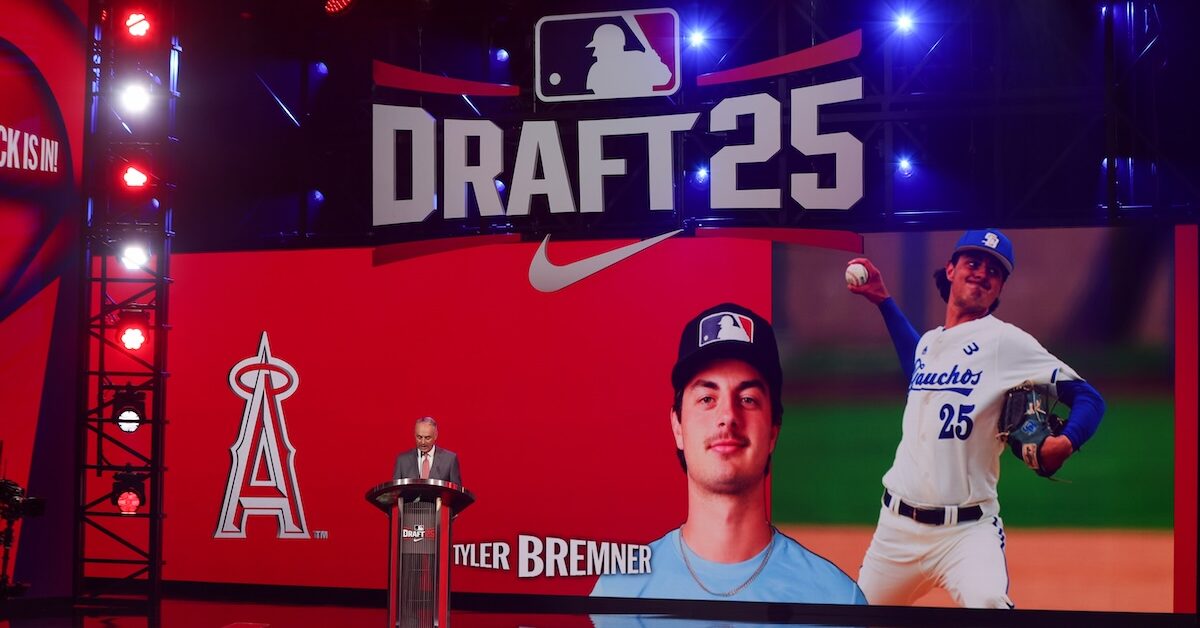
Tyler Bremner is the top prospect in what is widely viewed as a below-average Los Angeles Angels system. Drafted second overall last summer out of UC Santa Barbara, the 21-year-old right-hander is anything but below average — and that is especially true when it comes to his signature offering. Bremner boasts one of the best changeups of any prospect, in any organization. Factor in a fastball that sits mid-90s and touches 98, and you can see why my colleague Brendan Gawlowski referred to Bremner as “the draft’s most big league-ready player.”
Premium strike-throwing is another of Bremner’s attributes. As Gawlowski pointed out in his January write-up, the 6-foot-2, 195-pound San Diego native not only averaged fewer than 2.5 walks per nine innings across three collegiate seasons, he also “missed a ton of bats.” His draft-year strikeout rate was a heady 35.8%.
Bremner discussed his high-spin changeup, his sometimes-sinking four-seamer, and what he’s been learning in big league camp, prior to a recent game at Tempe Diablo Stadium.
———
David Laurila: I’ve read that you have a 70-grade changeup. What can you tell me about it?
Tyler Bremner: “I’ve kind of had the same grip since high school. I wouldn’t say it’s the most conventional grip. It’s a circle change, but I’m sliding down from the two-seam, so my middle and ring fingers are both on the horseshoe. I also like to tuck my pinky under it. That’s maybe a little unconventional, I guess. Not many people tuck their pinky like that.
“The grip is one thing, but there is also how you throw it. I’ve been blessed with being able to pronate the ball pretty well. For me, it’s not about trying to kill spin. I’m basically making it spin hard the other way, so I get that diving action. My arm speed also helps make it look like a heater. At the end of the day, you can have a changeup that moves a lot, but if it comes out in a way that hitters can pick it up — they can see the circle, or the spin is different than the fastball — then it’s not going to be as effective as one that isn’t as nasty. A changeup plays well if it is deceptive off the heater, so I’m really just trying to keep the arm speed and make it look like a fastball.”
Laurila: How much does your changeup spin?
Bremner: “I want to say 2,300-2,400 [rpms]. It normally spins just the same as my fastball. Overall, the metrics on it are pretty solid. It’s got some depth and some run. I think depth is more important for pitches than run, especially with the changeup. You get those swings-and-misses, and those swings where they’re feeling a little lost, when you’re getting the ball to dive late, down. If your changeup runs 20 inches but doesn’t drop at all, it’s kind of just a slow two-seam.”
Laurila: How does your fastball compare, velocity and movement wise, to your changeup?
Bremner: “I think the speed differential is good; I feel that my changeup is relatively slow. I usually throw it 83-85, and my fastball is normally 94-97, so there is a good 10-to-12-mph difference. Like I said, a big part of it is the spin. Obviously, the movement profiles are different. I throw a four-seam, and the changeup kind of dives off of that.”
Laurila: A four-seam? I’ve read that you throw a sinker?
Bremner: “I do not throw a two-seam. Sometimes I can get a little on the side of the ball and my four-seam will run, but most of the time I’m trying to backspin it. Ideally, I’m getting the vert above 16 [inches]. If I could get it to 20, that would be awesome, but it obviously varies from how well you can get behind the ball.”
Laurila: No two-seam, so either something was written incorrectly or, which is certainly possible, I read something incorrectly…
Bremner: “Who knows. Sometimes I throw fastballs that have more of a two-seam profile, but it’s a four-seam grip.”
Laurila: I’ve also read that your key pitch going forward is the slider. True?
Bremner: “I would agree with that. Being out here in camp is huge. There are so many guys who have big league sliders, and being able to pick their brains about their grips and how they release the ball, is really helpful. I think I’m making big jumps there.
“My slider is a gyro. Like I said, I’m pretty gifted at pronating, so supinating naturally comes a little harder for me. It’s not easy for me to get around the ball and throw a sweeper, so I just try to stay on the side of it and rip it. I throw it hard, and it comes out as a gyro.”
Laurila: Any final thoughts, maybe something I haven’t asked you, but should?
Bremner: “I think an interesting question to ask is why guys think they’ve had success, and what separates them from other guys. When you come out here and throw… I mean, there is so much talent, so many arms that do different things. You kind of need to not compare yourself, but instead realize what it is that you do well, and play into that strength.
“There are guys who throw plenty hard. I’m really just average from that standpoint. I was always a hard thrower growing up, but then you get here and it’s, ‘Wow, these guys really know how to throw a baseball.’ So, if anything separates me, it’s my strike-throwing ability and feel with the baseball. I know how to make adjustments, pitch to pitch, when I miss a spot. I know my mechanics and how to fix them in-game.
“At the end of the day, I’m a competitor. I’m going to go out there not going beat myself. I’m going to put pressure on the other team. So, my ability to feel the ball, throw strikes, throw a good changeup… all of those things are going to help me be successful.”
David Laurila grew up in Michigan's Upper Peninsula and now writes about baseball from his home in Cambridge, Mass. He authored the Prospectus Q&A series at Baseball Prospectus from December 2006-May 2011 before being claimed off waivers by FanGraphs. He can be followed on Twitter @DavidLaurilaQA.
Bremner talks about his pitching craft like he’s 30.
(that’s a good thing)